James Pryde: o artista
A Life Etched in Atmosphere: The World of James Ferrier Pryde
James Ferrier Pryde, born on March 30, 1866, in Edinburgh, was a British artist whose work profoundly shaped the aesthetics of early 20th-century graphic design and painting. His life unfolded within a lineage steeped in artistic heritage – connected to the celebrated Scottish painters Robert Scott Lauder and James Eckford Lauder – nurturing an environment that valued creativity and intellectual exploration from his earliest years. Raised in Edinburgh, Pryde’s formal artistic training commenced at the Royal Scottish Academy between 1885 and 1888, providing him with a foundational understanding of technique and composition. This early education proved pivotal, laying the groundwork for a career characterized by an exceptional ability to capture atmosphere and emotion through his art. He was particularly influenced by the Glasgow School’s pioneering spirit, drawing inspiration from artists like James Guthrie and Edward Arthur Walton, whose innovative approaches resonated deeply with his own artistic sensibilities. A brief but formative period in Paris, studying under William-Adolphe Bouguereau at the Académie Julian, ultimately proved less aligned with Pryde's vision; the stifling atmosphere of the Parisian atelier prompted a swift return to Scotland, where he began to forge his distinct artistic path.
The Beggarstaffs and a Revolution in Design
Pryde’s most enduring legacy stems from his collaborative partnership with William Nicholson, forming “The Beggarstaffs” in 1893. This union marked a watershed moment in the history of graphic design, ushering in a new era of visual communication characterized by boldness, theatricality, and a deliberate rejection of conventional norms. Prior to The Beggarstaffs, posters were often cluttered with illustrative elements, serving primarily as functional advertisements. Pryde and Nicholson, however, fundamentally reimagined the poster’s potential, stripping away superfluous details and embracing striking compositions, arresting imagery, and a dramatic sensibility. Their designs transcended mere commercial promotion; they became statements of artistic intent, elevating the status of poster art to that of legitimate visual expression. A key element of their approach was a conscious decision to eschew established design conventions, creating work that was both visually captivating and intellectually stimulating. The Beggarstaffs’ impact extended beyond posters, encompassing signboards and other graphic elements—all united by a shared commitment to innovation and artistic vision. Their partnership dissolved in 1899, yet the influence of The Beggarstaffs reverberates through the world of design to this day, shaping the aesthetics of countless contemporary works.
Atmospheric Visions: A Painterly Language
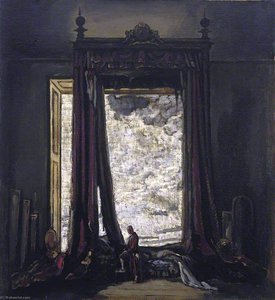
While celebrated for his contributions to graphic design, Pryde’s true passion resided in painting. He developed a deeply personal style centered around atmospheric architectural scenes—images that transcended simple representation and instead explored the emotional resonance of space and time. These canvases rarely depict buildings as they appear in reality; rather, they are evocative explorations of mood, memory, and a sense of melancholy. Pryde’s technique is characterized by broad brushwork, dramatic lighting effects, and a deliberate blurring of lines between observation and imagination. His paintings frequently feature structures dwarfing the human figures within them, emphasizing our vulnerability against the weight of history and the passage of time. The influence of Giovanni Battista Piranesi's etchings—particularly his depictions of Roman ruins—is readily apparent in Pryde’s monumental compositions and fascination with decaying architecture. He wasn’t interested in precise replication; instead, he sought to capture the *feeling* of a place – its history, its secrets, and its inherent sadness. His paintings often possess an almost dreamlike quality, inviting viewers into a realm where reality and imagination intertwine.
A Multifaceted Artist: Stagecraft and Recognition
Pryde’s artistic pursuits extended beyond painting and graphic design. He briefly pursued a career as an actor between 1894 and 1899, a period that undoubtedly informed his theatrical sensibility and understanding of spatial dynamics. This foray into the performing arts also brought him into contact with influential figures like Edward Gordon Craig, who recognized Pryde’s exceptional talent as a painter despite acknowledging his limitations as an actor. He became actively involved in artistic societies, becoming an associate of the International Society of Sculptors, Painters and Gravers in 1901 and later serving as its vice-president in 1921. In 1930, he brought his visual artistry to the stage, designing sets for Paul Robeson’s production of *Othello* at the Savoy Theatre, demonstrating a versatility that extended beyond the canvas. Despite holding only two solo exhibitions during his lifetime – one at the Baillie Gallery in 1911 and another at the Leicester Galleries in 1933 – Pryde received recognition from patrons like Viscountess Cowdray and was lauded by critics such as Frank Rutter, who described him as “stupendous.” His work continues to be studied and appreciated for its unique blend of artistic skill and emotional depth.
A Lasting Legacy
James Ferrier Pryde passed away on February 24, 1941, in London. Though he didn’t align himself with any specific artistic movement, his distinctive style and contributions to early 20th-century art are increasingly recognized as significant. A memorial exhibition held in 1949, touring Edinburgh, Brighton, and London, helped revive interest in his work. While exhibitions of his paintings remain relatively infrequent, a growing number of his works are held in public collections, ensuring that his atmospheric visions continue to captivate audiences. Pryde’s legacy rests not only on the beauty of his individual artworks but also on the profound impact of The Beggarstaffs' innovative graphic design, which continues to inspire artists and designers today. He remains a compelling figure—a painter who dared to explore the emotional power of architecture and a designer who helped redefine the very language of visual communication.