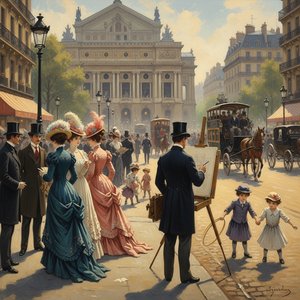
Jacques Eugène Feyen: A Painter of Breton Life and Parisian Salon Fame
Jacques Eugène Feyen, a name perhaps less familiar than many of his contemporaries, nevertheless holds a significant place in 19th-centuryFrench art. Born in Bey-sur-Seille in 1815, Feyen’s life was one of artistic evolution, marked by a shift from the burgeoning realism of photography to a deeply personal and evocative portrayal of Breton landscapes and everyday life. His career spanned over seven decades, culminating in a respected position within the Parisian art world, particularly at the prestigious Salon exhibitions. Feyen's legacy lies not just in his paintings but also in his ability to capture a fleeting moment in time, imbued with both romanticism and a keen observation of human experience.
Early Life and Artistic Training
Feyen’s artistic journey began under the tutelage of his elder brother, Auguste Feyen-Perrin, an established painter known for his historical scenes. This early influence instilled in Jacques Eugène a solid foundation in academic technique and composition. He subsequently enrolled at the École des Beaux-Arts in Paris, where he studied under Paul Delaroche, a pivotal figure in 19th-century art who championed the “historical anecdote”—a genre that sought to depict historical events with a documentary realism. However, Feyen’s artistic inclinations soon led him away from purely historical subjects, drawn instead to the more intimate and immediate world around him. Notably, he also spent time studying under Léon Coignet, whose instruction focused on capturing the nuances of light and color, further refining Feyen's painterly skills. This period marked a crucial turning point, setting him on a path toward exploring themes that would define his later work.
The Influence of Cancale and Breton Landscapes
Around 1861, Feyen embarked on a transformative journey to the coastal town of Cancale in Brittany – a region he would repeatedly revisit throughout his career. This move proved pivotal, providing him with an unparalleled subject matter: the rugged coastline, the oyster-picking women (the “Cancalaises”), and the vibrant community life of this relatively untouched corner of France. The allure of Cancale was not merely aesthetic; it represented a rejection of the increasingly industrialized and urbanized Paris, offering a refuge for artists seeking authenticity and inspiration. His paintings from this period are characterized by a soft, diffused light, capturing the atmosphere of Breton summers with remarkable sensitivity. He wasn’t simply depicting landscapes; he was conveying a sense of place—a feeling of timelessness and connection to nature. Vincent van Gogh, a fervent admirer of Feyen's work, famously described him as “one of the few painters who pictures intimate modern life as it really is, and does not turn it into fashion plates.” This assessment speaks volumes about Feyen’s ability to capture genuine emotion and experience within his scenes.
Salon Exhibitions and Parisian Recognition
Feyen's artistic career gained considerable momentum through his consistent participation in the Paris Salon from 1841 until 1882. This established exhibition provided a crucial platform for artists to showcase their work and gain recognition. While he initially followed the academic tradition of historical painting, Feyen gradually shifted his focus toward his Breton subjects, steadily gaining acclaim for his evocative depictions of daily life. He received medals in 1866 and 1880, solidifying his position within the Parisian art scene. His paintings were exhibited at prestigious venues such as the Palais des Beaux-Arts in Lille and the Musée des Beaux-Arts in Rennes, further enhancing his reputation. His work resonated with a public increasingly interested in portraying contemporary life beyond idealized historical narratives.
Style and Legacy
Feyen’s style is often described as Romantic Realism—a blend of emotional intensity and meticulous observation. He employed soft colors and delicate brushwork to create an atmosphere of intimacy and nostalgia. His compositions frequently feature small groups of figures engaged in everyday activities – oyster picking, fishing, or simply relaxing by the sea. His paintings are not grand historical narratives but rather quiet moments of human connection, imbued with a sense of melancholy and beauty. While he experimented with photography during his career, he ultimately remained committed to painting as his primary medium, skillfully capturing the essence of Breton life and preserving it for posterity. Jacques Eugène Feyen’s work continues to be appreciated today for its sensitive portrayal of rural life, its evocative use of light and color, and its enduring connection to the spirit of 19th-century France. His paintings offer a poignant glimpse into a bygone era, reminding us of the beauty and simplicity found in everyday moments.
Pela Equipe Editorial de OriginalUniqueArt.com
Quiz
Cada pergunta possui apenas uma resposta correta.
Pergunta 1:
Jacques-Eugène Feyen is most known for his paintings depicting which subject matter?
Pergunta 2:
During what period did Jacques-Eugène Feyen actively exhibit his work at the Paris Salon?
Pergunta 3:
What inspired Jacques-Eugène Feyen to spend several months each year painting in the town of Cancale?
Pergunta 4:
Vincent van Gogh admired Jacques-Eugène Feyen for his ability to portray:
Pergunta 5:
Which of the following best describes Jacques-Eugène Feyen's artistic style?
Explore the captivating world of Jean-Georges Béraud, master painter of Belle Époque Paris. Discover his iconic scenes, artistic evolution, and social commentary. A deep dive into 19th-century French art.
Onde posso encontrar as obras de Jacques Eugène Feyen agrupadas por paleta?
As obras de Jacques Eugène Feyen podem ser exploradas por paleta de cores na página de Por paleta de cores do artista.
Onde as obras de Jacques Eugène Feyen estão agrupadas por palavras-chave?
A página Por palavras-chave de Jacques Eugène Feyen agrupa as obras do artista por palavras-chave.
Por quais outros nomes Jacques Eugène Feyen é conhecido(a)?
Jacques Eugène Feyen também é conhecido pelos nomes Eugène Feyen, E. Feyen, Feyen-Perrin Eugene.
Onde posso ver as obras de Jacques Eugène Feyen organizadas por atmosfera?
A Coleção por Humor de Jacques Eugène Feyen organiza as obras do artista por humor.
De onde é Jacques Eugène Feyen?
Jacques Eugène Feyen nasceu em France.
Onde posso encontrar estatísticas sobre as obras de Jacques Eugène Feyen?
As estatísticas sobre as obras de Jacques Eugène Feyen estão disponíveis na página de Estatísticas do artista.
Posso navegar pelas obras de Jacques Eugène Feyen por técnica?
Para encontrar todas as obras de Jacques Eugène Feyen por técnica, acesse a página de Por Técnica do artista.
Existe uma cronologia da carreira de Jacques Eugène Feyen?
A trajetória de Jacques Eugène Feyen desenrola-se período a período na página Linha do tempo do artista: uma linha do tempo horizontal das obras, agrupadas em capítulos por fases da carreira.
Quantas obras de Jacques Eugène Feyen estão disponíveis para explorar?
Você pode explorar 9 obras de arte obras de Jacques Eugène Feyen na página Todas as obras.