Retrato de Jacob Van Strij

As 40 Pinturas Mais Famosas de Jacob Van Strij, Cada Uma Única

Atualizado em Novembro 2026 · classificado pela nossa pontuação de popularidade (pesquisas, visitas e pedidos de cada obra) · 41 obras de Jacob Van Strij em nosso catálogo

Em resumo

The yacht of the Chamber of Rotterdam for the Dutch East India Company salutes an East-Indiaman and a Dutch man-of-war on the roadstead of Hellevoetsluis. é a pintura de Jacob Van Strij que mais atrai olhares; a obra original pertence ao Maritime Museum Rotterdam, Roterdão. Depois disso, o olhar recai sobre Landscape with Cattle (1800) e Dutch River landscape with cows (1781). Entre as 41 obras de Jacob Van Strij em nosso catálogo, estas 40 são as mais famosas, cada uma uma original única apresentada com o seu ano, o seu museu e a razão pela qual perdura.

1756 – 1815, Dordrecht Mais obras: Dordrechts Museum

As 10 principais pinturas de Jacob Van Strij, sob o olhar da galeria

1
The yacht of the Chamber of Rotterdam for the Dutch East India Company salutes an East-Indiaman and a Dutch man-of-war on the roadstead of Hellevoetsluis. de Jacob Van Strij

The yacht of the Chamber of Rotterdam for the Dutch East India Company salutes an East-Indiaman and a Dutch man-of-war on the roadstead of Hellevoetsluis.

Oil On Canvas · Maritime Museum Rotterdam, Roterdão

Introduction Jacob van Strij Dordrecht was a Dutch painter, printmaker, and draftsman born in 1756. He was known for his landscapes, maritime scenes, and portraits. One of his most famous works is "The Yacht of the Chamber of Rotterdam for the Dutch East India Company Salutes an East-Indiaman and a Dutch Man-of-War on the Roadstead of Hellevoetsluis." Historical Context During the 17th century, the Dutch East India Company (VOC) was…

2
Landscape with Cattle (1800) de Jacob Van Strij

Landscape with Cattle

1800 · Metropolitan Museum of Art, Nova York

Landscape with Cattle is an artwork by Jacob van Strij. The painting was created probably ca. 1800. This work is an oil on wood composition that measures 80 x 107.3 cm. The artist, Jacob van Strij, was born in Dordrecht, Dutch Republic, and lived from 2 October 1756 to 4 February 1815.

3
Dutch River landscape with cows (1781) de Jacob Van Strij

Dutch River landscape with cows

1781 · Oil On Canvas

The composition centers on a riverbank in the Dutch countryside, where the land meets a wide, open sky. In the foreground, several figures and livestock occupy the immediate space. Two women and a man are positioned near a group of cows and sheep, tending to the animals. The livestock is rendered with attention to texture, from the coarse fur of the cows to the soft wool of the sheep. To…

4
Equestrian Portrait of Cornelis (1639–1680) and Michiel Pompe van Meerdervoort (1638–1653) with Their Tutor and Coachman ("Starting for the Hunt") (1794) de Jacob Van Strij

Equestrian Portrait of Cornelis (1639–1680) and Michiel Pompe van Meerdervoort (1638–1653) with Their Tutor and Coachman ("Starting for the Hunt")

1794 · Oil On Canvas · Dordrechts Museum, Dordrecht

In this 1652 oil on canvas, we find ourselves observing a quiet, yet charged, moment of preparation. Two young men, Cornelis and Michiel Pompe van Meerdervoort, sit astride their horses, poised for a hunt. There is a certain stillness in their posture that suggests the anticipation of movement. They are accompanied by a tutor and a coachman, figures who ground the composition and provide a sense of social order. The…

5
Cows at Pasture (1800) de Jacob Van Strij

Cows at Pasture

1800 · Oil · Museu Nacional de Cracóvia, Cracóvia

The landscape unfolds in muted, naturalistic tones, where ochre and sienna earth meets a hazy, atmospheric sky of soft blues and greys. In the center-right, a large, light-colored cow is rendered in profile, its anatomical details—ribs and udder—suggested through precise, painterly brushstrokes. To the far left, a second cow rests upon the ground, while on the far right, a seated figure appears partially obscured, tending to the task at hand.…

Pinturas famosas de Jacob Van Strij, números 11 a 40

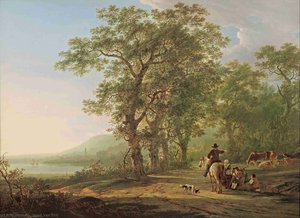
11Landscape with cows resting a the bank of the river (Oude) Maas, in the backgrouns Dordrecht (1793) de Jacob Van StrijLandscape with cows resting a the bank of the river (Oude) Maas, in the backgrouns Dordrecht1793 · Dordrechts Museum 12River landscape near Dordrecht, with a horseman and cattle (1793) de Jacob Van StrijRiver landscape near Dordrecht, with a horseman and cattle1793 · Dordrechts Museum 13Cattle resting on a bank (1793) de Jacob Van StrijCattle resting on a bank1793 · Amsterdam Museum 14Cattle in a Landscape (1800) de Jacob Van StrijCattle in a Landscape1800 · Attingham Park 15Landscape with River and Trees in the Vicinity of Dordrecht (1810) de Jacob Van StrijLandscape with River and Trees in the Vicinity of Dordrecht1810 · Dordrechts Museum 16The Discharge of Water from the Alblasserwaard Flooded on 30 January 1809 through the Sluices of Elshout (1809) de Jacob Van StrijThe Discharge of Water from the Alblasserwaard Flooded on 30 January 1809 through the Sluices of Elshout1809 · Dordrechts Museum 17Landscape with Cows near a Ruin (1807) de Jacob Van StrijLandscape with Cows near a Ruin1807 · Rijksmuseum 18Landscape with Figures de Jacob Van StrijLandscape with FiguresDordrechts Museum 19Italianizing Landscape with Shepherd, Shepherd Boy and Cows de Jacob Van StrijItalianizing Landscape with Shepherd, Shepherd Boy and CowsDordrechts Museum 20Italianizing Landscape with Rider and Some Resting Travelers and a Building on the Left in the Background de Jacob Van StrijItalianizing Landscape with Rider and Some Resting Travelers and a Building on the Left in the BackgroundDordrechts Museum 21Italianizing Landscape with a Ruin and a Three-Masted Ship in the Background de Jacob Van StrijItalianizing Landscape with a Ruin and a Three-Masted Ship in the BackgroundDordrechts Museum 22Landscape with shepherds and cattle at water de Jacob Van StrijLandscape with shepherds and cattle at water 23Pastoral scene de Jacob Van StrijPastoral sceneMuseu Nacional de Varsóvia 24Figures in a forest landscape de Jacob Van StrijFigures in a forest landscapeArt Gallery of South Australia 25Landscape with a Shepherd (1800) de Jacob Van StrijLandscape with a Shepherd1800 · Rijksmuseum 26Dutch Landscape with Cattle near Farmhouse de Jacob Van StrijDutch Landscape with Cattle near FarmhouseDordrechts Museum 27Landscape with Entrance Gate to a Castle de Jacob Van StrijLandscape with Entrance Gate to a CastleDordrechts Museum 28Cattle near a River de Jacob Van StrijCattle near a RiverDulwich Picture Gallery 29Pastoral scene de Jacob Van StrijPastoral sceneMuseu Nacional de Varsóvia 30Untitled (494) de Jacob Van StrijUntitled (494)Dordrechts Museum 31Two Boeiers and a Cat under Sail de Jacob Van StrijTwo Boeiers and a Cat under Sail 32Landscape with Cattle, Sheep, and Herders de Jacob Van StrijLandscape with Cattle, Sheep, and Herders 33Autumn Landscape de Jacob Van StrijAutumn LandscapeDordrechts Museum 34Wooded Landscape with Resting Cattle de Jacob Van StrijWooded Landscape with Resting Cattle 35Landscape with cattle driver and shepherd. de Jacob Van StrijLandscape with cattle driver and shepherd.Rijksmuseum 36Milking time de Jacob Van StrijMilking timeRijksmuseum 37Pastureland with cattle de Jacob Van StrijPastureland with cattleRijksmuseum 38Cattle and a Donkey in a Landscape de Jacob Van StrijCattle and a Donkey in a Landscape 39Dutch Landscape with Figures de Jacob Van StrijDutch Landscape with FiguresSmithsonian American Art Museum 40Landscape with Cattle de Jacob Van StrijLandscape with CattleMetropolitan Museum of Art

Os temas que cativaram o olhar de Jacob Van Strij

Os quatro temas que mais se repetem nestas obras originais, cada um com o seu melhor exemplo.

Os museus que guardam os originais de Jacob Van Strij

Os 8 museus que detêm a maioria das pinturas desta página.

Museus Cidade Obras de Jacob Van Strij Pinturas desta lista
Dordrechts Museum, DordrechtDordrechts Museum Dordrecht 17 Equestrian Portrait of Cornelis (1639–1680) and Michiel Pompe van Meerdervoort (1638–1653) with Their Tutor and Coachman ("Starting for the Hunt"), Winter Landscape with Children on the Ice under a Bridge, Mountainous Landscape with River
Rijksmuseum, AmsterdãRijksmuseum Amsterdã 5 Landscape with Cows near a Ruin, Landscape with a Shepherd, Landscape with cattle driver and shepherd.
Metropolitan Museum of Art, Nova YorkMetropolitan Museum of Art Nova York 2 Landscape with Cattle, Landscape with Cattle
Museu Nacional de Varsóvia, VarsóviaMuseu Nacional de Varsóvia Varsóvia 2 Pastoral scene, Pastoral scene
Maritime Museum Rotterdam, RoterdãoMaritime Museum Rotterdam Roterdão 1 The yacht of the Chamber of Rotterdam for the Dutch East India Company salutes an East-Indiaman and a Dutch man-of-war on the roadstead of Hellevoetsluis.
Museu Nacional de Cracóvia, CracóviaMuseu Nacional de Cracóvia Cracóvia 1 Cows at Pasture
Rijksmuseum Twenthe, EnschedeRijksmuseum Twenthe Enschede 1 Meadow Landscape with Cattle
Amsterdam Museum, AmsterdãoAmsterdam Museum Amsterdão 1 Cattle resting on a bank

Jacob Van Strij ao longo das décadas: uma obra original única para cada uma

Obras por década

Escolha uma década para ver a obra original que a define.

Pinturas de Jacob Van Strij: perguntas para a galeria

Qual é a obra mais famosa de Jacob Van Strij?Revelar a resposta

The yacht of the Chamber of Rotterdam for the Dutch East India Company salutes an East-Indiaman and a Dutch man-of-war on the roadstead of Hellevoetsluis., Maritime Museum Rotterdam, Roterdão. Landscape with Cattle (1800) e Dutch River landscape with cows (1781) vêm a seguir.

Quais são as dez pinturas mais famosas de Jacob Van Strij?Revelar a resposta

The yacht of the Chamber of Rotterdam for the Dutch East India Company salutes an East-Indiaman and a Dutch man-of-war on the roadstead of Hellevoetsluis., Landscape with Cattle, Dutch River landscape with cows, Equestrian Portrait of Cornelis (1639–1680) and Michiel Pompe van Meerdervoort (1638–1653) with Their Tutor and Coachman ("Starting for the Hunt"), Cows at Pasture, Meadow Landscape with Cattle, Winter Landscape with Children on the Ice under a Bridge, Mountainous Landscape with River, Summer Landscape outside Dordrecht e Harbor View with Ships in Calm Water near a Quay. O ranking acima apresenta o ano e o museu de cada uma.

Quantas obras de Jacob Van Strij são conhecidas?Revelar a resposta

Nosso catálogo contém 41 obras de Jacob Van Strij, datadas de 1781 a 1810.

Onde se pode ver os originais mais famosos de Jacob Van Strij?Revelar a resposta

Principalmente em Dordrechts Museum (Dordrecht), Rijksmuseum (Amsterdã) e Metropolitan Museum of Art (Nova York). A tabela de museus acima lista todos eles.

Em que período Jacob Van Strij criou as suas pinturas mais conhecidas?Revelar a resposta

Em 1790s: 9 das 40 obras nesta página foram feitas então, sendo Equestrian Portrait of Cornelis (1639–1680) and Michiel Pompe van Meerdervoort (1638–1653) with Their Tutor and Coachman ("Starting for the Hunt") delas.

Qual pintura famosa de Jacob Van Strij é a mais antiga e qual é a mais recente?Revelar a resposta

Nesta página, a mais antiga é Dutch River landscape with cows (1781) e a mais recente é Landscape with River and Trees in the Vicinity of Dordrecht (1810).

Quais temas Jacob Van Strij preferia?Revelar a resposta

Landscape (8), Animals (4) e Sky (3), entre as 40 obras nesta página.

Com quais materiais Jacob Van Strij mais pintou?Revelar a resposta

Oil On Canvas, para 5 das 40 obras nesta página.

Quais originais de Jacob Van Strij posso ver no Dordrechts Museum?Revelar a resposta

Equestrian Portrait of Cornelis (1639–1680) and Michiel Pompe van Meerdervoort (1638–1653) with Their Tutor and Coachman ("Starting for the Hunt"), Winter Landscape with Children on the Ice under a Bridge e Mountainous Landscape with River: o Dordrechts Museum, Dordrecht detém 17 das obras desta página.

Jacob Van Strij: um retrato do artista

O Mestre do Abraço do Inverno: A Vida e o Legado de Jacob Van Strij

Nas paisagens silenciosas e tocadas pela geada do final do século XVIII, poucos artistas capturaram a beleza efêmera do ciclo sazonal holandês de forma tão pungente quanto Jacob Van Strij. Nascido na histórica cidade de Dordrecht em 2 de outubro de 1756, Van Strij era um pintor cuja alma parecia intrinsecamente ligada às mudanças atmosféricas dos Países Baixos. Ele emergiu de uma linhagem de devoção artística, sendo filho de Leendert van Strij, um respeitado pintor e desenhista que lhe proporcionou sua educação inicial. Esta base familiar, combinada com a presença de seu irmão Abraham — membro fundador da prestigiada sociedade de desenho Pictura Dordrecht — garantiu que a criação de Jacob fosse imersa nas rigorosas tradições da arte visual holandesa.

Sua jornada em direção à maturidade artística levou-o para além das fronteiras de sua terra natal, rumo à vibrante atmosfera acadêmica de Antuérpia. Entre 1774 e 1776, Van Strij frequentou as aulas de Andries Cornelis Lens na Academia de Belas Artes. Foi durante este período formativo que sua destreza técnica começou a fundir-se com uma profunda sensibilidade à luz. Sob a orientação de tais mentores, ele dominou os princípios clássicos de composição e o delicado jogo de sombras, habilidades que mais tarde lhe permitiriam infundir vida aos rios congelados e pastagens enevoadas que se tornaram sua marca registrada.

Uma Visão Enraizada na Era de Ouro

Embora Van Strij tenha vivido e trabalhado durante a transição do final do Barroco para o início do Rococó, seu coração artístico permaneceu ancorado na reverência à Era de Ouro Holandesa. Ele olhou para trás, para os mestres do século XVII, para encontrar um caminho à frente, extraindo imensa inspiração da perspectiva atmosférica de Aelbert Cuyp e do dramático claro-escuro de Rembrandt van Rijn. Esta conexão com o passado é evidente em sua habilidade de manipular a luz, utilizando-a não apenas como uma iluminação da forma, mas como um receptáculo para a emoção e o clima sazonal.

Sua obra é caracterizada por uma notável versatilidade temática, embora seja mais celebrado por gêneros específicos que evocam uma sensação de tranquilidade atemporal:

  • Paisagens de Inverno: Talvez sua contribuição mais duradoura, estas obras capturam a quietude de um mundo coberto de neve, onde o frio cortante é suavizado pelo calor de uma luz sutil e brilhante.
  • Pinturas de Marinhas: Demonstrando um olhar aguçado para a herança marítima dos Países Baixos, ele retratou o movimento da água e a majestade das embarcações com grande precisão.
  • Cenas Pastorais: Suas representações de gado, pastores e da vida rural refletem um profundo respeito pelos ritmos da natureza e pela dignidade silenciosa do campo.

Realização Artística e Significância Histórica

Além de sua habilidade técnica como pintor, gravador e desenhista, Jacob Van Strij era considerado por seus contemporâneos como um homem de grande intelecto e cultura. Ele era um indivíduo culto que contribuía para a vida intelectual de Dordrecht, proferindo palestras no Teekengenootschap Pictura sobre as complexidades da mitologia e o brilho eterno dos Velhos Mestres. Esta dualidade — o observador meticuloso da natureza e o guardião erudito da história da arte — permitiu-lhe criar obras que eram simultaneamente visualmente cativantes e intelectualmente fundamentadas.

Embora sua vida tenha terminado em 1815, a influência de Van Strij persiste através das muitas coleções que abrigam seus tesouros, desde o Dordrechts Museum até o Smithsonian American Art Museum. Sua capacidade de transformar uma paisagem simples em uma profunda meditação sobre a luz e as estações garante seu lugar no cânone da arte holandesa. Ele não apenas pintava o que via; ele pintava a sensação do vento, o peso da neve e a paz duradoura da paisagem holandesa, deixando um legado que continua a evocar um senso de maravilha em todos que o contemplam.