Retrato de Jacob Lawrence

As 100 Pinturas Mais Famosas de Jacob Lawrence, uma Seleção da Galeria

Atualizado em Novembro 2026 · classificado pela nossa pontuação de popularidade (pesquisas, visitas e pedidos de cada obra) · 157 obras de Jacob Lawrence em nosso catálogo

Em resumo

De todas as obras originais deixadas por Jacob Lawrence, a mais famosa é The Library (1960), da coleção do Smithsonian American Art Museum, em Washington, D.C.. Logo atrás vêm Genesis Creation Sermon V: And God Created All the Fowls of the Air and Fishes of the Seas (1989) e Bar and Grill (1941). Nosso catálogo contém 157 obras de Jacob Lawrence; a galeria preservou as 100 que o mundo mais admira, cada uma exibida com sua data, seu museu e sua história.

1917 – 2000, Atlantic City Mais obras: The Phillips Collection

As 10 principais pinturas de Jacob Lawrence: a escolha da galeria

1
The Library (1960) de Jacob Lawrence

The Library

1960 · Tempera · Smithsonian American Art Museum, Washington, D.C.

In the vibrant tapestry of twentieth-century American art, few works capture the pulse of communal aspiration as poignantly as Jacob Lawrence’s “The Library.” Completed in 1960, this masterpiece serves as much more than a mere depiction of a reading room; it is a profound window into the enduring spirit of the Harlem Renaissance. As one gazes upon the canvas, they are immediately swept into a bustling sanctuary of knowledge, where…

2
Genesis Creation Sermon V: And God Created All the Fowls of the Air and Fishes of the Seas (1989) de Jacob Lawrence

Genesis Creation Sermon V: And God Created All the Fowls of the Air and Fishes of the Seas

1989 · Painting · SCAD Museum of Art, Savannah

To stand before a piece from Jacob Lawrence’s Genesis Creation Sermon series is to be enveloped in a vibrant confluence of scripture, social history, and raw artistic energy. This particular panel, depicting "And God Created All the Fowls of the Air and Fishes of the Seas," transcends mere religious illustration; it is a monumental cultural document rendered in paint. Lawrence, whose life story was so deeply intertwined with the evolving…

3
Bar and Grill (1941) de Jacob Lawrence

Bar and Grill

1941 · Painting · Smithsonian American Art Museum, Washington, D.C.

Jacob Lawrence’s powerful 1941 work, "Bar and Grill," is far more than a mere depiction of an American social scene; it is a searing document etched in paint, capturing the suffocating reality of Jim Crow segregation. The painting plunges the viewer into the interior of a café, yet the atmosphere is anything but convivial. Lawrence masterfully uses composition to confront us with the visible, yet deeply ingrained, artificiality of racial…

4
Genesis Creation Sermon IV: And God Created the Day and the Night and God Creatied and Put Stars in the Skies (1989) de Jacob Lawrence

Genesis Creation Sermon IV: And God Created the Day and the Night and God Creatied and Put Stars in the Skies

1989 · Painting · SCAD Museum of Art, Savannah

In the profound depths of Jacob Lawrence’s 1989 masterpiece, Genesis Creation Sermon IV: And God Created the Day and the Night and God Created and Put Stars in the Skies, we find a breathtaking intersection between the divine and the earthly. This work is not merely a depiction of a biblical event; it is a visceral, rhythmic experience that captures the very moment light pierces the darkness. Lawrence, a master…

6
Taboo (1963) de Jacob Lawrence

Taboo

1963 · Painting · Philadelphia Museum of Art, Filadélfia

In 1963, Jacob Lawrence presented Taboo, a work that speaks with a clarity that belies its heavy subject matter. The painting captures two pairs of newlyweds, posed with the formal dignity of a traditional wedding portrait. On one side, a Black bride stands beside a white groom; on the other, the roles are reversed. They are dressed in full wedding regalia, their presence a calm assertion of existence in a…

7
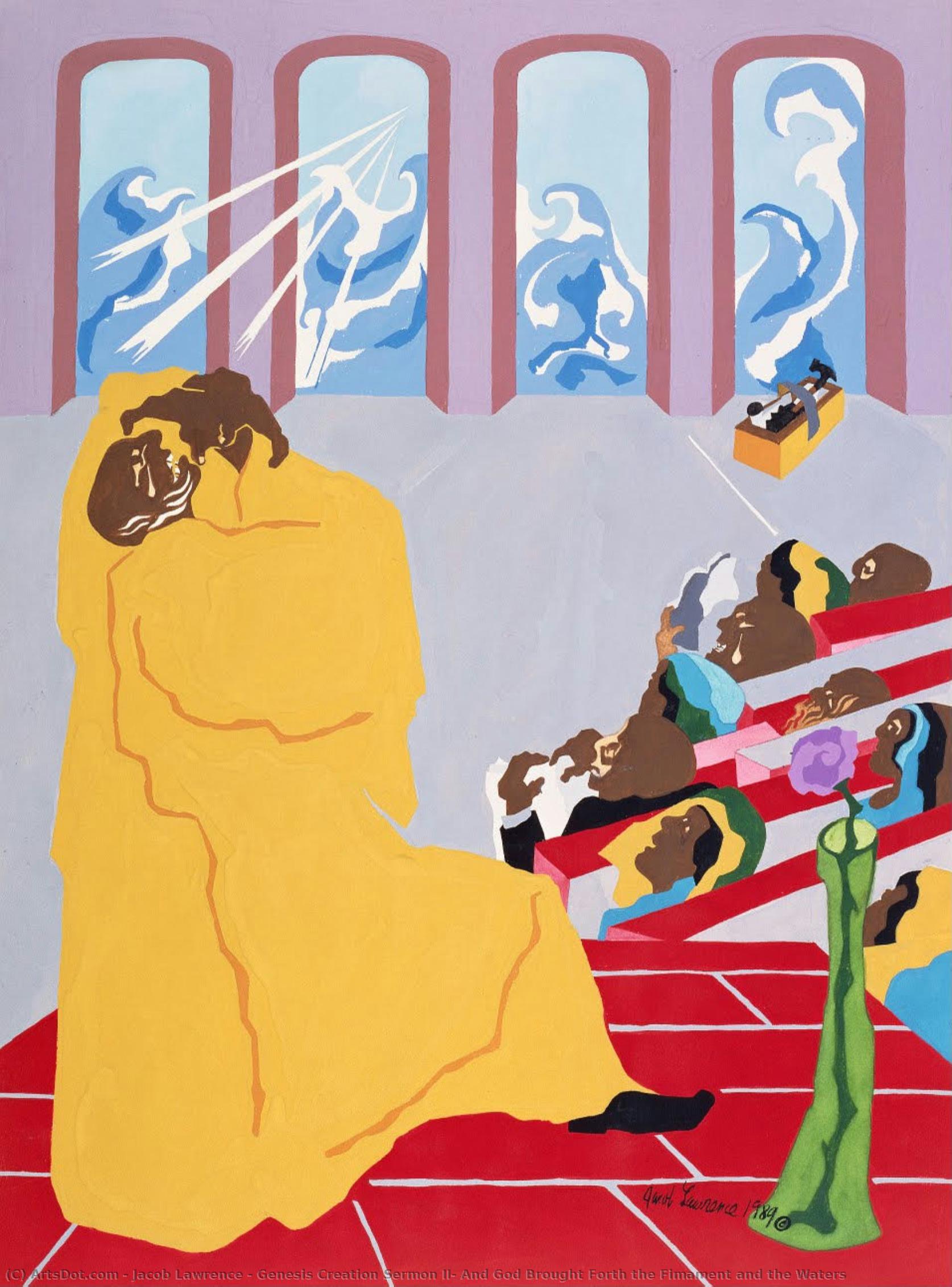
Genesis Creation Sermon II: And God Brought Forth the Fimament and the Waters (1989) de Jacob Lawrence

Genesis Creation Sermon II: And God Brought Forth the Fimament and the Waters

1989 · Oil On Canvas · SCAD Museum of Art, Savannah

Jacob Lawrence’s Genesis Creation Sermon II: And God Brought Forth the Fimament and the Waters is far more than a depiction of biblical scripture; it is a vibrant, deeply personal sermon rendered in paint. Inspired by the powerful oratory of Rev. Adam Clayton Powell Sr., this work channels the electrifying energy of Harlem’s cultural heart into an epic moment of cosmic genesis. The scene pulses with divine activity, capturing that…

8
Tombstones (1942) de Jacob Lawrence

Tombstones

1942 · Tempera · Whitney Museum of American Art, Nova Iorque

In the somber, evocative landscape of Jacob Lawrence’s 1942 masterpiece, Tombstones, we are invited into a profound visual dialogue between life and death. Painted during the turbulent era following Pearl Harbor, this work serves as much more than a mere depiction of a graveyard; it is a soulful testament to the collective experience of African Americans in Harlem. Lawrence, a master of narrative storytelling, utilizes his signature dynamic cubism to…

9
War Series: The Letter (1946) de Jacob Lawrence

War Series: The Letter

1946 · Acrylic On Canvas · Whitney Museum of American Art, Nova Iorque

Jacob Lawrence’s “The Letter,” part of his monumental “War Series” created in 1946, is not merely a depiction of sorrow; it’s an embodiment of profound human experience distilled into its most potent form. This work, rendered with the artist's signature flattened planes and stark geometry, immediately commands attention with its emotionally charged atmosphere. The central figure, hunched and isolated within a confined space, speaks volumes about the devastating impact of…

10
Migration Series No.57: The female workers were the last to arrive north (1941) de Jacob Lawrence

Migration Series No.57: The female workers were the last to arrive north

1941 · Tempera On Panel · The Phillips Collection, Washington, D.C.

A single, vertical line of reddish-brown cuts through the center of the frame, acting as a steady axis for the scene. Around this pole, the world feels flattened and heavy, composed of large, overlapping geometric planes that strip away unnecessary detail to reveal the essence of a moment. A figure, draped in a white cloth that obscures the face, leans into the work. Only dark hands are visible, gripping the…

A seleção de Jacob Lawrence continua, de 11 a 100

11Genesis Creation Sermon VIII: And Creation Was Done and All Was Well (1989) de Jacob LawrenceGenesis Creation Sermon VIII: And Creation Was Done and All Was Well1989 · SCAD Museum of Art 12Migration Series No.39: Railroad platforms were piled high with luggage (1941) de Jacob LawrenceMigration Series No.39: Railroad platforms were piled high with luggage1941 · The Phillips Collection 13Genesis Creation Sermon I: In the Beginning All Was Void (1989) de Jacob LawrenceGenesis Creation Sermon I: In the Beginning All Was Void1989 · SCAD Museum of Art 14Genesis Creation Sermon VI: And God Created All the Beasts of the Earth (1989) de Jacob LawrenceGenesis Creation Sermon VI: And God Created All the Beasts of the Earth1989 · SCAD Museum of Art 15Genesis Creation Sermon VII: And God Created Man and Woman (1989) de Jacob LawrenceGenesis Creation Sermon VII: And God Created Man and Woman1989 · SCAD Museum of Art 16Migration Series No.23: The migration spread (1941) de Jacob LawrenceMigration Series No.23: The migration spread1941 · The Phillips Collection 17Migration Series No.31: The migrants found improved housing when they arrived north (1941) de Jacob LawrenceMigration Series No.31: The migrants found improved housing when they arrived north1941 · The Phillips Collection 18Migration Series No.37: Many migrants found work in the steel industry (1941) de Jacob LawrenceMigration Series No.37: Many migrants found work in the steel industry1941 · The Phillips Collection 19Migration Series No.59: In the North they had the freedom to vote (1941) de Jacob LawrenceMigration Series No.59: In the North they had the freedom to vote1941 · The Phillips Collection 20The Migration Series, Panel no. 13: The crops were left to dry and rot.  There was no one to tend them. de Jacob LawrenceThe Migration Series, Panel no. 13: The crops were left to dry and rot. There was no one to tend them.The Phillips Collection 21Genesis Creation Sermon III: And God Said (1989) de Jacob LawrenceGenesis Creation Sermon III: And God Said1989 · SCAD Museum of Art 22The Migration Series, Panel no. 57: The female workers were the last to arrive north. de Jacob LawrenceThe Migration Series, Panel no. 57: The female workers were the last to arrive north.The Phillips Collection 23The Migration Series, Panel no. 43: In a few sections of the South leaders of both Black and White communities met to discuss ways of making the South a good place to live. de Jacob LawrenceThe Migration Series, Panel no. 43: In a few sections of the South leaders of both Black and White communities met to discuss ways of making the South a good place to live.The Phillips Collection 24The Card Game (1953) de Jacob LawrenceThe Card Game1953 · SCAD Museum of Art 25The Wedding (1948) de Jacob LawrenceThe Wedding1948 · Art Institute of Chicago 26Migration Series No.49: They found discrimination in the North. It was a different kind (1941) de Jacob LawrenceMigration Series No.49: They found discrimination in the North. It was a different kind1941 27Migration Series No.45: The migrants arrived in Pittsburgh, one of the great industrial centers of the North (1941) de Jacob LawrenceMigration Series No.45: The migrants arrived in Pittsburgh, one of the great industrial centers of the North1941 28Migration Series No.43: In a few sections of the South leaders of both Black and White communities met to discuss ways of making the South a good place to live (1941) de Jacob LawrenceMigration Series No.43: In a few sections of the South leaders of both Black and White communities met to discuss ways of making the South a good place to live1941 29Migration Series No.35: They left the South in great numbers. They arrived in the North in great numbers (1941) de Jacob LawrenceMigration Series No.35: They left the South in great numbers. They arrived in the North in great numbers1941 30Migration Series No.33: Letters from relatives in the North told of the better life there (1941) de Jacob LawrenceMigration Series No.33: Letters from relatives in the North told of the better life there1941 31Migration Series No.29: The labor agent recruited unsuspecting laborers as strike breakers for northern industries (1941) de Jacob LawrenceMigration Series No.29: The labor agent recruited unsuspecting laborers as strike breakers for northern industries1941 32Migration Series No.28: The labor agent sent south by northern industry was a familiar presence in the Black communities (1941) de Jacob LawrenceMigration Series No.28: The labor agent sent south by northern industry was a familiar presence in the Black communities1941 33Migration Series No.17: Tenant farmers received harsh treatment at the hands of the planter (1941) de Jacob LawrenceMigration Series No.17: Tenant farmers received harsh treatment at the hands of the planter1941 34Migration Series No.14: For African Americans there was no justice in the southern courts (1941) de Jacob LawrenceMigration Series No.14: For African Americans there was no justice in the southern courts1941 35Painting the Bilges (1944) de Jacob LawrencePainting the Bilges1944 36Watchmaker (1946) de Jacob LawrenceWatchmaker1946 37Cabinet Makers (1946) de Jacob LawrenceCabinet Makers1946 38Sedation (1950) de Jacob LawrenceSedation1950 39Vaudeville (1951) de Jacob LawrenceVaudeville1951 40...if we fail, let us fail like men, and expire together in one common strugge... -Henry Clay, 1813 (1956) de Jacob Lawrence...if we fail, let us fail like men, and expire together in one common strugge... -Henry Clay, 18131956 41The Cue and the Ball (1956) de Jacob LawrenceThe Cue and the Ball1956 42Pool (1954) de Jacob LawrencePool1954 43Street Shadows (1959) de Jacob LawrenceStreet Shadows1959 44Through Forest, Through Rivers, Up Mountains (1967) de Jacob LawrenceThrough Forest, Through Rivers, Up Mountains1967 45Struggle Series - No. 10: Washington Crossing the Delaware (1954) de Jacob LawrenceStruggle Series - No. 10: Washington Crossing the Delaware1954 · Metropolitan Museum of Art 46...is life so dear or peace so sweet as to be purchased at the prices of chains and slavery? Patrick Henry-1775 (1955) de Jacob Lawrence...is life so dear or peace so sweet as to be purchased at the prices of chains and slavery? Patrick Henry-17751955 47The Migration Series, Panel no. 53: African American, long-time residents of northern cities met the migrants with aloofness and disdain. de Jacob LawrenceThe Migration Series, Panel no. 53: African American, long-time residents of northern cities met the migrants with aloofness and disdain.The Phillips Collection 48The Migration Series, Panel no. 27: Many men stayed behind until they could take their families north with them. de Jacob LawrenceThe Migration Series, Panel no. 27: Many men stayed behind until they could take their families north with them.The Phillips Collection 49The Migration Series, Panel no. 21: Families arrived at the station very early.  They did not wish to miss their trains north. de Jacob LawrenceThe Migration Series, Panel no. 21: Families arrived at the station very early. They did not wish to miss their trains north.The Phillips Collection 50Frederick Douglass listened to William Lloyd Garrison denounce slavery de Jacob LawrenceFrederick Douglass listened to William Lloyd Garrison denounce slavery 51Race riots were very numerous all over the North because of the antagonism that was caused between the Negro and white workers de Jacob LawrenceRace riots were very numerous all over the North because of the antagonism that was caused between the Negro and white workers 52Migration Series No.58: In the North the African American had more educational opportunities (1941) de Jacob LawrenceMigration Series No.58: In the North the African American had more educational opportunities1941 53Migration Series No.55: The migrants, having moved suddenly into a crowded and unhealthy environment, soon contracted tuberculosis. The death rate rose (1941) de Jacob LawrenceMigration Series No.55: The migrants, having moved suddenly into a crowded and unhealthy environment, soon contracted tuberculosis. The death rate rose1941 54Migration Series No.54: For the migrants, the church was the center of life (1941) de Jacob LawrenceMigration Series No.54: For the migrants, the church was the center of life1941 55Migration Series No.53: African Americans, long-time residents of northern cities, met the migrants with aloofness and disdain (1941) de Jacob LawrenceMigration Series No.53: African Americans, long-time residents of northern cities, met the migrants with aloofness and disdain1941 56Migration Series No.51: African Americans seeking to find better housing attempted to move into new areas. This resulted in the bombing of their new homes (1941) de Jacob LawrenceMigration Series No.51: African Americans seeking to find better housing attempted to move into new areas. This resulted in the bombing of their new homes1941 57Migration Series No.47: As the migrant population grew, good housing became scarce. Workers were forced to live in overcrowded and dilapidated tenement houses (1941) de Jacob LawrenceMigration Series No.47: As the migrant population grew, good housing became scarce. Workers were forced to live in overcrowded and dilapidated tenement houses1941 58Migration Series No.46: Industries boarded their workers in unhealthy quarters. Labor camps were numerous (1941) de Jacob LawrenceMigration Series No.46: Industries boarded their workers in unhealthy quarters. Labor camps were numerous1941 59Migration Series No.44: But living conditions were better in the North (1941) de Jacob LawrenceMigration Series No.44: But living conditions were better in the North1941 60Migration Series No.42: To make it difficult for the migrants to leave, they were arrested en masse. They often missed their trains (1941) de Jacob LawrenceMigration Series No.42: To make it difficult for the migrants to leave, they were arrested en masse. They often missed their trains1941 61Migration Series No.41: The South was desperate to keep its cheap labor. Northern labor agents were jailed or forced to operate in secrecy (1941) de Jacob LawrenceMigration Series No.41: The South was desperate to keep its cheap labor. Northern labor agents were jailed or forced to operate in secrecy1941 62Migration Series No.30: In every southern home people met to decide whether or not to go north (1941) de Jacob LawrenceMigration Series No.30: In every southern home people met to decide whether or not to go north1941 63Migration Series No.27: Many men stayed behind until they could take their families north with them (1941) de Jacob LawrenceMigration Series No.27: Many men stayed behind until they could take their families north with them1941 64Migration Series No.25: They left their homes. Soon some communities were left almost empty (1941) de Jacob LawrenceMigration Series No.25: They left their homes. Soon some communities were left almost empty1941 65Migration Series No.22: Migrants left. They did not feel safe. It was not wise to be found on the streets late at night. They were arrested on the slightest provocation (1941) de Jacob LawrenceMigration Series No.22: Migrants left. They did not feel safe. It was not wise to be found on the streets late at night. They were arrested on the slightest provocation1941 66Migration Series No.21: Families arrived at the station very early. They did not wish to miss their trains north (1941) de Jacob LawrenceMigration Series No.21: Families arrived at the station very early. They did not wish to miss their trains north1941 67Migration Series No.19: There had always been discrimination (1941) de Jacob LawrenceMigration Series No.19: There had always been discrimination1941 · The Phillips Collection 68Migration Series No.15: There were lynchings (1941) de Jacob LawrenceMigration Series No.15: There were lynchings1941 · The Phillips Collection 69Migration Series No.13: The crops were left to dry and rot. There was no one to tend them (1941) de Jacob LawrenceMigration Series No.13: The crops were left to dry and rot. There was no one to tend them1941 70Migration Series No.9: They left because the boll weevil had ravaged the cotton crop (1941) de Jacob LawrenceMigration Series No.9: They left because the boll weevil had ravaged the cotton crop1941 · The Phillips Collection 71Migration Series No.7: The migrant, whose life had been rural and nurtured by the earth, was now moving to urban life dependent on industrial machinery (1941) de Jacob LawrenceMigration Series No.7: The migrant, whose life had been rural and nurtured by the earth, was now moving to urban life dependent on industrial machinery1941 72Migration Series No.5: Migrants were advanced passage on the railroads, paid for by northern industry. Northern industry was to be repaid by the migrants out of their future wages (1941) de Jacob LawrenceMigration Series No.5: Migrants were advanced passage on the railroads, paid for by northern industry. Northern industry was to be repaid by the migrants out of their future wages1941 73Migration Series No.3: From every southern town migrants left by the hundreds to travel north (1941) de Jacob LawrenceMigration Series No.3: From every southern town migrants left by the hundreds to travel north1941 74Migration Series No.1: During World War I there was a great migration north by southern African Americans (1941) de Jacob LawrenceMigration Series No.1: During World War I there was a great migration north by southern African Americans1941 75Bar and Grill (1941) de Jacob LawrenceBar and Grill1941 · Smithsonian American Art Museum 76Harriet Tubman Series (Panel -4) (1940) de Jacob LawrenceHarriet Tubman Series (Panel -4)1940 · Hampton University Museum 77When It Is Warm the Parks Are Filled with People (1943) de Jacob LawrenceWhen It Is Warm the Parks Are Filled with People1943 78This is Harlem (1943) de Jacob LawrenceThis is Harlem1943 79Captain Skinner (1944) de Jacob LawrenceCaptain Skinner1944 80War Series: Shipping Out (1947) de Jacob LawrenceWar Series: Shipping Out1947 · Whitney Museum of American Art 81War Series: Prayer (1947) de Jacob LawrenceWar Series: Prayer1947 · Whitney Museum of American Art 82African Gold Miners (1946) de Jacob LawrenceAfrican Gold Miners1946 83Defeat (1954) de Jacob LawrenceDefeat1954 84I alarmed almost every house till I got to Lexington-Paul Revere (1954) de Jacob LawrenceI alarmed almost every house till I got to Lexington-Paul Revere1954 85Trappers (1956) de Jacob LawrenceTrappers1956 86Victory and Defeat (1955) de Jacob LawrenceVictory and Defeat1955 87We, the people of the United States, in order to form a more perfect Union, establish justice, insure domestic tranquility (1955) de Jacob LawrenceWe, the people of the United States, in order to form a more perfect Union, establish justice, insure domestic tranquility1955 88...for freedom we want and will have, for we have served this cruel land long enuff... -a Georgia slave, 1810 (1956) de Jacob Lawrence...for freedom we want and will have, for we have served this cruel land long enuff... -a Georgia slave, 18101956 89I cannot speak sufficiently in praise of the firmness and deliberation with which my whole line received their approach... -Andrew Jackson, New Orleans, 1815 (1956) de Jacob LawrenceI cannot speak sufficiently in praise of the firmness and deliberation with which my whole line received their approach... -Andrew Jackson, New Orleans, 18151956 90Untitled (D2X9VM) (1955) de Jacob LawrenceUntitled (D2X9VM)1955 91Thousands of American citizens have been torn from their country and from everying dear to them: they have been dragged on board ships of ward of a foreign nation. -Madison, 1 June 1812 (1956) de Jacob LawrenceThousands of American citizens have been torn from their country and from everying dear to them: they have been dragged on board ships of ward of a foreign nation. -Madison, 1 June 18121956 92120.9.14.286.9.33-ton 290.9.27 be at 153.9.28.110.8.17.255.9.29 evening 178.9.8... -an informer's coded message (1955) de Jacob Lawrence120.9.14.286.9.33-ton 290.9.27 be at 153.9.28.110.8.17.255.9.29 evening 178.9.8... -an informer's coded message1955 93Listen, Father! The Americans have not yet defeated us by land; neither are we sure they have done so by water--we therefore wish to remain here and fight our enemy... Tecumseh to the British, Tippecanoe, 1811 (1956) de Jacob LawrenceListen, Father! The Americans have not yet defeated us by land; neither are we sure they have done so by water--we therefore wish to remain here and fight our enemy... Tecumseh to the British, Tippecanoe, 18111956 94Fulton and Nostrand (1958) de Jacob LawrenceFulton and Nostrand1958 · Cleveland Museum of Art 95Fruits and Vegetables (1959) de Jacob LawrenceFruits and Vegetables1959 · Cincinnati Art Museum 96The Visitors (1959) de Jacob LawrenceThe Visitors1959 · Dallas Museum of Art 97Magic Man (1958) de Jacob LawrenceMagic Man1958 98Parade (1960) de Jacob LawrenceParade1960 99Pool Parlor (1942) de Jacob LawrencePool Parlor1942 100Firewood 55 (1942) de Jacob LawrenceFirewood 551942

Pinturas famosas de Jacob Lawrence, período por período

Os temas que cativaram o olhar de Jacob Lawrence

Os quatro temas que mais se repetem nestas obras originais, cada um com o seu melhor exemplo.

Os museus que guardam os originais de Jacob Lawrence

Os 8 museus que detêm a maioria das pinturas desta página.

Museus Cidade Obras de Jacob Lawrence Pinturas desta lista
The Phillips Collection, Washington, D.C.The Phillips Collection Washington, D.C. 35 Migration Series No.11: Food had doubled in price because of the war, Migration Series No.57: The female workers were the last to arrive north, Migration Series No.39: Railroad platforms were piled high with luggage
SCAD Museum of Art, SavannahSCAD Museum of Art Savannah 10 Genesis Creation Sermon V: And God Created All the Fowls of the Air and Fishes of the Seas, Genesis Creation Sermon IV: And God Created the Day and the Night and God Creatied and Put Stars in the Skies, Genesis Creation Sermon II: And God Brought Forth the Fimament and the Waters
Whitney Museum of American Art, Nova IorqueWhitney Museum of American Art Nova Iorque 4 Tombstones, War Series: The Letter, War Series: Shipping Out
Smithsonian American Art Museum, Washington, D.C.Smithsonian American Art Museum Washington, D.C. 3 The Library, Bar and Grill, Bar and Grill
Philadelphia Museum of Art, FiladélfiaPhiladelphia Museum of Art Filadélfia 1 Taboo
Art Institute of Chicago, ChicagoArt Institute of Chicago Chicago 1 The Wedding
Metropolitan Museum of Art, Nova YorkMetropolitan Museum of Art Nova York 1 Struggle Series - No. 10: Washington Crossing the Delaware
Hampton University Museum, HamptonHampton University Museum Hampton 1 Harriet Tubman Series (Panel -4)

Jacob Lawrence década a década: a obra original que define cada uma

Obras por década

Escolha uma década para ver a obra original que a define.

Perguntas de colecionadores sobre as pinturas de Jacob Lawrence

Por qual obra Jacob Lawrence é mais conhecido(a)?Revelar a resposta

The Library (1960), Smithsonian American Art Museum, Washington, D.C.. Genesis Creation Sermon V: And God Created All the Fowls of the Air and Fishes of the Seas (1989) e Bar and Grill (1941) vêm a seguir.

Qual era a idade de Jacob Lawrence quando The Library foi feita?Revelar a resposta

43 anos: The Library data de 1960, e Jacob Lawrence nasceu em 1917.

Quais são as dez pinturas mais famosas de Jacob Lawrence?Revelar a resposta

The Library, Genesis Creation Sermon V: And God Created All the Fowls of the Air and Fishes of the Seas, Bar and Grill, Genesis Creation Sermon IV: And God Created the Day and the Night and God Creatied and Put Stars in the Skies, Migration Series No.11: Food had doubled in price because of the war, Taboo, Genesis Creation Sermon II: And God Brought Forth the Fimament and the Waters, Tombstones, War Series: The Letter e Migration Series No.57: The female workers were the last to arrive north. O ranking acima apresenta o ano e o museu de cada uma.

Quantas pinturas Jacob Lawrence deixou?Revelar a resposta

Nosso catálogo contém 157 obras de Jacob Lawrence, datadas de 1940 a 1989.

Em quais museus estão expostas as obras-primas de Jacob Lawrence?Revelar a resposta

Principalmente em The Phillips Collection (Washington, D.C.), SCAD Museum of Art (Savannah) e Whitney Museum of American Art (Nova Iorque). A tabela de museus acima lista todos eles.

Em que anos Jacob Lawrence pintou as suas obras mais famosas?Revelar a resposta

Em 1940s: 56 das 100 obras nesta página foram feitas então, sendo Bar and Grill delas.

Quais são as primeiras e as últimas obras originais famosas de Jacob Lawrence?Revelar a resposta

Nesta página, a mais antiga é Harriet Tubman Series (Panel -4) (1940) e a mais recente é Genesis Creation Sermon V: And God Created All the Fowls of the Air and Fishes of the Seas (1989).

Quais temas Jacob Lawrence escolheu com mais frequência?Revelar a resposta

People (8), Harlem renaissance (6) e Figures (6), entre as 100 obras nesta página.

Qual técnica Jacob Lawrence mais utilizou?Revelar a resposta

Painting, para 10 das 100 obras nesta página.

Quais obras de Jacob Lawrence estão expostas no The Phillips Collection?Revelar a resposta

Migration Series No.11: Food had doubled in price because of the war, Migration Series No.57: The female workers were the last to arrive north e Migration Series No.39: Railroad platforms were piled high with luggage: o The Phillips Collection, Washington, D.C. detém 16 das obras desta página.

Jacob Lawrence: vida e obra

A Life Painted in Story: The World of Jacob Lawrence

Jacob Armstead Lawrence, nascido em Atlantic City, Nova Jersey, em 1917, emergiu como um dos artistas americanos mais significativos do século XX. Sua vida se entrelaça intrinsecamente com sua arte – uma narrativa poderosa moldada pelas realidades de ser afro-americano durante um período de profundas mudanças sociais. Após o divórcio de seus pais em 1924, Lawrence experimentou uma infância marcada pela mobilidade e adaptação, passando tempo em famílias acolhedoras em Filadélfia antes de finalmente encontrar um lar com sua mãe em Harlem durante os vibrantes anos do Renascimento de Harlem. Essa imersão no coração cultural da comunidade negra se tornaria a fonte primordial de sua visão artística. Foi nas ruas movimentadas e no espírito comunitário de Harlem que Lawrence primeiro encontrou arte, frequentando classes na Utopia Children’s House e posteriormente estudando sob Charles Alston na Harlem Art Workshop – uma experiência formativa que o lançou em um caminho para se tornar um contador visual de histórias incomparável em profundidade.

Dynamic Cubism: A Style Born of Experience

Lawrence não simplesmente adotava estilos artísticos; ele os forjava, descrevendo-os como “cubismo dinâmico”. Isso não era uma imitação da vanguarda europeia, mas sim uma síntese única de princípios modernistas e as experiências vividas de sua comunidade. Influenciado pelas cores ousadas e formas achatadas das esculturas africanas e pelos muralistas mexicanos – artistas que priorizavam a narrativa e o comentário social – Lawrence desenvolveu uma linguagem visual que era ao mesmo tempo surpreendentemente moderna e profundamente enraizada na cultura negra. Suas pinturas são caracterizadas por formas fortes e simplificadas, paletas de cores vibrantes e um abandono deliberado da perspectiva tradicional. Essa abordagem não era meramente estética; servia para enfatizar o peso emocional de seus temas e criar uma sensação de imediatismo e acessibilidade. Ele buscava não replicar a realidade, mas destilá-la, capturando o espírito de um povo e sua história com honestidade inabalável.

Chronicling History & Everyday Life

A produção artística de Lawrence é notável por sua amplitude e consistência temática. Ele não se concentrava em retratos isolados ou paisagens; em vez disso, criou ciclos épicos que abordavam eventos históricos monumentais e as nuances da vida cotidiana negra. Seu sucesso veio com a *The Migration Series*, uma sequência poderosa de sessenta painéis que retratam a Grande Migração – a massiva movimentação de afro-americanos do sul rural para o norte industrial em busca de oportunidade e fuga da segregação do Jim Crow. Esta obra, iniciada em 1940-41, catapultou Lawrence ao reconhecimento nacional, lhe rendendo elogios e garantindo seu lugar como uma voz líder na arte americana. Mas a *The Migration Series* foi apenas o começo. Ele continuou a criar ciclos igualmente convincentes dedicados a figuras como Toussaint L’Ouverture, Frederick Douglass e Harriet Tubman – transformando narrativas históricas em histórias visuais acessíveis. Além desses grandes ciclos históricos, Lawrence também encontrou beleza e significado na vida cotidiana: cenas de bares, restaurantes e vida doméstica se tornaram telas para explorar temas de comunidade, resiliência e identidade. Sua pintura Bar and Grill, uma representação impactante da segregação em um café de Nova Orleans, exemplifica sua capacidade de destilar realidades sociais complexas em declarações visuais poderosas. Da mesma forma, Victory and Defeat, com suas imponentes paredes de canhões, comemora o cerco crucial de Yorktown, Virgínia, oferecendo uma reflexão sutil sobre a história americana.

Influences & Artistic Development

Lawrence’s artistic development was profoundly shaped by his early experiences. The vibrant colors and expressive forms of African art, particularly the sculptures he encountered in Harlem, served as a key inspiration. He also drew heavily from Mexican muralism, admiring their commitment to social commentary and their ability to tell stories through visual narratives. The influence of Charles Alston at the Harlem Art Workshop was crucial, providing him with technical skills and guidance on how to translate his observations into powerful paintings. The experience of working during the WPA Federal Art Project exposed him to a wide range of subjects and techniques, further broadening his artistic horizons. His distinctive style evolved over time, moving from more representational forms in his early work to the dynamic cubism that became his hallmark – a bold simplification of shapes and colors combined with a strong narrative element.

Legacy & Enduring Influence

O impacto de Jacob Lawrence se estende muito além de sua impressionante obra. Ele não foi apenas um artista, mas também um educador dedicado, ensinando em instituições como Black Mountain College e a Universidade de Washington por dezesseis anos. Através de seu ensino, ele nutriu gerações de artistas, incentivando-os a encontrar suas próprias vozes e explorar temas relevantes para suas experiências. Lawrence abriu o caminho para inúmeros artistas afro-americanos que o seguiram, desafiando as normas prevalecentes e expandindo os limites da arte americana. Sua obra continua a ressoar hoje, provocando conversas críticas sobre raça, história e justiça social. Exposta em importantes museus como o Smithsonian American Art Museum e a coleção da Universidade de Washington, suas pinturas servem como testemunhos duradouros do poder da arte para iluminar a condição humana e inspirar mudanças. Ele deixou um legado não apenas de imagens belas, mas também de narrativas corajosas – um registro visual da jornada de um povo em direção à liberdade e à autodeterminação.