


1


Atualizado em Novembro 2026 · classificado pela nossa pontuação de popularidade (pesquisas, visitas e pedidos de cada obra) · 28 obras de Henri Evenepoel em nosso catálogo
Em resumo
Man in Red (1894) é a pintura de Henri Evenepoel que mais atrai olhares; a obra original pertence ao Museus Reais de Belas Artes, Bruxelas. Depois disso, o olhar recai sobre My Ill Grandfather (1892) e Charles Milcendeau (1899). Entre as 28 obras de Henri Evenepoel em nosso catálogo, estas 26 são as mais famosas, cada uma uma original única apresentada com o seu ano, o seu museu e a razão pela qual perdura.


This portrait, titled Charles Milcendeau, was painted by Henri Evenepoel in 1899. It captures a specific individual, Charles Edmond Théodore Soullans, who is known to us through this work as Charles Milcendeau. The painting offers a direct encounter with the subject, presented in a way that feels both personal and quiet.


 Count Aymer de la Chevalerie1896 · Royal Museum of Fine Arts Antwerp
12
 The running girl1895 · Royal Museum of Fine Arts Antwerp
13
 Wrestling Barrack at a Fair1898 · Royal Museum of Fine Arts Antwerp
14
 The Poulterer1897 · Royal Museum of Fine Arts Antwerp
15
 The Box1896 · Royal Museum of Fine Arts Antwerp
16
 Portrait of Edward Tuck, Vice-Consul of the United States in Paris1899 · Museum of Fine Arts Ghent (MSK)
17
 Sunday at the Bois de Boulogne1899 · Royal Museum of Fine Arts Antwerp
18
 Sunday in the Bois de Boulogne1891
19
 Orange Market at Blida1898 · Museus Reais de Belas Artes da Bélgica
20
 Sunday Fair at Les Invalides1897 · Royal Museum of Fine Arts Antwerp
21
 Mendiant. Algerie1897
22
 Veterans' Festival1898 · Musées Royaux des Beaux-Arts
23
 Henriette in a Large Hat1899 · Museus Reais de Belas Artes
24
 La chambre de l'artiste
25
 Charles in a Striped Jersey1898
26
 The Spaniard in Paris1899 · Museum of Fine Arts Ghent (MSK)
Os 8 museus que detêm a maioria das pinturas desta página.
| Museus | Cidade | Obras de Henri Evenepoel | Pinturas desta lista |
|---|---|---|---|
 Royal Museum of Fine Arts Antwerp |
Antuérpia | 10 | My Ill Grandfather, Louise in Mourning, Returning from Work at Sunset |
 Museum of Fine Arts Ghent (MSK) |
Gante | 4 | Portrait of Hélène Roulet, the Wife of the Artist Adolphe Crespin, The Clown, Portrait of Edward Tuck, Vice-Consul of the United States in Paris |
 Museus Reais de Belas Artes |
Bruxelas | 2 | Man in Red, Henriette in a Large Hat |
 Museus Reais de Belas Artes da Bélgica |
Bruxelas | 2 | Pictures - Portrait of Louis Charles Crespin, Orange Market at Blida |
 Musée d'Orsay |
Paris | 1 | Charles Milcendeau |
 Städel Museum |
Frankfurt | 1 | In the Café d'Harcourt in Paris |
 Museum of Fine Arts |
Houston | 1 | At the Moulin Rouge |
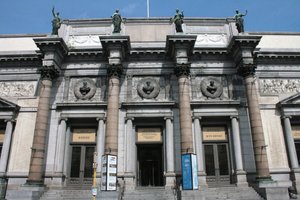 Musées Royaux des Beaux-Arts |
Bruxelas | 1 | Veterans' Festival |
Os originais datados de Henri Evenepoel exibidos aqui abrangem cerca de dez anos, de 1891 a 1899: o olhar percorre-os ano após ano.
Escolha um ano para ver as obras originais.

Mais de 1896
This portrait, titled Charles Milcendeau, was painted by Henri Evenepoel in 1899. It captures a specific individual, Charles Edmond Théodore Soullans, who is known to us through this work as Charles Milcendeau. The painting offers a direct encounter with the subject, presented in a way that feels both personal and quiet.
Mais de 1899
Man in Red (1894), Museus Reais de Belas Artes, Bruxelas. My Ill Grandfather (1892) e Charles Milcendeau (1899) vêm a seguir.
22 anos: Man in Red data de 1894, e Henri Evenepoel nasceu em 1872.
Man in Red, My Ill Grandfather, Charles Milcendeau, In the Café d'Harcourt in Paris, Pictures - Portrait of Louis Charles Crespin, At the Moulin Rouge, Portrait of Hélène Roulet, the Wife of the Artist Adolphe Crespin, The Clown, Louise in Mourning e Returning from Work at Sunset. O ranking acima apresenta o ano e o museu de cada uma.
Nosso catálogo contém 28 obras de Henri Evenepoel, datadas de 1891 a 1899.
Principalmente em Royal Museum of Fine Arts Antwerp (Antuérpia), Museum of Fine Arts Ghent (MSK) (Gante) e Museus Reais de Belas Artes (Bruxelas). A tabela de museus acima lista todos eles.
Em 1897: 5 das 26 obras nesta página foram feitas então, sendo In the Café d'Harcourt in Paris delas.
Nesta página, a mais antiga é Sunday in the Bois de Boulogne (1891) e a mais recente é Charles Milcendeau (1899).
My Ill Grandfather, Louise in Mourning e Returning from Work at Sunset: o Royal Museum of Fine Arts Antwerp, Antuérpia detém 10 das obras desta página.


