Retrato de Hans Holbein, O Velho

Pinturas de Hans Holbein, O Velho: As 65 mais famosas, sob o olhar de uma galeria

Atualizado em Novembro 2026 · classificado pela nossa pontuação de popularidade (pesquisas, visitas e pedidos de cada obra) · 65 obras de Hans Holbein, O Velho em nosso catálogo

Em resumo

Aos olhos da galeria, a pintura mais famosa de Hans Holbein, O Velho é Grey Passion (1500), cuja obra original está exposta no Staatsgalerie Stuttgart, em Stuttgart. Kaisheim Descent from the Cross (1500) e Katherine Altar: Martyrdom of Saint Peter (1512) completam o trio que todos reconhecem. Dos 65 trabalhos de Hans Holbein, O Velho em nosso catálogo, a galeria apresenta abaixo as 65 obras mais famosas, cada uma original, com seu ano, seu museu e o que a torna única.

1465 – 1524, Augsburgo Northern renaissance Mais obras: Bavarian State Painting Collections

As 10 principais pinturas de Hans Holbein, O Velho na galeria

1
Grey Passion (1500) de Hans Holbein, O Velho

Grey Passion

1500 · Oil · Staatsgalerie Stuttgart, Stuttgart

The Grey Passion is a series of twelve panels created by Hans Holbein the Elder between 1494 and 1500. These paintings illustrate the Passion of Christ, forming the wings of a larger altarpiece. The original structure was a triptych, designed to surround a central element. This centerpiece consisted of a sculpture by Gregor Erhart, which is now lost.

2
Kaisheim Descent from the Cross (1500) de Hans Holbein, O Velho

Kaisheim Descent from the Cross

1500 · Oil On Panel · Bavarian State Painting Collections, Munique

A heavy silence hangs over the wooden beams. The body of Christ hangs limp, a pale weight being lowered from the cross. Shadows cling to the deep folds of crimson and dark green drapery, swallowing the periphery in a somber gloom. Every line follows the downward pull of gravity, tracing the path from the rigid geometry of the timber to the slumped, organic curves of the mourners. At the base,…

3
Katherine Altar: Martyrdom of Saint Peter (1512) de Hans Holbein, O Velho

Katherine Altar: Martyrdom of Saint Peter

1512 · Oil On Panel · Bavarian State Painting Collections, Munique

Created in 1512, this work belongs to the Northern Renaissance. It reflects the transition from late Gothic traditions toward a more realistic, humanistic approach. The painting emphasizes the visceral details of the human body and the specific textures of material goods. This style is characteristic of early 16th-century German painting, where precision in draftsmanship was a primary concern. The subject matter focuses on religious devotion through the depiction of sacrifice…

4
Kaisheim Crucifixion (1500) de Hans Holbein, O Velho

Kaisheim Crucifixion

1500 · Oil On Panel · Bavarian State Painting Collections, Munique

The Kaisheim Crucifixion is a dramatic religious painting from 1500 that captures a moment of profound sorrow. The composition is defined by a strong verticality, centering on the figure of Christ on the cross against a dark, near-black background. This high-contrast setting serves to illuminate his pale body, making him the focal point of the work. The color palette is composed of deep reds, stark whites, and heavy blacks, accented…

6
Burial of Kaisheim (1500) de Hans Holbein, O Velho

Burial of Kaisheim

1500 · Oil On Panel · Bavarian State Painting Collections, Munique

In this somber composition from 1500, we find ourselves drawn into a tight, vertical arrangement of mourning. The scene depicts the Lamentation, a moment of profound sorrow where the physical presence of the deceased Christ is the focal point. There is a palpable sense of claustrophobia here; the figures are packed closely together, their grief pressing inward upon the viewer. The color palette relies on deep, saturated tones—crimson reds, dark…

7
Epitaph of the Vetter Sisters (1499) de Hans Holbein, O Velho

Epitaph of the Vetter Sisters

1499 · Oil On Panel · Bavarian State Painting Collections, Munique

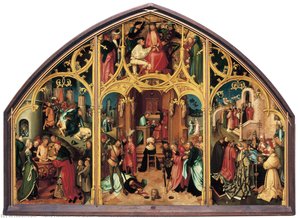
The Epitaph of the Vetter Sisters emerges from the shadows of the late Gothic era, a large-scale altarpiece that commands the space it occupies. Painted by Hans Holbein The Elder, this work dates to about 1499. It exists as a complex, multi-tiered narrative, unfolding through a series of interconnected vignettes that guide the eye across its structured, pointed, arched frame. The scale of the piece carries a weight that demands…

8
Frankfurt Dominican Altarpiece: Flagellation (1501) de Hans Holbein, O Velho

Frankfurt Dominican Altarpiece: Flagellation

1501 · Mixed Technique · Städel Museum, Frankfurt

The Frankfurt Dominican Altarpiece: Flagellation is a significant work by Hans Holbein The Elder, dating to 1501. This painting was originally commissioned by the Dominican Convent for the High Altar of the Dominican Church in Frankfurt am Main. It remains a profound example of the artist's early period, executed during a time when his technical precision was already becoming a defining characteristic of his hand.

10
Frankfurt Dominican Altarpiece: Ecce Homo (1501) de Hans Holbein, O Velho

Frankfurt Dominican Altarpiece: Ecce Homo

1501 · Oil On Panel · Städel Museum, Frankfurt

Frankfurt Dominican Altarpiece: Ecce Homo is a work by Hans Holbein The Elder, executed in 1501. The piece belongs to the Northern Renaissance tradition, emerging from the artist's early career in the German region. It was created during a period when the transition from Late Gothic sensibilities toward Renaissance humanism was reshaping the visual language of religious art.

Pinturas de Hans Holbein, O Velho, classificadas de 11 a 65

11Frankfurt Dominican Altarpiece: The Cleansing of the Temple (1501) de Hans Holbein, O VelhoFrankfurt Dominican Altarpiece: The Cleansing of the Temple1501 · Städel Museum 12Frankfurt Dominican Altarpiece: Christ’s Arrest (1501) de Hans Holbein, O VelhoFrankfurt Dominican Altarpiece: Christ’s Arrest1501 · Städel Museum 13Frankfurt Dominican Altarpiece: Christ Washing St Peter's Feet (1501) de Hans Holbein, O VelhoFrankfurt Dominican Altarpiece: Christ Washing St Peter's Feet1501 · Städel Museum 14Frankfurt Dominican Altarpiece: Christ before Pontius Pilate (1501) de Hans Holbein, O VelhoFrankfurt Dominican Altarpiece: Christ before Pontius Pilate1501 · Städel Museum 15Frankfurt Dominican Altarpiece: Christ Crowned with Thorns (1501) de Hans Holbein, O VelhoFrankfurt Dominican Altarpiece: Christ Crowned with Thorns1501 · Städel Museum 16Frankfurt Dominican Altarpiece: Bearing of the Cross (1501) de Hans Holbein, O VelhoFrankfurt Dominican Altarpiece: Bearing of the Cross1501 · Städel Museum 17Frankfurt Dominican Altarpiece: The Agony in the Garden (1501) de Hans Holbein, O VelhoFrankfurt Dominican Altarpiece: The Agony in the Garden1501 · Städel Museum 18Frankfurt Dominican Altarpiece: Tree of Jesse (lower part) (1501) de Hans Holbein, O VelhoFrankfurt Dominican Altarpiece: Tree of Jesse (lower part)1501 · Städel Museum 19Frankfurt Dominican Altarpiece: Resurrection (1501) de Hans Holbein, O VelhoFrankfurt Dominican Altarpiece: Resurrection1501 · Städel Museum 20Frankfurt Dominican Altarpiece: Lineage of the Dominican Order (lower part) (1501) de Hans Holbein, O VelhoFrankfurt Dominican Altarpiece: Lineage of the Dominican Order (lower part)1501 · Städel Museum 21Frankfurt Dominican Altarpiece: Sunday view (1501) de Hans Holbein, O VelhoFrankfurt Dominican Altarpiece: Sunday view1501 · Städel Museum 22Frankfurt Dominican Altarpiece: Tree of Jesse (upper part) (1501) de Hans Holbein, O VelhoFrankfurt Dominican Altarpiece: Tree of Jesse (upper part)1501 · Städel Museum 23Basilica Santa Maria Maggiore (1499) de Hans Holbein, O VelhoBasilica Santa Maria Maggiore1499 · Bavarian State Painting Collections 24The Virgin Mary as the Mother of Sorrows (1495) de Hans Holbein, O VelhoThe Virgin Mary as the Mother of Sorrows1495 · Gemäldegalerie 25Good Deeds of Empress Kunigunde (1506) de Hans Holbein, O VelhoGood Deeds of Empress Kunigunde1506 · Bavarian State Painting Collections 26Kaisheim Altar: Birth of Christ (1502) de Hans Holbein, O VelhoKaisheim Altar: Birth of Christ1502 · Bavarian State Painting Collections 27Kaisheim Altar: Christ before Pilate (1502) de Hans Holbein, O VelhoKaisheim Altar: Christ before Pilate1502 · Bavarian State Painting Collections 28Epitaph of the Walther Sisters: Feeding of the Five Thousand (1502) de Hans Holbein, O VelhoEpitaph of the Walther Sisters: Feeding of the Five Thousand1502 · Bavarian State Painting Collections 29Epitaph of the Walther Sisters: Healing of the Possessed (1502) de Hans Holbein, O VelhoEpitaph of the Walther Sisters: Healing of the Possessed1502 · Bavarian State Painting Collections 30Votive Image of Ulrich Schwarz: Christ and Mary as Intercessors before God the Father (1503) de Hans Holbein, O VelhoVotive Image of Ulrich Schwarz: Christ and Mary as Intercessors before God the Father1503 · Bavarian State Painting Collections 31Kaisheim Altar: Annunciation of Mary (1502) de Hans Holbein, O VelhoKaisheim Altar: Annunciation of Mary1502 · Bavarian State Painting Collections 32Kaisheim Altar: Capture of Christ (1502) de Hans Holbein, O VelhoKaisheim Altar: Capture of Christ1502 · Bavarian State Painting Collections 33Kaisheim Altar: Crowning of Christ with Thorns (1502) de Hans Holbein, O VelhoKaisheim Altar: Crowning of Christ with Thorns1502 · Bavarian State Painting Collections 34Emperor Henry Condemns the Empress to Trial by Ordeal (1506) de Hans Holbein, O VelhoEmperor Henry Condemns the Empress to Trial by Ordeal1506 · Bavarian State Painting Collections 35Emperor Henry Asks the Empress for Forgiveness (1506) de Hans Holbein, O VelhoEmperor Henry Asks the Empress for Forgiveness1506 · Bavarian State Painting Collections 36Epitaph of the Walther Sisters: Transfiguration of Christ (1502) de Hans Holbein, O VelhoEpitaph of the Walther Sisters: Transfiguration of Christ1502 · Bavarian State Painting Collections 37Death of Emperor Heinrich (1506) de Hans Holbein, O VelhoDeath of Emperor Heinrich1506 · Bavarian State Painting Collections 38Devils Inform a Hermit That They Could Not Lay Hold of the Soul of the Emperor (1506) de Hans Holbein, O VelhoDevils Inform a Hermit That They Could Not Lay Hold of the Soul of the Emperor1506 · Bavarian State Painting Collections 39The Devil in the Form of a Youth in the Chamber of Empress Kunigunde (1506) de Hans Holbein, O VelhoThe Devil in the Form of a Youth in the Chamber of Empress Kunigunde1506 · Bavarian State Painting Collections 40Katharinenaltar: Saint Ulrich and Conrad (1512) de Hans Holbein, O VelhoKatharinenaltar: Saint Ulrich and Conrad1512 · Bavarian State Painting Collections 41Kaisheim Altar: Visitation of Mary (1502) de Hans Holbein, O VelhoKaisheim Altar: Visitation of Mary1502 · Bavarian State Painting Collections 42Kaisheim Altar: Carrying of the Cross of Christ (1502) de Hans Holbein, O VelhoKaisheim Altar: Carrying of the Cross of Christ1502 · Bavarian State Painting Collections 43Kaisheim Altar: Presentation in the Temple (1502) de Hans Holbein, O VelhoKaisheim Altar: Presentation in the Temple1502 · Bavarian State Painting Collections 44Kaisheim Altar: Christ on the Mount of Olives (1502) de Hans Holbein, O VelhoKaisheim Altar: Christ on the Mount of Olives1502 · Bavarian State Painting Collections 45Kaisheim Altar: Resurrection of Christ (1502) de Hans Holbein, O VelhoKaisheim Altar: Resurrection of Christ1502 · Bavarian State Painting Collections 46Kaisheim Altar: Adoration of the Magi (1502) de Hans Holbein, O VelhoKaisheim Altar: Adoration of the Magi1502 · Bavarian State Painting Collections 47Empress Kunigunde Accused of Adultery (1506) de Hans Holbein, O VelhoEmpress Kunigunde Accused of Adultery1506 · Bavarian State Painting Collections 48Kaisheim Altar: Death of Mary (1502) de Hans Holbein, O VelhoKaisheim Altar: Death of Mary1502 · Bavarian State Painting Collections 49Kaisheim Altar: Temple Walk of Mary (1502) de Hans Holbein, O VelhoKaisheim Altar: Temple Walk of Mary1502 · Bavarian State Painting Collections 50Kaisheim Altar: Ecce Homo (1502) de Hans Holbein, O VelhoKaisheim Altar: Ecce Homo1502 · Bavarian State Painting Collections 51Kaisheim Altar: Circumcision of Christ (1502) de Hans Holbein, O VelhoKaisheim Altar: Circumcision of Christ1502 · Bavarian State Painting Collections 52Empress Kunigunde Walks Over Glowing Plowshares (1506) de Hans Holbein, O VelhoEmpress Kunigunde Walks Over Glowing Plowshares1506 · Bavarian State Painting Collections 53Catherine Altar: Martyrdom of Saint Catherine (1512) de Hans Holbein, O VelhoCatherine Altar: Martyrdom of Saint Catherine1512 · Bavarian State Painting Collections 54Kaisheim Altar: Flagellation of Christ (1502) de Hans Holbein, O VelhoKaisheim Altar: Flagellation of Christ1502 · Bavarian State Painting Collections 55Mary with the Child (1502) de Hans Holbein, O VelhoMary with the Child1502 · Bavarian State Painting Collections 56Virgin with Child by Hans Holbein the Elder, Museu Nacional de Arte Antiga (1519) de Hans Holbein, O VelhoVirgin with Child by Hans Holbein the Elder, Museu Nacional de Arte Antiga1519 · Museu Nacional de Arte Antiga 57Portrait of a Member of the Weiss Family of Augsburg (1522) de Hans Holbein, O VelhoPortrait of a Member of the Weiss Family of Augsburg1522 · Städel Museum 58Basilica San Paolo Fuori Le Mura (1504) de Hans Holbein, O VelhoBasilica San Paolo Fuori Le Mura1504 · Bavarian State Painting Collections 59Ecce Homo (Grey Passion-6) (1500) de Hans Holbein, O VelhoEcce Homo (Grey Passion-6)1500 · Staatsgalerie Stuttgart 60Bildnis Der Nonne Veronika Vetter (1499) de Hans Holbein, O VelhoBildnis Der Nonne Veronika Vetter1499 61Christ in silence (Grey Passion-9) (1500) de Hans Holbein, O VelhoChrist in silence (Grey Passion-9)1500 · Staatsgalerie Stuttgart 62Maria Der Verkündigung (Sebastiansaltar) (1516) de Hans Holbein, O VelhoMaria Der Verkündigung (Sebastiansaltar)1516 · Bavarian State Painting Collections 63Portrait of a Wife of An Unknown Stonemason (1505) de Hans Holbein, O VelhoPortrait of a Wife of An Unknown Stonemason1505 64Grey Passion (1500) de Hans Holbein, O VelhoGrey Passion1500 · Staatsgalerie Stuttgart 65The crown of thorns (Grey Passion-5) (1500) de Hans Holbein, O VelhoThe crown of thorns (Grey Passion-5)1500 · Staatsgalerie Stuttgart

Pinturas famosas de Hans Holbein, O Velho, período por período

Os temas que cativaram o olhar de Hans Holbein, O Velho

Os quatro temas que mais se repetem nestas obras originais, cada um com o seu melhor exemplo.

Os museus que guardam os originais de Hans Holbein, O Velho

Os 5 museus que detêm a maioria das pinturas desta página.

Museus Cidade Obras de Hans Holbein, O Velho Pinturas desta lista
Bavarian State Painting Collections, MuniqueBavarian State Painting Collections Munique 40 Kaisheim Descent from the Cross, Katherine Altar: Martyrdom of Saint Peter, Kaisheim Crucifixion
Städel Museum, FrankfurtStädel Museum Frankfurt 16 Frankfurt Dominican Altarpiece: Flagellation, Frankfurt Dominican Altarpiece: The Entry into Jerusalem, Frankfurt Dominican Altarpiece: Ecce Homo
Staatsgalerie Stuttgart, StuttgartStaatsgalerie Stuttgart Stuttgart 5 Grey Passion, Ecce Homo (Grey Passion-6), Christ in silence (Grey Passion-9)
Gemäldegalerie, BerlimGemäldegalerie Berlim 1 The Virgin Mary as the Mother of Sorrows
Museu Nacional de Arte Antiga, LisboaMuseu Nacional de Arte Antiga Lisboa 1 Virgin with Child by Hans Holbein the Elder, Museu Nacional de Arte Antiga

Hans Holbein, O Velho, uma pintura emblemática por década

Obras por década

Escolha uma década para ver a obra original que a define.

Pinturas de Hans Holbein, O Velho: a galeria responde

Qual pintura de Hans Holbein, O Velho é a mais famosa de todas?Revelar a resposta

Grey Passion (1500), Staatsgalerie Stuttgart, Stuttgart. Kaisheim Descent from the Cross (1500) e Katherine Altar: Martyrdom of Saint Peter (1512) vêm a seguir.

Qual era a idade de Hans Holbein, O Velho ao concluir Grey Passion?Revelar a resposta

35 anos: Grey Passion data de 1500, e Hans Holbein, O Velho nasceu em 1465.

Quais são as 10 principais pinturas de Hans Holbein, O Velho?Revelar a resposta

Grey Passion, Kaisheim Descent from the Cross, Katherine Altar: Martyrdom of Saint Peter, Kaisheim Crucifixion, Katherine Altar: Saint Anne Self-Third, Burial of Kaisheim, Epitaph of the Vetter Sisters, Frankfurt Dominican Altarpiece: Flagellation, Frankfurt Dominican Altarpiece: The Entry into Jerusalem e Frankfurt Dominican Altarpiece: Ecce Homo. O ranking acima apresenta o ano e o museu de cada uma.

Quantas obras Hans Holbein, O Velho criou?Revelar a resposta

Nosso catálogo contém 65 obras de Hans Holbein, O Velho, datadas de 1495 a 1522.

Onde estão expostos os originais mais famosos de Hans Holbein, O Velho?Revelar a resposta

Principalmente em Bavarian State Painting Collections (Munique), Städel Museum (Frankfurt) e Staatsgalerie Stuttgart (Stuttgart). A tabela de museus acima lista todos eles.

Quando é que Hans Holbein, O Velho criou as suas pinturas mais famosas?Revelar a resposta

Em 1500s: 54 das 65 obras nesta página foram feitas então, sendo Grey Passion delas.

Quais são as obras mais famosas de Hans Holbein, O Velho no início e no fim de sua carreira?Revelar a resposta

Nesta página, a mais antiga é The Virgin Mary as the Mother of Sorrows (1495) e a mais recente é Portrait of a Member of the Weiss Family of Augsburg (1522).

Quais temas Hans Holbein, O Velho mais explorou?Revelar a resposta

People (21), Drapery (18) e Figures (15), entre as 65 obras nesta página.

Em qual técnica Hans Holbein, O Velho mais trabalhou?Revelar a resposta

Oil On Panel, para 40 das 65 obras nesta página.

Com qual movimento Hans Holbein, O Velho está associado(a)?Revelar a resposta

Northern renaissance, a julgar pelos originais nesta página.

Quais obras originais de Hans Holbein, O Velho o Bavarian State Painting Collections possui?Revelar a resposta

Kaisheim Descent from the Cross, Katherine Altar: Martyrdom of Saint Peter e Kaisheim Crucifixion: o Bavarian State Painting Collections, Munique detém 40 das obras desta página.

Hans Holbein, O Velho: o artista

O Mestre do Retrato do Renascimento Nórdico: Hans Holbein, O Velho

Hans Holbein, O Velho, um nome sinônimo de detalhe meticuloso e profunda percepção psicológica, destaca-se como uma das figuras mais importantes na transição entre a arte do Gótico tardio e o Alto Renascimento. Nascido em Augsburgo, na Alemanha, por volta de 1465 — embora as datas precisas permaneçam incertas — ele floresceu durante um período de imensa mudança artística, servindo de ponte entre o fervor religioso do mundo medieval e o humanismo emergente do Renascimento. Sua vida inicial é envolta em certo mistério; no entanto, sabe-se que ele recebeu seu treinamento inicial no ateliê de seu pai, Hans Holbein, o Jovem (não confundir com seu filho mais famoso), um respeitado pintor e artista gráfico. Esta base familiar instilou nele um profundo apreço pelo desenho preciso e um domínio precoce de técnicas como a têmpera e a pintura a óleo. A própria Augsburgo era um vibrante centro artístico, fomentando um clima onde a inovação prosperava ao lado de tradições estabelecidas. As obras iniciais de Holbein refletem esse ambiente — retábulos detalhados e painéis devocionais caracterizados por uma ornamentação intrincada e uma sensibilidade distintamente norte-europeia. Ele rapidamente ganhou reconhecimento por sua habilidade de renderizar texturas com um realismo surpreendente, desde as dobras delicadas dos tecidos até o brilho do metal polido.

Uma Jornada pela Alemanha: Basileia e Além

A carreira de Hans Holbein, O Velho, levou-o por uma jornada através de várias cidades alemãs de extrema importância, cada uma deixando sua marca indelével em seu desenvolvimento artístico. Ele trabalhou em Ulm, Colônia e, finalmente, estabeleceu-se em Basileia em 1516. Este período revelou-se crucial. Basileia era um reduto do pensamento humanista, atraindo estudiosos, impressores e artistas de todas as partes. O estilo de Holbein começou a evoluir, influenciado pelos mestres do Renascimento italiano, cujas obras circulavam pela cidade através de gravuras e artistas visitantes. Embora tenha continuado a produzir pinturas religiosas, o seu foco deslocou-se progressivamente para a retratística — um género que lhe permitiu explorar as complexidades do caráter humano com uma profundidade sem precedentes. Tornou-se uma figura altamente requisitada pela elite de Basileia, capturando as suas semelhanças em retratos que não eram meras representações, mas sim estudos psicológicos profundos. O seu uso da cor tornou-se mais sofisticado e ele começou a experimentar novas técnicas de composição, colocando frequentemente os seus sujeitos contra fundos neutros para enfatizar a sua individualidade. Este período também viu Holbein mergulhar na ilustração de livros em xilogravura, notavelmente para a série A Dança da Morte, uma poderosa meditação sobre a mortalidade que demonstrou as suas competências gráficas e o seu comentário social. A Dança da Morte, com a sua imagética austera e figuras alegóricas, consolidou a sua reputação como um artista capaz de abordar temas filosóficos profundos.

A Corte Inglesa e o Triunfo Artístico

Em 1526, Hans Holbein, O Velho embarcou em sua primeira jornada à Inglaterra, uma viagem que alteraria dramaticamente o curso de sua carreira. Inicialmente, ele buscou o patrocínio de Sir Thomas More, um proeminente estudioso humanista e estadista. Essa conexão abriu portas para encomendas de outros membros da corte inglesa, incluindo o rei Henrique VIII e diversos nobres. Os retratos de Hans Holbein, O Velho da elite Tudor são, indiscutivelmente, suas obras mais famosas — verdadeiras obras-primas de realismo, diplomacia e percepção psicológica. Ele possuía uma habilidade quase sobrenatural de capturar não apenas a semelhança física de seus modelos, mas também suas personalidades, ambições e posição social. Seu retrato de Henrique VIII, por exemplo, é uma poderosa afirmação de autoridade real, transmitindo a presença imponente e o poder inabalável do monarca. A técnica de Holbein na Inglaterra envolvia a aplicação de finas camadas de verniz sobre painéis meticulosamente preparados, criando superfícies que cintilavam com detalhes vívidos, quase reais. Ele também se tornou mestre em incorporar elementos simbólicos em seus retratos, comunicando sutilmente mensagens sobre o status e as crenças de seus sujeitos. Seu sucesso na corte inglesa resultou em um período de relativa prosperidade e liberdade artística.

Legado e Influência Duradoura

Hans Holbein, O Velho faleceu em Augsburgo em 1543, deixando para trás um legado que continua a inspirar artistas até os dias de hoje. Embora seu filho, Hans Holbein, o Jovem, tenha alcançado uma fama ainda maior, as contribuições do mais velho foram fundamentais para o desenvolvimento do retrato no Renascimento Nórdico e das artes gráficas. Sua técnica meticulosa, profundidade psicológica e a habilidade de capturar as complexidades do caráter humano o distinguiram de seus contemporâneos. Sua influência pode ser vista nas obras de artistas posteriores, incluindo Rembrandt e Van Dyck, que admiravam seu domínio da luz e da sombra e sua capacidade de transmitir personalidade através do retrato. A série Dança da Morte permanece como um poderoso testemunho de suas habilidades gráficas e de seu comentário social. Além disso, os retratos de Holbein da elite Tudor oferecem visões inestimáveis sobre as personalidades e as dinâmicas de poder da Inglaterra do século XVI. Ele não era simplesmente um pintor; era um cronista de uma era, capturando seu espírito em pinceladas e xilogravuras.
  • Realismo magistral e atenção aos detalhes.
  • Percepção psicológica pioneira no retrato.
  • Contribuições significativas para a ilustração de livros com a série Dança da Morte.
  • Ponte entre os estilos artísticos Gótico e Renascentista.
Sua obra continua a ser celebrada por seu brilho técnico, profundidade intelectual e beleza perene.