Retrato de Giuliano Bugiardini

Pinturas de Giuliano Bugiardini: As 30 mais famosas, sob o olhar de uma galeria

Atualizado em Novembro 2026 · classificado pela nossa pontuação de popularidade (pesquisas, visitas e pedidos de cada obra) · 30 obras de Giuliano Bugiardini em nosso catálogo

Em resumo

Aos olhos da galeria, a pintura mais famosa de Giuliano Bugiardini é Scenes from the Story of Tobias (1500), cuja obra original está exposta no Staatliche Museen zu Berlin, em Berlim. Rape of Dinah (1535) e Madonna and Child Enthroned with Saints Mary Magdalen and John the Baptist (1523) completam o trio que todos reconhecem. Dos 30 trabalhos de Giuliano Bugiardini em nosso catálogo, a galeria apresenta abaixo as 30 obras mais famosas, cada uma original, com seu ano, seu museu e o que a torna única.

1475 – 1554, Florença High renaissance Mais obras: Staatliche Museen zu Berlin

As 10 principais pinturas de Giuliano Bugiardini na galeria

1
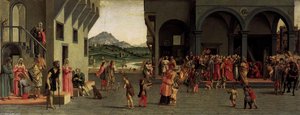
Scenes from the Story of Tobias (1500) de Giuliano Bugiardini

Scenes from the Story of Tobias

1500 · Oil On Canvas · Staatliche Museen zu Berlin, Berlim

Giuliano Bugiardini's "Scenes from the Story of Tobias," painted in 1500, isn’t merely a depiction of a biblical narrative; it’s a vibrant snapshot of Renaissance life, brimming with social interaction and subtle symbolism. Housed within the hallowed halls of the Staatliche Museen in Berlin, this oil-on-wood masterpiece offers a captivating glimpse into a world where piety intertwined seamlessly with everyday existence. Measuring a substantial 60 x 159 cm, the painting…

2
Rape of Dinah (1535) de Giuliano Bugiardini

Rape of Dinah

1535 · Oil · Kunsthistorisches Museum, Viena

The air in the plaza feels heavy with the sudden movement of bodies. In the center of the composition, a woman is gripped by men, her form a focal point of struggle against the rigid, geometric lines of the surrounding architecture. The scene is a collision of organic human limbs and the unyielding stone of a Renaissance cityscape. Deep reds and golds bleed into the shadows of the drapery, while…

3
Madonna and Child Enthroned with Saints Mary Magdalen and John the Baptist (1523) de Giuliano Bugiardini

Madonna and Child Enthroned with Saints Mary Magdalen and John the Baptist

1523 · Oil On Panel · Metropolitan Museum of Art, Nova York

The composition rests upon a stone throne, a heavy and classical foundation that anchors the figures in a geometric stability. At the center, the Virgin Mary sits with a quiet, sculptural volume, her form defined by the deep ultramarine of her mantle and the sharp vermilion of her gown. She holds the Christ Child, whose presence provides the apex of a perfect pyramid. Around them, the air feels still, held…

4
Madonna with Christ-child (1517) de Giuliano Bugiardini

Madonna with Christ-child

1517 · Oil On Panel · Bavarian State Painting Collections, Munique

In Madonna with Christ-child by Giuliano Bugiardini, the focus rests entirely upon the intimate connection between mother and child. The two figures occupy the center of the frame, arranged in a stable, pyramidal structure that draws the eye inward toward their shared space. The Virgin is draped in a crimson robe, a deep red that meets the heavy, dark blue of her mantle. Gold lining traces the edges of her…

5
Mary with the child and the juvenile Johannes (1514) de Giuliano Bugiardini

Mary with the child and the juvenile Johannes

1514 · Oil On Panel · Gemäldegalerie, Berlim

The composition rests upon a stable, pyramidal structure, anchoring the figures within a quiet, sacred space. Mary sits as the central pillar, her form providing a sense of permanence amidst the soft contours of the scene. The light descends from the upper left, carving out the volume of her face and the heavy, rhythmic folds of her garments. Shadows pool in the recesses of the drapery, lending a three-dimensional weight…

6
The Virgin and Blessing Child, Young St. John and Angel (1510) de Giuliano Bugiardini

The Virgin and Blessing Child, Young St. John and Angel

1510 · Oil On Panel · Gemäldegalerie, Berlim

The Virgin Mary sits in a three-quarter view, her form a soft curve against the stillness of the composition. She cradles the Christ Child upon her lap, her hands a gentle cradle for the divine. To the left, an angel with visible wings gazes toward the children, a silent witness to the intimacy of the scene. In the lower foreground, the young St. John stands, his presence grounding the celestial…

7
St. John the Baptist in the Wilderness (1530) de Giuliano Bugiardini

St. John the Baptist in the Wilderness

1530 · Oil

A young man kneels in the silence of a rugged landscape. He is caught in a moment of profound listening, holding a small shell to his ear as if catching the whispers of the divine or the rush of distant waters. His body, rendered with the anatomical precision of the High Renaissance, shows the subtle tension of muscle and skin under a soft, diffused light. He wears only a simple…

8
St. John the Baptist in the Wilderness (1525) de Giuliano Bugiardini

St. John the Baptist in the Wilderness

1525 · Oil On Panel · Pinacoteca Nazionale di Bologna, Bolonha

A single figure sits upon a craggy, ochre-colored rock formation within a landscape of muted earth tones. This man, identified as St. John the Baptist, is positioned centrally in a vertical composition. He is clad in a garment made of animal skin, rendered with a coarse, tactile texture that contrasts with the smoother rendering of his skin. His limbs are bent in a posture of quietude, and he holds a…

9
Virgin and child (1530) de Giuliano Bugiardini

Virgin and child

1530 · Oil On Panel · Art Gallery of South Australia, Adelaide

The painting titled Virgin and child is a work by the Italian Renaissance painter Giuliano Bugiardini. Created about 1530, this European painting depicts a religious subject through a vertical composition. The figures are positioned against a backdrop of classical stone architecture and a distant landscape. The scene focuses on the physical closeness of the Virgin Mary and the Christ Child.

10
Madonna and Child with St. John and an angel (1525) de Giuliano Bugiardini

Madonna and Child with St. John and an angel

1525 · Oil On Panel · Museu Nacional de Varsóvia, Varsóvia

In Madonna and Child with St. John and an angel, Giuliano Bugiardini organizes the scene within a circular tondo format. The Virgin Mary is seated as the central focal point, providing a sense of stability to the entire arrangement. Around her, three smaller figures are positioned to create a balanced, pyramidal structure. This geometric arrangement directs the eye through the intimate connections between the figures, emphasizing a sense of maternal…

Pinturas de Giuliano Bugiardini, classificadas de 11 a 30

Pinturas famosas de Giuliano Bugiardini, período por período

Os temas que cativaram o olhar de Giuliano Bugiardini

Os quatro temas que mais se repetem nestas obras originais, cada um com o seu melhor exemplo.

Os museus que guardam os originais de Giuliano Bugiardini

Os 8 museus que detêm a maioria das pinturas desta página.

Museus Cidade Obras de Giuliano Bugiardini Pinturas desta lista
Staatliche Museen zu Berlin, BerlimStaatliche Museen zu Berlin Berlim 2 Scenes from the Story of Tobias, Scenes from the Story of Tobias
Metropolitan Museum of Art, Nova YorkMetropolitan Museum of Art Nova York 2 Madonna and Child Enthroned with Saints Mary Magdalen and John the Baptist, Adam; Eve
Gemäldegalerie, BerlimGemäldegalerie Berlim 2 Mary with the child and the juvenile Johannes, The Virgin and Blessing Child, Young St. John and Angel
Walters Art Museum, BaltimoreWalters Art Museum Baltimore 2 Madonna and Child, Portrait of a Bolognese Gentleman in a Fur-lined Coat
National Gallery of Art, WashingtonNational Gallery of Art Washington 2 Leonardo de' Ginori, Portrait of a Young Woman
Kunsthistorisches Museum, VienaKunsthistorisches Museum Viena 1 Rape of Dinah
Bavarian State Painting Collections, MuniqueBavarian State Painting Collections Munique 1 Madonna with Christ-child
Pinacoteca Nazionale di Bologna, BolonhaPinacoteca Nazionale di Bologna Bolonha 1 St. John the Baptist in the Wilderness

Giuliano Bugiardini, uma pintura emblemática por década

Obras por década

Escolha uma década para ver a obra original que a define.

Pinturas de Giuliano Bugiardini: a galeria responde

Qual pintura de Giuliano Bugiardini é a mais famosa de todas?Revelar a resposta

Scenes from the Story of Tobias (1500), Staatliche Museen zu Berlin, Berlim. Rape of Dinah (1535) e Madonna and Child Enthroned with Saints Mary Magdalen and John the Baptist (1523) vêm a seguir.

Qual era a idade de Giuliano Bugiardini ao concluir Scenes from the Story of Tobias?Revelar a resposta

25 anos: Scenes from the Story of Tobias data de 1500, e Giuliano Bugiardini nasceu em 1475.

Quais são as 10 principais pinturas de Giuliano Bugiardini?Revelar a resposta

Scenes from the Story of Tobias, Rape of Dinah, Madonna and Child Enthroned with Saints Mary Magdalen and John the Baptist, Madonna with Christ-child, Mary with the child and the juvenile Johannes, The Virgin and Blessing Child, Young St. John and Angel, St. John the Baptist in the Wilderness, St. John the Baptist in the Wilderness, Virgin and child e Madonna and Child with St. John and an angel. O ranking acima apresenta o ano e o museu de cada uma.

Quantas obras Giuliano Bugiardini criou?Revelar a resposta

Nosso catálogo contém 30 obras de Giuliano Bugiardini, datadas de 1500 a 1539.

Onde estão expostos os originais mais famosos de Giuliano Bugiardini?Revelar a resposta

Principalmente em Staatliche Museen zu Berlin (Berlim), Metropolitan Museum of Art (Nova York) e Gemäldegalerie (Berlim). A tabela de museus acima lista todos eles.

Quando é que Giuliano Bugiardini criou as suas pinturas mais famosas?Revelar a resposta

Em 1520s: 9 das 30 obras nesta página foram feitas então, sendo Madonna and Child Enthroned with Saints Mary Magdalen and John the Baptist delas.

Quais são as obras mais famosas de Giuliano Bugiardini no início e no fim de sua carreira?Revelar a resposta

Nesta página, a mais antiga é Scenes from the Story of Tobias (1500) e a mais recente é Francesco Guicciardini (1539).

Quais temas Giuliano Bugiardini mais explorou?Revelar a resposta

Woman (8), Child (8) e Drapery (5), entre as 30 obras nesta página.

Em qual técnica Giuliano Bugiardini mais trabalhou?Revelar a resposta

Oil On Panel, para 12 das 30 obras nesta página.

Com qual movimento Giuliano Bugiardini está associado(a)?Revelar a resposta

High renaissance e Renaissance, a julgar pelos originais nesta página.

Quais obras originais de Giuliano Bugiardini o Staatliche Museen zu Berlin possui?Revelar a resposta

Scenes from the Story of Tobias e Scenes from the Story of Tobias: o Staatliche Museen zu Berlin, Berlim detém 2 das obras desta página.

Giuliano Bugiardini: o artista

Uma Vida Moldada pelo Renascimento Florentino

Giuliano Bugiardini destaca-se como uma figura profunda do Renascimento Italiano, um pintor cuja vida e obra estiveram intrinsecamente entrelaçadas com o vibrante tecido cultural de Florença. Sua jornada começou no coração deste epicentro artístico, onde provavelmente encontrou sua primeira inspiração no prestigiado jardim de esculturas de Lorenzo de' Medici, próximo ao convento de San Marco. Foi neste ambiente fértil, sob a orientação do escultor Bertoldo, que Bugiardini encontrou pela primeira vez o brilho emergente da era. Seus anos de formação foram marcados por conexões profundas com os mestres de seu tempo; ele ingressou no ateliê de Domenico Ghirlandaio no início da década de 1490, um período que moldaria sua maestria técnica e o apresentaria a outros talentos em ascensão, como o jovem Michelangelo.

A trajetória da carreira de Bugiardini foi definida tanto pela colaboração quanto pela independência. Por volta de 1503, ele já havia se estabelecido como um artista independente, juntando-se à confraria de pintores florentinos, a Compagnia di San Luca. Esta era o viu envolvido em uma importante parceria comercial com Mariotto Albertinelli, um vínculo que durou até 1509. Ao longo de sua longa carreira, Bugiardini manteve amizades duradouras com algumas das figuras mais monumentais da história da arte. Sua relação com Michelangelo foi particularmente notável; não apenas compartilharam a formação inicial, mas Bugiardini também capturou a semelhança de Michelangelo em retratos e trabalhou em obras onde a influência do grande mestre era palpável, como nas figuras desenhadas para o seu Martírio de Santa Catarina.

Maestria da Narrativa Sagrada e da Emoção Humana

A obra de Bugiardini é um testemunho da versatilidade e da profundidade espiritual características da pintura do Alto Renascimento. Embora fosse primordialmente um pintor de temas religiosos, sua habilidade de infundir narrativas sagradas com drama humano e realismo social permitiu que seu trabalho ressoasse muito além das paredes das capelas. Em obras-primas como Cenas da História de Tobias, pintada em 1500, ele transformou um conto bíblico em um tableau vívido da vida do Renascimento. Através desta obra, observa-se um comando meticuloso do detalhe — as texturas de roupas finas, a precisão arquitetônica e as expressões sutis e emotivas que dão vida aos personagens dentro de um pátio movimentado e ensolarado.

Suas composições religiosas frequentemente utilizavam a clássica estrutura piramidal para evocar uma sensação de paz eterna e estabilidade. Em obras como Sagrada Família com São João Batista, Bugiardini capturou momentos de profunda graça e intimidade familiar. Sua técnica baseava-se no uso sofisticado da tinta a óleo, que lhe permitia alcançar gradações sutis de luz e cor, criando uma sensação de volume e profundidade atmosférica que era revolucionária. Seja retratando a presença serena da Madona ou o movimento complexo de uma procissão, sua pincelada soprava vida no divino, tornando o sagrado acessível através da lente da experiência humana.

Legado Artístico e Sofisticação Técnica

A importância histórica de Giuliano Bugiardini reside no seu papel como uma ponte entre as tradições do final do século XV e o dinamismo emergente do século XVI. Sua capacidade de executar não apenas grandes retábulos, mas também retratos íntimos e temas mitológicos, demonstra uma amplitude de habilidade que impôs respeito em toda a Itália, incluindo períodos de atividade em Bolonha. Seu trabalho é caracterizado por várias marcas artísticas duradouras:

  • Realismo Renascentista: Uma habilidade excepcional de representar o mundo físico, desde os padrões intrincados de tecidos até a anatomia realista de figuras e animais.
  • Profundidade Narrativa: A capacidade de tecer histórias bíblicas ou mitológicas complexas em instantâneos sociais vibrantes que refletem o espírito da sociedade florentina.
  • Cor e Luz: Uma paleta rica apresentando vermelhos profundos, azuis vibrantes e tons terrosos, utilizados através de camadas cuidadosas para criar textura e luminosidade.
  • Composição Clássica: O uso de arranjos geométricos equilibrados para instilar um senso de harmonia e permanência espiritual em seus temas sagrados.

Embora muitas vezes eclipsado pelos gigantes mais tempestuosos de sua era, a contribuição de Bugiardini para o Renascimento é inegável. Ele foi um artista que conseguiu capturar a própria essência da devoção espiritual enquanto, simultaneamente, documentava as texturas sociais de seu tempo, deixando para trás um legado de beleza, precisão e profunda conexão humana.