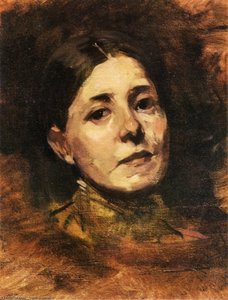
Retrato de Frank Duveneck

As 100 Pinturas Mais Famosas de Frank Duveneck, Cada Uma Única

Atualizado em Novembro 2026 · classificado pela nossa pontuação de popularidade (pesquisas, visitas e pedidos de cada obra) · 201 obras de Frank Duveneck em nosso catálogo

Em resumo

Portrait of Emil Carlson (1884) é a pintura de Frank Duveneck que mais atrai olhares. Depois disso, o olhar recai sobre Study of a Nude (1877) e Henry James (1811-1882) (1881). Entre as 201 obras de Frank Duveneck em nosso catálogo, estas 100 são as mais famosas, cada uma uma original única apresentada com o seu ano, o seu museu e a razão pela qual perdura.

1848 – 1919, Covington Realism Mais obras: Cincinnati Art Museum

As 10 principais pinturas de Frank Duveneck, sob o olhar da galeria

1
Portrait of Emil Carlson (1884) de Frank Duveneck

Portrait of Emil Carlson

1884 · Oil On Canvas

In this 1884 portrait, we find ourselves in the presence of Emil Carlson, seated in a moment of profound stillness. He is positioned slightly off-center, a choice that lends a natural, unforced quality to his posture. His gaze is direct, meeting ours with a look that carries a hint of melancholy, yet remains composed. There is a certain weight to his presence, an understated dignity that emerges from the way…

2
Study of a Nude (1877) de Frank Duveneck

Study of a Nude

1877 · Oil On Canvas

In this 1877 oil on canvas, we find a moment of profound stillness. A woman sits with her back turned to us, her figure occupying the majority of the frame. There is a certain weight to her posture, a sense of being grounded as she sits upon the floor. The darkness of the background is not merely a void; it acts as a deliberate shadow that pushes her form forward,…

3
Henry James (1811-1882) (1881) de Frank Duveneck

Henry James (1811-1882)

1881 · Oil On Canvas · Harvard Art Museums, Cambridge

A single light source descends from the upper left, carving a face out of the dark. The skin is a map of lived years, etched with fine lines and the heavy texture of age. A white beard flows downward, its strands rendered with thick, tactile brushstrokes that catch the light. This is a study in monochrome, a grayscale world where shadows hold as much substance as the highlights on a…

4
Head of an Old Man (1878) de Frank Duveneck

Head of an Old Man

1878 · Oil On Canvas · Smithsonian American Art Museum, Washington, D.C.

Frank Duveneck executed Head of an Old Man as an oil on canvas. Created ca. 1877-1879, the work functions as a study rather than a fully realized portrait. The artist focused his attention on the face, utilizing broad brushstrokes to model the features in a manner reminiscent of a sculptor working in clay.

5
J. Frank Currier  (1843-1909) (1876) de Frank Duveneck

J. Frank Currier (1843-1909)

1876 · Oil · Art Institute of Chicago, Chicago

In this 1876 oil portrait, we encounter J. Frank Currier, a man whose presence is felt through the weight of the paint rather than the precision of a line. The subject is positioned centrally, a bust-length figure emerging from a dark, nebulous background that offers no spatial distractions. He wears a wide-brimmed hat that casts a heavy shadow over his brow, framing a face defined by a full beard and…

6
Study Head, Man with Hat (1881) de Frank Duveneck

Study Head, Man with Hat

1881 · Oil On Canvas · Saint Louis Art Museum, Saint Louis

Study Head, Man with Hat is a painting by the artist Frank Duveneck. This work, which is an oil on canvas, focuses on the head of a single subject. The composition places the figure slightly off-center against a dark, deep background. The subject is depicted in a close-up portrait view, emerging from the shadows through the use of directional lighting that enters from the upper left. This light source casts…

8
A Red Haired Boy (1870) de Frank Duveneck

A Red Haired Boy

1870 · Oil On Canvas · Cincinnati Art Museum, Cincinnati

In this intimate oil portrait, A Red Haired Boy presents us with a quiet moment of contemplation. Painted by Frank Duveneck, the work captures a young child whose presence is defined by a striking shock of red hair. It is a piece that invites a closer look, focusing entirely on the character and spirit of the subject.

9
The Old Professor (1871) de Frank Duveneck

The Old Professor

1871 · Oil On Canvas · Museu de Belas Artes de Boston, Boston

The Old Professor emerges from the shadows, a portrait study of an elderly man that captures a quiet, heavy moment of existence. Painted by Frank Duveneck, the work presents a face etched with the weight of years. The subject sits before us, an elderly man wearing glasses and a goatee, his features caught in a state of profound introspection. He exists in a space where the light barely touches the…

10
Madonna and Child (1867) de Frank Duveneck

Madonna and Child

1867 · Oil On Canvas

In this work, titled Madonna and Child, Frank Duveneck presents a quiet, devotional scene centered on the Virgin Mary and the Christ Child. Painted about 1867, the image focuses entirely on the intimate connection between mother and son. The subject matter carries profound weight, utilizing the figures to symbolize motherhood, divinity, and salvation. There is a stillness here that invites a moment of reflection.

Pinturas famosas de Frank Duveneck, números 11 a 100

11Portrait of a Fellow Artist (1870) de Frank DuveneckPortrait of a Fellow Artist1870 12Portrait of a Young Man (1875) de Frank DuveneckPortrait of a Young Man1875 · Buffalo AKG Art Museum 13Portrait of Henry L. Fry, Woodcarver (1874) de Frank DuveneckPortrait of Henry L. Fry, Woodcarver1874 · Cincinnati Art Museum 14Professor Ludwig Loefftz (1873) de Frank DuveneckProfessor Ludwig Loefftz1873 · Cincinnati Art Museum 15Self-Portrait (1878) de Frank DuveneckSelf-Portrait1878 · Indianapolis Museum of Art 16Portrait of Ralph Curtis (1872) de Frank DuveneckPortrait of Ralph Curtis1872 17He Lives by His Wits (1878) de Frank DuveneckHe Lives by His Wits1878 18Spanish Don (1877) de Frank DuveneckSpanish Don1877 19William Gedney Bunce (1878) de Frank DuveneckWilliam Gedney Bunce1878 · National Gallery of Art 20Francis Boott (1881) de Frank DuveneckFrancis Boott1881 · Cincinnati Art Museum 21Venetian Girl (1880) de Frank DuveneckVenetian Girl1880 · Cincinnati Art Museum 22Guard of the Harem (1880) de Frank DuveneckGuard of the Harem1880 · Cincinnati Art Museum 23Portrait of a Lady (Elizabeth Boott Duveneck) (1879) de Frank DuveneckPortrait of a Lady (Elizabeth Boott Duveneck)1879 · Ulrich Museum of Art 24Portrait of a Woman (1879) de Frank DuveneckPortrait of a Woman1879 25The Red Sail (1884) de Frank DuveneckThe Red Sail1884 26Venetian Bathers (1885) de Frank DuveneckVenetian Bathers1885 27John White Alexander (1879) de Frank DuveneckJohn White Alexander1879 28Water Carriers, Venice (1884) de Frank DuveneckWater Carriers, Venice1884 · Smithsonian American Art Museum 29Girl in Blue Blouse (1885) de Frank DuveneckGirl in Blue Blouse1885 30Figures on Venetian Steps (1883) de Frank DuveneckFigures on Venetian Steps1883 31Head of an Oriental Woman (1880) de Frank DuveneckHead of an Oriental Woman1880 32A Venetian Shrine (1885) de Frank DuveneckA Venetian Shrine1885 · Cincinnati Art Museum 33Siesta (1886) de Frank DuveneckSiesta1886 · Cincinnati Art Museum 34Marie Danforth Page (1889) de Frank DuveneckMarie Danforth Page1889 · Cincinnati Art Museum 35Head of a Child (1890) de Frank DuveneckHead of a Child1890 · Museu de Belas Artes de Boston 36Boy Wearing Cloak (1888) de Frank DuveneckBoy Wearing Cloak1888 · Cincinnati Art Museum 37Siesta (1887) de Frank DuveneckSiesta1887 38Siesta, Number Two (1887) de Frank DuveneckSiesta, Number Two1887 39Italian Girl with Rake (1886) de Frank DuveneckItalian Girl with Rake1886 40Italian Boy (1886) de Frank DuveneckItalian Boy1886 41F. B. Duveneck as a Child (1890) de Frank DuveneckF. B. Duveneck as a Child1890 42Study of a School Boy (1895) de Frank DuveneckStudy of a School Boy1895 · Cincinnati Museum Center at Union Terminal 43Chioggia Fisherman (1894) de Frank DuveneckChioggia Fisherman1894 · Birmingham Museum of Art 44Leslie Pease Barnum (1876) de Frank DuveneckLeslie Pease Barnum1876 · National Gallery of Art 45Lady with a Red Hat (Portrait of Maggie Wilson) (1904) de Frank DuveneckLady with a Red Hat (Portrait of Maggie Wilson)1904 · Dallas Museum of Art 46Steep Ramp (1905) de Frank DuveneckSteep Ramp1905 47Walter Shirlaw (1873) de Frank DuveneckWalter Shirlaw1873 · Smithsonian American Art Museum 48Portrait of a Bearded Man (1874) de Frank DuveneckPortrait of a Bearded Man1874 · Bavarian State Painting Collections 49Caucasian Soldier (1870) de Frank DuveneckCaucasian Soldier1870 · Museu de Belas Artes de Boston 50Whistling Boy de Frank DuveneckWhistling BoyDallas Museum of Art 51Little Girl in Gray (1890) de Frank DuveneckLittle Girl in Gray1890 52Girl Reading (1876) de Frank DuveneckGirl Reading1876 · Museu de Belas Artes de Boston 53Portrait of an Old Man de Frank DuveneckPortrait of an Old ManDallas Museum of Art 54Frank Duveneck Self-Portrait (1890) de Frank DuveneckFrank Duveneck Self-Portrait1890 · National Portrait Gallery 55Landscape, Polling, Bavaria (1878) de Frank DuveneckLandscape, Polling, Bavaria1878 · Cincinnati Art Museum 56Lady with Fan (1873) de Frank DuveneckLady with Fan1873 · Metropolitan Museum of Art 57Still Life with Watermelon (1878) de Frank DuveneckStill Life with Watermelon1878 · Cincinnati Art Museum 58Old Towl Brook, Polling, Bavaria (1878) de Frank DuveneckOld Towl Brook, Polling, Bavaria1878 59The Old Philosopher (1878) de Frank DuveneckThe Old Philosopher1878 60The Turkish Page (1876) de Frank DuveneckThe Turkish Page1876 · Pennsylvania Academy of Fine Arts 61Profile of Girl with Hat (1878) de Frank DuveneckProfile of Girl with Hat1878 62Portrait of Frances Schillinger Hinkle (1875) de Frank DuveneckPortrait of Frances Schillinger Hinkle1875 · Cincinnati Art Museum 63Portrait of Major Dillard H. Clark (1877) de Frank DuveneckPortrait of Major Dillard H. Clark1877 64The Bridges: Florence (1880) de Frank DuveneckThe Bridges: Florence1880 · Saint Louis Art Museum 65Ship in Grand Canal (1881) de Frank DuveneckShip in Grand Canal1881 66Miss Blood (1880) de Frank DuveneckMiss Blood1880 67Grand Canal in Venice (1883) de Frank DuveneckGrand Canal in Venice1883 68Portrait Sketch of Elizabeth Boott (1885) de Frank DuveneckPortrait Sketch of Elizabeth Boott1885 69Venetian Fruit Market (1884) de Frank DuveneckVenetian Fruit Market1884 70Fellow Artist in Costume (1880) de Frank DuveneckFellow Artist in Costume1880 71Portrait of a Boy (1882) de Frank DuveneckPortrait of a Boy1882 72Heads and Hands (study) (1879) de Frank DuveneckHeads and Hands (study)1879 73Girl in Black Hood (1879) de Frank DuveneckGirl in Black Hood1879 74Steamer at Anchor, Twilight, Venice (1884) de Frank DuveneckSteamer at Anchor, Twilight, Venice1884 75Washerwomen, Venice (1885) de Frank DuveneckWasherwomen, Venice1885 76Guard of the Harem (study) (1879) de Frank DuveneckGuard of the Harem (study)1879 77Red Sail in the Harbor at Venice (1884) de Frank DuveneckRed Sail in the Harbor at Venice1884 · Cincinnati Art Museum 78Gloucester (1890) de Frank DuveneckGloucester1890 · Cincinnati Art Museum 79Miss Westlake (1889) de Frank DuveneckMiss Westlake1889 80Red Sail, Venice (1886) de Frank DuveneckRed Sail, Venice1886 81Italian Courtyard (1886) de Frank DuveneckItalian Courtyard1886 82Nude Standing (1892) de Frank DuveneckNude Standing1892 83Elizabeth Boott Duveneck (1888) de Frank DuveneckElizabeth Boott Duveneck1888 · Cincinnati Art Museum 84Portrait of Elizabeth Boott (1886) de Frank DuveneckPortrait of Elizabeth Boott1886 85Elizabeth Boott Duveneck (1888) de Frank DuveneckElizabeth Boott Duveneck1888 · Dordrechts Museum 86Florentine Flower Girl (1886) de Frank DuveneckFlorentine Flower Girl1886 · Cincinnati Art Museum 87Self-Portrait (1887) de Frank DuveneckSelf-Portrait1887 · Cincinnati Art Museum 88Double Portrait of a Girl (1895) de Frank DuveneckDouble Portrait of a Girl1895 89Marine (1900) de Frank DuveneckMarine1900 · Indianapolis Museum of Art 90Tuscan Hills (1900) de Frank DuveneckTuscan Hills1900 91That Summer Afternoon in My Garden (1900) de Frank DuveneckThat Summer Afternoon in My Garden1900 92Horizon at Gloucester (1905) de Frank DuveneckHorizon at Gloucester1905 93Dock Sheds at Low Tide (1900) de Frank DuveneckDock Sheds at Low Tide1900 94Girl with Parasol (1900) de Frank DuveneckGirl with Parasol1900 95Head of a Young Woman (1900) de Frank DuveneckHead of a Young Woman1900 96Portrait of Brother John (1900) de Frank DuveneckPortrait of Brother John1900 97Study of an Old Man de Frank DuveneckStudy of an Old ManArt Museum at The University of Kentucky 98Henry James, Sr. de Frank DuveneckHenry James, Sr.Indianapolis Museum of Art 99Nude de Frank DuveneckNudeIndianapolis Museum of Art 100Portrait of Squire Duveneck de Frank DuveneckPortrait of Squire DuveneckIndianapolis Museum of Art

Pinturas famosas de Frank Duveneck, período por período

Os temas que cativaram o olhar de Frank Duveneck

Os quatro temas que mais se repetem nestas obras originais, cada um com o seu melhor exemplo.

Os museus que guardam os originais de Frank Duveneck

Os 8 museus que detêm a maioria das pinturas desta página.

Museus Cidade Obras de Frank Duveneck Pinturas desta lista
Cincinnati Art Museum, CincinnatiCincinnati Art Museum Cincinnati 21 A Red Haired Boy, Portrait of Henry L. Fry, Woodcarver, Professor Ludwig Loefftz
Indianapolis Museum of Art, IndianapolisIndianapolis Museum of Art Indianapolis 7 Self-Portrait, Marine, Henry James, Sr.
Museu de Belas Artes de Boston, BostonMuseu de Belas Artes de Boston Boston 4 The Old Professor, Head of a Child, Caucasian Soldier
Smithsonian American Art Museum, Washington, D.C.Smithsonian American Art Museum Washington, D.C. 3 Head of an Old Man, Water Carriers, Venice, Walter Shirlaw
Dallas Museum of Art, DallasDallas Museum of Art Dallas 3 Lady with a Red Hat (Portrait of Maggie Wilson), Whistling Boy, Portrait of an Old Man
Saint Louis Art Museum, Saint LouisSaint Louis Art Museum Saint Louis 2 Study Head, Man with Hat, The Bridges: Florence
National Gallery of Art, WashingtonNational Gallery of Art Washington 2 William Gedney Bunce, Leslie Pease Barnum
Harvard Art Museums, CambridgeHarvard Art Museums Cambridge 1 Henry James (1811-1882)

Frank Duveneck ao longo das décadas: uma obra original única para cada uma

Obras por década

Escolha uma década para ver a obra original que a define.

Pinturas de Frank Duveneck: perguntas para a galeria

Qual é a obra mais famosa de Frank Duveneck?Revelar a resposta

Portrait of Emil Carlson (1884). Study of a Nude (1877) e Henry James (1811-1882) (1881) vêm a seguir.

Com que idade Frank Duveneck criou Portrait of Emil Carlson?Revelar a resposta

36 anos: Portrait of Emil Carlson data de 1884, e Frank Duveneck nasceu em 1848.

Quais são as dez pinturas mais famosas de Frank Duveneck?Revelar a resposta

Portrait of Emil Carlson, Study of a Nude, Henry James (1811-1882), Head of an Old Man, J. Frank Currier (1843-1909), Study Head, Man with Hat, Portrait of William Merritt Chase, A Red Haired Boy, The Old Professor e Madonna and Child. O ranking acima apresenta o ano e o museu de cada uma.

Quantas obras de Frank Duveneck são conhecidas?Revelar a resposta

Nosso catálogo contém 201 obras de Frank Duveneck, datadas de 1867 a 1905.

Onde se pode ver os originais mais famosos de Frank Duveneck?Revelar a resposta

Principalmente em Cincinnati Art Museum (Cincinnati), Indianapolis Museum of Art (Indianapolis) e Museu de Belas Artes de Boston (Boston). A tabela de museus acima lista todos eles.

Em que período Frank Duveneck criou as suas pinturas mais conhecidas?Revelar a resposta

Em 1880s: 39 das 100 obras nesta página foram feitas então, sendo Portrait of Emil Carlson delas.

Qual pintura famosa de Frank Duveneck é a mais antiga e qual é a mais recente?Revelar a resposta

Nesta página, a mais antiga é Madonna and Child (1867) e a mais recente é Steep Ramp (1905).

Quais temas Frank Duveneck preferia?Revelar a resposta

Man (23), Portrait (22) e Dark background (13), entre as 100 obras nesta página.

Com quais materiais Frank Duveneck mais pintou?Revelar a resposta

Oil On Canvas, para 44 das 100 obras nesta página.

A qual movimento pertence a obra de Frank Duveneck?Revelar a resposta

Realism, a julgar pelos originais nesta página.

Quais originais de Frank Duveneck posso ver no Cincinnati Art Museum?Revelar a resposta

A Red Haired Boy, Portrait of Henry L. Fry, Woodcarver e Professor Ludwig Loefftz: o Cincinnati Art Museum, Cincinnati detém 18 das obras desta página.

Frank Duveneck: um retrato do artista

A Life Forged in Tragedy and Realism

Frank Duveneck, born Frank Decker in 1848 amidst the bustling river town of Covington, Kentucky, was an artist whose life story is as compelling as the powerfully rendered canvases he created. His early years were profoundly shaped by loss; the untimely death of his father to cholera when he was barely a year old indelibly altered his trajectory. This formative tragedy, coupled with his mother’s subsequent marriage to Joseph “Squire” Duveneck – from whom he adopted his enduring name – instilled within him a remarkable resilience and perhaps, an enhanced sensitivity that would later manifest in the emotional depth of his art. The blending of German heritage through his stepfather and the distinctly American landscape of his upbringing formed a unique cultural foundation for the artist, contributing to a complex and layered artistic vision. Even as a young boy, a natural aptitude for drawing blossomed, leading to studies under local painter Johann Schmitt and an apprenticeship with a firm specializing in church decoration—a crucial period where he honed technical skills and absorbed the narrative power of visual imagery, learning how art could evoke profound emotion and tell compelling stories – lessons that would resonate throughout his career.

The Munich Crucible: Embracing Dark Realism

In 1869, Duveneck embarked on a transformative journey to Munich, Germany, seeking advanced artistic training at the Royal Academy. This move proved pivotal, exposing him to an entirely different aesthetic landscape. The prevailing artistic climate in Munich was characterized by a stark realism—a deliberate rejection of academic idealism in favor of direct observation and unflinching honesty. It resonated deeply with Duveneck, who embraced a darker palette and a more vigorous, expressive brushstroke. He became captivated by the work of 17th-century Dutch masters like Frans Hals, whose lively portraits and masterful handling of light profoundly influenced his style. Hals’s ability to capture fleeting moments of life, imbued with both joy and melancholy, served as a powerful model for Duveneck's own artistic approach. This influence is strikingly evident in paintings such as *Lady with Fan* (1873), where slashing brushwork and a somber tonality echo Hals’s spirit while simultaneously establishing Duveneck’s own distinctive voice – a willingness to confront the complexities of human experience with unflinching honesty. The atmosphere of Munich, steeped in artistic debate and experimentation, provided fertile ground for Duveneck's creative development. He spent years immersed in the studio, absorbing techniques and developing his unique style, laying the groundwork for his future success.

A Mentor’s Influence: The “Duveneck Boys” and Beyond

By 1878, Duveneck had established himself as a significant figure in the art world, not only as a painter but also as an influential educator. He opened his own school in Munich, attracting a cohort of ambitious American artists who became known collectively as the “Duveneck Boys.” Among them were John Twachtman, Otto Bacher, Julius Rolshoven, and John White Alexander—artists who would themselves become prominent figures in American Impressionism and Realism. Duveneck’s teaching philosophy emphasized direct observation, bold brushwork, and a rejection of conventional academic constraints. He encouraged his students to forge their own artistic paths while grounding them in the principles of sound draftsmanship and expressive color. His influence extended back to America when he accepted a position at the Art Academy of Cincinnati, where he mentored another generation of artists including Ida Holterhoff Holloway, John Christen Johansen, and Russel Wright. He fostered a spirit of innovation and independence that helped shape the course of American art, leaving an indelible mark on those who studied under his guidance – students who carried forward his commitment to realism and emotional expression.

Evolving Visions and Lasting Legacy

Duveneck’s artistic journey continued to evolve after his return to America. While he remained committed to realism, his palette began to lighten, influenced by the burgeoning Impressionist movement and his frequent travels to Italy and France. He explored landscape painting with increasing frequency, capturing the sun-drenched scenes of Venice and the rugged beauty of coastal Massachusetts. Despite these stylistic shifts, his work always retained a distinctive character—a blend of technical mastery, psychological depth, and emotional resonance. The personal tragedy of losing his wife, Elizabeth Boott Duveneck, in 1888 cast a long shadow over his later years, perhaps contributing to the introspective quality of some of his subsequent works. His paintings from this period often convey a sense of quiet melancholy and profound reflection. Frank Duveneck passed away in Covington, Kentucky, in 1919, leaving behind a rich artistic legacy that continues to inspire artists today. His paintings are now held in prestigious collections such as the Metropolitan Museum of Art in New York City, the National Gallery of Art in Washington, D.C., and the Cincinnati Art Museum—testaments to his enduring contribution to American art. He remains a pivotal figure in the transition from academic tradition to modern realism, an artist who dared to challenge conventions and forge his own path with unwavering conviction.

A Lasting Impact

Duveneck’s legacy extends far beyond his individual paintings; it resides in the spirit of artistic independence he instilled in his students and the enduring power of his vision. His pioneering commitment to portraying life as it was, without idealization, paved the way for future generations of American realist painters. He fostered a vibrant community of artists who embraced direct observation and emotional honesty. The “Duveneck Boys” became renowned for their distinctive style, carrying forward his influence into the 20th century. His technical mastery—his skillful handling of brushwork, color, and composition—continues to inspire artists today. And finally, his ability to capture the inner lives of his subjects – their joys, sorrows, and complexities – adds a layer of psychological depth and emotional resonance to his work that resonates deeply with viewers. Frank Duveneck stands as a testament to the transformative potential of art, born from personal tragedy and fueled by an unwavering commitment to truth and beauty.