Retrato de François Bonvin

As 68 Pinturas Mais Famosas de François Bonvin, Cada Uma Única

Atualizado em Novembro 2026 · classificado pela nossa pontuação de popularidade (pesquisas, visitas e pedidos de cada obra) · 70 obras de François Bonvin em nosso catálogo

Em resumo

Woman Ironing (1858) é a pintura de François Bonvin que mais atrai olhares; a obra original pertence ao Philadelphia Museum of Art, Filadélfia. Depois disso, o olhar recai sobre Sophie Unternährer at her easel (1848) e Woman Playing Games (1853). Entre as 70 obras de François Bonvin em nosso catálogo, estas 68 são as mais famosas, cada uma uma original única apresentada com o seu ano, o seu museu e a razão pela qual perdura.

1817 – 1887, Paris Realism Mais obras: Burrell Collection

As 10 principais pinturas de François Bonvin, sob o olhar da galeria

1
Woman Ironing (1858) de François Bonvin

Woman Ironing

1858 · Oil · Philadelphia Museum of Art, Filadélfia

A single woman leans into her labor. The scene is tight, a quiet corner of a room where the air feels heavy with the scent of heated fabric. She is bent over her task, her body forming a soft curve against the stark, bright white of the linens. The light does not flood the room; it strikes only what is necessary. It catches the ridge of her shoulder, the pale…

2
Sophie Unternährer at her easel (1848) de François Bonvin

Sophie Unternährer at her easel

1848 · Oil

The studio is swallowed by shadow, leaving only a single, concentrated pool of light to illuminate the scene. Within this luminous circle, Sophie Unternährer leans toward her canvas, her entire being pulled into the act of making. She is a figure of intense focus, caught in a private stillness that feels almost sacred. The light, spilling from the upper left, catches the heavy, creamy folds of her voluminous white dress,…

3
Woman Playing Games (1853) de François Bonvin

Woman Playing Games

1853 · Oil On Panel · Centraal Museum, Utrecht

The oil painting titled Woman Playing Games captures a singular, quiet moment of domesticity. Created by the French artist François Bonvin, the work belongs to the genre art tradition. It focuses on the private, unadorned rhythms of daily life, finding weight in the stillness of a single figure.

5
The Embroideress (La Brodeuse) (1857) de François Bonvin

The Embroideress (La Brodeuse)

1857 · Oil · Museum Gouda, Gouda

The Embroideress (La Brodeuse) is a realist oil painting from 1857 that captures a solitary woman immersed in the quiet task of embroidery. The composition is centered on the seated figure, creating an atmosphere of domestic devotion and stillness. The scene is characterized by a dark, muted color palette of deep blacks and browns, which serves to highlight the stark white of the woman's collar and the warm, reddish-orange hue…

6
Drawing Water (1858) de François Bonvin

Drawing Water

1858 · Oil On Canvas · Walters Art Museum, Baltimore

In "Drawing Water" by François Bonvin, a quiet moment of domestic labor unfolds within a vertically oriented space. The scene captures a solitary woman engaged in her daily chore, positioned slightly to the right of center. She leans toward a water dispenser, her form defined by the steady rhythm of her task. In the immediate foreground, a bucket sits waiting, grounding the viewer in this intimate, private sphere. The perspective…

7
Ave Maria : interior of the  Aramont convent (1870) de François Bonvin

Ave Maria : interior of the Aramont convent

1870 · Oil On Canvas · Musée d'Orsay, Paris

The scene unfolds within the quietude of Ave Maria : interior of the Aramont convent, a work that captures a moment of stillness through the eyes of François Bonvin. This painting emerges from the year 1870, offering a glimpse into a world of devotion and architectural weight. The atmosphere feels heavy with the presence of the past, as if the very air within the convent holds its breath.

8
Woman in White (1865) de François Bonvin

Woman in White

1865 · Oil On Canvas · Musée des Beaux-Arts, Reims

In Woman in White, François Bonvin captures a moment of quietude through a vertically oriented composition. The subject is positioned slightly off-center, a profile of a woman seen from the side. She gazes downward, her eyes cast toward an unseen point below. This posture creates a sense of stillness against a dark, indistinct background that offers no distraction from her form. The space around her feels heavy and silent.

10
Interior of a Tavern (1867) de François Bonvin

Interior of a Tavern

1867 · Oil On Canvas · Walters Art Museum, Baltimore

In Interior of a Tavern by François Bonvin, we find ourselves within a quiet, somber moment of 19th-century life. The scene is anchored by a woman in a red bodice and white apron, who occupies the center of the composition. To her left, a man sits quietly at a wooden table, while to her right, a standing man wearing a red vest and a dark hat directs his gaze toward…

Pinturas famosas de François Bonvin, números 11 a 68

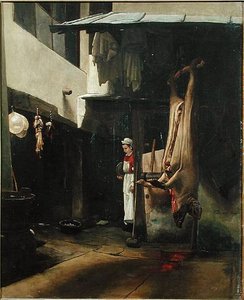
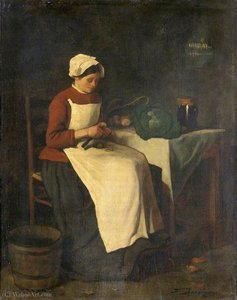
11Young Woman with a Mandolin, Portrait of Louison Köhler (1873) de François BonvinYoung Woman with a Mandolin, Portrait of Louison Köhler1873 · Cleveland Museum of Art 12The Scrubber (1887) de François BonvinThe Scrubber1887 · Musée des Beaux-Arts 13La Servante indiscrete (1871) de François BonvinLa Servante indiscrete1871 · Art Gallery of Hamilton 14Still Life with Oyster (1860) de François BonvinStill Life with Oyster1860 · Yale University Art Gallery 15Still Life with Asparagus (1867) de François BonvinStill Life with Asparagus1867 · Kröller-Müller Museum 16Attributes of Music (1863) de François BonvinAttributes of Music1863 · Cleveland Museum of Art 17Still Life (1858) de François BonvinStill Life1858 · Museum of Fine Arts 18Landscape with Barn (1869) de François BonvinLandscape with Barn1869 · Museum Gouda 19Still Life with Oysters (1865) de François BonvinStill Life with Oysters1865 · National Gallery of Ireland 20Still life with cherries. (1865) de François BonvinStill life with cherries.1865 · Museum of John Paul II Collection 21The Candlestick (Still Life with Candle) (1878) de François BonvinThe Candlestick (Still Life with Candle)1878 · Museum Gouda 22Still Life with Grapes (1877) de François BonvinStill Life with Grapes1877 · Museum Gouda 23Still Life with Clogs (1875) de François BonvinStill Life with Clogs1875 · Museum Gouda 24Port-Marly (1872) de François BonvinPort-Marly1872 · Musée d'Orsay 25The Trio (1880) de François BonvinThe Trio1880 · Centraal Museum 26Still Life with Vegetables (1880) de François BonvinStill Life with Vegetables1880 · Museum Gouda 27Still Life With Brass Kettle (1883) de François BonvinStill Life With Brass Kettle1883 · Museum Boijmans Van Beuningen 28Still life, two glazed earthenware pots. (1887) de François BonvinStill life, two glazed earthenware pots.1887 · Musée des Beaux-Arts de Rouen 29Femme lisant de François BonvinFemme lisantMusée Fabre 30'Miss' de François Bonvin'Miss'Burrell Collection 31The Butcher de François BonvinThe Butcher 32A woman ironing de François BonvinA woman ironingNational Museum Cardiff 33Two countrywomen de François BonvinTwo countrywomenBowes Museum 34The winder de François BonvinThe winder 35The Blacksmiths, Memory of Treport de François BonvinThe Blacksmiths, Memory of Treport 36Still life, François Bonvin, 1871 (1871) de François BonvinStill life, François Bonvin, 18711871 · Rijksmuseum 37Stilleven met vier vruchten, glas en aardewerk, François Bonvin, 1827 - 1887 (1887) de François BonvinStilleven met vier vruchten, glas en aardewerk, François Bonvin, 1827 - 18871887 · Rijksmuseum 38Still Life de François BonvinStill LifeMusée des Beaux-Arts 39Still life de François BonvinStill lifeYork Art Gallery 40Still Life with Jar of Cherries de François BonvinStill Life with Jar of Cherries 41Woman at a Spinet de François BonvinWoman at a SpinetBurrell Collection 42The crow de François BonvinThe crowBurrell Collection 43Interior of a Tavern de François BonvinInterior of a Tavern 44Grandmamma's breakfast de François BonvinGrandmamma's breakfastBowes Museum 45Still Life with a Copper Pot de François BonvinStill Life with a Copper PotBurrell Collection 46The violin de François BonvinThe violinBurrell Collection 47The meadow de François BonvinThe meadowNational Gallery 48The young housewife de François BonvinThe young housewifeNational Museum Cardiff 49The Letter of Recommendation de François BonvinThe Letter of Recommendation 50Housemaid At The Wasserholen de François BonvinHousemaid At The WasserholenMusée d'Orsay 51Oysters de François BonvinOystersBurrell Collection 52Interior de François BonvinInteriorFitzwilliam Museum 53Charity de François BonvinCharity 54Still Life with Game de François BonvinStill Life with GameBurrell Collection 55Still Life with Oysters, a Wine Bottle and a Glass of Wine de François BonvinStill Life with Oysters, a Wine Bottle and a Glass of WineBurrell Collection 56Peasant knitting de François BonvinPeasant knitting 57Still Life with Book, Papers and Inkwell de François BonvinStill Life with Book, Papers and InkwellNational Gallery 58Still Life with Apples and a Silver Goblet de François BonvinStill Life with Apples and a Silver GobletKelvingrove Art Gallery and Museum 59Interior with an Old Woman Kneeling de François BonvinInterior with an Old Woman Kneeling 60The Attributes of Painting de François BonvinThe Attributes of PaintingBarber Institute of Fine Arts 61Nature morte de François BonvinNature morteBerwick Museum and Art Gallery 62Still Life with a Tobacco Pot and a Pipe de François BonvinStill Life with a Tobacco Pot and a PipeBurrell Collection 63Still Life with a Jug, Cheese, Onions, Fish and a Knife de François BonvinStill Life with a Jug, Cheese, Onions, Fish and a KnifeBurrell Collection 64Still Life with a Glass, Pears and a Knife de François BonvinStill Life with a Glass, Pears and a KnifeBurrell Collection 65Still Life with Asparagus de François BonvinStill Life with AsparagusScottish National Gallery 66Still Life with a Book and an Ink Well de François BonvinStill Life with a Book and an Ink WellBurrell Collection 67Still Life with Vegetables and Cooking Utensils de François BonvinStill Life with Vegetables and Cooking UtensilsBurrell Collection 68Self portrait de François BonvinSelf portraitBowes Museum

Os temas que cativaram o olhar de François Bonvin

Os quatro temas que mais se repetem nestas obras originais, cada um com o seu melhor exemplo.

Os museus que guardam os originais de François Bonvin

Os 8 museus que detêm a maioria das pinturas desta página.

Museus Cidade Obras de François Bonvin Pinturas desta lista
Burrell Collection, GlasgowBurrell Collection Glasgow 13 'Miss', Woman at a Spinet, The crow
Museum Gouda, GoudaMuseum Gouda Gouda 6 The Embroideress (La Brodeuse), Landscape with Barn, The Candlestick (Still Life with Candle)
Musée d'Orsay, ParisMusée d'Orsay Paris 3 Ave Maria : interior of the Aramont convent, Port-Marly, Housemaid At The Wasserholen
Bowes Museum, Barnard CastleBowes Museum Barnard Castle 3 Two countrywomen, Grandmamma's breakfast, Self portrait
Centraal Museum, UtrechtCentraal Museum Utrecht 2 Woman Playing Games, The Trio
Walters Art Museum, BaltimoreWalters Art Museum Baltimore 2 Drawing Water, Interior of a Tavern
Musée des Beaux-Arts, ReimsMusée des Beaux-Arts Reims 2 Woman in White, The Scrubber
Cleveland Museum of Art, ClevelandCleveland Museum of Art Cleveland 2 Young Woman with a Mandolin, Portrait of Louison Köhler, Attributes of Music

François Bonvin ao longo das décadas: uma obra original única para cada uma

Obras por década

Escolha uma década para ver a obra original que a define.

Pinturas de François Bonvin: perguntas para a galeria

Qual é a obra mais famosa de François Bonvin?Revelar a resposta

Woman Ironing (1858), Philadelphia Museum of Art, Filadélfia. Sophie Unternährer at her easel (1848) e Woman Playing Games (1853) vêm a seguir.

Com que idade François Bonvin criou Woman Ironing?Revelar a resposta

41 anos: Woman Ironing data de 1858, e François Bonvin nasceu em 1817.

Quais são as dez pinturas mais famosas de François Bonvin?Revelar a resposta

Woman Ironing, Sophie Unternährer at her easel, Woman Playing Games, The Guitar Player, The Embroideress (La Brodeuse), Drawing Water, Ave Maria : interior of the Aramont convent, Woman in White, Portrait of a Seated Woman e Interior of a Tavern. O ranking acima apresenta o ano e o museu de cada uma.

Quantas obras de François Bonvin são conhecidas?Revelar a resposta

Nosso catálogo contém 70 obras de François Bonvin, datadas de 1848 a 1887.

Onde se pode ver os originais mais famosos de François Bonvin?Revelar a resposta

Principalmente em Burrell Collection (Glasgow), Museum Gouda (Gouda) e Musée d'Orsay (Paris). A tabela de museus acima lista todos eles.

Em que período François Bonvin criou as suas pinturas mais conhecidas?Revelar a resposta

Em 1870s: 9 das 68 obras nesta página foram feitas então, sendo Ave Maria : interior of the Aramont convent delas.

Qual pintura famosa de François Bonvin é a mais antiga e qual é a mais recente?Revelar a resposta

Nesta página, a mais antiga é Sophie Unternährer at her easel (1848) e a mais recente é The Scrubber (1887).

Quais temas François Bonvin preferia?Revelar a resposta

Woman (12), Life (12) e Table (5), entre as 68 obras nesta página.

Com quais materiais François Bonvin mais pintou?Revelar a resposta

Oil On Canvas, para 10 das 68 obras nesta página.

A qual movimento pertence a obra de François Bonvin?Revelar a resposta

Realism e Contemporary realism, a julgar pelos originais nesta página.

Quais originais de François Bonvin posso ver no Burrell Collection?Revelar a resposta

'Miss', Woman at a Spinet e The crow: o Burrell Collection, Glasgow detém 13 das obras desta página.

François Bonvin: um retrato do artista

O Observador Silencioso: A Vida e o Legado de François Bonvin

Na paisagem agitada e transformadora da Paris do século XIX, onde as sombras da Revolução Industrial começavam a se alongar sobre as ruas de paralelepípedos da cidade, existia um pintor que encontrava uma beleza profunda nos cantos mais despretensiosos da existência. François Bonvin (1817–1887) não era um cronista de grandes batalhas históricas ou epopeias mitológicas; em vez disso, era um mestre do íntimo, um realista cuja pincelada capturava a dignidade silenciosa do cotidiano. Sua vida, marcada por dificuldades precoces e um espírito resiliente, espelhava os próprios temas que pintava — despojada, honesta e profundamente humana.

Nascido em circunstâncias humildes, como filho de um policial e de uma costureira, a infância de Bonvin estava longe da versão romantizada da vida parisiense frequentemente retratada na literatura. A perda de sua mãe para a tuberculose quando ele tinha apenas quatro anos deixou-o vulnerável a um mundo de escassez e negligência. Criado em um lar lotado com numerosos irmãos e enfrentando as duras realidades de uma criação desnutrida, essas lutas iniciais instilaram nele uma profunda empatia pelos marginalizados. Foi essa sensibilidade que mais tarde definiria sua visão artística, permitindo-lhe enxergar o peso poético em um simples cesto de frutas ou no trabalho silencioso de uma trabalhadora doméstica.

Uma Jornada Através da Luz e da Sombra

O caminho de Bonvin para a arte foi tanto fruto de determinação quanto de talento. Embora sua educação formal tenha começado na École de dessin, apoiada pela generosidade de um amigo da família, grande parte de seu verdadeiro desenvolvimento ocorreu através da devoção solitária e do estudo autodidata. Seu tempo como aprendiz de um impressor proporcionou-lhe um olhar disciplinado para o detalhe, mas foram suas frequentes peregrinações ao Louvre que verdadeiramente esculpiram sua alma. Lá, entre as obras-primas do passado, ele encontrou seus ancestrais espirituais. Ele encantou-se profundamente pelos Velhos Mestres Holandeses, particularmente pelo chiaroscuro dramático de Rembrandt e pela pincelada vibrante de Frans Hals.

Essa fascinação pelas tradições do norte da Europa permitiu que Bonvin desenvolvesse uma técnica que era unicamente sua — uma mistura de precisão francesa e profundidade tonal holandesa. Ele dominou a arte de capturar a luz conforme ela incide sobre texturas variadas: o brilho frio de uma taça de metal, a suavidade de um morango maduro ou o peso orgânico e denso de uma concha de ostra. Sua obra frequentemente apresenta uma paleta terrosa e suave que evita o ostensivo das tendências contemporâneas, optando, em vez disso, por uma gradação matizada de tons que cria uma sensação de atmosfera palpável e quietude.

A Arte do Cotidiano

A significância da obra de Bonvin reside na sua capacidade de elevar o mundano ao monumental. Suas pinturas funcionam frequentemente como janelas para as esferas privadas e domésticas da França do século XIX. Seja retratando uma natureza-morta com quatro frutas ou a cena pungente de Uma Mulher a Passar, há um senso inconfundível de presença e respeito pelo tema. Ele não buscava embelezar a realidade, mas sim honrá-la.

Suas contribuições para o movimento Realista podem ser resumidas através de várias marcas artísticas fundamentais:

  • Domínio da Textura: Uma habilidade requintada de renderizar as qualidades táteis de alimentos, cerâmicas e tecidos.
  • Influência do Chiaroscuro: O uso de luz e sombra dramáticas para criar profundidade e ressonância emocional.
  • Realismo Empático: Um foco na dignidade da vida comum e na beleza encontrada na domesticidade, através de um Realismo profundo.
  • Nuance Tonal: Uma abordagem sofisticada da cor que favorece transições sutis e atmosféricas em vez de pigmentos berrantes.

Embora possa não ter alcançado a fama generalizada de seus contemporâneos como Courbet, François Bonvin permanece uma figura vital para aqueles que buscam a alma dentro do ordinário. Seu legado é encontrado em cada pincelada que celebra o silencioso, o negligenciado e os aspectos eternamente belos de nossa experiência humana compartilhada.