A Venetian Twilight: The Life and Art of Francesco Guardi
Francesco Lazzaro Guardi, born into a family deeply rooted in artistic tradition on October 5, 1712, stands as a poignant figure at the close of the illustrious Venetian School. His life mirrored the gradual decline of Venice itself—a city once a vibrant hub of commerce and culture, slowly yielding to political instability and economic hardship. Guardi wasn’t merely a painter; he was a chronicler of this twilight era, capturing its atmospheric beauty and underlying melancholy with a unique sensitivity that would later resonate profoundly with the Impressionists. The Guardi family workshop, established by his father Domenico, served as a bustling center of artistic production, where Francesco initially collaborated with his elder brother Gian Antonio on religious paintings. This early partnership provided a solid foundation in technique, but it was after Gian Antonio’s untimely death in 1760 that Francesco truly discovered his own voice, turning his attention to the *vedute*—the captivating cityscape views for which he would ultimately become celebrated.From Collaboration to Individual Vision
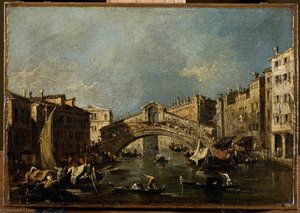
Initially, Guardi's work bore the unmistakable influence of Canaletto, the undisputed master of Venetian *vedute*. Both artists meticulously depicted the city’s canals, palaces, and bustling piazzas with remarkable detail. However, while Canaletto prioritized topographical accuracy—striving for a photographic representation of Venice—Guardi gradually shifted towards a more expressive and imaginative approach. He wasn't concerned with achieving perfect realism; instead, he sought to convey the *feeling* of Venice—its shimmering light, its atmospheric haze, and the sense of impermanence that permeated its beauty. This subtle yet significant departure is evident in his looser brushwork, characterized by spirited strokes and freely imagined architectural details. His skies became particularly noteworthy, often filled with dramatic cloud formations that hinted at impending change or a melancholic mood. This evolution away from strict representation wasn’t a rejection of Canaletto's skill but rather an organic development—a recognition that art could transcend mere imitation and capture the essence of a subject. The family legacy also played a crucial role; his sister, Maria Cecilia, married Giovanni Battista Tiepolo, one of the most celebrated artists of the era, fostering a rich exchange of ideas and artistic influences within their household.The Doge’s Feasts and *Pittura di Tocco*
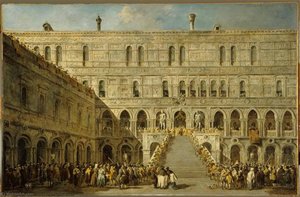
Guardi's most ambitious undertaking came in 1763 with his commission for *The Doge’s Feasts*, a series of twelve monumental canvases celebrating the elaborate ceremonies surrounding the election of Alvise IV Mocenigo. These paintings weren’t simply documentary records; they were grand theatrical spectacles, teeming with figures and vibrant details. They showcased Guardi’s mastery of composition and his ability to capture the energy and pageantry of Venetian civic life. During this period, his signature style—known as *pittura di tocco* (painting of touch)—fully blossomed. This technique involved applying paint in small, broken strokes, creating a shimmering surface that seemed to vibrate with light and movement. The effect wasn’t one of precise detail but rather an impressionistic rendering of form and atmosphere. This innovative approach set him apart from his contemporaries and foreshadowed the artistic revolutions that would unfold in France decades later. The sheer scale of *The Doge's Feasts* demanded a bold, dynamic style—a departure from the more controlled and polished techniques favored by some of his rivals.A Legacy of Atmosphere and Influence
Francesco Guardi passed away quietly in Cannaregio, Venice, on January 1, 1793, leaving behind a remarkable body of work that continues to captivate audiences today. His paintings weren’t merely depictions of a city; they were evocations of a mood—a poignant nostalgia for a bygone era and an awareness of the fragility of beauty. He differed significantly from Canaletto, who often presented Venice bathed in bright sunlight, Guardi frequently depicted the city shrouded in twilight or beneath clouded skies, emphasizing its melancholic charm. This atmospheric quality is what particularly resonated with the French Impressionists, such as Claude Monet and Edgar Degas, who recognized in his work a kindred spirit—an artist who prioritized feeling and sensation over strict representation. Guardi’s influence can be seen in their own explorations of light, color, and atmosphere. His subtle use of *sfumato* – the blurring of lines and edges to create an atmospheric effect – became a key element in the Impressionists' approach to capturing fleeting moments and subjective experiences.Rediscovering Guardi: A Lasting Impression
While not achieving the same level of widespread fame as Canaletto during his lifetime, Francesco Guardi’s reputation has steadily grown over the centuries. Today, he is recognized as a pivotal figure in Venetian art—a master who bridged the gap between the classical tradition and the burgeoning modern sensibility. His paintings are treasured for their unique blend of realism and imagination, their evocative atmosphere, and their poignant portrayal of a city on the cusp of change. Exploring his work offers not just a glimpse into 18th-century Venice but also an appreciation for the enduring power of art to capture the essence of a place and time—and to resonate with viewers across generations.- Key Dates: October 5, 1712: Birth; January 1, 1793: Death.
- Style: *Vedute*, *Pittura di tocco* (painting of touch).
- Influences: Canaletto, Venetian School traditions.
Perguntas e Respostas
Em qual período histórico Francesco Lazzaro Guardi trabalhou?
Francesco Lazzaro Guardi trabalhou no período Idade Moderna Inicial. O período situa a atividade do artista na história.
Existe uma linha do tempo das obras de Francesco Lazzaro Guardi?
As obras de Francesco Lazzaro Guardi podem ser visualizadas em ordem cronológica na página de Linha do tempo das obras do artista.
Qual é o local e o ano de nascimento de Francesco Lazzaro Guardi?
Francesco Lazzaro Guardi nasceu em Veneza, em 1712.