1

Atualizado em Novembro 2026 · classificado pela nossa pontuação de popularidade (pesquisas, visitas e pedidos de cada obra) · 13 obras de Frances Macdonald em nosso catálogo
Em resumo
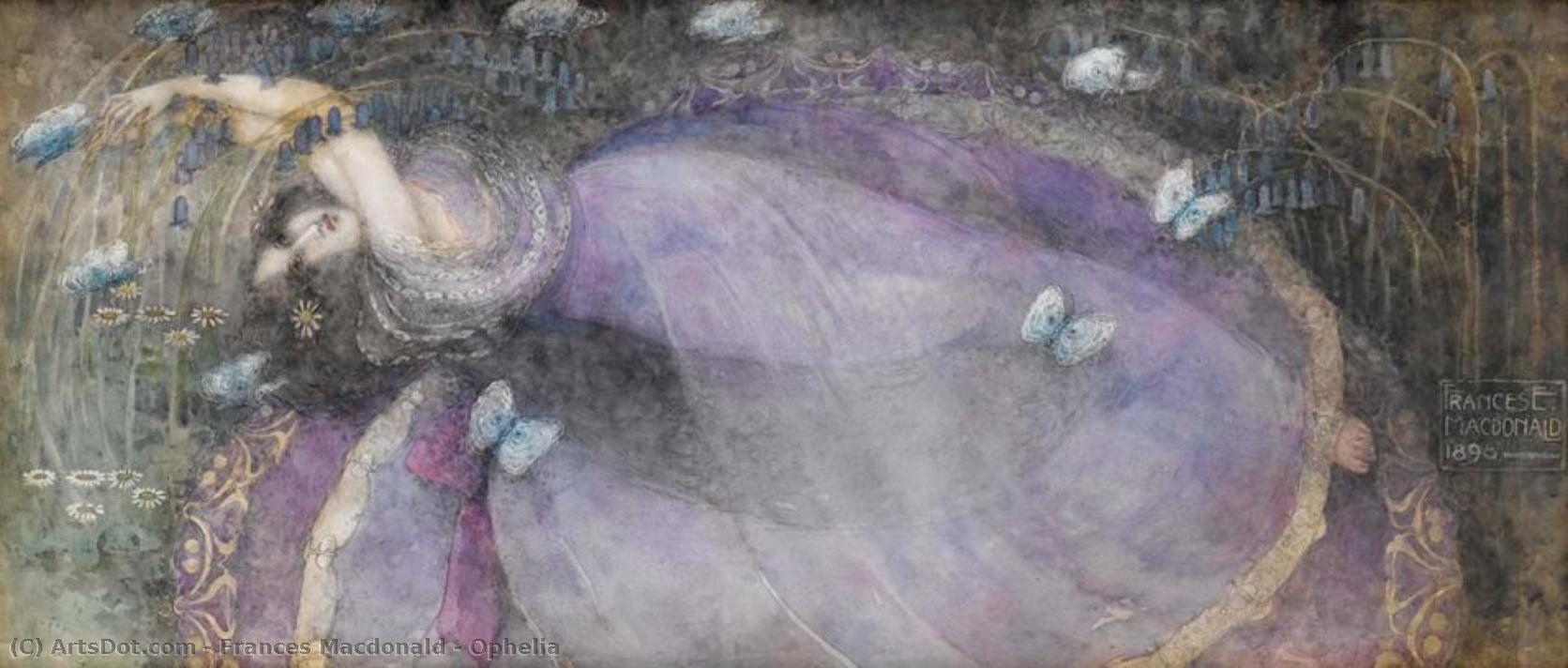
De todas as obras originais que Frances Macdonald deixou, a mais famosa é Ophelia (1898). Logo atrás vêm The Sleeping Princess (1896) e The Sleeping Princess (1910). Nosso catálogo contém 13 obras de Frances Macdonald; a galeria preservou as 13 que o mundo mais admira, cada uma exibida com sua data, seu museu e sua história.


O museu que detém a maioria das pinturas desta página.
| Museus | Cidade | Obras de Frances Macdonald | Pinturas desta lista |
|---|---|---|---|
 The Hunterian Museum and Art Gallery |
Glasgow | 1 | Spring |
Escolha uma década para ver a obra original que a define.
Ophelia (1898). The Sleeping Princess (1896) e The Sleeping Princess (1910) vêm a seguir.
25 anos: Ophelia data de 1898, e Frances Macdonald nasceu em 1873.
Ophelia, The Sleeping Princess, The Sleeping Princess, Sketch for 'London Docks', London Docks, Spring, Graveyard No.1 Metal and Produce Recovery Depot, Morris Works, Cowley, Oxford, In the Millbank Hospital during an Air Raid Patients Being Taken to the Shelter, The X Ray Department at the Queen Alexandra Military Hospital e Building the Mulberry Harbour, London Docks. O ranking acima apresenta o ano e o museu de cada uma.
Nosso catálogo contém 13 obras de Frances Macdonald, datadas de 1896 a 1910.
Principalmente em The Hunterian Museum and Art Gallery (Glasgow). A tabela de museus acima lista todos eles.
Em 1890s: 2 das 13 obras nesta página foram feitas então, sendo Ophelia delas.
Nesta página, a mais antiga é The Sleeping Princess (1896) e a mais recente é The Sleeping Princess (1910).
Art nouveau, a julgar pelos originais nesta página.
The story of Frances Macdonald is one of profound creative synergy and the ethereal beauty of the Glasgow Style. Born in 1873 in the industrial landscape of Wolverhampton, England, her life took a transformative turn when she moved to Glasgow in 1890. It was within the hallowed halls of the Glasgow School of Art that her destiny intertwined with a group of artists who would redefine British Art Nouveau. Alongside her sister, Margaret Macdonald Mackintosh, and the architects Charles Rennie Mackintosh and Herbert Macnair, Frances became a vital pillar of "The Four." This legendary quartet shared a singular aesthetic vision, blending the organic fluidity of nature with a haunting, symbolic mysticism that would leave an indelible mark on the dawn of Modernism.
Her artistic development was never a solitary pursuit but rather a beautiful, collaborative dance. In the mid-1990s, the Macdonald sisters established their own independent studio, a sanctuary where they could experiment with diverse media. Frances’s hand was visible across a breathtaking spectrum of crafts, from delicate textile designs and intricate embroidery to evocative metalwork panels. Her work often breathed with the spirit of Celtic imagery and folklore, utilizing elongated, stylized forms that seemed to float between reality and dreamscape. This period of intense creativity saw her influence spread far beyond Scotland, as her collaborative efforts reached prestigious exhibitions in London, Liverpool, Venice, and even Vienna.
Beyond the structural elegance of design, Frances Macdonald possessed a rare ability to capture the ephemeral essence of emotion through painting. Her watercolor works, such as the poignant “Ophelia” and “The Sleeping Princess,” serve as windows into a soul deeply moved by the symbolic movements of her era. Drawing inspiration from the visionary intensity of William Blake and the decadent, fine-lined precision of Aubrey Beardsley, she mastered the art of atmosphere. Her paintings were not merely depictions of subjects but explorations of mood, where soft washes of color and delicate linework evoked a sense of spiritual resonance and quiet melancholy.
The significance of her contribution lies in how she bridged the gap between fine art and decorative craft. In the eyes of Frances, there was no hierarchy between a beautifully rendered watercolor and a meticulously designed book illustration or metalwork piece; both were vessels for the same symbolic truth. This holistic approach to design—where every element of an interior or an object could be infused with meaning—became the hallmark of the Glasgow Style. Even as her personal circumstances shifted following her marriage to Herbert Macnair and their move to Liverpool, her commitment to this integrated aesthetic remained a testament to her artistic integrity.
Though the later years of her life were marked by the decline of the great Glasgow studios and personal hardships, the historical significance of Frances Macdonald remains undiminished. She was a pioneer for women in the arts, proving that female artists could be architects of a new visual language rather than mere observers of it. Her work helped to establish a uniquely Scottish contribution to the international Art Nouveau movement, characterized by a restraint and spiritual depth that set it apart from its more flamboyant continental counterparts.
Today, when we look upon the flowing lines and mystical motifs of the Glasgow Style, we see the enduring spirit of Frances Macdonald. Her legacy is found in: