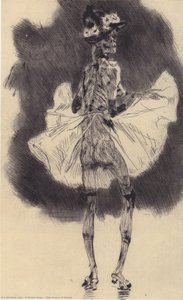
Retrato de Félicien Rops

As 46 Pinturas Mais Famosas de Félicien Rops, uma Seleção da Galeria

Atualizado em Novembro 2026 · classificado pela nossa pontuação de popularidade (pesquisas, visitas e pedidos de cada obra) · 46 obras de Félicien Rops em nosso catálogo

Em resumo

De todas as obras originais deixadas por Félicien Rops, a mais famosa é The Entrance to the Ball (1858), da coleção do musée provincial Félicien Rops, em Namur. Logo atrás vêm Satanic Self-Portrait (1860) e Head of an Old Antwerp Woman (1873). Nosso catálogo contém 46 obras de Félicien Rops; a galeria preservou as 46 que o mundo mais admira, cada uma exibida com sua data, seu museu e sua história.

1833 – 1898, Namur Symbolism Mais obras: musée provincial Félicien Rops

As 10 principais pinturas de Félicien Rops: a escolha da galeria

1
The Entrance to the Ball (1858) de Félicien Rops

The Entrance to the Ball

1858 · Oil · musée provincial Félicien Rops, Namur

In "The Entrance to the Ball" by Félicien Rops, the composition is vertically oriented, drawing the eye upward through a narrow, compressed space. The perspective is set at eye level, adopting a side view that places us directly alongside the central figure. This man, perhaps a guest or a servant, is positioned in the foreground near a doorway. The entrance itself is marked by text, providing a specific point of…

2
Satanic Self-Portrait (1860) de Félicien Rops

Satanic Self-Portrait

1860 · Charcoal

Created about 1860, Satanic Self-Portrait by Félicien Rops presents a monochromatic study of the artist himself. The work captures a somber and introspective image of Félicien Rops, rendered in a limited palette of grayscale tones and subtle browns. He is depicted from the waist up, his head slightly bowed in a gesture of melancholy or deep thought. A large, draped garment covers his shoulders, adding a sense of weight to…

3
Head of an Old Antwerp Woman (1873) de Félicien Rops

Head of an Old Antwerp Woman

1873 · Oil On Canvas · musée provincial Félicien Rops, Namur

In the work Head of an Old Antwerp Woman by Félicien Rops, the composition is a medium close-up that focuses on the subject's head and upper torso. The subject is an aged woman positioned slightly off-center within the frame. She is depicted from a direct, eye-level view, creating an intimate proximity between the viewer and the subject. The background remains dark and indistinct, providing no specific details of a domestic…

4
The Lady with the Puppet and the Fan (1873) de Félicien Rops

The Lady with the Puppet and the Fan

1873 · Pastel · musée provincial Félicien Rops, Namur

In "The Lady with the Puppet and the Fan" by Félicien Rops, a vertical portrait captures a woman in profile. She occupies the left and center of the frame, her gaze fixed upon a small, colorful jester-like puppet held in her hand. The scene is set against a background of ochre, gold, and yellow. This warm backdrop provides a sharp contrast to the cool blues and teals of her attire.…

5
In the Wings (1878) de Félicien Rops

In the Wings

1878 · Oil

In the Wings by Félicien Rops presents a vertical, figurative scene executed in a Symbolist style. Created about 1878, the work captures a backstage or theatrical setting defined by a palpable sense of tension and voyeurism. The composition centers on two primary figures positioned within a dark, draped environment.

7
The Lady with the Puppet (1884) de Félicien Rops

The Lady with the Puppet

1884 · Mixed Media

The Lady with the Puppet emerges from the creative mind of Félicien Rops, a Belgian artist who navigates the shadowy realms of Symbolism and Decadence. This specific piece exists as part of a small series of variations on a theme, where the artist explores recurring motifs through a lens of psychological depth. Within this collection, the work captures a singular, suspended moment of interaction between a woman and a miniature…

8
Eggnog (1879) de Félicien Rops

Eggnog

1879 · Pastel · musée provincial Félicien Rops, Namur

Eggnog by Félicien Rops is a small-scale, intimate figurative work created in 1879. The scene captures a private, domestic moment between two figures within an interior setting. A woman stands as a central vertical axis, dressed in light, possibly intimate, undergarments. She holds a small dish or cup, positioned as if in the act of serving. Opposite her, a man is seated in the foreground, providing a diagonal counterweight to…

9
The Farewells of Madness - Better to Bear Laughter Than Tears (1879) de Félicien Rops

The Farewells of Madness - Better to Bear Laughter Than Tears

1879 · Lithograph · musée provincial Félicien Rops, Namur

We are looking at The Farewells of Madness - Better to Bear Laughter Than Tears, a work produced by Félicien Rops around 1879. This piece emerged from the creative period of an artist who was born in 1833 in Namur, Belgium. Rops spent much of his life navigating the shifting intellectual currents of the late nineteenth century until his death in 1898.

10
Cherubim's Song (1879) de Félicien Rops

Cherubim's Song

1879 · Watercolor · musée provincial Félicien Rops, Namur

Cherubim's Song is a work by the Belgian artist Félicien Rops. Created about 1879, this piece belongs to a period in the artist's career where his output was closely associated with the Symbolism and Decadence movements. Rops was born in 1833 in Namur, Belgium, a location that remains central to his biographical history.

A seleção de Félicien Rops continua, de 11 a 46

Os temas que cativaram o olhar de Félicien Rops

Os quatro temas que mais se repetem nestas obras originais, cada um com o seu melhor exemplo.

Os museus que guardam os originais de Félicien Rops

Os 5 museus que detêm a maioria das pinturas desta página.

Museus Cidade Obras de Félicien Rops Pinturas desta lista
musée provincial Félicien Rops, Namurmusée provincial Félicien Rops Namur 11 The Entrance to the Ball, Head of an Old Antwerp Woman, The Lady with the Puppet and the Fan
Royal Museum of Fine Arts Antwerp, AntuérpiaRoyal Museum of Fine Arts Antwerp Antuérpia 5 Landscape in the Ardennes, Beach, Bridge over the River Lesse
Kröller-Müller Museum, OtterloKröller-Müller Museum Otterlo 1 Death at the Ball
Museum of Fine Arts Ghent (MSK), GanteMuseum of Fine Arts Ghent (MSK) Gante 1 Landscape in Sweden
Hammer Museum, Los AngelesHammer Museum Los Angeles 1 Cupid with a Tambourine

Félicien Rops década a década: a obra original que define cada uma

Obras por década

Escolha uma década para ver a obra original que a define.

Perguntas de colecionadores sobre as pinturas de Félicien Rops

Por qual obra Félicien Rops é mais conhecido(a)?Revelar a resposta

The Entrance to the Ball (1858), musée provincial Félicien Rops, Namur. Satanic Self-Portrait (1860) e Head of an Old Antwerp Woman (1873) vêm a seguir.

Qual era a idade de Félicien Rops quando The Entrance to the Ball foi feita?Revelar a resposta

25 anos: The Entrance to the Ball data de 1858, e Félicien Rops nasceu em 1833.

Quais são as dez pinturas mais famosas de Félicien Rops?Revelar a resposta

The Entrance to the Ball, Satanic Self-Portrait, Head of an Old Antwerp Woman, The Lady with the Puppet and the Fan, In the Wings, The incantation, The Lady with the Puppet, Eggnog, The Farewells of Madness - Better to Bear Laughter Than Tears e Cherubim's Song. O ranking acima apresenta o ano e o museu de cada uma.

Quantas pinturas Félicien Rops deixou?Revelar a resposta

Nosso catálogo contém 46 obras de Félicien Rops, datadas de 1858 a 1898.

Em quais museus estão expostas as obras-primas de Félicien Rops?Revelar a resposta

Principalmente em musée provincial Félicien Rops (Namur), Royal Museum of Fine Arts Antwerp (Antuérpia) e Kröller-Müller Museum (Otterlo). A tabela de museus acima lista todos eles.

Em que anos Félicien Rops pintou as suas obras mais famosas?Revelar a resposta

Em 1880s: 10 das 46 obras nesta página foram feitas então, sendo The Lady with the Puppet delas.

Quais são as primeiras e as últimas obras originais famosas de Félicien Rops?Revelar a resposta

Nesta página, a mais antiga é The Entrance to the Ball (1858) e a mais recente é Snow at Thozée (1898).

Quais temas Félicien Rops escolheu com mais frequência?Revelar a resposta

Woman (10), Man (7) e Portrait (3), entre as 46 obras nesta página.

Qual técnica Félicien Rops mais utilizou?Revelar a resposta

Pastel, para 3 das 46 obras nesta página.

A qual movimento artístico pertence Félicien Rops?Revelar a resposta

Symbolism, a julgar pelos originais nesta página.

Quais obras de Félicien Rops estão expostas no musée provincial Félicien Rops?Revelar a resposta

The Entrance to the Ball, Head of an Old Antwerp Woman e The Lady with the Puppet and the Fan: o musée provincial Félicien Rops, Namur detém 11 das obras desta página.

Félicien Rops: vida e obra

A Shadowy Visionary: The Life and Art of Félicien Rops

Félicien Victor Joseph Rops, born in Namur, Belgium (1833), stands as a singular figure bridging the stylistic currents of Realism, Symbolism, and the burgeoning world of modern graphic storytelling. His life unfolded against a backdrop of considerable social transformation – his father’s textile enterprise representing bourgeois stability – yet was perpetually driven by an artistic impulse that defied convention. Early training at local academies provided foundational skills, but it was his relocation to Brussels at twenty that truly catalyzed his creative trajectory. Despite brief enrollment at the Université Libre de Bruxelles, Rops found himself drawn inexorably towards the Académie de Saint-Luc, where he honed not only painting and drawing prowess but also satirical technique through lithography. These formative years weren’t merely about mastering craft; they were about discovering a voice—a voice that would soon become synonymous with challenging societal norms and delving into the darker recesses of human psychology.

Early Artistic Development and Influences

Rops's artistic journey commenced in Namur, where he received an education rooted in both visual arts and literature. His father’s successful textile business afforded him a comfortable upbringing, fostering intellectual curiosity alongside practical skills. Recognizing his talent early on, Rops pursued studies at the Université Libre de Bruxelles, immersing himself in philosophical discourse and preparing for legal pursuits—a pursuit that would ultimately prove less compelling than artistic vocation. Crucially, he enrolled at the Académie de Saint-Luc, where he honed his technical abilities while simultaneously absorbing the stylistic innovations of Symbolism. This exposure to influential artists like Gustave Moreau profoundly shaped his aesthetic sensibilities, informing his approach to composition, color palettes, and thematic exploration. The Académie’s emphasis on psychological realism—a hallmark of Symbolist art—became a cornerstone of Rops's artistic worldview.

Parisian Encounters and the Embrace of Symbolism

The year 1862 marked a decisive turning point as Rops migrated to Paris, a city pulsating with artistic ferment and intellectual dynamism. It was here that he encountered Félix Bracquemond and Jules Ferdinand Jacquemart—etchers who championed intaglio techniques—establishing invaluable connections within the Parisian printmaking milieu. Recognizing the transformative potential of these methods, Rops largely abandoned lithography around 1865, dedicating himself to mastering etching and aquatint with meticulous precision. However, his most significant encounter transpired in 1864: a meeting with Charles Baudelaire—the poet whose exploration of beauty intertwined with decay resonated deeply within Rops’s artistic soul. Baudelaire's preoccupation with the sublime—the paradoxical experience of confronting both terror and wonder—became an intellectual lodestar, influencing Rops’s thematic concerns and stylistic choices. This collaboration culminated in Rops creating the frontispiece for Baudelaire’s *Les Fleurs du Mal*, a bold assertion of artistic freedom against censorship—a testament to his unwavering commitment to challenging conventions.

A Master of Printmaking: Technique and Vision

Rops's artistic style is instantly recognizable for its intricate detail, dramatic chiaroscuro – the interplay of light and shadow – and an atmosphere imbued with haunting psychological depth. He wasn’t merely depicting scenes; he was conveying emotional states—often veiled in ambiguity—through masterful manipulation of printmaking techniques. His preference for soft-ground etching—a method rarely utilized by his contemporaries—allowed him to achieve unparalleled textural richness and tonal nuance, capturing the subtle nuances of human emotion with remarkable sensitivity. Works like “Pornokratès” (1878), a powerfully unsettling depiction of female power and transgression, exemplify his fascination with confronting taboo subjects—a characteristic that distinguishes him from many artists of his time. Beyond these iconic images, Rops demonstrated versatility across genres, producing text comics and sequential drawings for Belgian student magazines – establishing himself as a pioneer of the comic strip form. His illustrations for Jules Barbey d’Aurevilly's *Les Diaboliques* showcase his ability to capture both exquisite beauty and underlying decadence—reflecting the anxieties prevalent in the fin de siècle.

Legacy and Influence Beyond Art

Rops’s artistic legacy extends beyond the realm of visual art, encompassing intellectual engagement and social critique. His membership in Les XX (“the twenty”), formed in Brussels in 1884—a collective dedicated to exploring avant-garde aesthetics—underscored his commitment to pushing creative boundaries and challenging established norms. He was recognized as a Freemason, reflecting an intellectual curiosity that transcended artistic pursuits—demonstrating a broader engagement with philosophical ideas and social reform. Rops’s enduring influence can be discerned in the works of subsequent artists—particularly Edvard Munch and Max Klinger—who embraced his stylistic innovations and explored similar thematic concerns. His unflinching portrayal of human psychology, combined with his masterful command of printmaking techniques, cemented his place as a pivotal figure in Symbolist art—a visionary who continues to inspire contemplation and provoke debate over a century after his death. He remains a testament to the transformative power of artistic expression and its capacity to illuminate the complexities of the human experience.