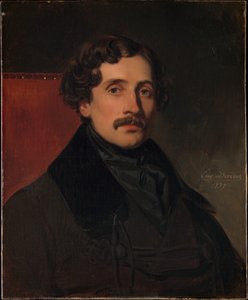
Retrato de Eugène Devéria

As 33 Pinturas Mais Famosas de Eugène Devéria, Cada Uma Única

Atualizado em Novembro 2026 · classificado pela nossa pontuação de popularidade (pesquisas, visitas e pedidos de cada obra) · 33 obras de Eugène Devéria em nosso catálogo

Em resumo

Portrait of Monsieur Couche (1824) é a pintura de Eugène Devéria que mais atrai olhares; a obra original pertence ao Detroit Institute of Arts, Detroit. Depois disso, o olhar recai sobre Young Women Sitting (1827) e The Assassination (1828). Entre as 33 obras de Eugène Devéria em nosso catálogo, estas 33 são as mais famosas, cada uma uma original única apresentada com o seu ano, o seu museu e a razão pela qual perdura.

1805 – 1865, Paris Mais obras: Musée des Beaux-Arts de Pau

As 10 principais pinturas de Eugène Devéria, sob o olhar da galeria

2
Young Women Sitting (1827) de Eugène Devéria

Young Women Sitting

1827 · Oil On Canvas

In the oil painting Young Women Sitting by Eugène Devéria, the composition is centered on a woman seated upon a large, gilded yellow chaise longue. To the left, a second woman reclines, her form partially obscured by heavy red drapery. The scene is set within an opulent interior where the color palette is dominated by deep reds, golds, and creams. This arrangement creates a shallow perspective that directs the viewer's…

3
The Assassination (1828) de Eugène Devéria

The Assassination

1828 · Oil On Canvas · Reading Public Museum, Reading

We find ourselves before The Assassination, a significant work by the French painter Eugène Devéria. This piece was executed about 1828, a period when the artist was beginning to establish his presence within the Parisian art scene. Devéria, who was born in Paris, France, in 1805, brought a specific sense of historical gravity to his compositions, a quality that is palpable in this particular canvas.

4
Portrait of General Joseph-Léopold Sigisbert Hugo (1835) de Eugène Devéria

Portrait of General Joseph-Léopold Sigisbert Hugo

1835 · Oil On Canvas · Musée Victor Hugo, Paris

The subject is captured in a moment of quiet authority, positioned centrally against a somber, atmospheric landscape. He wears a dark blue military tunic, heavily detailed with gold braided aiguillettes, epaulettes, and medals that catch a sharp, directional light. This illumination, striking from the upper left, defines the contours of his face and the metallic textures of his uniform while casting the background into deep shadow. A sense of monumental…

5
Puget Presenting His Statue of Milon de Crotone to Louis XIV, in the Gardens of Versailles (1832) de Eugène Devéria

Puget Presenting His Statue of Milon de Crotone to Louis XIV, in the Gardens of Versailles

1832 · Oil On Canvas

In this 1832 oil on canvas, we find ourselves within the formal, structured elegance of the Gardens of Versailles. The scene captures a specific historical intersection: the presentation of a sculpture by Puget to the French monarchy. At the heart of the composition, a large, muscular statue of Milon de Crotone commands the viewer's attention. The figure is rendered with a sense of physical weight, its pale, marble-like surface contrasting…

6
Puget Presenting His Statue of Milo of Croton to Louis XIV, in the Gardens of Versailles (1832) de Eugène Devéria

Puget Presenting His Statue of Milo of Croton to Louis XIV, in the Gardens of Versailles

1832 · Oil On Canvas

The scene unfolds in the grand, manicured expanse of the Gardens of Versailles, where the air feels heavy with the weight of ceremony. Here, the artist Eugène Devéria captures a moment of profound historical significance. In this work, titled Puget Presenting His Statue of Milo of Croton to Louis XIV, in the Gardens of Versailles, the viewer finds themselves amidst a gathering of the French elite. The composition centers on…

7
Portrait of the Artist and His Brother Achille (1836) de Eugène Devéria

Portrait of the Artist and His Brother Achille

1836 · Terracotta · Opera de Versalhes, Versalhes

The gaze settles upon Portrait of the Artist and His Brother Achille, a work that brings together two figures bound by blood and art. This piece is the creation of Eugène Devéria, a man whose life began in Paris, France, in 1805. He carries the weight of a long creative life until his passing in 1865. Within this frame, the artist captures a personal connection, presenting himself alongside his brother,…

8
Breton Family Praying Before a Country Oratory (1838) de Eugène Devéria

Breton Family Praying Before a Country Oratory

1838 · Oil · Musée des Beaux-Arts de Quimper, Quimper

In Breton Family Praying Before a Country Oratory, Eugène Devéria arranges a quiet, intimate scene of religious devotion. The composition is centered on a group of five figures—two men, one woman, and two children—who are gathered in a moment of shared prayer. They are positioned in a triangular formation, a structural choice that provides a sense of stability and familial unity. This geometric arrangement naturally directs the viewer's eye toward…

9
Sketch for the church Notre-Dame-de-Lorette: Apotheosis of Saint Genevieve (1835) de Eugène Devéria

Sketch for the church Notre-Dame-de-Lorette: Apotheosis of Saint Genevieve

1835 · Oil On Canvas · Petit Palais, Paris

The artwork titled Sketch for the church Notre-Dame-de-Lorette: Apotheosis of Saint Genevieve is a religious study by the French painter Eugène Devéria. Created about 1835, this oil on canvas work functions as a preliminary sketch for a larger painting intended for the church Notre-Dame-de-Lorette. The composition focuses on the subject matter of the Apotheosis of Saint Genevieve, depicting the saint's transition toward a celestial state.

10
Apotheosis of Saint Genevieve, sketch for the painting of the church Notre-Dame-de-Lorette (1835) de Eugène Devéria

Apotheosis of Saint Genevieve, sketch for the painting of the church Notre-Dame-de-Lorette

1835 · Drawing · Musée Carnavalet, Paris

This vertical sketch, dated 1835, captures a moment of religious exaltation centered on the figure of Saint Genevieve. The composition is organized around a strong upward movement, drawing the eye from the lower grouping of figures toward a concentrated burst of white and yellow light at the top of the frame. Saint Genevieve is positioned in the midground, her arms reaching toward the celestial light, her white garments providing a…

Pinturas famosas de Eugène Devéria, números 11 a 33

Pinturas famosas de Eugène Devéria, período por período

Os temas que cativaram o olhar de Eugène Devéria

Os quatro temas que mais se repetem nestas obras originais, cada um com o seu melhor exemplo.

Os museus que guardam os originais de Eugène Devéria

Os 8 museus que detêm a maioria das pinturas desta página.

Museus Cidade Obras de Eugène Devéria Pinturas desta lista
Musée des Beaux-Arts de Pau, PauMusée des Beaux-Arts de Pau Pau 3 Portrait of Octavie Courcier, née Devéria (1804-1887), Portrait of Philippe-Adolphe Courcier, husband of Octavie Devéria, Christopher Columbus at the Court of Ferdinand and Isabella
Detroit Institute of Arts, DetroitDetroit Institute of Arts Detroit 1 Portrait of Monsieur Couche
Reading Public Museum, ReadingReading Public Museum Reading 1 The Assassination
Musée Victor Hugo, ParisMusée Victor Hugo Paris 1 Portrait of General Joseph-Léopold Sigisbert Hugo
Opera de Versalhes, VersalhesOpera de Versalhes Versalhes 1 Portrait of the Artist and His Brother Achille
Musée des Beaux-Arts de Quimper, QuimperMusée des Beaux-Arts de Quimper Quimper 1 Breton Family Praying Before a Country Oratory
Petit Palais, ParisPetit Palais Paris 1 Sketch for the church Notre-Dame-de-Lorette: Apotheosis of Saint Genevieve
Musée Carnavalet, ParisMusée Carnavalet Paris 1 Apotheosis of Saint Genevieve, sketch for the painting of the church Notre-Dame-de-Lorette

Eugène Devéria ao longo das décadas: uma obra original única para cada uma

Obras por década

Escolha uma década para ver a obra original que a define.

Pinturas de Eugène Devéria: perguntas para a galeria

Qual é a obra mais famosa de Eugène Devéria?Revelar a resposta

Portrait of Monsieur Couche (1824), Detroit Institute of Arts, Detroit. Young Women Sitting (1827) e The Assassination (1828) vêm a seguir.

Com que idade Eugène Devéria criou Portrait of Monsieur Couche?Revelar a resposta

19 anos: Portrait of Monsieur Couche data de 1824, e Eugène Devéria nasceu em 1805.

Quais são as dez pinturas mais famosas de Eugène Devéria?Revelar a resposta

Portrait of Monsieur Couche, Young Women Sitting, The Assassination, Portrait of General Joseph-Léopold Sigisbert Hugo, Puget Presenting His Statue of Milon de Crotone to Louis XIV, in the Gardens of Versailles, Puget Presenting His Statue of Milo of Croton to Louis XIV, in the Gardens of Versailles, Portrait of the Artist and His Brother Achille, Breton Family Praying Before a Country Oratory, Sketch for the church Notre-Dame-de-Lorette: Apotheosis of Saint Genevieve e Apotheosis of Saint Genevieve, sketch for the painting of the church Notre-Dame-de-Lorette. O ranking acima apresenta o ano e o museu de cada uma.

Quantas obras de Eugène Devéria são conhecidas?Revelar a resposta

Nosso catálogo contém 33 obras de Eugène Devéria, datadas de 1824 a 1864.

Onde se pode ver os originais mais famosos de Eugène Devéria?Revelar a resposta

Principalmente em Musée des Beaux-Arts de Pau (Pau), Detroit Institute of Arts (Detroit) e Reading Public Museum (Reading). A tabela de museus acima lista todos eles.

Em que período Eugène Devéria criou as suas pinturas mais conhecidas?Revelar a resposta

Em 1830s: 10 das 33 obras nesta página foram feitas então, sendo Portrait of General Joseph-Léopold Sigisbert Hugo delas.

Qual pintura famosa de Eugène Devéria é a mais antiga e qual é a mais recente?Revelar a resposta

Nesta página, a mais antiga é Portrait of Monsieur Couche (1824) e a mais recente é Charles-Théodule Devéria (1831-1871) (1864).

Quais temas Eugène Devéria preferia?Revelar a resposta

Man (11), Woman (9) e People (6), entre as 33 obras nesta página.

Com quais materiais Eugène Devéria mais pintou?Revelar a resposta

Oil On Canvas, para 10 das 33 obras nesta página.

Quais originais de Eugène Devéria posso ver no Musée des Beaux-Arts de Pau?Revelar a resposta

Portrait of Octavie Courcier, née Devéria (1804-1887), Portrait of Philippe-Adolphe Courcier, husband of Octavie Devéria e Christopher Columbus at the Court of Ferdinand and Isabella: o Musée des Beaux-Arts de Pau, Pau detém 3 das obras desta página.

Eugène Devéria: um retrato do artista

Eugène Devéria: Entre a História e a Observação

Eugène François Marie Joseph Devéria (1805 – 1865) foi um pintor francês cujo estilo distintivo combinava um realismo meticuloso com um manuseio expressivo da cor, estabelecendo-o como um dos principais cronistas de sua era. Nascido em Paris, em uma família imersa na tradição artística — seu pai era escultor — a infância de Eugène Devéria prefigurou sua futura vocação, mergulhando-o na vibrante paisagem cultural da França da Restauração. Embora os detalhes biográficos permaneçam algo escassos, pesquisas acadêmicas sugerem que ele aperfeiçoou suas habilidades sob a tutela de Jean-Baptiste Camille Corot e Alexandre Cabanel, absorvendo o espírito impressionista ao lado do rigor acadêmico da École Supérieure des Beaux-Arts.

Os anos formativos de Devéria coincidiram com um período de renascimento artístico após o reinado de Napoleão. O movimento Romântico impactou profundamente sua sensibilidade, fomentando um apreço por paisagens dramáticas e narrativas emocionalmente carregadas. No entanto, ele equilibrou habilmente essas influências com a observação meticulosa defendida por Corot e Cabanel — artistas que priorizavam a captura da luz natural e da textura com uma precisão inigualável.

A obra de Devéria é notavelmente diversa, abrangendo tanto pinturas históricas monumentais quanto retratos íntimos. Ele alcançou renome considerável por suas representações de clãs escoceses, meticulosamente renderizadas em óleos que transmitem não apenas a semelhança física, mas também uma profundidade psicológica — um testemunho de sua habilidade em destilar emoções complexas na tela.

Obras Notáveis e Estilo Artístico

O estilo artístico de Devéria é caracterizado por uma mistura notável de realismo e sutileza tonal. Ele evitou as pinceladas extravagantes favorecidas por alguns contemporâneos, optando, em vez disso, por superfícies suaves e mescladas que alcançavam um grau de luminosidade surpreendente. Esta técnica — particularmente evidente em suas célebres telas que retratam a chegada de Cristóvão Colombo à América e em O Pombo-Torcaz — permitia-lhe transmitir condições atmosféricas com uma precisão de tirar o fôlego. Além disso, a paleta de Devéria era contida, porém expressiva, utilizando tons suaves para criar uma sensação de humor e atmosfera que ressoava profundamente com os espectadores.

Suas narrativas históricas, como em obras monumentais como “A Recepção de Cristóvão Colombo”, exemplificam seu compromisso em retratar eventos históricos com detalhes implacáveis. As composições de Devéria são cuidadosamente construídas, guiando o olhar através de paisagens expansivas e capturando expressões fugazes de emoção humana — refletindo uma sensibilidade humanista que o distinguia de muitos artistas de sua época. Da mesma forma, seus retratos eram dignos de nota por sua percepção psicológica; ele capturava habilmente a essência da personalidade de seus modelos, transmitindo não apenas a aparência física, mas também o caráter interior através de gestos sutis e expressões faciais.

Legado e Significância Histórica

A contribuição de Eugène Devéria para a história da arte francesa estende-se para além de suas obras-primas individuais. Ele ajudou a consolidar a reputação de excelência da École Supérieure des Beaux-Arts, nutrindo uma geração de artistas que abraçaram tanto a tradição acadêmica quanto a inovação impressionista. Suas pinturas continuam a inspirar admiração por sua virtuosidade técnica e ressonância emocional — servindo como lembretes duradouros de um momento crucial na cultura artística europeia. A observação meticulosa e o domínio tonal de Devéria consolidaram seu lugar entre os pintores mais influentes de meados do século XIX, garantindo que sua obra fosse estudada e apreciada por décadas.