Retrato de Emil Carlsen

As 94 Pinturas Mais Famosas de Emil Carlsen, uma Seleção da Galeria

Atualizado em Novembro 2026 · classificado pela nossa pontuação de popularidade (pesquisas, visitas e pedidos de cada obra) · 95 obras de Emil Carlsen em nosso catálogo

Em resumo

De todas as obras originais que Emil Carlsen deixou, a mais famosa é Ruby Reflection (1895). Logo atrás vêm The Picture from Thibet (1920) e Leeds Jug (1920). Nosso catálogo contém 95 obras de Emil Carlsen; a galeria preservou as 94 que o mundo mais admira, cada uma exibida com sua data, seu museu e sua história.

1848 – 1932, Copenhaga Impressionism Mais obras: Museum of Fine Arts

As 10 principais pinturas de Emil Carlsen: a escolha da galeria

1
Ruby Reflection (1895) de Emil Carlsen

Ruby Reflection

1895 · Oil On Canvas

In 1895, Emil Carlsen captured a quiet moment in Ruby Reflection. This oil on canvas work emerges from the hand of an American Impressionist painter. The surface holds the weight of pigment and intent, a stillness caught in the grain of the fabric. It is a study of light and form, anchored by the artist's presence in the corner of the frame.

3
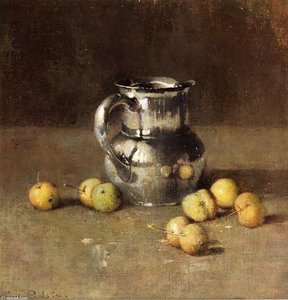
Leeds Jug (1920) de Emil Carlsen

Leeds Jug

1920 · Oil · Taubman Museum of Art, Roanoke

The painting reflects a specific period in the artist's development, characterized by a mastery of still life. The influence of French still life traditions is evident in the way the everyday object is treated with dignity. Rather than focusing on dramatic movement, the work emphasizes the stillness of the subject. This approach aligns with the tonalist aesthetic, where the mood is established through the careful arrangement of light and atmosphere.…

4
Mums in an Oriental Vase (1893) de Emil Carlsen

Mums in an Oriental Vase

1893 · Oil On Canvas

Mums in an Oriental Vase is a still life painting by Emil Carlsen. Created about 1893, the work captures a quiet arrangement of flowers held within a white vase accented with blue. This oil on canvas piece focuses on the delicate details of nature, presenting a harmonious display of botanical forms.

6
Blackfish and Clams (1880) de Emil Carlsen

Blackfish and Clams

1880 · Oil On Canvas · Metropolitan Museum of Art, Nova York

To gaze upon Blackfish and Clams is to be drawn into a moment suspended in time—a quiet tableau of sustenance and domestic grace. Søren Emil Carlsen, with his masterful hand, has captured not merely objects, but the very essence of a bountiful catch laid out for contemplation. The composition itself speaks volumes; it is structured around a gentle, almost unconscious triangle, drawing the eye from the central woven basket outward…

A seleção de Emil Carlsen continua, de 11 a 94

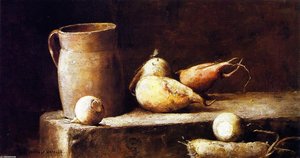
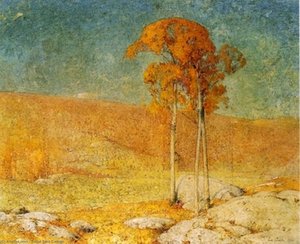
11The Root Cellar (1884) de Emil CarlsenThe Root Cellar1884 12A Young Girl Preparing Poultry (1885) de Emil CarlsenA Young Girl Preparing Poultry1885 13Still Life with Skate (1884) de Emil CarlsenStill Life with Skate1884 14The Root Cellar (1884) de Emil CarlsenThe Root Cellar1884 15Cape Ann Sands (1885) de Emil CarlsenCape Ann Sands1885 16Still Life with Fish (1882) de Emil CarlsenStill Life with Fish1882 · National Gallery of Art 17Still LIfe with Goose (1883) de Emil CarlsenStill LIfe with Goose1883 18Still LIfe with Flowers (1883) de Emil CarlsenStill LIfe with Flowers1883 19Haddock (1886) de Emil CarlsenHaddock1886 · Smithsonian American Art Museum 20Still Life with Bust and White Roses (1888) de Emil CarlsenStill Life with Bust and White Roses1888 21Still Life (1892) de Emil CarlsenStill Life1892 22White Asparagus (1891) de Emil CarlsenWhite Asparagus1891 23Still LIfe with Strawberries (1891) de Emil CarlsenStill LIfe with Strawberries1891 24Still Life with Fish (1893) de Emil CarlsenStill Life with Fish1893 25Chrysanthemums in a Canton Vase (1893) de Emil CarlsenChrysanthemums in a Canton Vase1893 26Vase of Roses (1895) de Emil CarlsenVase of Roses1895 27Still Life of Chrysanthemums in a Canton Vase (1893) de Emil CarlsenStill Life of Chrysanthemums in a Canton Vase1893 28Still Life with Dead Game (1895) de Emil CarlsenStill Life with Dead Game1895 29May (1895) de Emil CarlsenMay1895 30Still Life with Fish (1897) de Emil CarlsenStill Life with Fish1897 · Museum of Fine Arts 31Roses (1894) de Emil CarlsenRoses1894 32Still Life with Squash and PItcher (1893) de Emil CarlsenStill Life with Squash and PItcher1893 33Still Life with Fish and Copper Bowl (1894) de Emil CarlsenStill Life with Fish and Copper Bowl1894 34Orchard in Bloom (1904) de Emil CarlsenOrchard in Bloom1904 · Rhode Island School of Design Museum of Art 35Still Life with Oriental Works of Art (1901) de Emil CarlsenStill Life with Oriental Works of Art1901 36Study in Grey (1906) de Emil CarlsenStudy in Grey1906 · Dallas Museum of Art 37The South Strand (1909) de Emil CarlsenThe South Strand1909 · Smithsonian American Art Museum 38Wood Interior (1910) de Emil CarlsenWood Interior1910 · Cleveland Museum of Art 39Meeting of the Two Seas (1908) de Emil CarlsenMeeting of the Two Seas1908 40Moonlilt Seascape (1909) de Emil CarlsenMoonlilt Seascape1909 41Moonlight on the Kattegat (1910) de Emil CarlsenMoonlight on the Kattegat1910 42Still LIfe with Garlic (1906) de Emil CarlsenStill LIfe with Garlic1906 43The Open Sea (1910) de Emil CarlsenThe Open Sea1910 44Still Life with Kettle and Jug (1906) de Emil CarlsenStill Life with Kettle and Jug1906 45Oriental Jars (1914) de Emil CarlsenOriental Jars1914 · Saint Louis Art Museum 46Still Life (1914) de Emil CarlsenStill Life1914 47Entrance to the Harbor of St. Thomas (1915) de Emil CarlsenEntrance to the Harbor of St. Thomas1915 · Reading Public Museum 48Summer Light (1915) de Emil CarlsenSummer Light1915 49The Sky and the Ocean (1913) de Emil CarlsenThe Sky and the Ocean1913 50Moonlight Scene (1913) de Emil CarlsenMoonlight Scene1913 51The Fan (1919) de Emil CarlsenThe Fan1919 · Saint Louis Art Museum 52Landscape (1919) de Emil CarlsenLandscape1919 · Instituto de Arte de Dayton 53Still Life (1920) de Emil CarlsenStill Life1920 · Museum of Fine Arts 54The French Fan (1922) de Emil CarlsenThe French Fan1922 55Meeting of the Seas (1919) de Emil CarlsenMeeting of the Seas1919 56The Leeds Jug (1920) de Emil CarlsenThe Leeds Jug1920 57Iron Kettle and Clams (1926) de Emil CarlsenIron Kettle and Clams1926 58Connecticut Farmhouse (1928) de Emil CarlsenConnecticut Farmhouse1928 59A Cleaaring beyond the Trees (also known as Green Trees) (1928) de Emil CarlsenA Cleaaring beyond the Trees (also known as Green Trees)1928 60Wood Pasture (1930) de Emil CarlsenWood Pasture1930 61Evening Light (1930) de Emil CarlsenEvening Light1930 62Still Life with Self-Portrait Reflection (1931) de Emil CarlsenStill Life with Self-Portrait Reflection1931 63October Summer (1904) de Emil CarlsenOctober Summer1904 64The Open Sea (1909) de Emil CarlsenThe Open Sea1909 · Metropolitan Museum of Art 65Still Life with Yellow Roses de Emil CarlsenStill Life with Yellow RosesMuseum of Fine Arts 66Oriental Still Life de Emil CarlsenOriental Still Life 67Still Life with Teapot and Onion de Emil CarlsenStill Life with Teapot and Onion 68Cliff and Sea, Ogunquit de Emil CarlsenCliff and Sea, Ogunquit 69Surf Breaking on Rocks de Emil CarlsenSurf Breaking on Rocks 70Woods de Emil CarlsenWoods 71Through the Woods de Emil CarlsenThrough the Woods 72The Majestic Sea de Emil CarlsenThe Majestic Sea 73Trees in Forest de Emil CarlsenTrees in Forest 74The Market, Venice de Emil CarlsenThe Market, Venice 75Lakeside Landscape de Emil CarlsenLakeside Landscape 76Wooded Interior de Emil CarlsenWooded Interior 77Still Life with Teapot and Onion de Emil CarlsenStill Life with Teapot and Onion 78Still Life of Chrysanthemums de Emil CarlsenStill Life of Chrysanthemums 79Jade and Ancient Glass de Emil CarlsenJade and Ancient Glass 80Silver and Gray de Emil CarlsenSilver and Gray 81Misty Sea de Emil CarlsenMisty Sea 82Vase and Flowers de Emil CarlsenVase and Flowers 83Still Life with Mallards and Copper Pots de Emil CarlsenStill Life with Mallards and Copper Pots 84A Freshening Breeze de Emil CarlsenA Freshening Breeze 85Still LIfe with Pitcher and Pivar de Emil CarlsenStill LIfe with Pitcher and Pivar 86The Caribbean de Emil CarlsenThe Caribbean 87The Ocean at Sunrise de Emil CarlsenThe Ocean at Sunrise 88Landscape de Emil CarlsenLandscape 89Landscape, Orange Mountain de Emil CarlsenLandscape, Orange Mountain 90Still LIfe with Chinese Porcelain de Emil CarlsenStill LIfe with Chinese Porcelain 91The Valley, Moonlight de Emil CarlsenThe Valley, Moonlight 92The Samovar (1920) de Emil CarlsenThe Samovar1920 93The Canal de Emil CarlsenThe CanalReading Public Museum 94Still Life with Copper, Brass and Onions (1888) de Emil CarlsenStill Life with Copper, Brass and Onions1888

Os temas que cativaram o olhar de Emil Carlsen

Os quatro temas que mais se repetem nestas obras originais, cada um com o seu melhor exemplo.

Os museus que guardam os originais de Emil Carlsen

Os 8 museus que detêm a maioria das pinturas desta página.

Museus Cidade Obras de Emil Carlsen Pinturas desta lista
Museum of Fine Arts, HoustonMuseum of Fine Arts Houston 3 Still Life with Fish, Still Life, Still Life with Yellow Roses
National Gallery of Art, WashingtonNational Gallery of Art Washington 2 The Picture from Thibet, Still Life with Fish
Metropolitan Museum of Art, Nova YorkMetropolitan Museum of Art Nova York 2 Blackfish and Clams, The Open Sea
Smithsonian American Art Museum, Washington, D.C.Smithsonian American Art Museum Washington, D.C. 2 Haddock, The South Strand
Saint Louis Art Museum, Saint LouisSaint Louis Art Museum Saint Louis 2 Oriental Jars, The Fan
Reading Public Museum, ReadingReading Public Museum Reading 2 Entrance to the Harbor of St. Thomas, The Canal
Taubman Museum of Art, RoanokeTaubman Museum of Art Roanoke 1 Leeds Jug
Art Institute of Chicago, ChicagoArt Institute of Chicago Chicago 1 Nantasket Beach

Emil Carlsen década a década: a obra original que define cada uma

Obras por década

Escolha uma década para ver a obra original que a define.

Perguntas de colecionadores sobre as pinturas de Emil Carlsen

Por qual obra Emil Carlsen é mais conhecido(a)?Revelar a resposta

Ruby Reflection (1895). The Picture from Thibet (1920) e Leeds Jug (1920) vêm a seguir.

Qual era a idade de Emil Carlsen quando Ruby Reflection foi feita?Revelar a resposta

47 anos: Ruby Reflection data de 1895, e Emil Carlsen nasceu em 1848.

Quais são as dez pinturas mais famosas de Emil Carlsen?Revelar a resposta

Ruby Reflection, The Picture from Thibet, Leeds Jug, Mums in an Oriental Vase, Old Sycamore, Blackfish and Clams, Nantasket Beach, Sailor's Wife, Chrysanthemums e The River Bank. O ranking acima apresenta o ano e o museu de cada uma.

Quantas pinturas Emil Carlsen deixou?Revelar a resposta

Nosso catálogo contém 95 obras de Emil Carlsen, datadas de 1876 a 1931.

Em quais museus estão expostas as obras-primas de Emil Carlsen?Revelar a resposta

Principalmente em Museum of Fine Arts (Houston), National Gallery of Art (Washington) e Metropolitan Museum of Art (Nova York). A tabela de museus acima lista todos eles.

Em que anos Emil Carlsen pintou as suas obras mais famosas?Revelar a resposta

Em 1890s: 15 das 94 obras nesta página foram feitas então, sendo Ruby Reflection delas.

Quais são as primeiras e as últimas obras originais famosas de Emil Carlsen?Revelar a resposta

Nesta página, a mais antiga é Nantasket Beach (1876) e a mais recente é Still Life with Self-Portrait Reflection (1931).

Quais temas Emil Carlsen escolheu com mais frequência?Revelar a resposta

Life (17), Flowers (8) e Vase (7), entre as 94 obras nesta página.

Qual técnica Emil Carlsen mais utilizou?Revelar a resposta

Oil On Canvas, para 5 das 94 obras nesta página.

A qual movimento artístico pertence Emil Carlsen?Revelar a resposta

Impressionism, a julgar pelos originais nesta página.

Quais obras de Emil Carlsen estão expostas no Museum of Fine Arts?Revelar a resposta

Still Life with Fish, Still Life e Still Life with Yellow Roses: o Museum of Fine Arts, Houston detém 3 das obras desta página.

Emil Carlsen: vida e obra

Soren Emil Carlsen: The Quiet Mastery of American Impressionism

Soren Emil Carlsen (1853-1932) stands as a singular figure in the annals of American art—a testament to understated brilliance and enduring influence. Born October 19, 1853, in Copenhagen, Denmark, his artistic journey began with an initial fascination for architecture at the Royal Academy, grounding him in principles of structure and form before he ultimately surrendered to the irresistible allure of pure creative expression. This pivotal decision propelled him toward a transformative relocation to Chicago in 1872, where he embarked on a career that would redefine American painting through its distinctive tonalist aesthetic—a style characterized by muted palettes, subtle gradations of light, and an unwavering focus on mood and atmosphere.
  • Early Influences & Education: Carlsen’s formative years were steeped in artistic tradition. His mother practiced painting, fostering a familial appreciation for visual art, while his cousin, Viggo Johansen—a celebrated Danish painter—served as a significant mentor, shaping his understanding of artistic technique and vision.
  • The Embrace of Impressionism: Following his studies in Paris in 1875, Carlsen encountered the revolutionary ideas of Jean-Baptiste-Siméon Chardin, whose masterful depictions of still life captivated him. This encounter spurred him to explore new approaches to painting, culminating in a return to Chicago and the establishment of the Chicago Academy of Design as its inaugural instructor—a role that would profoundly impact generations of aspiring artists.
  • The “American Chardin”: Carlsen’s artistic signature became synonymous with “The American Chardin,” reflecting his unparalleled ability to imbue everyday objects with dignity and poetic resonance. His early works—copper pans gleaming softly, game birds arranged with meticulous detail, delicate flowers poised in vases—were not merely representations of the visual world; they were meditations on texture, form, and the ephemeral beauty of time itself.

A Synthesis of Tonalism and Impressionistic Light

Carlsen’s artistic style represents a remarkable convergence of tonalist principles and impressionistic techniques—a harmonious blend that distinguishes him from many of his contemporaries. He skillfully captured the subtle nuances of light and atmosphere, mirroring Chardin's approach to portraying natural subjects with quiet contemplation. This sensitivity to luminescence became a hallmark of his oeuvre, establishing him as one of the foremost painters of his time. His exploration of landscapes and seascapes—influenced by encounters with Impressionist luminaries like John Twachtman and Julian Alden Weir—further solidified his reputation as an innovator who dared to challenge conventional artistic boundaries.
  • Still Life Mastery: Carlsen’s enduring legacy rests primarily on his exquisite still lifes, which exemplify the tonalist tradition's preoccupation with capturing mood and atmosphere. His compositions often featured commonplace objects—copper pans, brass candlesticks, game birds—rendered with painstaking detail and bathed in soft, diffused light.
  • The Influence of Chardin: Carlsen’s artistic sensibilities were profoundly shaped by Jean-Baptiste-Siméon Chardin's unwavering commitment to portraying the natural world with understated elegance and profound emotional depth. He sought to emulate Chardin’s ability to convey a sense of serenity and contemplation—a stylistic ambition that resonated throughout his career.

Teaching Legacy & Recognition

Beyond his artistic achievements, Carlsen left an indelible mark on American art education—serving as director of the California School of Design (now San Francisco Art Institute) from 1887 to 1889 and subsequently holding positions at the National Academy of Design, the Art Students League, and the Pennsylvania Academy of Fine Arts for over four decades. His pedagogical approach emphasized observation, technique, and a deep understanding of artistic principles—inspiring countless students to pursue their own creative visions. He was awarded numerous honors during his lifetime, including the Samuel T. Shaw Purchase Prize, the Gold Medal at the Louisiana Purchase Exposition, and the prestigious Medal of Honor at the Panama–Pacific International Exposition—testaments to his unwavering dedication to excellence in art instruction.
  • Chicago Academy of Design: Carlsen’s tenure as instructor at Chicago Academy of Design established him as a pioneer in American art education, fostering a generation of artists who embraced tonalism and Impressionism.
  • Notable Students: Among his most distinguished pupils was Guy Rose—a prominent figure in California Impressionism—whose artistic development benefited immensely from Carlsen’s guidance.

A Lasting Impression on American Art History

Soren Emil Carlsen's contribution to American art history transcends mere stylistic innovation; it embodies a profound appreciation for beauty found in simplicity and an unwavering belief in the transformative power of light—qualities that continue to inspire artists and viewers alike. His paintings—characterized by their muted palettes, subtle gradations of luminescence, and evocative mood—remain treasured artifacts of a bygone era—a testament to Carlsen’s enduring artistic vision and his indelible legacy as “The American Chardin.” He died January 2, 1932, in New York City.