Retrato de Elliott Daingerfield

As 49 Pinturas Mais Famosas de Elliott Daingerfield, Cada Uma Única

Atualizado em Novembro 2026 · classificado pela nossa pontuação de popularidade (pesquisas, visitas e pedidos de cada obra) · 57 obras de Elliott Daingerfield em nosso catálogo

Em resumo

Grand Canyon, Moonlight (1913) é a pintura de Elliott Daingerfield que mais atrai olhares. Depois disso, o olhar recai sobre Monk Smelling a Bottle of Wine (1880) e Sunset Hour (1893). Entre as 57 obras de Elliott Daingerfield em nosso catálogo, estas 49 são as mais famosas, cada uma uma original única apresentada com o seu ano, o seu museu e a razão pela qual perdura.

1859 – 1932, Harpers Ferry Mais obras: The Johnson Collection

As 10 principais pinturas de Elliott Daingerfield, sob o olhar da galeria

1
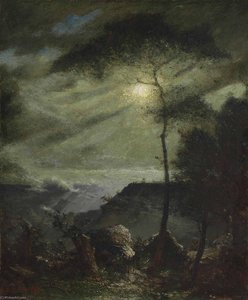
Grand Canyon, Moonlight (1913) de Elliott Daingerfield

Grand Canyon, Moonlight

1913 · Oil On Canvas

Grand Canyon, Moonlight is a work by Elliott Daingerfield. Created in 1913, the painting emerged during a period of significant travel for the artist, who explored the American West in 1911 and 1913. This specific piece is one of seven paintings the artist produced of the Grand Canyon.

2
Monk Smelling a Bottle of Wine (1880) de Elliott Daingerfield

Monk Smelling a Bottle of Wine

1880 · Oil On Canvas

In "Monk Smelling a Bottle of Wine" by Elliott Daingerfield, a young man dressed in the robes of a monk or friar occupies the center of the frame. He is positioned within a dark, shadowy setting that obscures the background. The figure holds several bottles, appearing to drink from one as he engages in a solitary activity. The composition remains relatively simple, focusing the viewer's attention on the man and…

3
Sunset Hour (1893) de Elliott Daingerfield

Sunset Hour

1893 · Oil On Canvas · The Johnson Collection, Spartanburg County

A seated woman and a small child occupy the foreground of this 1893 oil on canvas, sheltered beneath the heavy, spreading canopy of a dark tree. The composition centers on their stillness, a moment of rest amidst a rural landscape. Earthy tones dominate the scene, from the deep greens of the meadow to the muted browns and greys of the figures' clothing. On the horizon, a striking red sun provides…

Pinturas famosas de Elliott Daingerfield, números 11 a 49

Os temas que cativaram o olhar de Elliott Daingerfield

Os quatro temas que mais se repetem nestas obras originais, cada um com o seu melhor exemplo.

Os museus que guardam os originais de Elliott Daingerfield

Os 8 museus que detêm a maioria das pinturas desta página.

Museus Cidade Obras de Elliott Daingerfield Pinturas desta lista
The Johnson Collection Spartanburg County 3 Sunset Hour, Springtime, Troubled Waters
The Mint Museum, CharlotteThe Mint Museum Charlotte 3 Call of the Winds, Moonlight, Cornelia Vanderbilt
Smithsonian American Art Museum, Washington, D.C.Smithsonian American Art Museum Washington, D.C. 2 Bringing home the new born lamb, Return from the Farm
Morris Museum of Art Location, AugustaMorris Museum of Art Location Augusta 2 The Genius of the Canyon, A Fantasy
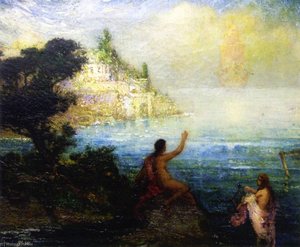
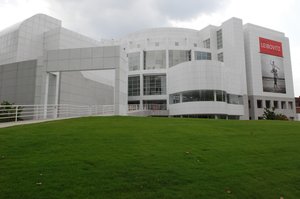
High Museum of Art, AtlantaHigh Museum of Art Atlanta 1 Tanagra
Metropolitan Museum of Art, Nova YorkMetropolitan Museum of Art Nova York 1 Slumbering Fog
Mint Museums, CharlotteMint Museums Charlotte 1 Landscape with Green Mountain
Reading Public Museum, ReadingReading Public Museum Reading 1 Mountain Country

Elliott Daingerfield ao longo das décadas: uma obra original única para cada uma

Obras por década

Escolha uma década para ver a obra original que a define.

Pinturas de Elliott Daingerfield: perguntas para a galeria

Qual é a obra mais famosa de Elliott Daingerfield?Revelar a resposta

Grand Canyon, Moonlight (1913). Monk Smelling a Bottle of Wine (1880) e Sunset Hour (1893) vêm a seguir.

Com que idade Elliott Daingerfield criou Grand Canyon, Moonlight?Revelar a resposta

54 anos: Grand Canyon, Moonlight data de 1913, e Elliott Daingerfield nasceu em 1859.

Quais são as dez pinturas mais famosas de Elliott Daingerfield?Revelar a resposta

Grand Canyon, Moonlight, Monk Smelling a Bottle of Wine, Sunset Hour, Shepherdess, Flowers, Bringing home the new born lamb, The Drover, Home and Harvest, My Lady Rhododendron e Tanagra. O ranking acima apresenta o ano e o museu de cada uma.

Quantas obras de Elliott Daingerfield são conhecidas?Revelar a resposta

Nosso catálogo contém 57 obras de Elliott Daingerfield, datadas de 1880 a 1927.

Onde se pode ver os originais mais famosos de Elliott Daingerfield?Revelar a resposta

Principalmente em The Johnson Collection (Spartanburg County), The Mint Museum (Charlotte) e Smithsonian American Art Museum (Washington, D.C.). A tabela de museus acima lista todos eles.

Em que período Elliott Daingerfield criou as suas pinturas mais conhecidas?Revelar a resposta

Em 1910s: 13 das 49 obras nesta página foram feitas então, sendo Grand Canyon, Moonlight delas.

Qual pintura famosa de Elliott Daingerfield é a mais antiga e qual é a mais recente?Revelar a resposta

Nesta página, a mais antiga é Monk Smelling a Bottle of Wine (1880) e a mais recente é Springtime (1927).

Com quais materiais Elliott Daingerfield mais pintou?Revelar a resposta

Oil On Canvas, para 3 das 49 obras nesta página.

Quais originais de Elliott Daingerfield posso ver no The Johnson Collection?Revelar a resposta

Sunset Hour, Springtime e Troubled Waters: o The Johnson Collection, Spartanburg County detém 3 das obras desta página.

Elliott Daingerfield: um retrato do artista

The Visionary Spirit of Elliott Daingerfield

Elliott Daingerfield stands as one of North Carolina’s most celebrated and evocative artists, a painter whose work bridged the gap between the tangible beauty of the American landscape and the profound depths of spiritual symbolism. Born in 1859 in Harpers Ferry, West Virginia, to a Confederate officer, Daingerfield’s early life was shaped by the rugged landscapes of his youth in Fayetteville, North Carolina. This deep-seated connection to the natural world would later become the foundation of his artistic language, providing him with an endless reservoir of inspiration for his sweeping vistas and luminous compositions.

His journey into the heart of the American art establishment began at the age of twenty-one when he moved to New York City. It was here that Daingerfield’s formal training took root under the guidance of Walter Satterlee, an apprenticeship that not only introduced him to the delicate nuances of still life painting but also placed him within a vibrant circle of influential masters. The shadows and light of his early studies were profoundly transformed by his encounters with titans such as George Inness and Albert Pinkham Ryder. These luminaries, along with the burgeoning influence of European Symbolism which he encountered during his travels abroad around 1897, guided him toward a visionary style. His work began to transcend mere representation, moving toward an expressive mode where color palettes became more luminous and brushwork more meticulous, designed to convey unseen spiritual truths.

A Legacy of Light and Devotion

As his career matured, Daingerfield achieved significant recognition within the prestigious National Academy of Design, ascending from an associate member in 1902 to full membership by 1906. This era marked his emergence as a master of religious and monumental art. His ability to weave narrative and emotion into large-scale works was perhaps most brilliantly demonstrated in his impactful commissions for sacred spaces, most notably the monumental mural adorning Saint Mary the Virgin Church in New York City. In these works, Daingerfield utilized a dramatic interplay of light and shadow to tell stories of faith, much like his more intimate pieces such as Monk Smelling a Bottle of Wine, which explores the delicate tension between indulgence and devotion.

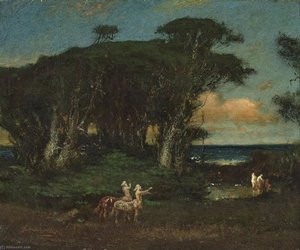
Beyond the confines of religious iconography, Daingerfield’s fascination with the grandeur of the American wilderness led him to remarkable heights. His travels to the American West in 1911 and 1913 resulted in a series of breathtaking paintings of the Grand Canyon, where he captured the geological majesty of the landscape through a Romantic lens. Whether depicting a moonlit forest in A Fantasy or the melancholic beauty of a young girl in Shepherdess, his oeuvre is characterized by an impasto texture and an evocative mood that invites the viewer into a dreamlike state.

Daingerfield’s contribution to American art extends beyond the canvas; he was also a dedicated scholar and biographer, documenting the lives of his contemporaries like George Inness and Ralph Albert Blakelock. His life, marked by both personal tragedy and immense professional triumph, concluded in Manhattan in 1932. Today, his legacy remains etched in the landscapes of North Carolina and the halls of museums worldwide, reminding us of a time when art served as a profound window into the soul of nature.