Retrato de Elihu Vedder

Pinturas de Elihu Vedder: As 100 mais famosas, sob o olhar de uma galeria

Atualizado em Novembro 2026 · classificado pela nossa pontuação de popularidade (pesquisas, visitas e pedidos de cada obra) · 119 obras de Elihu Vedder em nosso catálogo

Em resumo

Aos olhos da galeria, a pintura mais famosa de Elihu Vedder é (Illustration for Rubáiyát of Omar Khayyám) The Cup of Death (1884), cuja obra original está exposta no Smithsonian American Art Museum, em Washington, D.C.. (Illustration for Rubáiyát of Omar Khayyám) The Bitter Cup (1884) e A Glimpse into Hell, or Fear (1893) completam o trio que todos reconhecem. Dos 119 trabalhos de Elihu Vedder em nosso catálogo, a galeria apresenta abaixo as 100 obras mais famosas, cada uma original, com seu ano, seu museu e o que a torna única.

1836 – 1923, Nova Iorque Symbolism Mais obras: Metropolitan Museum of Art

As 10 principais pinturas de Elihu Vedder na galeria

1
(Illustration for Rubáiyát of Omar Khayyám) The Cup of Death (1884) de Elihu Vedder

(Illustration for Rubáiyát of Omar Khayyám) The Cup of Death

1884 · Acrylic On Canvas · Smithsonian American Art Museum, Washington, D.C.

Elihu Vedder’s Illustration for Rubáiyát of Omar Khayyám, subtitled "The Cup of Death," captures a scene so tender, it feels lifted directly from a whispered secret. This painting is not merely a depiction of two figures; it is an exquisite meditation on connection, devotion, and the quiet moments that define a life shared. The composition centers on a man bending with profound tenderness to kiss the forehead of a woman…

2
(Illustration for Rubáiyát of Omar Khayyám) The Bitter Cup (1884) de Elihu Vedder

(Illustration for Rubáiyát of Omar Khayyám) The Bitter Cup

1884 · Acrylic On Canvas · Smithsonian American Art Museum, Washington, D.C.

Elihu Vedder’s “The Bitter Cup,” a watercolor illustration accompanying Edward FitzGerald’s translation of Omar Khayyam’s *Rubaiyat*, is more than just a depiction of a simple vessel; it’s a profound meditation on mortality, beauty, and the ephemeral nature of existence. Created in 1884, this piece captures a pivotal moment within the collection – a contemplative pause amidst the verses that grapple with life's fleeting pleasures and inevitable sorrows. The artwork resides…

3
A Glimpse into Hell, or Fear (1893) de Elihu Vedder

A Glimpse into Hell, or Fear

1893 · Oil On Canvas · Art Institute of Chicago, Chicago

A tight arc of faces presses against the viewer, trapped within a lunette shape that denies any escape. Five female figures crowd the foreground, their skin pale against a backdrop of heavy, dark shadows. Their eyes are wide, fixed on something unseen below the frame, reflecting a profound psychological anguish. The light is directional, catching the sharp lines of furrowed brows and the frantic stillness of wide-eyed gazes. It is…

5
The Lost Mind (1864) de Elihu Vedder

The Lost Mind

1864 · Oil On Canvas · Metropolitan Museum of Art, Nova York

A lone woman stands amidst a desolate, rocky landscape, her figure centered against a vast, pale blue sky. She is wrapped in a dark cloak and a white cloth that catches the diffused light, creating a stark contrast against the rugged, jagged edges of the cliffs. The earth beneath her feet is a collection of ochre, tan, and brown tones, rendered with visible brushstrokes that give the stones a rough,…

6
Soul in Bondage (1891) de Elihu Vedder

Soul in Bondage

1891 · Oil On Canvas · Brooklyn Museum, Brooklyn

Soul in Bondage is an oil on canvas painting by the American artist Elihu Vedder. Created between 1891 and 1892, the work reflects the artist's established presence in the international art scene during the late nineteenth century. Vedder, born in 1836, utilized this period to refine a visual language centered on the internal complexities of the human condition.

7
Memory (1870) de Elihu Vedder

Memory

1870 · Oil On Board · Museu de Arte do Condado de Los Angeles, Los Angeles

In this 1870 work, titled Memory, Elihu Vedder explores a landscape that feels pulled from the quietest corners of the subconscious. The painting presents a scene where the natural world meets the surreal, featuring a turbulent sky and a dark sea that meet at a sandy shoreline. Within the heavy, dark blue and grey storm clouds, a translucent human face emerges from the mist, appearing to drift through the atmosphere.…

8
The Questioner of the Sphinx (1863) de Elihu Vedder

The Questioner of the Sphinx

1863 · Oil On Canvas · Museu de Belas Artes de Boston, Boston

The shadows of antiquity settle upon The Questioner of the Sphinx, a work that emerges from the hand of Elihu Vedder. Painted about 1863, this piece captures a moment of profound stillness. The artist, an American symbolist painter, book illustrator, and poet, brings a visionary depth to the canvas. His gaze often turned toward the mystical and the unseen, seeking to give form to the intangible through his brush and…

9
Fisherman and the Genie (Sketch) (1863) de Elihu Vedder

Fisherman and the Genie (Sketch)

1863 · Oil · Museu de Belas Artes de Boston, Boston

Elihu Vedder’s Fisherman and the Genie (Sketch) presents an asymmetrical landscape defined by narrative tension. On the left, a dense cluster of dark, gnarled trees anchors the composition, their twisted trunks rendered with expressive, gestural lines. This heavy massing contrasts with the right side of the frame, where a large, rising plume of dark smoke or a mountain-like shape creates a sense of upward movement and depth. The perspective is…

10
Fisherman and the Genie (1863) de Elihu Vedder

Fisherman and the Genie

1863 · Oil On Canvas · Museu de Belas Artes de Boston, Boston

In Fisherman and the Genie, Elihu Vedder explores a moment drawn from the depths of folklore. Created about 1863, this work captures a singular, transformative encounter. The scene focuses on a small, seated fisherman who finds himself dwarfed by the supernatural. He looks upward, his expression caught between awe and fear, as he confronts a presence far beyond the natural order.

Pinturas de Elihu Vedder, classificadas de 11 a 100

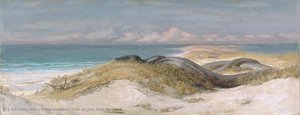
11Study for Prayer for Death in the Desert (1867) de Elihu VedderStudy for Prayer for Death in the Desert1867 · Brooklyn Museum 12Head of Medusa (1878) de Elihu VedderHead of Medusa1878 · Detroit Institute of Arts 13Italian Scene: Pompeo, Monte Colognola Landscape (1878) de Elihu VedderItalian Scene: Pompeo, Monte Colognola Landscape1878 · Rhode Island School of Design Museum of Art 14Young Marsyas (Marsyas Enchanting the Hares) (1878) de Elihu VedderYoung Marsyas (Marsyas Enchanting the Hares)1878 · Crystal Bridges Museum of American Art 15The Water Nymph (1878) de Elihu VedderThe Water Nymph1878 16Eugenia: Head of a Roman Girl (1879) de Elihu VedderEugenia: Head of a Roman Girl1879 · Museu de Belas Artes de Boston 17Delilah (1886) de Elihu VedderDelilah1886 · Detroit Institute of Arts 18Ideal Head — Dawn (1886) de Elihu VedderIdeal Head — Dawn1886 · Museu de Belas Artes de Boston 19Nude (1890) de Elihu VedderNude1890 · Museu de Belas Artes de Boston 20Frivolity (1893) de Elihu VedderFrivolity1893 · Yale University Art Gallery 21Victory (1893) de Elihu VedderVictory1893 · Yale University Art Gallery 22Goddess of Fortune Stay With U (1893) de Elihu VedderGoddess of Fortune Stay With U1893 · Yale University Art Gallery 23Abundance of The Days of the Week (1893) de Elihu VedderAbundance of The Days of the Week1893 · Yale University Art Gallery 24Music (1893) de Elihu VedderMusic1893 · Yale University Art Gallery 25Fame (1893) de Elihu VedderFame1893 · Yale University Art Gallery 26Drama (1893) de Elihu VedderDrama1893 · Yale University Art Gallery 27Wealth (1893) de Elihu VedderWealth1893 · Yale University Art Gallery 28Bounty (1893) de Elihu VedderBounty1893 · Yale University Art Gallery 29Poetry (1893) de Elihu VedderPoetry1893 · Yale University Art Gallery 30Rome Representative of the Arts (1894) de Elihu VedderRome Representative of the Arts1894 · Brooklyn Museum 31Head of Minerva (1896) de Elihu VedderHead of Minerva1896 32Lazarus Rising from the Tomb (1899) de Elihu VedderLazarus Rising from the Tomb1899 · Museu de Belas Artes de Boston 33Music (1910) de Elihu VedderMusic1910 · New Britain Museum of American Art 34Girl with Poppies (1877) de Elihu VedderGirl with Poppies1877 · High Museum of Art 35The Fable of the Miller, His Son, and the Donkey No. 1 (1867) de Elihu VedderThe Fable of the Miller, His Son, and the Donkey No. 11867 · Metropolitan Museum of Art 36Pansies and Spirea (1882) de Elihu VedderPansies and Spirea1882 · Yale University Art Gallery 37The Fable of the Miller, His Son, and the Donkey No. 4 (1867) de Elihu VedderThe Fable of the Miller, His Son, and the Donkey No. 41867 · Metropolitan Museum of Art 38The Fable of the Miller, His Son, and the Donkey No. 6 (1867) de Elihu VedderThe Fable of the Miller, His Son, and the Donkey No. 61867 · Metropolitan Museum of Art 39The Last Man (1886) de Elihu VedderThe Last Man1886 40The Sun God (1882) de Elihu VedderThe Sun God1882 · Smithsonian American Art Museum 41The Cup of Death de Elihu VedderThe Cup of DeathSmithsonian American Art Museum 42The Lair of the Sea Serpent (1864) de Elihu VedderThe Lair of the Sea Serpent1864 · Museu de Belas Artes de Boston 43The Fable of the Miller, His Son, and the Donkey No. 3 (1867) de Elihu VedderThe Fable of the Miller, His Son, and the Donkey No. 31867 · Metropolitan Museum of Art 44The Venetian Model (1878) de Elihu VedderThe Venetian Model1878 · Columbus Museum of Art 45Cypress and Poppies (1880) de Elihu VedderCypress and Poppies1880 · Metropolitan Museum of Art 46Landscape with Sheep and Old Well (1857) de Elihu VedderLandscape with Sheep and Old Well1857 · Museu de Belas Artes de Boston 47Volterra (1860) de Elihu VedderVolterra1860 · Smithsonian American Art Museum 48Three Trees: Italy (1871) de Elihu VedderThree Trees: Italy1871 · Cleveland Museum of Art 49Monks on the Appian Way (1865) de Elihu VedderMonks on the Appian Way1865 · Smithsonian American Art Museum 50Outside Porta San Lorenzo, Rome (1867) de Elihu VedderOutside Porta San Lorenzo, Rome1867 · New Britain Museum of American Art 51Old White Houses, Vitré, France (1866) de Elihu VedderOld White Houses, Vitré, France1866 · New York Historical Society 52Roman Campagna, Lago Di Bracciano (1866) de Elihu VedderRoman Campagna, Lago Di Bracciano1866 · New York Historical Society 53Near Perugia (1870) de Elihu VedderNear Perugia1870 54The Fable of the Miller, His Son, and the Donkey No. 5 (1867) de Elihu VedderThe Fable of the Miller, His Son, and the Donkey No. 51867 · Metropolitan Museum of Art 55The Fable of the Miller, His Son, and the Donkey No. 9 (1867) de Elihu VedderThe Fable of the Miller, His Son, and the Donkey No. 91867 · Metropolitan Museum of Art 56Etruscan Girl (1868) de Elihu VedderEtruscan Girl1868 57Girl with a Lute (1866) de Elihu VedderGirl with a Lute1866 58Etruscan Girl with Turtle (1867) de Elihu VedderEtruscan Girl with Turtle1867 59The Music Party (1871) de Elihu VedderThe Music Party1871 60The Lonely Spring (1865) de Elihu VedderThe Lonely Spring1865 61The Roc's Egg (1868) de Elihu VedderThe Roc's Egg1868 62Hillside Between Perugia and Gubbio, Italy (1867) de Elihu VedderHillside Between Perugia and Gubbio, Italy1867 63Landscape - Torgiano, Autumn Scene (1877) de Elihu VedderLandscape - Torgiano, Autumn Scene1877 · Rhode Island School of Design Museum of Art 64The Music Party (1875) de Elihu VedderThe Music Party1875 · Cleveland Museum of Art 65Storm in Umbria (1875) de Elihu VedderStorm in Umbria1875 · Art Institute of Chicago 66Waves at Palo (1874) de Elihu VedderWaves at Palo1874 67The Cumean Sibyl (1876) de Elihu VedderThe Cumean Sibyl1876 · Detroit Institute of Arts 68Feisole (1859) de Elihu VedderFeisole1859 · Detroit Institute of Arts 69San Gimignano (1879) de Elihu VedderSan Gimignano1879 · Metropolitan Museum of Art 70The Cloud, Florence, Sull'Arno, Italy (1885) de Elihu VedderThe Cloud, Florence, Sull'Arno, Italy1885 · New York Historical Society 71Roman Model Posing (1881) de Elihu VedderRoman Model Posing1881 72The Cup of Death (1885) de Elihu VedderThe Cup of Death1885 73Japanese Still Life (1879) de Elihu VedderJapanese Still Life1879 · Museu de Arte do Condado de Los Angeles 74Sphinx, Egypt (1890) de Elihu VedderSphinx, Egypt1890 · Pennsylvania Academy of Fine Arts 75Egyptian Nile (1890) de Elihu VedderEgyptian Nile1890 76The Etruscan Sorceress (1886) de Elihu VedderThe Etruscan Sorceress1886 77Fisherman and Mermaid (1888) de Elihu VedderFisherman and Mermaid1888 · Fogg Art Museum 78The Poet Bears the Sorrows of the World (1890) de Elihu VedderThe Poet Bears the Sorrows of the World1890 · Georgia Museum of Art 79Soul in Bondage (1891) de Elihu VedderSoul in Bondage1891 · Museum of Fine Arts 80Sibilia Cumaea (1898) de Elihu VedderSibilia Cumaea1898 81The Morning Glory (1899) de Elihu VedderThe Morning Glory1899 · Museu de Belas Artes de Boston 82The Fable of the Miller, His Son, and the Donkey No. 8 (1867) de Elihu VedderThe Fable of the Miller, His Son, and the Donkey No. 81867 · Metropolitan Museum of Art 83Sea Breeze (1899) de Elihu VedderSea Breeze1899 84Marsyas Enchanting the Hares (1899) de Elihu VedderMarsyas Enchanting the Hares1899 85Head of a Young Woman (1900) de Elihu VedderHead of a Young Woman1900 86The Old Well, Bordighera (1899) de Elihu VedderThe Old Well, Bordighera1899 87Color Sketch for Crown of Thorns de Elihu VedderColor Sketch for Crown of ThornsReading Public Museum 88Sketch for End of Story of the Fisherman's Mermaid de Elihu VedderSketch for End of Story of the Fisherman's MermaidReading Public Museum 89The lost mind de Elihu VedderThe lost mind 90The pleiades de Elihu VedderThe pleiadesMetropolitan Museum of Art 91The african sentinel de Elihu VedderThe african sentinelMetropolitan Museum of Art 92The cup of love de Elihu VedderThe cup of loveMetropolitan Museum of Art 93Study for the question of the sphinx de Elihu VedderStudy for the question of the sphinx 94The fable of the miller his son and the donkey no de Elihu VedderThe fable of the miller his son and the donkey no 95Little Shrine, Subiaco, Italy de Elihu VedderLittle Shrine, Subiaco, Italy 96Study of Jane Jackson de Elihu VedderStudy of Jane Jackson 97Elements Gazing on the First Man (1913) de Elihu VedderElements Gazing on the First Man1913 98The Fates Gathering in the Stars (1887) de Elihu VedderThe Fates Gathering in the Stars1887 · Art Institute of Chicago 99Lair of the Sea Serpent (1899) de Elihu VedderLair of the Sea Serpent1899 · Metropolitan Museum of Art 100The Fable of the Miller, His Son, and the Donkey No. 2 (1867) de Elihu VedderThe Fable of the Miller, His Son, and the Donkey No. 21867 · Metropolitan Museum of Art

Pinturas famosas de Elihu Vedder, período por período

Os temas que cativaram o olhar de Elihu Vedder

Os quatro temas que mais se repetem nestas obras originais, cada um com o seu melhor exemplo.

Os museus que guardam os originais de Elihu Vedder

Os 8 museus que detêm a maioria das pinturas desta página.

Museus Cidade Obras de Elihu Vedder Pinturas desta lista
Metropolitan Museum of Art, Nova YorkMetropolitan Museum of Art Nova York 18 The Lost Mind, The Fable of the Miller, His Son, and the Donkey No. 1, The Fable of the Miller, His Son, and the Donkey No. 4
Yale University Art Gallery, New HavenYale University Art Gallery New Haven 11 Frivolity, Victory, Goddess of Fortune Stay With U
Museu de Belas Artes de Boston, BostonMuseu de Belas Artes de Boston Boston 10 The Questioner of the Sphinx, Fisherman and the Genie (Sketch), Fisherman and the Genie
Smithsonian American Art Museum, Washington, D.C.Smithsonian American Art Museum Washington, D.C. 7 (Illustration for Rubáiyát of Omar Khayyám) The Cup of Death, (Illustration for Rubáiyát of Omar Khayyám) The Bitter Cup, The Sun God
Detroit Institute of Arts, DetroitDetroit Institute of Arts Detroit 4 Head of Medusa, Delilah, The Cumean Sibyl
Art Institute of Chicago, ChicagoArt Institute of Chicago Chicago 3 A Glimpse into Hell, or Fear, Storm in Umbria, The Fates Gathering in the Stars
Brooklyn Museum, BrooklynBrooklyn Museum Brooklyn 3 Soul in Bondage, Study for Prayer for Death in the Desert, Rome Representative of the Arts
New York Historical Society, Nova YorkNew York Historical Society Nova York 3 Old White Houses, Vitré, France, Roman Campagna, Lago Di Bracciano, The Cloud, Florence, Sull'Arno, Italy

Elihu Vedder, uma pintura emblemática por década

Obras por década

Escolha uma década para ver a obra original que a define.

Pinturas de Elihu Vedder: a galeria responde

Qual pintura de Elihu Vedder é a mais famosa de todas?Revelar a resposta

(Illustration for Rubáiyát of Omar Khayyám) The Cup of Death (1884), Smithsonian American Art Museum, Washington, D.C.. (Illustration for Rubáiyát of Omar Khayyám) The Bitter Cup (1884) e A Glimpse into Hell, or Fear (1893) vêm a seguir.

Qual era a idade de Elihu Vedder ao concluir (Illustration for Rubáiyát of Omar Khayyám) The Cup of Death?Revelar a resposta

48 anos: (Illustration for Rubáiyát of Omar Khayyám) The Cup of Death data de 1884, e Elihu Vedder nasceu em 1836.

Quais são as 10 principais pinturas de Elihu Vedder?Revelar a resposta

(Illustration for Rubáiyát of Omar Khayyám) The Cup of Death, (Illustration for Rubáiyát of Omar Khayyám) The Bitter Cup, A Glimpse into Hell, or Fear, The Keeper of the Threshold, The Lost Mind, Soul in Bondage, Memory, The Questioner of the Sphinx, Fisherman and the Genie (Sketch) e Fisherman and the Genie. O ranking acima apresenta o ano e o museu de cada uma.

Quantas obras Elihu Vedder criou?Revelar a resposta

Nosso catálogo contém 119 obras de Elihu Vedder, datadas de 1857 a 1913.

Onde estão expostos os originais mais famosos de Elihu Vedder?Revelar a resposta

Principalmente em Metropolitan Museum of Art (Nova York), Yale University Art Gallery (New Haven) e Museu de Belas Artes de Boston (Boston). A tabela de museus acima lista todos eles.

Quando é que Elihu Vedder criou as suas pinturas mais famosas?Revelar a resposta

Em 1890s: 27 das 100 obras nesta página foram feitas então, sendo A Glimpse into Hell, or Fear delas.

Quais são as obras mais famosas de Elihu Vedder no início e no fim de sua carreira?Revelar a resposta

Nesta página, a mais antiga é Landscape with Sheep and Old Well (1857) e a mais recente é Elements Gazing on the First Man (1913).

Quais temas Elihu Vedder mais explorou?Revelar a resposta

Woman (19), Ribbons (10) e Drapery (9), entre as 100 obras nesta página.

Em qual técnica Elihu Vedder mais trabalhou?Revelar a resposta

Oil On Canvas, para 28 das 100 obras nesta página.

Com qual movimento Elihu Vedder está associado(a)?Revelar a resposta

Symbolism, a julgar pelos originais nesta página.

Quais obras originais de Elihu Vedder o Metropolitan Museum of Art possui?Revelar a resposta

The Lost Mind, The Fable of the Miller, His Son, and the Donkey No. 1 e The Fable of the Miller, His Son, and the Donkey No. 4: o Metropolitan Museum of Art, Nova York detém 15 das obras desta página.

Elihu Vedder: o artista

Primeiros Anos e Formação Artística

  • Nascimento: 26 de fevereiro de 1836, Nova York, Estados Unidos
  • Falecimento: 29 de janeiro de 1923, Roma, Itália

Elijah Vedder nasceu sob o signo de circunstâncias familiares singulares, sendo seus pais primos entre si. Sua infância foi moldada por uma tapeçaria de experiências diversas, desde os dias passados em Cuba, devido à mudança de seu pai, até períodos alternados entre a casa do avô materno em Schenectady e a disciplina dos internatos. Embora tenha enfrentado as reservas iniciais de seu pai, as ambições artísticas de Vedder encontraram um porto seguro no apoio incondicional de sua mãe.

  • Formação Inicial: Vedder iniciou seu treinamento formal em Nova York, sob a tutela de Tompkins H. Matteson.
  • Estudos Europeus: Ele expandiu seus horizontes intelectuais e estéticos em Paris, estudando com François-Édouard Picot, e mais tarde na Itália, onde mergulhou profundamente na herança do Renascimento Italiano e no estilo dos pintores Macchiaioli.
  • Influência Italiana: Sua estadia na Itália cultivou um profundo vínculo emocional com o colega pintor Giovanni Costa, o que o levou a diversas viagens antes que limitações financeiras forçassem seu retorno à América.

Destaques da Carreira e Obras Notáveis

A trajetória de Vedder foi uma jornada por múltiplas disciplinas artísticas, transcendendo a pintura e a ilustração para alcançar o design de murais e a poesia. Em sua busca por significado, ele cultivou amizades com figuras literárias proeminentes, como Walt Whitman e Herman Melville.

  • Ilustrações para o Rubaiyat: Vedder é mundialmente reconhecido pelas suas cinquenta e cinco ilustrações que acompanham a tradução de Edward FitzGerald para The Rubáiyát of Omar Khayyam (edição de luxo). Estas obras são hoje consideradas verdadeiras obras-primas da arte simbolista.
  • Pinturas Visionárias: Suas telas mais memoráveis, como "The Roc’s Egg", “The Fisherman and the Genii” e “Lair of the Sea Serpent”, revelam um estilo visionário repleto de temas imaginativos e oníricos.
  • Trabalho Muralista: Sua maestria também se expressou na arquitetura, ao decorar o corredor da Sala de Leitura da Biblioteca do Congresso em Washington com pinturas murais imponentes.
  • Colaboração com Tiffany: Vedder uniu sua visão estética ao prestígio de Louis Comfort Tiffany, colaborando no design de vidraria, mosaicos e estatuetas para a renomada empresa Tiffany.

Estilo Artístico e Influências

O estilo artístico de Vedder é definido por uma natureza visionária, imbuída de uma imagética romântica e pela incorporação frequente de influências orientais que conferem um exotismo místico às suas composições.

  • Simbolismo: Como figura central do movimento Simbolista, Vedder priorizava a expressão da emoção e do individualismo em detrimento do realismo estrito.
  • Pré-Rafaelitas: Sua passagem pela Inglaterra o aproximou da Irmandade Pré-Rafaelita, o que refinou sua técnica em direção a uma maior clareza e detalhamento minucioso.
  • Místicos Ingleses e Irlandeses: A obra de William Blake e William Butler Yeats exerceu um fascínio sobre ele, refletindo sua própria busca pela espiritualidade e pelo misticismo.
  • Renascimento Italiano e Macchiaioli: Seus estudos na Itália foram fundamentais para consolidar sua compreensão de forma, cor e composição clássica.

Legado e Últimos Anos

As contribuições de Vedder para a arte americana estenderam-se muito além das telas. Ele desempenhou um papel vital na fundação do grupo In Arte Libertas na Itália e deixou um legado literário rico, composto por reflexões autobiográficas e poesia.

  • Membro de Prestígio: Vedder integrou a prestigiada Academia Americana de Artes e Letras.
  • Produção Literária: Publicou obras como The Digressions of V (1910), Miscellaneous Moods in Verse (1914) e Doubt and Other Things (1922).
  • Anos Finais: Vedder passou seus últimos anos vivendo primordialmente na Itália, onde continuou a criar e escrever até seu falecimento em Roma, em 1923. Seu legado permanece vivo através de suas pinturas e ilustrações evocativas, que continuam a cativar o imaginário do público contemporâneo.