Retrato de Edward Bird

As 54 Pinturas Mais Famosas de Edward Bird, uma Seleção da Galeria

Atualizado em Novembro 2026 · classificado pela nossa pontuação de popularidade (pesquisas, visitas e pedidos de cada obra) · 54 obras de Edward Bird em nosso catálogo

Em resumo

De todas as obras originais deixadas por Edward Bird, a mais famosa é The Scavengers (1800), da coleção do Musée Cognacq-Jay, em Paris. Logo atrás vêm Village Choristers Rehearsing an Anthem for Sunday (1810) e Mr Ricketts' Return From Shooting. Nosso catálogo contém 54 obras de Edward Bird; a galeria preservou as 54 que o mundo mais admira, cada uma exibida com sua data, seu museu e sua história.

1772 – 1819, Wolverhampton Mais obras: Sunnycroft

As 10 principais pinturas de Edward Bird: a escolha da galeria

1
The Scavengers (1800) de Edward Bird

The Scavengers

1800 · Oil On Canvas · Musée Cognacq-Jay, Paris

Two small figures occupy the center of a shadowed world. They are children, caught in a quiet act of discovery amidst the heavy, dark foliage of a large tree. A strong light descends from the upper left, carving their pale faces out of the gloom and catching the light-colored fabric of a girl's apron. The scene is a study in contrast, where the soft skin of youth meets the rough,…

2
Village Choristers Rehearsing an Anthem for Sunday (1810) de Edward Bird

Village Choristers Rehearsing an Anthem for Sunday

1810 · Oil On Canvas · Royal Collection, Londres

The scene unfolds within a crowded, dimly lit room where a group of villagers has assembled for a musical rehearsal. The composition is dense, with figures arranged in a semi-circle around a central wooden table. To the left, seated musicians anchor the group, while standing figures occupy the right side of the frame. Light enters from a window on the far left, casting directional beams that illuminate faces and hands…

3
Mr Ricketts' Return From Shooting de Edward Bird

Mr Ricketts' Return From Shooting

Oil

The room is heavy with the scent of roasted meat and the warmth of a low fire. At the head of the table, a man sits in a green coat, his yellow waistcoat catching the light as he turns his gaze toward the viewer. He has returned from the field, his presence anchoring the domestic scene. Beside him, a woman in a blue dress looks upward, her posture a silent…

4
The Reading Of The Will Concluded de Edward Bird

The Reading Of The Will Concluded

Oil On Panel

The air in the room feels heavy, thick with the unspoken expectations of those gathered. A man stands at the center of the composition, his posture firm as he holds a document that holds the power to shift fortunes. He reads aloud, his voice cutting through the stillness of the drawing room. Around him, the figures are frozen in a state of intense observation. Some sit in chairs, their bodies…

5
Proclaiming Joash King de Edward Bird

Proclaiming Joash King

Oil

Proclaiming Joash King is an oil painting by the English artist Edward Bird. Created about 1815, the work depicts a specific narrative from the Old Testament of the Bible. The scene focuses on the anointing of the young Joash as the king of Judah. This historical and religious subject matter reflects the artist's transition toward large-scale historical and religious themes during this period of his career.

6
Princess Caraboo of Javasu , (1817) de Edward Bird

Princess Caraboo of Javasu ,

1817 · Oil

Edward Bird painted Princess Caraboo of Javasu , in 1817. The portrait presents Mary Baker in exotic attire, presenting her as the fictional Princess Caraboo of Javasu. This identity was a fabrication used by Baker, an English impostor, to claim royal lineage from a non-existent island in the Indian Ocean.

A seleção de Edward Bird continua, de 11 a 54

Pinturas famosas de Edward Bird, período por período

Os temas que cativaram o olhar de Edward Bird

Os quatro temas que mais se repetem nestas obras originais, cada um com o seu melhor exemplo.

Os museus que guardam os originais de Edward Bird

Os 4 museus que detêm a maioria das pinturas desta página.

Museus Cidade Obras de Edward Bird Pinturas desta lista
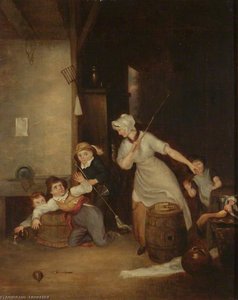
Sunnycroft, WellingtonSunnycroft Wellington 2 A Dame Scolding Naughty Children, The Toy Prisoner Being Shot In The School Room
Musée Cognacq-Jay, ParisMusée Cognacq-Jay Paris 1 The Scavengers
Royal Collection, LondresRoyal Collection Londres 1 Village Choristers Rehearsing an Anthem for Sunday
Anglesey AbbeyAnglesey Abbey 1 The Life Guards In A Guardroom

Edward Bird ano a ano: as obras originais que definem cada um

De 1800 a 1817, Edward Bird trabalhou durante 18 anos: a seleção acompanha essa longa carreira ano a ano, através das suas mais belas obras originais.

Obras por ano

Escolha um ano para ver as obras originais.

Perguntas de colecionadores sobre as pinturas de Edward Bird

Por qual obra Edward Bird é mais conhecido(a)?Revelar a resposta

The Scavengers (1800), Musée Cognacq-Jay, Paris. Village Choristers Rehearsing an Anthem for Sunday (1810) e Mr Ricketts' Return From Shooting vêm a seguir.

Qual era a idade de Edward Bird quando The Scavengers foi feita?Revelar a resposta

28 anos: The Scavengers data de 1800, e Edward Bird nasceu em 1772.

Quais são as dez pinturas mais famosas de Edward Bird?Revelar a resposta

The Scavengers, Village Choristers Rehearsing an Anthem for Sunday, Mr Ricketts' Return From Shooting, The Reading Of The Will Concluded, Proclaiming Joash King, Princess Caraboo of Javasu ,, The Arrival of Louis XVIII at Calais, The Birth, The Duet e The Life Guards In A Guardroom. O ranking acima apresenta o ano e o museu de cada uma.

Quantas pinturas Edward Bird deixou?Revelar a resposta

Nosso catálogo contém 54 obras de Edward Bird, datadas de 1800 a 1817.

Em quais museus estão expostas as obras-primas de Edward Bird?Revelar a resposta

Principalmente em Sunnycroft (Wellington), Musée Cognacq-Jay (Paris) e Royal Collection (Londres). A tabela de museus acima lista todos eles.

Quais são as primeiras e as últimas obras originais famosas de Edward Bird?Revelar a resposta

Nesta página, a mais antiga é The Scavengers (1800) e a mais recente é Princess Caraboo of Javasu , (1817).

Quais temas Edward Bird escolheu com mais frequência?Revelar a resposta

Children (5), Man (3) e Royalty (3), entre as 54 obras nesta página.

Qual técnica Edward Bird mais utilizou?Revelar a resposta

Oil, para 3 das 54 obras nesta página.

Quais obras de Edward Bird estão expostas no Sunnycroft?Revelar a resposta

A Dame Scolding Naughty Children e The Toy Prisoner Being Shot In The School Room: o Sunnycroft, Wellington detém 2 das obras desta página.

Edward Bird: vida e obra

Edward Bird (1772–1819)

Edward Bird, born in Wolverhampton, Staffordshire, England, on April 12th, 1772, embarked upon an artistic journey far removed from the grand narratives of history painting. Instead, his formative years were spent honing skills within the practical realm of a carpenter’s workshop – his father’s trade – where he initially apprenticed as a japanning artist, meticulously applying decorative designs onto tea trays.

Early Influences: The precision and decorative prowess cultivated through japanning techniques served as an initial catalyst for Bird's artistic sensibilities. He absorbed inspiration from the meticulous craftsmanship of his father’s profession, shaping his understanding of visual artistry.

The Bristol School and Artistic Flourishing

Bird relocated to Bristol in 1794 seeking broader horizons, a city brimming with cultural vibrancy. There he married Martha Dodrell and established himself as an independent artist, accepting commissions ranging from intimate portraiture to illustrative work for books and decorative paintings commissioned by local churches.

Bristol proved more than merely a place of employment; it became a crucible for intellectual exchange and artistic experimentation. Bird swiftly joined forces with fellow artists—Edward Villiers Rippingille and Nathan Cooper Branwhite—forming what would become known as the Bristol School. This informal collective prioritized fresh color palettes and keen observation of everyday life, qualities that would define Bird’s distinctive style.

A pivotal relationship was his friendship with George Cumberland, an art collector whose extensive library provided invaluable access to a wealth of artistic inspiration. Cumberland's patronage opened doors to study works by the Old Masters, profoundly shaping Bird’s aesthetic sensibilities.

Recognition in London and a Shift to Historical Themes

The year 1809 marked a turning point in Bird’s career. His submission to the Royal Academy garnered immediate acclaim, its compelling narrative and skillful execution resonating with both critics and patrons. This success brought royal recognition—the Prince Regent acquired his painting ‘Good News,’ and commissioned him for further projects.

He transitioned towards history painting, specializing in dramatic battle scenes demanding technical mastery alongside a powerful sense of narrative. Notable works included ‘The Field of Chevy Chase’ and ‘The Day After the Battle,’ showcasing Bird's ability to capture the intensity and emotional weight of historical events.

Later Years, Legacy, and Artistic Style

Despite achieving considerable acclaim, Bird’s later years were shadowed by declining health and artistic challenges. His attempts at large-scale historical paintings proved more difficult than anticipated, and he struggled to maintain the momentum of his earlier successes.

Bird passed away on November 2nd, 1819, leaving behind a diverse body of work celebrated in a retrospective exhibition held shortly after his death. Edward Bird is remembered as a pivotal figure in British art history—particularly for his contributions to the development of the Bristol School and his unique ability to seamlessly blend genre painting with historical themes.

His influence extended beyond his immediate circle, inspiring subsequent generations of artists who embraced naturalism and sought to capture the authenticity of everyday life. Bird’s legacy lies not only in the beauty and skill of his paintings but also in his role as a catalyst for artistic innovation within Bristol—a testament to collaboration and the enduring appeal of naturalistic representation.

Bird's style was characterized by naturalism, fresh color palettes, and detailed depictions of both everyday life and significant historical events. He skillfully combined elements of genre and history painting, creating works that were both emotionally resonant and technically accomplished.