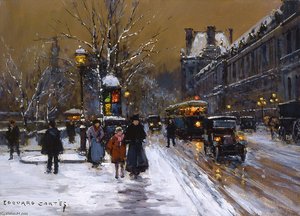
Retrato de Edouard-Léon Cortès

Pinturas de Edouard-Léon Cortès: As 100 mais famosas, sob o olhar de uma galeria

Atualizado em Novembro 2026 · classificado pela nossa pontuação de popularidade (pesquisas, visitas e pedidos de cada obra) · 212 obras de Edouard-Léon Cortès em nosso catálogo

Em resumo

Aos olhos da galeria, a pintura mais famosa de Edouard-Léon Cortès é La Place de la Bastille, Paris. Flower Market At La Madeleine e Theatre du Vaudeville completam o trio que todos reconhecem. Dos 212 trabalhos de Edouard-Léon Cortès em nosso catálogo, a galeria apresenta abaixo as 100 obras mais famosas, cada uma original, com seu ano, seu museu e o que a torna única.

1882 – 1969, Lagny-sur-Marne Post-impressionism

As 10 principais pinturas de Edouard-Léon Cortès na galeria

1
La Place de la Bastille, Paris de Edouard-Léon Cortès

La Place de la Bastille, Paris

Oil On Canvas

Step closer and observe how the light settles upon the damp pavement of La Place de la Bastille. There is a particular weight to the air in this scene, a sense of an overcast autumn evening where the sky holds an orange haze. The streets are not merely surfaces but mirrors, reflecting the glow from nearby storefronts and the soft flicker of street lamps. You can almost feel the humidity…

2
Flower Market At La Madeleine de Edouard-Léon Cortès

Flower Market At La Madeleine

Oil On Canvas

This oil on canvas, titled Flower Market At La Madeleine, is a work by Edouard Cortès. It presents a cityscape focused on the daily rhythms of Parisian street life and the activity of a local market. The artist, Edouard Cortès, was known for his ability to capture the atmosphere of the city through a specific, personal lens. This particular piece is signed, marking the hand of the creator within the…

3
Theatre du Vaudeville de Edouard-Léon Cortès

Theatre du Vaudeville

Oil On Canvas

is an oil painting by the artist Edouard Cortès. The work depicts a Parisian street scene, focusing on the urban landscape and the activity surrounding a theater. This specific composition captures a moment of city life within a metropolitan setting.

4
Rue de la Paix, Rain de Edouard-Léon Cortès

Rue de la Paix, Rain

Oil On Canvas

Rue de la Paix, Rain is a work by Edouard Cortès. A French post-impressionist painter, Cortès was born on August 6, 1882, in Lagny-sur-Marne, France. He remained connected to this region throughout his life, eventually passing away in Lagny on November 26, 1969.

5
View of the Street Rivoli and Notre Dame de Edouard-Léon Cortès

View of the Street Rivoli and Notre Dame

Oil

View of the Street Rivoli and Notre Dame is a cityscape by Edouard Cortès. This post-impressionist work depicts a specific urban setting within Paris, France. The composition focuses on the intersection of city life and architectural presence, centering on the activity within the street and the proximity of the Notre Dame structure.

6
Bouquinistes de Edouard-Léon Cortès

Bouquinistes

Oil On Canvas

There is a certain quietude that settles over the city when the rain begins to fall, a softening of the edges that turns the bustling streets into something more contemplative. In this oil painting, we find ourselves on a damp Parisian street, where the air feels heavy with moisture and the scent of old paper. The composition draws the eye toward the silhouette of Notre Dame, which rises through a…

7
St.Denis, Winter de Edouard-Léon Cortès

St.Denis, Winter

Oil On Canvas

The oil painting titled St.Denis, Winter by Edouard Cortès presents a specific urban scene set within Paris. The subject matter focuses on the essence of Parisian street life during the winter season. The composition centers on a bustling thoroughfare where movement and architecture define the space. Pedestrians navigate the sidewalks alongside horse-drawn carriages, moving through a landscape shaped by the seasonal conditions.

8
Notre Dame, St. Michael, under the snow de Edouard-Léon Cortès

Notre Dame, St. Michael, under the snow

Oil On Canvas

Snow falls softly over the city, dusting the rooftops and the wide boulevards in a quiet, pale layer. The air feels heavy with moisture, a mix of falling flakes and a light rain that turns the cobblestones into dark, reflective mirrors. In the background, the massive silhouette of Notre Dame looms through the haze, its stone details softened by the winter atmosphere. People move through the scene, some huddled under…

Pinturas de Edouard-Léon Cortès, classificadas de 11 a 100

11Boulevard de la Madeleine (9) de Edouard-Léon CortèsBoulevard de la Madeleine (9) 12Rue Royale Madeleine de Edouard-Léon CortèsRue Royale Madeleine 13Boulevard de la Madeleine de Edouard-Léon CortèsBoulevard de la Madeleine 14Boulevard Bonne Nouvelle, Porte St. Denis de Edouard-Léon CortèsBoulevard Bonne Nouvelle, Porte St. Denis 15The Ferryman de Edouard-Léon CortèsThe Ferryman 16Omnibus on the Place de la Madeleine de Edouard-Léon CortèsOmnibus on the Place de la Madeleine 17Boulevard de la Madeleine de Edouard-Léon CortèsBoulevard de la Madeleine 18Place Saint Michel, Notre Dame de Edouard-Léon CortèsPlace Saint Michel, Notre Dame 19Place de la Republique de Edouard-Léon CortèsPlace de la Republique 20Quay du Louvre de Edouard-Léon CortèsQuay du Louvre 21Pont Neuf de Edouard-Léon CortèsPont Neuf 22Place de l'Opera de Edouard-Léon CortèsPlace de l'Opera 23Rue Royale Madeleine, Winter de Edouard-Léon CortèsRue Royale Madeleine, Winter 24Rue Royale Madeleine de Edouard-Léon CortèsRue Royale Madeleine 25Theatre du Chatelet de Edouard-Léon CortèsTheatre du Chatelet 26Paris, Place de la Republique de Edouard-Léon CortèsParis, Place de la Republique 27Place de l'Opera de Edouard-Léon CortèsPlace de l'Opera 28Place Saint Michel, Notre Dame de Edouard-Léon CortèsPlace Saint Michel, Notre Dame 29Rue de Rivoli de Edouard-Léon CortèsRue de Rivoli 30Booksellers along the Seine de Edouard-Léon CortèsBooksellers along the Seine 31Place de la Republique de Edouard-Léon CortèsPlace de la Republique 32Rue de la Paix de Edouard-Léon CortèsRue de la Paix 33Avenue De L'Opera de Edouard-Léon CortèsAvenue De L'Opera 34Boulevard et la Porte St.Denis de Edouard-Léon CortèsBoulevard et la Porte St.Denis 35Rue Royale de Edouard-Léon CortèsRue Royale 36Rue Dulm Pantheon de Edouard-Léon CortèsRue Dulm Pantheon 37Quai de Montebello de Edouard-Léon CortèsQuai de Montebello 38Metro George V de Edouard-Léon CortèsMetro George V 39Café de la Paix, Paris de Edouard-Léon CortèsCafé de la Paix, Paris 40Boulevard de la Madeleine de Edouard-Léon CortèsBoulevard de la Madeleine 41Place de l'Opera de Edouard-Léon CortèsPlace de l'Opera 42Opera, Paris de Edouard-Léon CortèsOpera, Paris 43Lamp Effect (1903) de Edouard-Léon CortèsLamp Effect1903 44St.Denis (1905) de Edouard-Léon CortèsSt.Denis1905 45The Grands Boulevards de Edouard-Léon CortèsThe Grands Boulevards 46Booksellers of Notre-Dame de Edouard-Léon CortèsBooksellers of Notre-Dame 47New Bridge de Edouard-Léon CortèsNew Bridge 48New Bridge de Edouard-Léon CortèsNew Bridge 49Place de la Concorde de Edouard-Léon CortèsPlace de la Concorde 50Place Pigalle, winter de Edouard-Léon CortèsPlace Pigalle, winter 51Tuileries Garden de Edouard-Léon CortèsTuileries Garden 52Bouquinistes de Notre Dame de Edouard-Léon CortèsBouquinistes de Notre Dame 53Place de l'Opera de Edouard-Léon CortèsPlace de l'Opera 54St.Denis, Winter de Edouard-Léon CortèsSt.Denis, Winter 55Rue de Rivoli de Edouard-Léon CortèsRue de Rivoli 56Place du Chatelet de Edouard-Léon CortèsPlace du Chatelet 57Boulevard de la Madeleine, Winter de Edouard-Léon CortèsBoulevard de la Madeleine, Winter 58Les Grands Boulevards de Edouard-Léon CortèsLes Grands Boulevards 59St.Denis de Edouard-Léon CortèsSt.Denis 60St.Martin de Edouard-Léon CortèsSt.Martin 61Place de la Madeleine de Edouard-Léon CortèsPlace de la Madeleine 62St.Martin de Edouard-Léon CortèsSt.Martin 63Quay du Louvre (1925) de Edouard-Léon CortèsQuay du Louvre1925 64Flower Market At La Madeleine de Edouard-Léon CortèsFlower Market At La Madeleine 65St.Martin de Edouard-Léon CortèsSt.Martin 66Boulevard a Paris de Edouard-Léon CortèsBoulevard a Paris 67Place de la Republique de Edouard-Léon CortèsPlace de la Republique 68Triumphal Arch (8) de Edouard-Léon CortèsTriumphal Arch (8) 69Quai de la Siene de Edouard-Léon CortèsQuai de la Siene 70Rue Royale Concorde de Edouard-Léon CortèsRue Royale Concorde 71Rue Royale Concorde de Edouard-Léon CortèsRue Royale Concorde 72Les Halles de Edouard-Léon CortèsLes Halles 73Place de la Bastille de Edouard-Léon CortèsPlace de la Bastille 74La Madeleine, winter de Edouard-Léon CortèsLa Madeleine, winter 75Flower Market At La Madeleine de Edouard-Léon CortèsFlower Market At La Madeleine 76Place de la Republique (8) de Edouard-Léon CortèsPlace de la Republique (8) 77Place Vendome de Edouard-Léon CortèsPlace Vendome 78Quay Saint Michel de Edouard-Léon CortèsQuay Saint Michel 79Chatelet de Edouard-Léon CortèsChatelet 80Triumphal Arch de Edouard-Léon CortèsTriumphal Arch 81Place de la Republique de Edouard-Léon CortèsPlace de la Republique 82The theater of the Comedie Francaise de Edouard-Léon CortèsThe theater of the Comedie Francaise 83Quay du Louvre de Edouard-Léon CortèsQuay du Louvre 84Winter evening de Edouard-Léon CortèsWinter evening 85Caf de la Paix, Paris de Edouard-Léon CortèsCaf de la Paix, Paris 86Theatre du Vaudeville de Edouard-Léon CortèsTheatre du Vaudeville 87Boulevard de la Madeleine, Winter de Edouard-Léon CortèsBoulevard de la Madeleine, Winter 88Sacred Heart of Paris de Edouard-Léon CortèsSacred Heart of Paris 89The Triumphal Arc, Winter de Edouard-Léon CortèsThe Triumphal Arc, Winter 90Flower Market At La Madeleine de Edouard-Léon CortèsFlower Market At La Madeleine 91Railway Ballast de Edouard-Léon CortèsRailway Ballast 92Place from a knoll Montmartre de Edouard-Léon CortèsPlace from a knoll Montmartre 93Place de la Republique de Edouard-Léon CortèsPlace de la Republique 94Flower Market At La Madeleine de Edouard-Léon CortèsFlower Market At La Madeleine 95Les Grands Boulevards de Edouard-Léon CortèsLes Grands Boulevards 96Fountain on Place de la Concorde de Edouard-Léon CortèsFountain on Place de la Concorde 97Tournelles Dock de Edouard-Léon CortèsTournelles Dock 98St.Denis de Edouard-Léon CortèsSt.Denis 99Place de la Bastille de Edouard-Léon CortèsPlace de la Bastille 100Place Pigalle, Winter Evening de Edouard-Léon CortèsPlace Pigalle, Winter Evening

Pinturas famosas de Edouard-Léon Cortès, período por período

Os temas que cativaram o olhar de Edouard-Léon Cortès

Os quatro temas que mais se repetem nestas obras originais, cada um com o seu melhor exemplo.

Edouard-Léon Cortès, as pinturas emblemáticas de cada ano

23 anos da arte de Edouard-Léon Cortès, de 1903 a 1925: a galeria acompanha o seu percurso ano a ano, através dos seus originais mais famosos.

Obras por ano

Escolha um ano para ver as obras originais.

Pinturas de Edouard-Léon Cortès: a galeria responde

Qual pintura de Edouard-Léon Cortès é a mais famosa de todas?Revelar a resposta

La Place de la Bastille, Paris. Flower Market At La Madeleine e Theatre du Vaudeville vêm a seguir.

Quais são as 10 principais pinturas de Edouard-Léon Cortès?Revelar a resposta

La Place de la Bastille, Paris, Flower Market At La Madeleine, Theatre du Vaudeville, Rue de la Paix, Rain, View of the Street Rivoli and Notre Dame, Bouquinistes, St.Denis, Winter, Notre Dame, St. Michael, under the snow, Paris Evening e Place Saint Michel, Notre Dame. O ranking acima apresenta o ano e o museu de cada uma.

Quantas obras Edouard-Léon Cortès criou?Revelar a resposta

Nosso catálogo contém 212 obras de Edouard-Léon Cortès, datadas de 1903 a 1925.

Quando é que Edouard-Léon Cortès criou as suas pinturas mais famosas?Revelar a resposta

Em 1905: 2 das 100 obras nesta página foram feitas então, sendo Paris Evening delas.

Quais são as obras mais famosas de Edouard-Léon Cortès no início e no fim de sua carreira?Revelar a resposta

Nesta página, a mais antiga é Lamp Effect (1903) e a mais recente é Quay du Louvre (1925).

Quais temas Edouard-Léon Cortès mais explorou?Revelar a resposta

Buildings (63), Roads (63) e Forests (22), entre as 100 obras nesta página.

Em qual técnica Edouard-Léon Cortès mais trabalhou?Revelar a resposta

Oil On Canvas, para 12 das 100 obras nesta página.

Com qual movimento Edouard-Léon Cortès está associado(a)?Revelar a resposta

Post-impressionism, a julgar pelos originais nesta página.

Edouard-Léon Cortès: o artista

The Parisian Poet: A Life in Light and Shadow

Édouard Léon Cortès, affectionately known as “Le Poète Parisien de la Peinture” – the Parisian Poet of Painting – wasn’t born into the glittering world he would so vividly capture on canvas. His origins lay in Lagny-sur-Marne, a quiet town east of Paris, where he arrived on August 6th, 1882. Though France was his birthplace, artistic lineage flowed through his veins from his Spanish father, Antonio Cortés, a painter who had once served the Spanish Royal Court. This heritage instilled within young Édouard an early appreciation for artistry and a dedication to honing his skills. He began formal studies at the École des Beaux-Arts in Paris at just seventeen, immersing himself in the techniques of the masters while simultaneously forging his own distinct path. Even then, Cortès possessed a fiercely independent spirit, playfully rebuffing suggestions that he was merely a student of any particular master, declaring himself “a student of myself only.” This self-reliance would become a hallmark of his career and artistic vision.

Capturing the Soul of Paris

Cortès’s name became synonymous with Parisian cityscapes. He didn't simply paint buildings; he painted atmospheres – the soft glow of gas lamps on rain-slicked cobblestones, the bustling energy of boulevards teeming with life, the quiet intimacy of a café scene unfolding under a hazy sky. His work wasn’t about grand monuments or historical events, but rather the everyday poetry of Parisian existence. He possessed an uncanny ability to capture fleeting moments – a shaft of sunlight illuminating Notre Dame, the vibrant colors reflected in puddles after a shower, the hushed anticipation before a performance at the Opera. These weren't idealized visions; they were honest portrayals of a city brimming with life, beauty, and a touch of melancholy. His palette favored muted tones, skillfully blended to evoke mood and atmosphere, often employing shades of gray, blue, and ochre that perfectly mirrored the Parisian climate. He wasn’t interested in radical experimentation or abstract forms; his focus remained steadfastly on representing the world as he saw it – beautiful, transient, and deeply evocative. His paintings are not mere depictions of places but rather windows into a specific feeling, a particular moment in time captured with remarkable sensitivity.

A Soldier's Brush: War and Resilience

The idyllic world Cortès painted was shattered by the outbreak of World War I. Despite being a committed pacifist, duty called, and at the age of thirty-two, he enlisted in the French Infantry Regiment. The horrors of war profoundly impacted him, yet even amidst the chaos and destruction, his artistic spirit endured. Wounded early in the conflict, he was reassigned to utilize his talent for sketching, tasked with mapping enemy positions. This experience, though harrowing, likely sharpened his observational skills and deepened his appreciation for the fragility of life – themes that would subtly permeate his later work. He refused the Légion d’Honneur offered by the French government, a testament to his unwavering pacifist beliefs. Personal tragedy also struck during this period; his first wife, Fernande Joyeuse, passed away in 1918, leaving him with their daughter, Jacqueline Simone. He later married Fernande’s sister, Lucienne Joyeuse, finding solace and companionship amidst the lingering shadows of war.

Influences and Artistic Kinship

While Cortès developed a uniquely personal style, echoes of other masters can be discerned within his work. The atmospheric effects and subtle play of light recall the Impressionists, particularly Camille Pissarro and Alfred Sisley. However, he lacked their focus on pure optical sensation, instead prioritizing narrative and emotional resonance. Post-Impressionist artists like Eugène Boudin also influenced his approach to capturing fleeting moments and atmospheric conditions. *His dedication to depicting everyday life aligns him with Realist painters*, yet his romanticized vision of Paris elevates his work beyond mere documentation. He wasn’t attempting to replicate reality precisely; he was striving to capture its essence, its mood, its poetry. Artists like Frederick Soulacroix and Paul Gauguin, though distinct in their styles, shared Cortès's fascination with capturing the spirit of a place and its people, imbuing their canvases with a sense of atmosphere and emotion. His legacy lies not in revolutionizing painting but in perfecting a particular vision – a deeply personal and profoundly moving portrayal of Paris that continues to resonate with audiences today.

Major Achievements and Recognition

Cortès’s career spanned several decades, during which he established himself as one of the leading artists capturing the spirit of modern Paris. He exhibited his work extensively throughout France and internationally, gaining recognition for his distinctive style and masterful use of light and color. His paintings were featured in prestigious exhibitions, including those at the Salon de Paris and later in North America. In 1969, in his final year, he received the prestigious Prix Antoine-Quinson from the Salon de Vincennes – a fitting tribute to a lifetime dedicated to artistic expression. His work is now held in numerous private collections and public museums, ensuring that his unique vision of Paris will continue to be appreciated for generations to come. His paintings are not just beautiful objects; they are historical documents, offering a poignant glimpse into the life and atmosphere of a city undergoing rapid transformation at the turn of the 20th century.

A Lasting Legacy

Edouard Cortès died on November 26, 1969, in Lagny-sur-Marne, leaving behind a vast body of work that continues to captivate art lovers worldwide. A street in his hometown bears his name, a lasting testament to the “Parisian Poet” who immortalized the city’s soul on canvas. His paintings remain highly sought after, not merely as decorative pieces but as windows into a bygone era – glimpses of a Paris that exists now primarily through his evocative and enduring art. His ability to distill the essence of Parisian life—its beauty, its melancholy, its vibrant energy—into a single image is what secures his place as one of the most beloved artists associated with the city of lights.