Retrato de Eanger Irving Couse

Pinturas de Eanger Irving Couse: As 100 mais famosas, sob o olhar de uma galeria

Atualizado em Novembro 2026 · classificado pela nossa pontuação de popularidade (pesquisas, visitas e pedidos de cada obra) · 152 obras de Eanger Irving Couse em nosso catálogo

Em resumo

Aos olhos da galeria, a pintura mais famosa de Eanger Irving Couse é Taos Indian and Pottery (1920). The Harvest Song (1920) e Indian Brave Recording General MacKenzie's Fight with the Cheyenes (1902) completam o trio que todos reconhecem. Dos 152 trabalhos de Eanger Irving Couse em nosso catálogo, a galeria apresenta abaixo as 100 obras mais famosas, cada uma original, com seu ano, seu museu e o que a torna única.

1866 – 1936, Saginaw Mais obras: Reading Public Museum

As 10 principais pinturas de Eanger Irving Couse na galeria

1
Taos Indian and Pottery (1920) de Eanger Irving Couse

Taos Indian and Pottery

1920 · Oil On Canvas

In 1920, E. Irving Couse captures a quiet moment of stillness in Taos Indian and Pottery. The scene unfolds within the intimate confines of an indoor space, perhaps a humble room or a traditional hut. A deep red wall provides a warm backdrop to the central figure, grounding the composition in a sense of place and purpose.

2
The Harvest Song (1920) de Eanger Irving Couse

The Harvest Song

1920 · Oil On Canvas

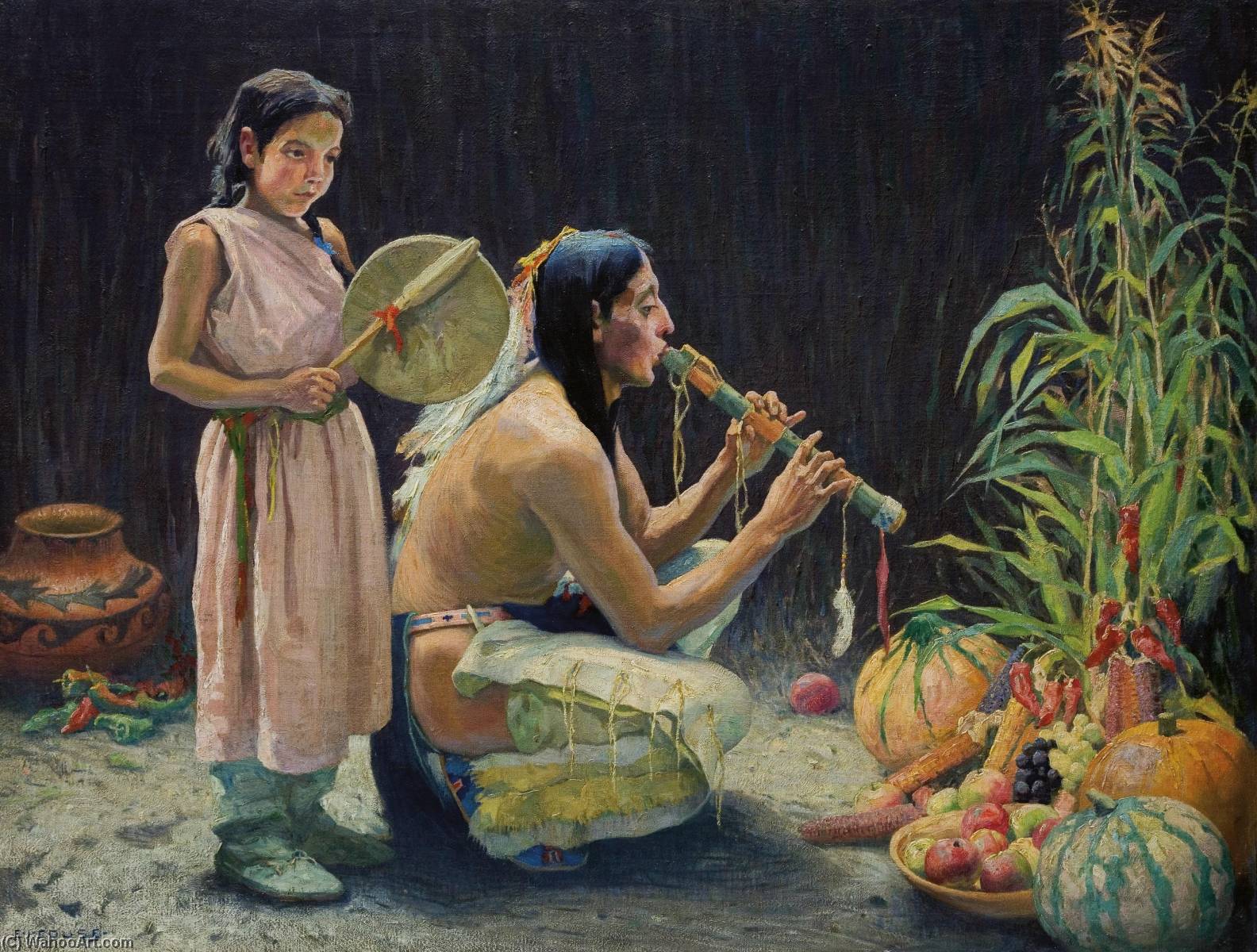
The air feels heavy with the scent of ripening produce in The Harvest Song, a work painted by E. Irving Couse in 1920. Within this sun-drenched field, a man sits amidst an abundance of nature, his breath steady as he plays a flute. Beside him, a woman holds a drum, her presence completing a rhythmic duet that seems to echo through the surrounding crops. They exist in a moment of…

3
Indian Brave Recording General MacKenzie's Fight with the Cheyenes (1902) de Eanger Irving Couse

Indian Brave Recording General MacKenzie's Fight with the Cheyenes

1902 · Oil

In "Indian Brave Recording General MacKenzie's Fight with the Cheyenes" by E. Irving Couse, a quiet moment of creation unfolds. Two Native American men lean into their task, focused entirely on the act of painting a mural. They work upon a large, stretched animal hide, perhaps deer or buffalo, which serves as the canvas for their story. This central activity anchors the entire scene, drawing the eye directly to the…

4
The Water Course (1910) de Eanger Irving Couse

The Water Course

1910 · Oil · Reading Public Museum, Reading

In The Water Course, E. Irving Couse presents a quiet moment of interaction with the natural world. Painted around 1910, the work focuses on two Native American figures positioned within a rugged, sunlit landscape. They are situated near a flowing stream, their presence integrated into the terrain rather than imposed upon it. The scene captures a sense of tranquility, focusing on the subtle connection between the individuals and the land…

5
The Sculptor (1914) de Eanger Irving Couse

The Sculptor

1914 · Oil On Canvas

The Sculptor is an oil painting by E. Irving Couse, executed in 1914. The work focuses on a Native American man engaged in the act of creating petroglyphs or drawings upon a textured surface. The subject is positioned in a central-right profile, kneeling as he works against a shallow, textured background suggesting a rock face or cave wall.

6
The Cooling Stream (1912) de Eanger Irving Couse

The Cooling Stream

1912 · Oil On Canvas

The air feels heavy and still under a blanket of overcast clouds. Near the edge of a flowing river, a group of indigenous figures gathers, their presence deeply woven into the natural landscape. There is a quiet, somber energy in the way they move, a sense of ritual or perhaps a shared moment of mourning that settles over the scene. The water of the stream ripples softly, catching subtle highlights…

7
The Mountain Stream (1914) de Eanger Irving Couse

The Mountain Stream

1914 · Oil On Canvas

In The Mountain Stream, E. Irving Couse positions a solitary Indigenous man in the foreground, seated along a riverbank. The figure is the central focus, rendered with a posture and gaze that suggest deep introspection. This quietude is framed by a landscape of flowing water and dense foliage, creating a scene centered on contemplation and a profound connection with the natural world.

9
Indian Hunter (1925) de Eanger Irving Couse

Indian Hunter

1925 · Oil · Reading Public Museum, Reading

In this 1925 oil painting, a Native American hunter moves through a sun-dappled grove of birch or aspen trees. The composition is oriented vertically, drawing the eye to the profile of the figure on the left as he moves toward the right. There is a stillness here, a sense of quiet tension as the subject navigates the forest floor. Light filters through the canopy in patches of pale yellow, creating…

10
The Blanket Mender (1934) de Eanger Irving Couse

The Blanket Mender

1934 · Oil · The Owings Gallery, Santa Fe

The Blanket Mender is an oil painting by E. Irving Couse. Created about 1934, this work captures a quiet moment of focused labor. The subject is a Native American figure, depicted in a state of stillness as they attend to a textile. There is a profound sense of patience in the way the figure engages with the fabric, a task requiring steady hands and a calm mind.

Pinturas de Eanger Irving Couse, classificadas de 11 a 100

11Flute Player (1931) de Eanger Irving CouseFlute Player1931 · Private collection 12Untitled (AQU5U9) (1899) de Eanger Irving CouseUntitled (AQU5U9)1899 13Indian Weaver (1914) de Eanger Irving CouseIndian Weaver1914 · American Museum of Western Art 14Untitled (AQU5U3) (1927) de Eanger Irving CouseUntitled (AQU5U3)1927 · El Paso Museum of Art 15Ambush (1897) de Eanger Irving CouseAmbush1897 · Briscoe Western Art Museum 16The Pictographs (1919) de Eanger Irving CouseThe Pictographs1919 17The Captive (1891) de Eanger Irving CouseThe Captive1891 18The Card Player (1897) de Eanger Irving CouseThe Card Player1897 19Klikitat Indian with Pony (1898) de Eanger Irving CouseKlikitat Indian with Pony1898 20Indian Seated by a Campfire (1898) de Eanger Irving CouseIndian Seated by a Campfire1898 21An Indian Hunter (1897) de Eanger Irving CouseAn Indian Hunter1897 22The Peace Pipe (1901) de Eanger Irving CouseThe Peace Pipe1901 · Metropolitan Museum of Art 23Indian Drinking (1903) de Eanger Irving CouseIndian Drinking1903 24Moki Snake Sance (1904) de Eanger Irving CouseMoki Snake Sance1904 · American Museum of Western Art 25Walpi Pueblo (1903) de Eanger Irving CouseWalpi Pueblo1903 · Smithsonian American Art Museum 26The Forest Pool de Eanger Irving CouseThe Forest PoolThe Owings Gallery 27Quail Hunters de Eanger Irving CouseQuail Hunters 28Sacred Waters de Eanger Irving CouseSacred WatersIndianapolis Museum of Art 29Woman in a White Dress de Eanger Irving CouseWoman in a White Dress 30The Speaker de Eanger Irving CouseThe Speaker 31Indian Portrait de Eanger Irving CouseIndian Portrait 32Evening Solitude de Eanger Irving CouseEvening Solitude 33Western Sunlight de Eanger Irving CouseWestern Sunlight 34Medicine Man de Eanger Irving CouseMedicine Man 35Hunting Cranes de Eanger Irving CouseHunting Cranes 36Klickitat Brave de Eanger Irving CouseKlickitat Brave 37The Sculptor de Eanger Irving CouseThe Sculptor 38Ute Waterbottle de Eanger Irving CouseUte Waterbottle 39Young Kibbey Whitman Couse de Eanger Irving CouseYoung Kibbey Whitman Couse 40The Thinker de Eanger Irving CouseThe Thinker 41The Setting Sun de Eanger Irving CouseThe Setting Sun 42John Concha, Taos Pueblo de Eanger Irving CouseJohn Concha, Taos Pueblo 43Resting de Eanger Irving CouseResting 44Moonlight Meditation de Eanger Irving CouseMoonlight Meditation 45The Master Workman de Eanger Irving CouseThe Master Workman 46The Evening Meal de Eanger Irving CouseThe Evening Meal 47Indian By A Stream de Eanger Irving CouseIndian By A Stream 48The Lovers de Eanger Irving CouseThe LoversBrigham Young University Museum of Art 49Lamb de Eanger Irving CouseLamb 50Young Hunter by a Stream de Eanger Irving CouseYoung Hunter by a Stream 51Portrait Of Kibbey Whitman Couse de Eanger Irving CousePortrait Of Kibbey Whitman Couse 52Flute Player, Rio Lucero, Taos, NM de Eanger Irving CouseFlute Player, Rio Lucero, Taos, NM 53The Arrow Maker de Eanger Irving CouseThe Arrow Maker 54Indians in Moonlight de Eanger Irving CouseIndians in Moonlight 55The Tom Tom Lesson de Eanger Irving CouseThe Tom Tom Lesson 56The Lesson de Eanger Irving CouseThe Lesson 57Lovers (Indian Love Song) de Eanger Irving CouseLovers (Indian Love Song) 58The Peace Pipe de Eanger Irving CouseThe Peace Pipe 59Putting on the War Shoes de Eanger Irving CousePutting on the War Shoes 60Indian Painter de Eanger Irving CouseIndian Painter 61The Drink de Eanger Irving CouseThe Drink 62Serenade de Eanger Irving CouseSerenade 63The Pottery Maker de Eanger Irving CouseThe Pottery Maker 64Indian by the Fire de Eanger Irving CouseIndian by the Fire 65Return of the War Party (1910) de Eanger Irving CouseReturn of the War Party1910 66The Beaded Tobacco Bag de Eanger Irving CouseThe Beaded Tobacco Bag 67By the Fire de Eanger Irving CouseBy the Fire 68Beaded Bag de Eanger Irving CouseBeaded Bag 69Evening Reverie (1911) de Eanger Irving CouseEvening Reverie1911 70The Love Call (1908) de Eanger Irving CouseThe Love Call1908 71The Pottery Decorator de Eanger Irving CouseThe Pottery Decorator 72New Rug (1917) de Eanger Irving CouseNew Rug1917 73Making Pottery (1912) de Eanger Irving CouseMaking Pottery1912 74Lone Hunter (1915) de Eanger Irving CouseLone Hunter1915 75The Sentinel (1912) de Eanger Irving CouseThe Sentinel1912 76The Successful Hunter (1913) de Eanger Irving CouseThe Successful Hunter1913 77Indian Girl in a Blanket (1921) de Eanger Irving CouseIndian Girl in a Blanket1921 78Crow Tent (1918) de Eanger Irving CouseCrow Tent1918 79The Evening Meal (1918) de Eanger Irving CouseThe Evening Meal1918 80The Magic Flute (also known as Flute Player at the Spring) (1918) de Eanger Irving CouseThe Magic Flute (also known as Flute Player at the Spring)1918 81The Flute Ceremony (1922) de Eanger Irving CouseThe Flute Ceremony1922 82Untitled (AQU5UF) (1921) de Eanger Irving CouseUntitled (AQU5UF)1921 · El Paso Museum of Art 83Indian Summer (1924) de Eanger Irving CouseIndian Summer1924 84Moonlight on the Hondo (1928) de Eanger Irving CouseMoonlight on the Hondo1928 85Hunting the Turkey in the Aspens (1926) de Eanger Irving CouseHunting the Turkey in the Aspens1926 86Flute Song, Moonlight (1927) de Eanger Irving CouseFlute Song, Moonlight1927 87Sheep At Sundown de Eanger Irving CouseSheep At Sundown 88Pottery Vendor (1916) de Eanger Irving CousePottery Vendor1916 · Philbrook Museum of Art 89The Chief de Eanger Irving CouseThe Chief 90Chief David Shoppenegons (1911) de Eanger Irving CouseChief David Shoppenegons1911 · Detroit Institute of Arts 91The Lesson (1902) de Eanger Irving CouseThe Lesson1902 92Indian Painter de Eanger Irving CouseIndian PainterMinneapolis Institute of Art 93Hidden House de Eanger Irving CouseHidden House 94Moving In Clouds de Eanger Irving CouseMoving In Clouds 95Purple Shore de Eanger Irving CousePurple Shore 96Boat Alone de Eanger Irving CouseBoat Alone 97Trees In Snow de Eanger Irving CouseTrees In Snow 98Lillies de Eanger Irving CouseLillies 99At The Spring (Sheep In Field) de Eanger Irving CouseAt The Spring (Sheep In Field) 100Taos Canyon Creek de Eanger Irving CouseTaos Canyon Creek

Os temas que cativaram o olhar de Eanger Irving Couse

Os quatro temas que mais se repetem nestas obras originais, cada um com o seu melhor exemplo.

Os museus que guardam os originais de Eanger Irving Couse

Os 8 museus que detêm a maioria das pinturas desta página.

Museus Cidade Obras de Eanger Irving Couse Pinturas desta lista
Reading Public Museum, ReadingReading Public Museum Reading 2 The Water Course, Indian Hunter
The Owings Gallery Santa Fe 2 The Blanket Mender, The Forest Pool
American Museum of Western Art, ColoradoAmerican Museum of Western Art Colorado 2 Indian Weaver, Moki Snake Sance
El Paso Museum of Art, El PasoEl Paso Museum of Art El Paso 2 Untitled (AQU5U3), Untitled (AQU5UF)
Smithsonian American Art Museum, Washington, D.C.Smithsonian American Art Museum Washington, D.C. 2 Walpi Pueblo
Cincinnati Art Museum, CincinnatiCincinnati Art Museum Cincinnati 1 Indian Drinking from a Lake
Private collection, AkronPrivate collection Akron 1 Flute Player
Briscoe Western Art Museum, San AntonioBriscoe Western Art Museum San Antonio 1 Ambush

Eanger Irving Couse, uma pintura emblemática por década

Obras por década

Escolha uma década para ver a obra original que a define.

Pinturas de Eanger Irving Couse: a galeria responde

Qual pintura de Eanger Irving Couse é a mais famosa de todas?Revelar a resposta

Taos Indian and Pottery (1920). The Harvest Song (1920) e Indian Brave Recording General MacKenzie's Fight with the Cheyenes (1902) vêm a seguir.

Qual era a idade de Eanger Irving Couse ao concluir Taos Indian and Pottery?Revelar a resposta

54 anos: Taos Indian and Pottery data de 1920, e Eanger Irving Couse nasceu em 1866.

Quais são as 10 principais pinturas de Eanger Irving Couse?Revelar a resposta

Taos Indian and Pottery, The Harvest Song, Indian Brave Recording General MacKenzie's Fight with the Cheyenes, The Water Course, The Sculptor, The Cooling Stream, The Mountain Stream, Indian Drinking from a Lake, Indian Hunter e The Blanket Mender. O ranking acima apresenta o ano e o museu de cada uma.

Quantas obras Eanger Irving Couse criou?Revelar a resposta

Nosso catálogo contém 152 obras de Eanger Irving Couse, datadas de 1891 a 1934.

Onde estão expostos os originais mais famosos de Eanger Irving Couse?Revelar a resposta

Principalmente em Reading Public Museum (Reading), The Owings Gallery (Santa Fe) e American Museum of Western Art (Colorado). A tabela de museus acima lista todos eles.

Quando é que Eanger Irving Couse criou as suas pinturas mais famosas?Revelar a resposta

Em 1910s: 18 das 100 obras nesta página foram feitas então, sendo The Water Course delas.

Quais são as obras mais famosas de Eanger Irving Couse no início e no fim de sua carreira?Revelar a resposta

Nesta página, a mais antiga é The Captive (1891) e a mais recente é The Blanket Mender (1934).

Quais temas Eanger Irving Couse mais explorou?Revelar a resposta

Native american (14), Native american culture (13) e Southwestern landscape (10), entre as 100 obras nesta página.

Em qual técnica Eanger Irving Couse mais trabalhou?Revelar a resposta

Oil On Canvas, para 10 das 100 obras nesta página.

Quais obras originais de Eanger Irving Couse o Reading Public Museum possui?Revelar a resposta

The Water Course e Indian Hunter: o Reading Public Museum, Reading detém 2 das obras desta página.

Eanger Irving Couse: o artista

Eanger Irving Couse: Um Ponte Entre Mundos

Eanger Irving Couse, nascido em 1866, emergiu de um cenário industrial em ascensão em Saginaw, Michigan, como um artista destinado a se tornar uma figura central na arte americana. Sua história não é apenas um relato de desenvolvimento artístico; é uma narrativa convincente de conexão cultural, que une as rigorosas tradições da pintura acadêmica europeia com uma representação profunda e respeitosa da vida nativa americana e das cativantes paisagens do sudoeste. Desde seus primeiros anos, Couse demonstrou uma curiosidade inata sobre os tribos Chippewa que habitavam as terras próximas à sua infância – uma atração que floresceu em uma dedicação de vida para retratar sua existência com sensibilidade e dignidade. Essa não foi mera observação; foi a semente de uma empatia profunda que moldaria fundamentalmente sua jornada artística. Ele abandonou os estudos tradicionais aos dezesseis anos, impulsionado por um compromisso inabalável com a arte, estudando inicialmente na Art Institute of Chicago e depois na National Academy of Design em Nova York antes de embarcar em uma década de peregrinação em Paris.

De Salões Parisienses à Atração do Sudoeste

Paris provou ser transformadora. Estudar sob William-Adolphe Bouguereau na École des Beaux-Arts e Académie Julian inculcou em Couse um domínio das técnicas clássicas – desenho preciso, modelagem sutil e um senso refinado de composição. Ele aperfeiçoou suas habilidades capturando a luz e a atmosfera da costa da Normandia, mas mesmo em meio a essas influências europeias, o chamado para o Oeste americano permaneceu forte. Uma visita ao rancho de seu sogro gerou interesse nos assuntos nativos americanos, culminando em *The Captive*, exibido no Salão de Paris em 1892. Esta obra significativa e precoce, retratando uma cena do Massacre de Whitman e modelada por sua esposa Virginia e uma nativa Klikitat local, demonstrou tanto sua perícia técnica quanto suas preocupações temáticas emergentes. Retornando aos Estados Unidos, Couse equilibrou o trabalho em estúdio em Nova York com viagens cada vez mais frequentes para o oeste, eventualmente levando-o a Taos, Novo México, em 1902. Este marcou um ponto de virada; ele foi cativado pelo cenário único, paisagens e cultura da região, estabelecendo uma residência de verão que evoluiu para seu lar permanente. Ele não estava apenas visitando; estava se imergindo, buscando entender e representar uma maneira de vida muito distante das cidades movimentadas da Costa Leste.

A Alma de Taos: Uma Visão Artística Definidora

Taos tornou-se mais do que um mero local para Couse – era uma imersão em uma cultura. Ele se dedicou a estudar e pintar a vida dos índios Taos, não como figuras exóticas, mas como indivíduos possuindo dignidade e graça inerentes. Ao contrário de alguns contemporâneos que se concentravam em narrativas dramáticas ou representações românticas, Couse procurava capturar momentos silenciosos da vida cotidiana – cenas de contemplação, artesanato e conexão familiar. Seu estilo evoluiu para uma mistura distinta de precisão acadêmica e uso evocativo da luz e da cor, criando pinturas que eram tanto tecnicamente habilidosas quanto emocionalmente ressonantes. Ele preferia tons quentes e terrosos, muitas vezes retratando seus assuntos banhados pela suave luz do fogo ou pelos tons dourados do pôr do sol. Ele frequentemente empregava dois modelos principais, Ben Lujan e Jerry Mirable, permitindo-lhe capturar um senso de continuidade e intimidade em seu trabalho. Essa dedicação levou-o a se tornar membro fundador e primeiro presidente da Taos Society of Artists em 1915, consolidando a reputação de Taos como um importante centro artístico. Suas pinturas não eram apenas representações; eram interpretações imbuídas de respeito e compreensão – um testemunho de seu compromisso em retratar a vida nativa americana autenticamente.

Reconhecimento, Legado e Influência Duradoura

O talento de Couse não passou despercebido. Ele recebeu inúmeros prêmios ao longo de sua carreira, incluindo o Prêmio Altman da National Academy of Design, o Prêmio Isidor do Salmagundi Club e o Prêmio Lippincott da Pennsylvania Academy of Fine Arts. Notavelmente, ele garantiu comissões do Santa Fe Railway entre 1914 e 1936 para criar pinturas usadas em suas campanhas publicitárias – um testemunho de sua capacidade de capturar o fascínio do sudoeste para um público mais amplo. *Elk-foot of the Taos Tribe* é amplamente considerada sua obra-prima, eventualmente sendo adquirida pela coleção de arte nacional dos Estados Unidos, consolidando seu lugar no cânone da arte americana. Além desses louvores, o legado duradouro de Couse reside em sua contribuição para moldar as percepções da vida nativa americana e estabelecer uma identidade artística única para a Taos Society. Ele ofereceu uma perspectiva que se diferenciava das representações mais estereotipadas prevalecentes na época, enfatizando a coexistência pacífica e a beleza inerente da cultura Pueblo.

Características Chave de Sua Obra

  • Precisão Acadêmica: A base de Couse em técnicas acadêmicas europeias é evidente no detalhamento meticuloso e na representação realista de seus personagens e paisagens.
  • Uso Evocativo da Luz: Ele dominou o uso da luz e da sombra para criar atmosfera e profundidade emocional, muitas vezes retratando cenas banhadas por tons quentes e dourados.
  • Representação Respeitosa: As representações de Couse de nativos americanos eram caracterizadas por dignidade e sensibilidade, evitando representações estereotipadas ou românticas.
  • Foco na Vida Cotidiana: Ele preferia capturar momentos silenciosos da existência cotidiana em vez de narrativas dramáticas, oferecendo um vislumbre das rotinas e tradições da cultura Pueblo.
  • Paleta Limitada: Couse favoreceu uma paleta quente e terrosa que refletia as cores do cenário do sudoeste e criava uma sensação de harmonia e tranquilidade.
A arte de Eanger Irving Couse continua a ressoar hoje não apenas por sua brilhância técnica, mas também por sua mensagem duradoura de compreensão e respeito cultural. Ele permanece uma figura significativa na história da arte americana, um testemunho do poder da arte para unir divisões e iluminar o espírito humano.