Retrato de Dong Qichang

Pinturas de Dong Qichang: As 54 mais famosas, sob o olhar de uma galeria

Atualizado em Novembro 2026 · classificado pela nossa pontuação de popularidade (pesquisas, visitas e pedidos de cada obra) · 54 obras de Dong Qichang em nosso catálogo

Em resumo

Aos olhos da galeria, a pintura mais famosa de Dong Qichang é 明 董其昌 荊谿招隱圖 卷 Invitation to Reclusion at Jingxi (1611), cuja obra original está exposta no Metropolitan Museum of Art, em Nova York. 明 董其昌 倣倪瓚山水圖 軸 Landscape with Trees in the Manner of Ni Zan (1301–1374) (1622) e Excerpt from Xie Huilian’s Prose Poem “On Snow” completam o trio que todos reconhecem. Dos 54 trabalhos de Dong Qichang em nosso catálogo, a galeria apresenta abaixo as 54 obras mais famosas, cada uma original, com seu ano, seu museu e o que a torna única.

1555 – 1636, Songjiang Mais obras: Metropolitan Museum of Art

As 10 principais pinturas de Dong Qichang na galeria

1
明 董其昌 荊谿招隱圖 卷 Invitation to Reclusion at Jingxi (1611) de Dong Qichang

明 董其昌 荊谿招隱圖 卷 Invitation to Reclusion at Jingxi

1611 · Ink On Paper · Metropolitan Museum of Art, Nova York

Snow clings to the jagged edges of the landscape, a pale weight upon the earth. In this ink-washed world, trees stand scattered like silent witnesses to the season. A few figures move through the white expanse, their presence small against the vastness of the mountains. The scene is a study in stillness, where the cold air seems to settle between the brushstrokes. It is a landscape of retreat, where the…

2
明 董其昌 倣倪瓚山水圖 軸 Landscape with Trees in the Manner of Ni Zan (1301–1374) (1622) de Dong Qichang

明 董其昌 倣倪瓚山水圖 軸 Landscape with Trees in the Manner of Ni Zan (1301–1374)

1622 · Ink On Paper · Metropolitan Museum of Art, Nova York

A quiet forest breathes upon the paper, captured in a moment of profound stillness. Trees with skeletal branches and delicate leaves reach upward, their forms etched with a deliberate, calligraphic grace. This is not a scene of lush, overwhelming growth, but rather a study in sparse, rhythmic elegance. The ink flows in varying shades of grey, creating a sense of depth through the subtle interplay of light and shadow. Each…

3
Excerpt from Xie Huilian’s Prose Poem “On Snow” de Dong Qichang

Excerpt from Xie Huilian’s Prose Poem “On Snow”

Ink

Excerpt from Xie Huilian’s Prose Poem “On Snow” is a work by Dong Qichang. Born in 1555, the artist was a native of Hua Ting, located in modern-day Shanghai. His influence extended through his membership in the Nine Friends, a group of influential figures during the later period of the Ming dynasty.

4
Eight Views of Autumn Moods-6 de Dong Qichang

Eight Views of Autumn Moods-6

In this composition, we find ourselves amidst a quietude that only the changing seasons can provide. The scene unfolds with a sense of profound stillness, where mountains rise in the background, their forms softened by the atmosphere. Trees surround the landscape, their presence felt through delicate brushwork that suggests the weight of the season. Scattered throughout this terrain are several figures, some positioned near the water's edge while others find…

5
Untitled (AQR4UL) (1603) de Dong Qichang

Untitled (AQR4UL)

1603 · Ink On Paper

The ink rests upon the paper, still holding the energy of the hand that guided it. In this work from 1603, Chinese characters emerge from the void, their forms shifting and turning as if caught in a slow, rhythmic movement. There is a profound sense of time held within these strokes; some characters appear bold and commanding, while others drift with a lighter, more ethereal grace. The composition avoids a…

6
Mt. Qingbian (1617) de Dong Qichang

Mt. Qingbian

1617 · Ink On Paper · Cleveland Museum of Art, Cleveland

This vertical scroll painting, executed in 1617, presents a rugged mountainous terrain rendered in monochrome ink. The composition utilizes a high-distance perspective, guiding the eye from a detailed foreground of rocky outcrops and dense vegetation upward through winding paths. The terrain is characterized by towering peaks and steep cliffs that recede into the background. Atmospheric perspective is achieved through varying ink densities, where the distant mountain tops appear lighter and…

7
Reminiscence of Jian River (1621) de Dong Qichang

Reminiscence of Jian River

1621 · Ink On Paper · Yale University Art Gallery, New Haven

The vertical composition of this 1621 ink and light color work presents a landscape of jagged mountain peaks and winding water. In the foreground, gnarled trees and rocky outcrops are rendered with fine, dark brushwork. These elements lead the eye upward through middle-ground hills that are partially obscured by pale grey washes. The upper register of the painting features towering, distant peaks that emerge from a layer of mist. The…

9
Transcription of the "Prose-poem on Promenading in the Back Garden" by Xie Tiao (464–499) and "Zuoyouming" by Cui Yuan (77–142) (1616) de Dong Qichang

Transcription of the "Prose-poem on Promenading in the Back Garden" by Xie Tiao (464–499) and "Zuoyouming" by Cui Yuan (77–142)

1616 · Ink

This work is a Transcription of the "Prose-poem on Promenading in the Back Garden" by Xie Tiao (464–499) and "Zuoyouming" by Cui Yuan (77–142). The piece was executed by Dong Qichang, a Chinese art theorist, calligrapher, painter, and politician. It dates to about 1616, originating from the later period of the Ming dynasty.

10
明 董其昌 溪山樾館圖 軸 紙本 Shaded Dwellings among Streams and Mountains (1622) de Dong Qichang

明 董其昌 溪山樾館圖 軸 紙本 Shaded Dwellings among Streams and Mountains

1622 · Ink On Paper

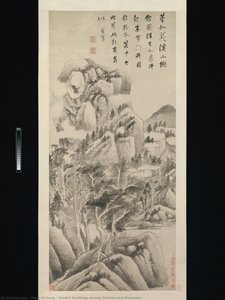
We are looking at 明 董其昌 溪山樾館圖 軸 紙本 Shaded Dwellings among Streams and Mountains, a significant work by the Ming dynasty artist Dong Qichang. Created in 1622, this piece is a vertical Chinese landscape painting, or Shanshui, rendered on paper. It represents a moment in the artist's career when his theories on the Southern School of painting were deeply integrated into his personal practice.

Pinturas de Dong Qichang, classificadas de 11 a 54

11Landscape in the Style of Mi Fu (1612) de Dong QichangLandscape in the Style of Mi Fu1612 · Metropolitan Museum of Art 12Poem in Cursive Script (1622) de Dong QichangPoem in Cursive Script1622 13Poem Commemorating an Imperially Bestowed Feast (1632) de Dong QichangPoem Commemorating an Imperially Bestowed Feast1632 · Metropolitan Museum of Art 14River and Mountains on a Clear Autumn Day (1625) de Dong QichangRiver and Mountains on a Clear Autumn Day1625 · Cleveland Museum of Art 15Poet Commemorating an Imperially Bestowed Feast (1632) de Dong QichangPoet Commemorating an Imperially Bestowed Feast1632 16Poem by Wang Wei (1632) de Dong QichangPoem by Wang Wei1632 17明 董其昌 山水圖 冊 紙本 Landscapes after old masters (1630) de Dong Qichang明 董其昌 山水圖 冊 紙本 Landscapes after old masters1630 · Metropolitan Museum of Art 18Spring Mountains over Warm Greenery (1630) de Dong QichangSpring Mountains over Warm Greenery1630 · Metropolitan Museum of Art 19明 董其昌 山水圖詩 冊 Landscapes and Poems (1625) de Dong Qichang明 董其昌 山水圖詩 冊 Landscapes and Poems1625 · Metropolitan Museum of Art 20English Five character Poem in Running Script (1644) de Dong QichangEnglish Five character Poem in Running Script1644 21Misty Trees and Mountain Range (1670) de Dong QichangMisty Trees and Mountain Range1670 · Minneapolis Institute of Art 22Summer Landscape de Dong QichangSummer LandscapeMetropolitan Museum of Art 23Autumn Mountains de Dong QichangAutumn MountainsMetropolitan Museum of Art 24Du Fu’s Poems in Running Script (1626) de Dong QichangDu Fu’s Poems in Running Script1626 25Calligraphy after ancient masters (1600) de Dong QichangCalligraphy after ancient masters1600 26Epitaph for Wang Jihuan and his Wife, Madame Min (1622) de Dong QichangEpitaph for Wang Jihuan and his Wife, Madame Min1622 27Shaded Dwellings among Streams and Mountains (1622) de Dong QichangShaded Dwellings among Streams and Mountains1622 · Metropolitan Museum of Art 28Steep Mountains and Silent Waters (1632) de Dong QichangSteep Mountains and Silent Waters1632 · Kimbell Art Museum 29Landscape in the Style of Ni Zan de Dong QichangLandscape in the Style of Ni Zan 30Letter de Dong QichangLetter 31River Landscape, in Ming style de Dong QichangRiver Landscape, in Ming style 32"Guitian fu" by Zhang Pingzi de Dong Qichang"Guitian fu" by Zhang Pingzi 33Scene in Jiangnan de Dong QichangScene in Jiangnan 34Letter de Dong QichangLetter 35Eight Views of Autumn Moods-8 de Dong QichangEight Views of Autumn Moods-8China Modern and Contemporary Art Document Research Center 36Eight Views of Autumn Moods-5 de Dong QichangEight Views of Autumn Moods-5China Modern and Contemporary Art Document Research Center 37Calligraphy de Dong QichangCalligraphy 38COUPLET IN RUNNING SCRIPT de Dong QichangCOUPLET IN RUNNING SCRIPT 39CALLIGRAPHY AFTER ZHONG YOU de Dong QichangCALLIGRAPHY AFTER ZHONG YOU 40CALLIGRAPHY IN CURSIVE SCRIPT de Dong QichangCALLIGRAPHY IN CURSIVE SCRIPT 41CALLIGRAPHY IN RUNNING SCRIPT de Dong QichangCALLIGRAPHY IN RUNNING SCRIPT 42LANDSCAPE de Dong QichangLANDSCAPE 43Eight Views of Autumn Moods-3 de Dong QichangEight Views of Autumn Moods-3China Modern and Contemporary Art Document Research Center 44LONELY TREES IN AN ISOLATED VILLAGE de Dong QichangLONELY TREES IN AN ISOLATED VILLAGE 45Eight Views of Autumn Moods-4 de Dong QichangEight Views of Autumn Moods-4China Modern and Contemporary Art Document Research Center 46Eight Views of Autumn Moods-2 de Dong QichangEight Views of Autumn Moods-2China Modern and Contemporary Art Document Research Center 47LETTERS de Dong QichangLETTERS 48COLLECTION OF LETTERS de Dong QichangCOLLECTION OF LETTERS 49CI POEMS IN RUNNING SCRIPT de Dong QichangCI POEMS IN RUNNING SCRIPT 50LANDSCAPE AND CALLIGRAPHY de Dong QichangLANDSCAPE AND CALLIGRAPHY 51ODE TO THE RED CLIFF IN RUNNING SCRIPT de Dong QichangODE TO THE RED CLIFF IN RUNNING SCRIPT 52Eight Views of Autumn Moods-1 de Dong QichangEight Views of Autumn Moods-1China Modern and Contemporary Art Document Research Center 53AUTUMN MOUNTAIN WITH RED TREES de Dong QichangAUTUMN MOUNTAIN WITH RED TREES 54Mountain landscape (1617) de Dong QichangMountain landscape1617 · National Gallery of Victoria

Pinturas famosas de Dong Qichang, período por período

Os temas que cativaram o olhar de Dong Qichang

Os quatro temas que mais se repetem nestas obras originais, cada um com o seu melhor exemplo.

Os museus que guardam os originais de Dong Qichang

Os 7 museus que detêm a maioria das pinturas desta página.

Museus Cidade Obras de Dong Qichang Pinturas desta lista
Metropolitan Museum of Art, Nova YorkMetropolitan Museum of Art Nova York 10 明 董其昌 荊谿招隱圖 卷 Invitation to Reclusion at Jingxi, 明 董其昌 倣倪瓚山水圖 軸 Landscape with Trees in the Manner of Ni Zan (1301–1374), Landscape in the Style of Mi Fu
China Modern and Contemporary Art Document Research Center, PequimChina Modern and Contemporary Art Document Research Center Pequim 7 Eight Views of Autumn Moods-6, Eight Views of Autumn Moods-8, Eight Views of Autumn Moods-5
Cleveland Museum of Art, ClevelandCleveland Museum of Art Cleveland 2 Mt. Qingbian, River and Mountains on a Clear Autumn Day
Minneapolis Institute of Art, MinneapolisMinneapolis Institute of Art Minneapolis 2 Studies of Traditional Trees and Rocks, Misty Trees and Mountain Range
Yale University Art Gallery, New HavenYale University Art Gallery New Haven 1 Reminiscence of Jian River
Kimbell Art Museum, Fort WorthKimbell Art Museum Fort Worth 1 Steep Mountains and Silent Waters
National Gallery of Victoria, MelbourneNational Gallery of Victoria Melbourne 1 Mountain landscape

Dong Qichang, uma pintura emblemática por década

Obras por década

Escolha uma década para ver a obra original que a define.

Pinturas de Dong Qichang: a galeria responde

Qual pintura de Dong Qichang é a mais famosa de todas?Revelar a resposta

明 董其昌 荊谿招隱圖 卷 Invitation to Reclusion at Jingxi (1611), Metropolitan Museum of Art, Nova York. 明 董其昌 倣倪瓚山水圖 軸 Landscape with Trees in the Manner of Ni Zan (1301–1374) (1622) e Excerpt from Xie Huilian’s Prose Poem “On Snow” vêm a seguir.

Qual era a idade de Dong Qichang ao concluir 明 董其昌 荊谿招隱圖 卷 Invitation to Reclusion at Jingxi?Revelar a resposta

56 anos: 明 董其昌 荊谿招隱圖 卷 Invitation to Reclusion at Jingxi data de 1611, e Dong Qichang nasceu em 1555.

Quais são as 10 principais pinturas de Dong Qichang?Revelar a resposta

明 董其昌 荊谿招隱圖 卷 Invitation to Reclusion at Jingxi, 明 董其昌 倣倪瓚山水圖 軸 Landscape with Trees in the Manner of Ni Zan (1301–1374), Excerpt from Xie Huilian’s Prose Poem “On Snow”, Eight Views of Autumn Moods-6, Untitled (AQR4UL), Mt. Qingbian, Reminiscence of Jian River, Studies of Traditional Trees and Rocks, Transcription of the "Prose-poem on Promenading in the Back Garden" by Xie Tiao (464–499) and "Zuoyouming" by Cui Yuan (77–142) e 明 董其昌 溪山樾館圖 軸 紙本 Shaded Dwellings among Streams and Mountains. O ranking acima apresenta o ano e o museu de cada uma.

Quantas obras Dong Qichang criou?Revelar a resposta

Nosso catálogo contém 54 obras de Dong Qichang, datadas de 1600 a 1632.

Onde estão expostos os originais mais famosos de Dong Qichang?Revelar a resposta

Principalmente em Metropolitan Museum of Art (Nova York), China Modern and Contemporary Art Document Research Center (Pequim) e Cleveland Museum of Art (Cleveland). A tabela de museus acima lista todos eles.

Quando é que Dong Qichang criou as suas pinturas mais famosas?Revelar a resposta

Em 1620s: 9 das 54 obras nesta página foram feitas então, sendo 明 董其昌 倣倪瓚山水圖 軸 Landscape with Trees in the Manner of Ni Zan (1301–1374) delas.

Quais são as obras mais famosas de Dong Qichang no início e no fim de sua carreira?Revelar a resposta

Nesta página, a mais antiga é Calligraphy after ancient masters (1600) e a mais recente é Poem Commemorating an Imperially Bestowed Feast (1632).

Quais temas Dong Qichang mais explorou?Revelar a resposta

Trees (9), Mountains (8) e Calligraphy (8), entre as 54 obras nesta página.

Em qual técnica Dong Qichang mais trabalhou?Revelar a resposta

Ink On Paper, para 16 das 54 obras nesta página.

Quais obras originais de Dong Qichang o Metropolitan Museum of Art possui?Revelar a resposta

明 董其昌 荊谿招隱圖 卷 Invitation to Reclusion at Jingxi, 明 董其昌 倣倪瓚山水圖 軸 Landscape with Trees in the Manner of Ni Zan (1301–1374) e Landscape in the Style of Mi Fu: o Metropolitan Museum of Art, Nova York detém 10 das obras desta página.

Dong Qichang: o artista

Uma Vida Dedicada à Tinta: O Mundo de Dong Qichang

Dong Qichang (1555–1636) foi muito mais do que um simples pintor; ele foi a personificação do oficial letrado do final da dinastia Ming, um homem cuja vida estava intrinsecamente entrelaçada com a caligrafia, a pintura e uma profunda dedicação à teoria da arte. Nascido em Huating, perto da atual Xangai, em uma modesta família de estudiosos, a ambição inicial de Dong não residia nas artes, mas sim na conquista de um cargo na burocracia imperial. Suas primeiras tentativas nos exames de serviço civil revelaram-se infrutíferas, em grande parte devido à sua percebida falta de destreza na caligrafia — uma ironia profunda, considerando que ele viria a ser celebrado como um dos maiores calígrafos da China. Esse revés impulsionou-o em um rigoroso processo de aperfeiçoamento pessoal, dominando não apenas o uso do pincel, mas também as ricas tradições da expressão literária e artística chinesa.

A perseverança de Dong rendeu frutos quando ele passou no nível mais alto dos exames imperiais aos 34 anos, dando início a uma carreira que o levou a ascender nos escalões do governo Ming. No entanto, sua vida oficial não foi isenta de turbulências. Ele enfrentou controvérsias decorrentes de seus padrões intransigentes e de uma personalidade ocasionalmente abrasiva, o que resultou em períodos de aposentadoria e até em um incidente no qual sua residência foi atacada por uma multidão enfurecida, após ele ter supostamente insultado mulheres que buscavam reparação por queixas. Apesar desses desafios, Dong permaneceu firme em suas buscas artísticas, vendo nelas algo essencial à sua identidade e um meio de expressar suas convicções filosóficas mais profundas.

As Duas Escolas e o Ideal do Sul

O legado mais duradouro de Dong Qichang não reside apenas em suas pinturas, mas em sua revolucionária teoria da arte. Ele propôs uma divisão na pintura de paisagem chinesa em duas escolas distintas: a “Escola do Norte” e a “Escola do Sul”. Esta categorização, inicialmente sugerida por seu amigo Mo Shilong, não se baseava na geografia, mas sim em fundamentos filosóficos enraizados no Budismo Chan. A Escola do Norte, argumentava ele, enfatizava o detalhe meticuloso, as cores vibrantes e uma aquisição gradual de habilidade — focando na proficiência técnica e no apelo a gostos mais amplos. Em contraste, a Escola do Sul priorizava o pincelado expressivo, a espontaneidade caligráfica e uma compreensão intuitiva da essência, personificando o espírito dos estudiosos-amadores que pintavam para o autoconhecimento, e não para o ganho comercial.

Ele defendeu a Escola do Sul como a verdadeira herdeira da tradição artística chinesa, acreditando que seus praticantes alcançavam uma compreensão mais profunda através da expressão direta. Central a este ideal estava a própria caligrafia — vista não apenas como escrita decorativa, mas como uma manifestação do caráter interior e do estado espiritual do artista. Dong admirava mestres como Mi Fu e Ni Zan, vendo-os como exemplares deste estilo individualista. Ele acreditava que os artistas deveriam construir sobre os alicerces lançados por esses predecessores, transformando a tradição em vez de simplesmente imitá-la, alcançando uma forma de “iluminação súbita” através de sua obra.

Um Estilo de Paisagem Único: Distorção e Expressão

As próprias pinturas de Dong Qichang refletem as suas convicções teóricas. Ele evitava deliberadamente o polimento excessivo ou o sentimentalismo, optando, em vez disso, por paisagens caracterizadas por características espaciais intencionalmente distorcidas e um foco no pincelismo expressivo. Embora enraizada nas tradições de mestres anteriores da dinastia Yuan – particularmente os “Quatro Mestres” – a sua obra era distintamente pessoal. Ele não buscava um realismo fotográfico, mas sim a evocação de atmosfera, de humor e de ressonância espiritual.

O seu caderno de esboços, que contém estudos primordiais de rochas e árvores, oferece um vislumbre raro do seu processo analítico. Estes esboços, de uma simplicidade enganosa, revelam a sua observação meticulosa da natureza e a sua exploração de diferentes possibilidades composicionais. Obras maduras como “Autumn Mountains” exibem a sua magistral técnica de lavagem de tinta, criando paisagens serenas que convidam à contemplação. As suas pinturas apresentam frequentemente montanhas imponentes envoltas em névoa, rios sinuosos e cenas escassamente povoadas – tudo renderizado com um delicado equilíbrio entre o controlo e a espontaneidade.

Legado e Influência

A influência de Dong Qichang sobre as gerações subsequentes de artistas chineses foi profunda e transformadora. Suas teorias a respeito das escolas do Norte e do Sul tornaram-se elementos intrínsecos ao discurso estético, moldando o rumo da pintura de paisagem por séculos a fio. Ele inspirou uma onda de pintores "individualistas" que buscavam emular seu estilo expressivo e sua abordagem filosófica, elevando a arte a um patamar de introspecção espiritual.

O início da dinastia Qing testemunhou a ascensão de diversos artistas proeminentes — incluindo os "Quatro Monges" e os "Quatro Wangs" — que foram diretamente influenciados pela obra de Dong. Colecionadores, particularmente naquelas regiões prósperas como Sungchiang e Yangchou, buscavam ansiosamente suas pinturas e as de seus seguidores, consolidando ainda mais sua reputação como um mestre incontestável. Mesmo hoje, Dong Qichang é reverenciado como uma das figuras mais cruciais da história da arte chinesa — um oficial letrado cuja dedicação à tinta e ao pincel transformou não apenas a pintura, mas a própria maneira como os artistas compreendiam seu lugar dentro da tradição.

  • Temas Principais: Cultura letrada, Budismo Chan, estética da paisagem, expressão individual
  • Influências: Zhao Mengfu, Wen Zhengming, Mi Fu, Ni Zan, Mestres da Dinastia Yuan
  • Características Chave: Traços espaciais distorcidos, pinceladas expressivas, técnica de lavagem de tinta, espontaneidade caligráfica