Retrato de Donato Creti

As 46 Pinturas Mais Famosas de Donato Creti, uma Seleção da Galeria

Atualizado em Novembro 2026 · classificado pela nossa pontuação de popularidade (pesquisas, visitas e pedidos de cada obra) · 46 obras de Donato Creti em nosso catálogo

Em resumo

De todas as obras originais que Donato Creti deixou, a mais famosa é Astronomical Observations. A Comet. Logo atrás vêm Astronomical Observations. The Moon e Astronomical Observations. Mars. Nosso catálogo contém 46 obras de Donato Creti; a galeria preservou as 46 que o mundo mais admira, cada uma exibida com sua data, seu museu e sua história.

1671 – 1749, Cremona Rococo Mais obras: Palazzo d'Accursio

As 10 principais pinturas de Donato Creti: a escolha da galeria

1
Astronomical Observations. A Comet de Donato Creti

Astronomical Observations. A Comet

Oil On Canvas

In this intimate work, titled Astronomical Observations. A Comet, the artist Donato Creti captures a specific celestial phenomenon. Creti, who lived from 1671 to 1749, approached the heavens with a precision that reflects the scientific curiosity of his era. This particular piece is part of a larger, cohesive series of eight small canvases. Each work in the collection focuses on a different celestial body, including the Sun, the Moon, Mercury,…

2
Astronomical Observations. The Moon de Donato Creti

Astronomical Observations. The Moon

Oil On Canvas

The night air hangs heavy and still as two figures find themselves lost in the vastness of the dark. On the left, a man stands poised, his gaze fixed upward, while to the right, a woman sits in quiet contemplation, her eyes following the same celestial path. They are small against the immense backdrop of the sky, mere witnesses to the celestial dance unfolding above them. A large, luminous moon…

3
Astronomical Observations. Mars de Donato Creti

Astronomical Observations. Mars

Oil On Canvas

In this oil on canvas, the celestial and the terrestrial meet under a nocturnal sky. A man stands to the left, hands raised toward the heavens in a gesture of observation or perhaps reverence. Nearby, other figures populate the landscape, their presence grounding the vastness of the cosmos within a human scale. An open book lies on the ground, a silent witness to the intellectual pursuit unfolding in the dark.…

4
Allegorical Tomb of Joseph Addison (1720) de Donato Creti

Allegorical Tomb of Joseph Addison

1720 · Oil On Canvas · Museu Nacional de Arte Antiga, Lisboa

In this Baroque-style oil on canvas, we find ourselves standing before a scene of profound solemnity. The composition is structured around a monumental architectural landscape, where classical ruins and a tall, dark obelisk rise against a soft, twilight sky. On the right, a large vertical element supports a statue of a man perched upon a high pedestal, watching over the scene. The atmosphere is one of quiet grandeur, achieved through…

5
Studies for the 'Road to Calvary' de Donato Creti

Studies for the 'Road to Calvary'

Ink On Paper

In these preparatory studies for the 'Road to Calvary', we encounter the hand of Donato Creti. The work captures a moment of intense movement and religious narrative, focusing on the procession toward Christ's crucifixion. It is a study of human emotion and collective action, rendered with a sense of urgency that suggests the artist was working through the complexities of the scene before committing it to a larger canvas.

6
The Glorification of St. Anthony of Padua (1700) de Donato Creti

The Glorification of St. Anthony of Padua

1700 · Oil On Canvas

The Glorification of St. Anthony of Padua is a fresco by Donato Creti. This work captures the ascension of Saint Anthony of Padua into heaven. He moves upward, a figure of divine grace, surrounded by a host of angels and cherubs. The scene is a celestial celebration of religious glorification.

7
The Cumaean Sibyl (1730) de Donato Creti

The Cumaean Sibyl

1730 · Oil · Museu de Belas Artes de Boston, Boston

Donato Creti’s The Cumaean Sibyl centers on a seated female figure, captured in a three-quarter view. Her gaze is directed upward and toward the left, a posture suggesting a moment of divine reception or prophetic insight. Accompanying her is a small winged cherub, which holds a scroll, reinforcing the theme of oracular revelation. The arrangement of the figures creates a focused, intimate scene within a dark, receding background.

8
Astronomical Observations: Jupiter de Donato Creti

Astronomical Observations: Jupiter

Oil On Canvas

Astronomical Observations: Jupiter is a work by the Italian painter Donato Creti. Created in 1711, the painting belongs to a specialized series of eight small canvases. This collection features various celestial bodies, including the Sun, the Moon, a comet, and the five known planets of the era.

9
Wreathed Muse de Donato Creti

Wreathed Muse

Oil On Canvas · Kunsthistorisches Museum, Viena

A solitary figure emerges from a heavy, dark atmosphere, her presence defined by a sudden, dramatic illumination. This Muse reaches outward, her arm cutting a sharp diagonal across the frame toward the right edge, as if grasping for an unseen inspiration or a fleeting thought. The light catches the soft contours of her face and the pale skin of her hand, while the rest of her form dissolves into deep…

10
Alexander the Great Threatened by His Father de Donato Creti

Alexander the Great Threatened by His Father

Oil On Canvas · National Gallery of Art, Washington

The air in the grand hall feels heavy, thick with the scent of cold marble and the metallic tang of a drawn blade. At the center of this tension, a father and son collide in a silent scream of movement. On the right, a man wears a golden crown and a yellow garment, his blue and gold embroidered mantle swirling around him like a storm. He holds a bared sword…

A seleção de Donato Creti continua, de 11 a 46

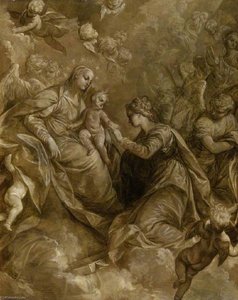
11LA GLORIFICATION DE SAINT BERNARDIN DE SIENNE de Donato CretiLA GLORIFICATION DE SAINT BERNARDIN DE SIENNEMuseu do Louvre 12Artemisia drinking the Ashes of Mausolus (1713) de Donato CretiArtemisia drinking the Ashes of Mausolus1713 · National Gallery 13Allegorical Tomb of Joseph Addison (1642–1719), Essayist and Poet (1721) de Donato CretiAllegorical Tomb of Joseph Addison (1642–1719), Essayist and Poet1721 · Government Art Collection 14Allegorical Tomb of Thomas Wharton (1648–1715), 1st Marquess of Wharton, Politician (1721) de Donato CretiAllegorical Tomb of Thomas Wharton (1648–1715), 1st Marquess of Wharton, Politician1721 · Government Art Collection 15Astronomical Observations. Mercury de Donato CretiAstronomical Observations. Mercury 16Astronomical Observations. Venus de Donato CretiAstronomical Observations. Venus 17Astronomical Observations. The Sun de Donato CretiAstronomical Observations. The Sun 18Astronomical Observations. Saturn de Donato CretiAstronomical Observations. Saturn 19The Immaculate Conception between Saint Vincent Ferrier and Saint Anthony of Padua de Donato CretiThe Immaculate Conception between Saint Vincent Ferrier and Saint Anthony of Padua 20Six studies of heads de Donato CretiSix studies of heads 21Religious subject de Donato CretiReligious subject 22Woman with turban and portrait of young man de Donato CretiWoman with turban and portrait of young man 23Studies of Hagar and Ishmael de Donato CretiStudies of Hagar and Ishmael 24Head of a young woman in profile to the left de Donato CretiHead of a young woman in profile to the left 25A naked tied to a tree, accompanied by three angels de Donato CretiA naked tied to a tree, accompanied by three angels 26Young woman in bath de Donato CretiYoung woman in bath 27The Three Ages of Man de Donato CretiThe Three Ages of Man 28Thetis Dipping the Infant Achilles into the Waters of the Styx de Donato CretiThetis Dipping the Infant Achilles into the Waters of the Styx 29Endymion de Donato CretiEndymion 30Pastoral landscape with figures de Donato CretiPastoral landscape with figures 31Head Of A Young Boy de Donato CretiHead Of A Young Boy 32God the Father supported by angels de Donato CretiGod the Father supported by angels 33The Glorification of Saint Bernardin de Sienne de Donato CretiThe Glorification of Saint Bernardin de Sienne 34Head of young boy, looking up and to the right de Donato CretiHead of young boy, looking up and to the right 35A Woman And A Small Boy Seated In A Wooded Landscape With A Piper In The Background de Donato CretiA Woman And A Small Boy Seated In A Wooded Landscape With A Piper In The Background 36Bathers in a Wooded Landscape de Donato CretiBathers in a Wooded Landscape 37The Virgin Bringing the Habit to the Seven Founding Fathers of the Servite Order de Donato CretiThe Virgin Bringing the Habit to the Seven Founding Fathers of the Servite Order 38The Glorification of Saint Antoine de Padoue de Donato CretiThe Glorification of Saint Antoine de Padoue 39The Mystic Marriage of Saint Catherine of Alexandria (1695) de Donato CretiThe Mystic Marriage of Saint Catherine of Alexandria1695 · Museu Fitzwilliam 40Mercury and Paris (1745) de Donato CretiMercury and Paris1745 · Palazzo d'Accursio 41LA GLORIFICATION DE SAINT ANTOINE DE PADOUE de Donato CretiLA GLORIFICATION DE SAINT ANTOINE DE PADOUEMuseu do Louvre 42The Martyrdom of Saint Lawrence de Donato CretiThe Martyrdom of Saint LawrenceStädel Museum 43A patrician family kneeling on a seashore experiencing a vision of the Madonna and Child and Saint Dominic, Saint John the Baptist and another saint de Donato CretiA patrician family kneeling on a seashore experiencing a vision of the Madonna and Child and Saint Dominic, Saint John the Baptist and another saint 44Study Of A Young Boy, Seen From Behind de Donato CretiStudy Of A Young Boy, Seen From Behind 45Achilles Handing over to Chiron de Donato CretiAchilles Handing over to ChironPalazzo d'Accursio 46The Charity (1745) de Donato CretiThe Charity1745 · Palazzo d'Accursio

Os temas que cativaram o olhar de Donato Creti

Os quatro temas que mais se repetem nestas obras originais, cada um com o seu melhor exemplo.

Os museus que guardam os originais de Donato Creti

Os 8 museus que detêm a maioria das pinturas desta página.

Museus Cidade Obras de Donato Creti Pinturas desta lista
Palazzo d'Accursio, BolonhaPalazzo d'Accursio Bolonha 3 Mercury and Paris, Achilles Handing over to Chiron, The Charity
Museu do Louvre, ParisMuseu do Louvre Paris 2 LA GLORIFICATION DE SAINT BERNARDIN DE SIENNE, LA GLORIFICATION DE SAINT ANTOINE DE PADOUE
Government Art Collection, LondresGovernment Art Collection Londres 2 Allegorical Tomb of Joseph Addison (1642–1719), Essayist and Poet, Allegorical Tomb of Thomas Wharton (1648–1715), 1st Marquess of Wharton, Politician
Museu Nacional de Arte Antiga, LisboaMuseu Nacional de Arte Antiga Lisboa 1 Allegorical Tomb of Joseph Addison
Museu de Belas Artes de Boston, BostonMuseu de Belas Artes de Boston Boston 1 The Cumaean Sibyl
Kunsthistorisches Museum, VienaKunsthistorisches Museum Viena 1 Wreathed Muse
National Gallery of Art, WashingtonNational Gallery of Art Washington 1 Alexander the Great Threatened by His Father
National Gallery, LondresNational Gallery Londres 1 Artemisia drinking the Ashes of Mausolus

Donato Creti década a década: a obra original que define cada uma

Obras por década

Escolha uma década para ver a obra original que a define.

Perguntas de colecionadores sobre as pinturas de Donato Creti

Por qual obra Donato Creti é mais conhecido(a)?Revelar a resposta

Astronomical Observations. A Comet. Astronomical Observations. The Moon e Astronomical Observations. Mars vêm a seguir.

Quais são as dez pinturas mais famosas de Donato Creti?Revelar a resposta

Astronomical Observations. A Comet, Astronomical Observations. The Moon, Astronomical Observations. Mars, Allegorical Tomb of Joseph Addison, Studies for the 'Road to Calvary', The Glorification of St. Anthony of Padua, The Cumaean Sibyl, Astronomical Observations: Jupiter, Wreathed Muse e Alexander the Great Threatened by His Father. O ranking acima apresenta o ano e o museu de cada uma.

Quantas pinturas Donato Creti deixou?Revelar a resposta

Nosso catálogo contém 46 obras de Donato Creti, datadas de 1695 a 1745.

Em quais museus estão expostas as obras-primas de Donato Creti?Revelar a resposta

Principalmente em Palazzo d'Accursio (Bolonha), Museu do Louvre (Paris) e Government Art Collection (Londres). A tabela de museus acima lista todos eles.

Em que anos Donato Creti pintou as suas obras mais famosas?Revelar a resposta

Em 1720s: 3 das 46 obras nesta página foram feitas então, sendo Allegorical Tomb of Joseph Addison delas.

Quais são as primeiras e as últimas obras originais famosas de Donato Creti?Revelar a resposta

Nesta página, a mais antiga é The Mystic Marriage of Saint Catherine of Alexandria (1695) e a mais recente é Mercury and Paris (1745).

Quais temas Donato Creti escolheu com mais frequência?Revelar a resposta

Landscape (7), Woman (5) e Sky (5), entre as 46 obras nesta página.

Qual técnica Donato Creti mais utilizou?Revelar a resposta

Oil On Canvas, para 13 das 46 obras nesta página.

A qual movimento artístico pertence Donato Creti?Revelar a resposta

Rococo, a julgar pelos originais nesta página.

Quais obras de Donato Creti estão expostas no Palazzo d'Accursio?Revelar a resposta

Mercury and Paris, Achilles Handing over to Chiron e The Charity: o Palazzo d'Accursio, Bolonha detém 3 das obras desta página.

Donato Creti: vida e obra

Um Bridging de Mundos em Bolonha: A Vida e a Arte de Donato Creti

Donato Creti, nascido em Cremona em 1671 e falecido em Bolonha em 1749, ocupa uma posição fascinante, embora por vezes negligenciada, na transição do Barroco para os estilos Rococó e Neoclássico. Ele não foi simplesmente arrastado por essas correntes mutantes; ele as navegou ativamente, forjando uma voz artística distinta que combinava grandeza teatral com um senso emergente de contenção formal. Seu pai, Gioseffo Creti, também era pintor, embora de menor renome, especializado em representações arquitetônicas – uma base sobre a qual Donato construiria, inicialmente abraçando cenários dramáticos antes de, eventualmente, transcender a mera decoração. A mudança da família para Bolonha no início de sua vida provou ser fundamental, imergindo-o na rica herança artística da cidade e preparando o palco para sua notável carreira.

Os Primeiros Anos e o Desenvolvimento Artístico

A jornada artística de Creti começou com um aprendizado sob Giorgio Rasparini, mas foi seu tutelado com Lorenzo Pasinelli que realmente moldou seu desenvolvimento inicial. Pasinelli, uma figura-chave conectada à escola bolonhesa descendente de Guido Reni, instilou nele uma base acadêmica rigorosa. Mesmo como estudante, Creti demonstrou talento excepcional, ganhando o apelido carinhoso de ‘ragazzino’ – “o menino” – por sua precocidade e habilidade. Essa aptidão natural atraiu o patrocínio de Conte Alessandro Fava, um benfeitor crucial que lhe proporcionou oportunidades para estudo e exploração criativa. As primeiras influências eram prontamente aparentes: os afrescos dinâmicos dos irmãos Carracci ressoaram profundamente, enquanto uma possível temporada em Veneza o expôs ao colorido vibrante e à teatralidade dos mestres venezianos como Veronese. Seus primeiros trabalhos frequentemente exibiam esse toque inspirado por Veronese, particularmente em suas elaboradas configurações arquitetônicas. No entanto, Creti não se contentava com mera imitação; ele absorveu as lições de Pasinelli, mas começou a cultivar uma abordagem única que ia além dos floreios decorativos em direção a uma sensibilidade classicamente informada mais estruturada.

Visões Celestiais e Narrativas Mitológicas

A produção artística de Creti foi notavelmente diversa, abrangendo cenas mitológicas, composições alegóricas e temas religiosos. No entanto, ele é talvez melhor conhecido por sua série de pequenas telas retratando corpos celestes contra paisagens noturnas – uma contribuição verdadeiramente singular para a arte do século XVIII. Encomendadas em 1711 pelo Conde Luigi Marsili, essas pinturas—representando o sol, a lua, um cometa e os então cinco planetas conhecidos (Mercúrio, Vênus, Marte, Júpiter, Saturno)—eram destinadas como um presente diplomático para o Papa Clemente XI. Mais do que meros objetos estéticos, elas serviram como uma peça de defesa, defendendo o estabelecimento de um observatório astronômico em Bolonha. Essa ambição foi finalmente realizada com o apoio papal, solidificando o papel de Creti não apenas como artista, mas como um defensor cultural. A pintura de Júpiter é particularmente notável; apresenta uma representação precisa da Grande Mancha Vermelha e pelo menos duas de suas luas – um testemunho das habilidades observacionais aguçadas de Creti e seu envolvimento com o conhecimento científico contemporâneo. Além desses estudos astronômicos, obras como *O Casamento Místico de Santa Catarina de Alexandria* e *Túmulo Alegórico de Joseph Addison* demonstram sua maestria na composição, cor e narrativa.

Um Legado de Transição e Influência

O historiador da arte Rudolf Wittkower descreveu apropriadamente Creti como o “Marco Benefial bolonhês”, reconhecendo seu papel fundamental em preencher a lacuna entre as tendências decorativas do Rococó e o estilo neoclássico emergente. Ele não foi um inovador radical, mas sim um sintetizador habilidoso que absorveu diversas influências e as forjou em algo exclusivamente seu. Seu trabalho é caracterizado por um estilo grandioso academizado – deliberado, refinado e enraizado em princípios clássicos – que evolui para um neoclassicismo manierista com modelagem nítida de figuras. Essa combinação de elegância e formalidade ressoou com os contemporâneos e influenciou as gerações subsequentes de artistas, incluindo Aureliano Milani, Francesco Monti e Ercole Graziani the Younger. A combinação única de habilidade artística e curiosidade científica torna Creti uma figura cativante na história da arte – um pintor que olhou para o passado em busca de inspiração e para os céus em busca de compreensão, deixando um legado que continua a cativar e inspirar.

Alunos Notáveis

  • Aureliano Milani
  • Francesco Monti
  • Ercole Graziani the Younger
  • Domenico Maria Fratta
  • Giuseppe Peroni