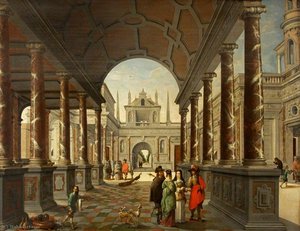
Retrato de Dirck Van Delen

Pinturas de Dirck Van Delen: As 57 mais famosas, sob o olhar de uma galeria

Atualizado em Novembro 2026 · classificado pela nossa pontuação de popularidade (pesquisas, visitas e pedidos de cada obra) · 57 obras de Dirck Van Delen em nosso catálogo

Em resumo

Aos olhos da galeria, a pintura mais famosa de Dirck Van Delen é A musical company in a Renaissance hall (1636), cuja obra original está exposta no Museum Boijmans Van Beuningen, em Roterdã. Iconoclasm in a Church (1630) e A colonnade. Part of a seven-part deorative sequence (1630) completam o trio que todos reconhecem. Dos 57 trabalhos de Dirck Van Delen em nosso catálogo, a galeria apresenta abaixo as 57 obras mais famosas, cada uma original, com seu ano, seu museu e o que a torna única.

1605 – 1671, Heusden Baroque Mais obras: Rijksmuseum

As 10 principais pinturas de Dirck Van Delen na galeria

1
A musical company in a Renaissance hall (1636) de Dirck Van Delen

A musical company in a Renaissance hall

1636 · Oil On Canvas · Museum Boijmans Van Beuningen, Roterdã

A checkered floor of stone and shadow stretches toward a distant, imagined horizon. In this Renaissance hall, the geometry of the room dictates the movement of the soul. Light spills from unseen windows on the left, catching the sharp edge of a lace collar and the heavy sheen of satin. The air feels still, held in place by massive columns and the weight of dark, polished wood. Figures gather in…

2
Iconoclasm in a Church (1630) de Dirck Van Delen

Iconoclasm in a Church

1630 · Oil On Panel · Rijksmuseum, Amsterdã

Dirck van Delen painted Iconoclasm in a Church in 1630. The work presents an imagined scene of iconoclasm within a church interior. It captures a moment of religious upheaval, focusing on the destruction of sacred objects and the disruption of ecclesiastical order.

3
A colonnade. Part of a seven-part deorative sequence (1630) de Dirck Van Delen

A colonnade. Part of a seven-part deorative sequence

1630 · Oil On Canvas · Rijksmuseum, Amsterdã

A colonnade. Part of a seven-part deorative sequence is an oil on canvas by Dirck van Delen. The work is dated 1630. It is also known by the title Gallery of a Palace with Ornamental Architecture and Columns. This painting was designed to function as part of a larger whole, serving as one piece of a seven-part wall decoration intended for a room in a palace.

4
The tomb of a Lord from the Van Tuyll van Serooskerken-family (1634) de Dirck Van Delen

The tomb of a Lord from the Van Tuyll van Serooskerken-family

1634 · Oil On Panel · Staatliche Kunsthalle Karlsruhe, Karlsruhe

In this 1634 work, we find ourselves standing within a space that feels both profoundly real and entirely imagined. Dirck van Delen, a painter who specialized in the construction of architectural fantasies, has crafted a monumental funerary monument for a member of the Van Tuyll van Serooskerken family. The scene is defined by a rigorous linear perspective that draws the eye deep into a grand, silent interior. A sense of…

5
An Architectural Fantasy (1634) de Dirck Van Delen

An Architectural Fantasy

1634 · Oil · National Gallery, Londres

The scene unfolds within An Architectural Fantasy, a work painted by Dirck van Delen in 1634. This composition presents an idealised city square, where the mathematical precision of perspective and proportion meets the shifting play of light and shade. The space feels vast and structured, inviting the eye to wander through a world of imagined grandeur and architectural order.

6
The Real Tennis Players (1626) de Dirck Van Delen

The Real Tennis Players

1626 · Oil On Panel

The Real Tennis Players is a work by Dirck van Delen, an artist who emerged from Heusden, Netherlands. This particular piece dates to about 1626, a period during which the artist was establishing his presence within the Dutch Golden Age. Van Delen, who lived from 1605 to 1671, focused his attention on the intricate details of architectural spaces and the social life contained within them.

7
Architectural Fantasy with Figures (1633) de Dirck Van Delen

Architectural Fantasy with Figures

1633 · Oil · Noordbrabants Museum, 's-Hertogenbosch

Architectural Fantasy with Figures emerges from the mind of Dirck van Delen, a painter who crafts grand, imagined spaces that challenge the boundaries of reality. This work invites the viewer into a structured world of palatial scale and mathematical precision. The artist, born in Heusden, Netherlands, in 1605, spent his life building these illusions of stone and light. He remains a significant figure of the Dutch Golden Age, having lived…

8
Gallant Scene in a Palace (1633) de Dirck Van Delen

Gallant Scene in a Palace

1633 · Oil On Panel · Petit Palais, Paris

Gallant Scene in a Palace is a work by Dirck van Delen, executed in 1633. The artist, born in Heusden, Netherlands, in 1605, spent his life crafting the geometry of imagined spaces. He died in 1671, leaving behind a legacy of structured illusions and precise perspectives.

9
An Interior with Ladies and Cavaliers (1629) de Dirck Van Delen

An Interior with Ladies and Cavaliers

1629 · Oil On Canvas · National Gallery of Ireland, Dublin

In the quiet, structured world of 1629, An Interior with Ladies and Cavaliers emerges from the brush of Dirck van Delen. This work invites the viewer into an intimate interior where genre scenes unfold amidst the grandeur of a private space. The scene captures a moment of social grace, pulling us into a setting where the architecture itself feels like a silent participant in the gathering.

10
Architectural Interior at Night with the Priests of Bel (1628) de Dirck Van Delen

Architectural Interior at Night with the Priests of Bel

1628 · Oil On Canvas · Rhode Island School of Design Museum of Art, Providence

Architectural Interior at Night with the Priests of Bel by Dirck van Delen depicts a gathering of priests or religious figures within a large interior at night. The composition is structured around a deep linear perspective that directs the viewer's gaze through a series of receding classical arches and colonnades. These architectural elements lead toward a distant, dimly lit interior. The use of lines is rigorous throughout the scene, with…

Pinturas de Dirck Van Delen, classificadas de 11 a 57

11Architectural Scene: A Palace Court (1627) de Dirck Van DelenArchitectural Scene: A Palace Court1627 · Rhode Island School of Design Museum of Art 12Allegory on the suppression of religious freedom in the Netherlands under the Duke of Alva; the 17 Dutch provincial virgins kneeling for Alva, Granvelle and the pope, in the background the decapitation of Egmond and Hoorne on the market in Brussels (1629) de Dirck Van DelenAllegory on the suppression of religious freedom in the Netherlands under the Duke of Alva; the 17 Dutch provincial virgins kneeling for Alva, Granvelle and the pope, in the background the decapitation of Egmond and Hoorne on the market in Brussels1629 · Museum Catharijneconvent 13Architectural fantasy with figures (1633) de Dirck Van DelenArchitectural fantasy with figures1633 14Fantasy architecture with an elegant couple (1627) de Dirck Van DelenFantasy architecture with an elegant couple1627 · Noordbrabants Museum 15Fantasy architecture with two elegant couples (1633) de Dirck Van DelenFantasy architecture with two elegant couples1633 · Noordbrabants Museum 16Interior of Church (1635) de Dirck Van DelenInterior of Church1635 · Royal Museum of Fine Arts Antwerp 17Distinguished Dinner Company in an Interior (1631) de Dirck Van DelenDistinguished Dinner Company in an Interior1631 · Nationalmuseum 18A palatial interior with ladies and gentleman feasting, entertained by Carnival mummers (1632) de Dirck Van DelenA palatial interior with ladies and gentleman feasting, entertained by Carnival mummers1632 19Fantasy architecture with four elegantly dressed women on the steps of a ramp (1627) de Dirck Van DelenFantasy architecture with four elegantly dressed women on the steps of a ramp1627 · New York Historical Society 20A Seven-Part Decorative Sequence: An Interior, Dirck van Delen, 1630 - 1632 (1632) de Dirck Van DelenA Seven-Part Decorative Sequence: An Interior, Dirck van Delen, 1630 - 16321632 · Rijksmuseum 21Colonnade with people and playing children (1637) de Dirck Van DelenColonnade with people and playing children1637 22Conversation outside a Palace (1636) de Dirck Van DelenConversation outside a Palace1636 · Statens Museum For Kunst 23Company at a Palace (1645) de Dirck Van DelenCompany at a Palace1645 · Statens Museum For Kunst 24Christ Healing at the Pool of Bethesda (1637) de Dirck Van DelenChrist Healing at the Pool of Bethesda1637 · Statens Museum For Kunst 25Elegant Company in Front of a Palace (1644) de Dirck Van DelenElegant Company in Front of a Palace1644 · Statens Museum For Kunst 26Susanna and the two elders (1640) de Dirck Van DelenSusanna and the two elders1640 · Museum Boijmans Van Beuningen 27A Family beside the Tomb of Prince William I in the Nieuwe Kerk, Delft (1645) de Dirck Van DelenA Family beside the Tomb of Prince William I in the Nieuwe Kerk, Delft1645 · Rijksmuseum 28Baroque church interior with a friar and peasants (1645) de Dirck Van DelenBaroque church interior with a friar and peasants1645 29Courtyard of a palace (1636) de Dirck Van DelenCourtyard of a palace1636 · Staatliche Kunsthalle Karlsruhe 30Church Interior with the Parable of the Pharisee and the Publican (Luke 18:9-14) (1653) de Dirck Van DelenChurch Interior with the Parable of the Pharisee and the Publican (Luke 18:9-14)1653 31Interior of a Gothic Church, Dirck van Delen, 1641 (1641) de Dirck Van DelenInterior of a Gothic Church, Dirck van Delen, 16411641 · Rijksmuseum 32The Great Hall of the Binnenhof in The Hague (1651) de Dirck Van DelenThe Great Hall of the Binnenhof in The Hague1651 · Rijksmuseum 33Great Garden Palace (1640) de Dirck Van DelenGreat Garden Palace1640 · Kunsthistorisches Museum 34A Seven-Part Decorative Sequence: An Outdoor Stairway, Dirck van Delen, 1630 - 1632 (1632) de Dirck Van DelenA Seven-Part Decorative Sequence: An Outdoor Stairway, Dirck van Delen, 1630 - 16321632 · Rijksmuseum 35A Seven-Part Decorative Sequence: An Outdoor Stairway, Dirck van Delen, 1630 - 1632 (1632) de Dirck Van DelenA Seven-Part Decorative Sequence: An Outdoor Stairway, Dirck van Delen, 1630 - 16321632 · Rijksmuseum 36A Seven-Part Decorative Sequence: An Outdoor Stairway, Dirck van Delen, 1630 - 1632 (1632) de Dirck Van DelenA Seven-Part Decorative Sequence: An Outdoor Stairway, Dirck van Delen, 1630 - 16321632 · Rijksmuseum 37A Seven-Part Decorative Sequence: An Outdoor Stairway, Dirck van Delen, 1630 - 1632 (1632) de Dirck Van DelenA Seven-Part Decorative Sequence: An Outdoor Stairway, Dirck van Delen, 1630 - 16321632 · Rijksmuseum 38A Seven-Part Decorative Sequence: A Gallery, Dirck van Delen, 1630 - 1632 (1632) de Dirck Van DelenA Seven-Part Decorative Sequence: A Gallery, Dirck van Delen, 1630 - 16321632 · Rijksmuseum 39Architectural Capriccio with Jephthah and His Daughter (1633) de Dirck Van DelenArchitectural Capriccio with Jephthah and His Daughter1633 40Palace Courtyard with Figures (1635) de Dirck Van DelenPalace Courtyard with Figures1635 · Philip Hahn Collection 41Elegant Figures in a Loggia (1635) de Dirck Van DelenElegant Figures in a Loggia1635 42An Interior with Ladies and Gentlemen Dining (1629) de Dirck Van DelenAn Interior with Ladies and Gentlemen Dining1629 43Tulip in a Wanli Kendi (1637) de Dirck Van DelenTulip in a Wanli Kendi1637 44A church interior (1642) de Dirck Van DelenA church interior1642 · Finnish National Gallery 45Fantasy architecture with steps and columns (1655) de Dirck Van DelenFantasy architecture with steps and columns1655 · Kunsthistorisches Museum 46Conversation outside a Castle (1636) de Dirck Van DelenConversation outside a Castle1636 · Statens Museum For Kunst 47Perspective Fantasy of a Palace, with Elegant Figures de Dirck Van DelenPerspective Fantasy of a Palace, with Elegant Figures 48An architectural fantasy de Dirck Van DelenAn architectural fantasy 49An Imaginary Church Interior, with a Large Pipe Organ de Dirck Van DelenAn Imaginary Church Interior, with a Large Pipe Organ 50A dutch garden scene de Dirck Van DelenA dutch garden scene 51Jupiter and Alkmene in an Architectural Setting de Dirck Van DelenJupiter and Alkmene in an Architectural Setting 52Interior of a Church de Dirck Van DelenInterior of a ChurchFitzwilliam Museum 53Interior of a Renaissance Church de Dirck Van DelenInterior of a Renaissance Church 54Pool of Bethesda de Dirck Van DelenPool of Bethesda 55Christ and the Woman Taken in Adultery de Dirck Van DelenChrist and the Woman Taken in Adultery 56A Conversation in a Palace Courtyard de Dirck Van DelenA Conversation in a Palace CourtyardScottish National Gallery 57The Entrance to a Palace de Dirck Van DelenThe Entrance to a PalaceDulwich Picture Gallery

Pinturas famosas de Dirck Van Delen, período por período

Os temas que cativaram o olhar de Dirck Van Delen

Os quatro temas que mais se repetem nestas obras originais, cada um com o seu melhor exemplo.

Os museus que guardam os originais de Dirck Van Delen

Os 8 museus que detêm a maioria das pinturas desta página.

Museus Cidade Obras de Dirck Van Delen Pinturas desta lista
Rijksmuseum, AmsterdãRijksmuseum Amsterdã 11 Iconoclasm in a Church, A colonnade. Part of a seven-part deorative sequence, A Seven-Part Decorative Sequence: An Interior, Dirck van Delen, 1630 - 1632
Statens Museum For Kunst, CopenhagueStatens Museum For Kunst Copenhague 5 Conversation outside a Palace, Company at a Palace, Christ Healing at the Pool of Bethesda
Noordbrabants Museum, 's-HertogenboschNoordbrabants Museum 's-Hertogenbosch 3 Architectural Fantasy with Figures, Fantasy architecture with an elegant couple, Fantasy architecture with two elegant couples
Museum Boijmans Van Beuningen, RoterdãMuseum Boijmans Van Beuningen Roterdã 2 A musical company in a Renaissance hall, Susanna and the two elders
Staatliche Kunsthalle Karlsruhe, KarlsruheStaatliche Kunsthalle Karlsruhe Karlsruhe 2 The tomb of a Lord from the Van Tuyll van Serooskerken-family, Courtyard of a palace
Rhode Island School of Design Museum of Art, ProvidenceRhode Island School of Design Museum of Art Providence 2 Architectural Interior at Night with the Priests of Bel, Architectural Scene: A Palace Court
Kunsthistorisches Museum, VienaKunsthistorisches Museum Viena 2 Great Garden Palace, Fantasy architecture with steps and columns
National Gallery, LondresNational Gallery Londres 1 An Architectural Fantasy

Dirck Van Delen, uma pintura emblemática por década

Obras por década

Escolha uma década para ver a obra original que a define.

Pinturas de Dirck Van Delen: a galeria responde

Qual pintura de Dirck Van Delen é a mais famosa de todas?Revelar a resposta

A musical company in a Renaissance hall (1636), Museum Boijmans Van Beuningen, Roterdã. Iconoclasm in a Church (1630) e A colonnade. Part of a seven-part deorative sequence (1630) vêm a seguir.

Qual era a idade de Dirck Van Delen ao concluir A musical company in a Renaissance hall?Revelar a resposta

31 anos: A musical company in a Renaissance hall data de 1636, e Dirck Van Delen nasceu em 1605.

Quais são as 10 principais pinturas de Dirck Van Delen?Revelar a resposta

A musical company in a Renaissance hall, Iconoclasm in a Church, A colonnade. Part of a seven-part deorative sequence, The tomb of a Lord from the Van Tuyll van Serooskerken-family, An Architectural Fantasy, The Real Tennis Players, Architectural Fantasy with Figures, Gallant Scene in a Palace, An Interior with Ladies and Cavaliers e Architectural Interior at Night with the Priests of Bel. O ranking acima apresenta o ano e o museu de cada uma.

Quantas obras Dirck Van Delen criou?Revelar a resposta

Nosso catálogo contém 57 obras de Dirck Van Delen, datadas de 1626 a 1655.

Onde estão expostos os originais mais famosos de Dirck Van Delen?Revelar a resposta

Principalmente em Rijksmuseum (Amsterdã), Statens Museum For Kunst (Copenhague) e Noordbrabants Museum ('s-Hertogenbosch). A tabela de museus acima lista todos eles.

Quando é que Dirck Van Delen criou as suas pinturas mais famosas?Revelar a resposta

Em 1630s: 27 das 57 obras nesta página foram feitas então, sendo A musical company in a Renaissance hall delas.

Quais são as obras mais famosas de Dirck Van Delen no início e no fim de sua carreira?Revelar a resposta

Nesta página, a mais antiga é The Real Tennis Players (1626) e a mais recente é Fantasy architecture with steps and columns (1655).

Quais temas Dirck Van Delen mais explorou?Revelar a resposta

Architecture (28), Columns (26) e People (14), entre as 57 obras nesta página.

Em qual técnica Dirck Van Delen mais trabalhou?Revelar a resposta

Oil On Panel, para 13 das 57 obras nesta página.

Com qual movimento Dirck Van Delen está associado(a)?Revelar a resposta

Baroque, a julgar pelos originais nesta página.

Quais obras originais de Dirck Van Delen o Rijksmuseum possui?Revelar a resposta

Iconoclasm in a Church, A colonnade. Part of a seven-part deorative sequence e A Seven-Part Decorative Sequence: An Interior, Dirck van Delen, 1630 - 1632: o Rijksmuseum, Amsterdã detém 11 das obras desta página.

Dirck Van Delen: o artista

Dirck van Delen: Architect of Illusion

A Era de Ouro Holandesa produziu uma miríade de artistas deslumbrantes, mas poucos capturaram a imaginação da mesma forma que Dirck van Delen (1605-1671). Mais do que um simples pintor, Van Delen foi um arquiteto de ilusão, esculpindo meticulosamente palácios impossíveis e interiores de igrejas deslumbrantes que desafiavam a realidade. Sua obra, em grande parte confinada a fantasias arquitetônicas, oferece uma janela única para as aspirações e a sensibilidade artística da Europa do século XVII – um período obcecado por grandeza, perspectiva e o sublime.

Nascido em Heusden, nos Países Baixos, a vida inicial de Van Delen permanece envolta em certo mistério. Os detalhes precisos de seu aprendizado são debatidos por historiadores da arte, com especulações centradas em uma possível tutela tanto de Frans Hals quanto de Hendrick Aerts, embora uma influência mais plausível tenha se originado de estudos sob Pieter van Bronckhorst e Bartholomeus van Bassen em Delft. Essa conexão com Delft é significativa, pois sugere uma exposição precoce às tendências artísticas emergentes dos Países Baixos – particularmente o domínio do desenho meticuloso e da precisão arquitetônica defendidos por figuras como Jan van Londerseel, cujos gravuras moldaram profundamente a linguagem visual de seu trabalho.

A carreira de Van Delen desdobrou-se principalmente em Arnemuiden, onde serviu como mestre de casa de pedágio e posteriormente ocupou uma posição proeminente no conselho da cidade. Esse envolvimento cívico forneceu estabilidade enquanto permitia que ele se dedicasse à sua arte. Ele se casou três vezes e, apesar de não ter filhos sobreviventes além da infância, estabeleceu um legado através de seus alunos – Daniël de Blieck e Hans Jurriaensz. van Baden – que transmitiram elementos de seu estilo distinto.

The Architect’s Palette: Style and Technique

A identidade artística de Van Delen está firmemente enraizada no período Barroco, mas ele desenvolveu uma abordagem altamente individual. Suas pinturas são caracterizadas por uma atenção quase obsessiva aos detalhes, renderizando meticulosamente cada coluna, cornija e elemento decorativo dentro de seus espaços arquitetônicos imaginários. Ao contrário de muitos de seus contemporâneos que se concentraram em cenas narrativas ou retratos, os assuntos de Van Delen eram inteiramente auto-contidos – palácios grandiosos e igrejas imponentes projetados unicamente para o prazer do espectador.

Sua paleta permaneceu notavelmente consistente ao longo de sua carreira, favorecendo uma gama sofisticada e controlada de cores: azuis e verdes frios contrastando com ocres e vermelhos quentes, muitas vezes pontuados por ouro reluzente. Ele manipulou habilmente a luz e a sombra para criar uma ilusão de profundidade e volume, empregando técnicas emprestadas dos mestres flamengos, mas infundidas com seu próprio senso único. A influência de Hendrick Aerts é particularmente evidente em suas obras iniciais, caracterizadas por um desenho meticuloso de detalhes arquitetônicos e um uso sutil da perspectiva.

Notavelmente, o trabalho de Van Delen frequentemente envolveu colaborações com outros artistas, mais notavelmente Gonzales Coques e Pieter Codde. Embora a natureza exata dessas parcerias permaneça debatida, acredita-se que Van Delen se concentrou principalmente em pintar as figuras dentro de suas composições, confiando nas habilidades dos outros para executar os elementos arquitetônicos. Essa divisão do trabalho reflete uma abordagem pragmática à produção artística – uma que permitiu que ele se concentrasse em sua força principal: criar ilusões convincentes e memoráveis.

Imaginary Realms: Themes and Symbolism

As fantasias arquitetônicas de Van Delen não são meras exibições decorativas; elas estão imbuidas de significado simbólico. Seus palácios, frequentemente adornados com esculturas elaboradas e mobiliário opulento, representam os ideais de riqueza, poder e autoridade divina – qualidades altamente valorizadas durante a Era de Ouro Holandesa. A inclusão de figuras dentro desses espaços—muitas vezes envolvidas em atividades cortesãs ou cerimônias religiosas—sugere um desejo de explorar a relação entre a ambição humana e a aspiração espiritual.

Seus interiores de igrejas, igualmente impressionantes em sua escala e detalhe, evocam uma sensação de reverência e admiração. Esses espaços meticulosamente renderizados, cheios de arcos imponentes, janelas vitrais e ornamentação intrincada, representam a glória de Deus e o poder duradouro da fé. O uso da perspectiva é particularmente notável, criando uma ilusão de vastidão que atrai o espectador para o coração do espaço arquitetônico.

Um aspecto fascinante do trabalho de Van Delen é sua ocasional inclusão de naturezas mortas – notavelmente um único arranjo floral—que se destacam em contraste com seus assuntos predominantemente arquitetônicos. Essas cenas íntimas oferecem um vislumbre do lado mais pessoal do artista, sugerindo uma apreciação pela beleza e pelas formas naturais.

Legacy and Influence

Apesar de sua relativa obscuridade durante sua vida, a obra de Dirck van Delen tem recebido reconhecimento crescente nas últimas décadas. Suas fantasias arquitetônicas meticulosamente renderizadas continuam a cativar os espectadores com suas qualidades ilusórias e sua representação evocativa da Era de Ouro Holandesa. Ele é considerado uma figura-chave no desenvolvimento da pintura barroca holandesa, particularmente por seu uso pioneiro da perspectiva e por sua capacidade de criar ilusões convincentes de espaço.

A influência de Van Delen pode ser vista no trabalho de gerações posteriores de artistas holandeses, incluindo Pieter van Bronckhorst e Bartholomeus van Bassen. Seu legado perdura como um testemunho do poder da imaginação artística – um lembrete de que até os sonhos mais impossíveis podem ser renderizados com detalhes e habilidade impressionantes.