Retrato de Cornelis Troost

Pinturas de Cornelis Troost: As 81 mais famosas, sob o olhar de uma galeria

Atualizado em Novembro 2026 · classificado pela nossa pontuação de popularidade (pesquisas, visitas e pedidos de cada obra) · 82 obras de Cornelis Troost em nosso catálogo

Em resumo

Aos olhos da galeria, a pintura mais famosa de Cornelis Troost é Inspection of a Cavalry Regiment, perhaps by William of Hesse-Homburg (1742), cuja obra original está exposta no Rijksmuseum, em Amsterdã. The Regents of the Oudezijds Huiszittenhuis (1740) e A Couple Making Music, Cornelis Troost, 1743 (1743) completam o trio que todos reconhecem. Dos 82 trabalhos de Cornelis Troost em nosso catálogo, a galeria apresenta abaixo as 81 obras mais famosas, cada uma original, com seu ano, seu museu e o que a torna única.

1696 – 1750, Amesterdão Rococo Mais obras: Rijksmuseum

As 10 principais pinturas de Cornelis Troost na galeria

1
Inspection of a Cavalry Regiment, perhaps by William of Hesse-Homburg (1742) de Cornelis Troost

Inspection of a Cavalry Regiment, perhaps by William of Hesse-Homburg

1742 · Oil · Rijksmuseum, Amsterdã

In this expansive oil painting from 1742, we find ourselves amidst a grand military ceremony set within a wooded landscape. The scene captures a formal inspection of a cavalry regiment, where the rigid structure of military hierarchy meets the organic textures of the natural world. A procession of mounted soldiers and infantry moves through the scene, their presence creating a sense of rhythmic movement across the wide horizontal plane. The…

2
The Regents of the Oudezijds Huiszittenhuis (1740) de Cornelis Troost

The Regents of the Oudezijds Huiszittenhuis

1740 · Oil On Canvas · Amsterdam Museum, Amsterdão

In this oil on canvas composition from 1740, five men are arranged within a structured interior. The group is positioned around a central table, forming a pyramidal configuration that directs the eye through the assembly. The men are dressed in 18th-century attire, featuring heavy fabrics such as silk and velvet. Their garments appear in shades of black, grey, and brown, though one central figure wears a coat of warm ochre.…

3
A Couple Making Music, Cornelis Troost, 1743 (1743) de Cornelis Troost

A Couple Making Music, Cornelis Troost, 1743

1743 · Oil On Panel · Rijksmuseum, Amsterdã

Step closer and observe the intimacy of this 1743 interior. We find ourselves in a private room where the air seems to hold the soft notes of a melody. A man stands to the right, his posture relaxed as he breathes life into a recorder. Beside him, his wife sits in a moment of quiet concentration, her fingers poised to turn the corner of a page in a music book.…

4
Scene in a Coffee Shop (1750) de Cornelis Troost

Scene in a Coffee Shop

1750 · Oil On Canvas · Museu Hermitage, São Petersburgo

The air in the room feels heavy with the scent of roasted beans and the low hum of conversation. Light pours through large windows on the left, slicing through the dimness to strike the edges of ceramic cups and the folds of heavy fabric. It is a wide, expansive space where the architecture of grand arches meets the intimate clutter of social life. A large, ornate medallion on the ceiling,…

5
The Organ Grinder (1743) de Cornelis Troost

The Organ Grinder

1743 · Oil On Canvas · Mauritshuis, Haia

A Moment Captured on an Amsterdam Street The air feels heavy with the soft light of an overcast day as a small crowd gathers in this mid-18th century street scene. In the foreground, a man dressed in dark clothing sits quietly, his gaze fixed upon a woman who cradles a baby in her arms. Beside them, another woman stands near a child, their figures part of a loose, naturalistic grouping…

6
Harlequin, Magician and Barber: The Rivals Exposed (1738) de Cornelis Troost

Harlequin, Magician and Barber: The Rivals Exposed

1738 · Oil On Canvas · Mauritshuis, Haia

Cornelis Troost's “Harlequin, Magician and Barber: The Rivals Exposed,” painted in 1738, isn’t merely a depiction of a bustling street scene; it’s a meticulously crafted window into the social fabric and subtle anxieties of 18th-century Amsterdam. This Baroque masterpiece, now housed within the Mauritshuis museum in The Hague, pulsates with life—a vibrant tableau of commerce, class distinctions, and perhaps even a touch of subversive commentary. Troost, a former actor who…

7
Double portrait of an unknown man and a boy (1722) de Cornelis Troost

Double portrait of an unknown man and a boy

1722 · Print · Rijksmuseum Twenthe, Enschede

In this 1722 portrait, we find ourselves in a private, monochromatic world where the weight of lineage is felt through a subtle, sepia-toned atmosphere. An older man sits with a quiet, regal dignity, his presence anchoring the composition. Beside him, a young boy stands, creating a gentle diagonal that draws the eye through the space. There is a profound sense of stillness here, as if we have interrupted a private…

8
Aeneas and Dido Set Out for the Hunt (1731) de Cornelis Troost

Aeneas and Dido Set Out for the Hunt

1731 · Oil On Canvas · Bavarian State Painting Collections, Munique

The oil painting titled Aeneas and Dido Set Out for the Hunt was created by the Dutch artist Cornelis Troost. This work dates to about 1731. It captures a moment of high drama within an ancient urban setting, where the figures of Aeneas and Dido move amidst a large, bustling entourage. The scene is framed by monumental architecture and the heavy presence of a central golden statue.

9
Triptych depicting the peasants' court from the comedy "Beslikte Swaantje" (1727) de Cornelis Troost

Triptych depicting the peasants' court from the comedy "Beslikte Swaantje"

1727 · Oil On Panel · Amsterdam Museum, Amsterdão

This triptych painting, created in 1727, presents a dramatic scene from the comedy "Beslikte Swaantje", depicting a peasants' court. The composition is organized into three vertical panels, establishing a stage-like setting that offers a wide, panoramic view of a group of characters gathered within an interior. The scene is characterized by a frontal perspective, placing the viewer directly before the unfolding narrative, which enhances the overall theatrical atmosphere of the…

10
Triptych depicting the peasants' court from the comedy "Beslikte Swaantje" (center panel of triptych) (1727) de Cornelis Troost

Triptych depicting the peasants' court from the comedy "Beslikte Swaantje" (center panel of triptych)

1727 · Oil · Amsterdam Museum, Amsterdão

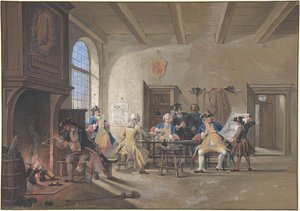
This 1727 oil painting captures a moment of dramatic tension from the comedy Beslikte Swaantje. The scene is set within a domestic interior, where a group of figures is gathered around a fireplace. A prominent character on the left, wearing a large, dark hat and a long cloak, gestures toward the assembly, driving the narrative forward. The composition relies on layered planes to create depth, with a smaller framed painting…

Pinturas de Cornelis Troost, classificadas de 11 a 81

11Triptych depicting the peasants' court from the comedy "Beslikte Swaantje" (right panel of triptych) (1727) de Cornelis TroostTriptych depicting the peasants' court from the comedy "Beslikte Swaantje" (right panel of triptych)1727 · Amsterdam Museum 12Triptych depicting the peasants' court from the comedy "Beslikte Swaantje" (left panel of triptych) (1727) de Cornelis TroostTriptych depicting the peasants' court from the comedy "Beslikte Swaantje" (left panel of triptych)1727 · Amsterdam Museum 13Portrait of two men in an interior (1727) de Cornelis TroostPortrait of two men in an interior1727 · Rijksmuseum Twenthe 14Portrait of Gerrit Sichterman ( -1730) (1726) de Cornelis TroostPortrait of Gerrit Sichterman ( -1730)1726 · Groninger Museum 15Portrait of an unknown man (1732) de Cornelis TroostPortrait of an unknown man1732 · Amsterdam Museum 16Portrait of een persoon genaamd Willem Roell (1700-1775) (1729) de Cornelis TroostPortrait of een persoon genaamd Willem Roell (1700-1775)1729 · Amsterdam Museum 17Portrait of een persoon genaamd Elisabeth de Famars (1715-1780) (1724) de Cornelis TroostPortrait of een persoon genaamd Elisabeth de Famars (1715-1780)1724 · Amsterdam Museum 18Inspectors of the Collegium Medicum in Amsterdam, 1724 (1724) de Cornelis TroostInspectors of the Collegium Medicum in Amsterdam, 17241724 · Rijksmuseum 19Portrait of Maria de Lange (1696-1744), wife of Cornelius Ascanius van Sypesteyn, with her three young children (1727) de Cornelis TroostPortrait of Maria de Lange (1696-1744), wife of Cornelius Ascanius van Sypesteyn, with her three young children1727 · Kasteel-Museum Sypesteyn 20Depart for hunting with monumental architecture (1731) de Cornelis TroostDepart for hunting with monumental architecture1731 21Portrait of the Inspectors of the Collegium Medicum, Cornelis Troost, 1724 (1724) de Cornelis TroostPortrait of the Inspectors of the Collegium Medicum, Cornelis Troost, 17241724 22Herman Boerhaave (1668-1738) (1740) de Cornelis TroostHerman Boerhaave (1668-1738)1740 · Amsterdam Museum 23Portrait of Jeronimus Tonneman and his Son Jeronimus (1736) de Cornelis TroostPortrait of Jeronimus Tonneman and his Son Jeronimus1736 · National Gallery of Ireland 24Anna Homout b. Horneman (1740) de Cornelis TroostAnna Homout b. Horneman1740 25Dutch delivery room (1741) de Cornelis TroostDutch delivery room1741 · Museum Boijmans Van Beuningen 26Het beslikte Zwaentje or the court house at Puyterveen (1741) de Cornelis TroostHet beslikte Zwaentje or the court house at Puyterveen1741 · Museum Boijmans Van Beuningen 27Portrait of Herman Boerhaave, teacher of medicine in Leiden (1736) de Cornelis TroostPortrait of Herman Boerhaave, teacher of medicine in Leiden1736 28Portrait of the Tolling Family (1742) de Cornelis TroostPortrait of the Tolling Family1742 · Museum de Fundatie 29Guardroom Scene (1744) de Cornelis TroostGuardroom Scene1744 30Portrait of a Man (1730) de Cornelis TroostPortrait of a Man1730 · Mauritshuis 31The Delivery Room (1748) de Cornelis TroostThe Delivery Room1748 · Rijksmuseum 32The Doctor's Visit (1750) de Cornelis TroostThe Doctor's Visit1750 33Nursery Visit (1750) de Cornelis TroostNursery Visit1750 34Portrait of Louise Christina Trip, Wife of Gerrit Sichterman (1725) de Cornelis TroostPortrait of Louise Christina Trip, Wife of Gerrit Sichterman1725 · Rijksmuseum 35Reinier Adriaansz (1737) de Cornelis TroostReinier Adriaansz1737 · Mauritshuis 36Lady with Cupid and a Songbook (1745) de Cornelis TroostLady with Cupid and a Songbook1745 · Mauritshuis 37Love Scene (1736) de Cornelis TroostLove Scene1736 · Rijksmuseum 38Rumor erat in casa (1740) de Cornelis TroostRumor erat in casa1740 · Mauritshuis 39Guardroom Scene;Allegory on the War with France in 1747 (1747) de Cornelis TroostGuardroom Scene;Allegory on the War with France in 17471747 · Mauritshuis 40False Virtue Discovered: The Discovery of Volkert in the Laundry Basket (1739) de Cornelis TroostFalse Virtue Discovered: The Discovery of Volkert in the Laundry Basket1739 · Mauritshuis 41The Mathematicians or the Young Lady Who Fled: The Dispute between Doctors Raasbollius and Urinaal (1741) de Cornelis TroostThe Mathematicians or the Young Lady Who Fled: The Dispute between Doctors Raasbollius and Urinaal1741 · Mauritshuis 42Nemo Loquebatur (1740) de Cornelis TroostNemo Loquebatur1740 · Mauritshuis 43Portrait of Maria Magdalena Stavenisse, Wife of Jacob de Witte of Elkerzee, Councilor of Zierikzee, Cornelis Troost, c. 1726 (1726) de Cornelis TroostPortrait of Maria Magdalena Stavenisse, Wife of Jacob de Witte of Elkerzee, Councilor of Zierikzee, Cornelis Troost, c. 17261726 · Rijksmuseum 44Regents of the Aalmoezeniersweeshuis Orphanage in Amsterdam, 1729, Cornelis Troost, 1729 (1729) de Cornelis TroostRegents of the Aalmoezeniersweeshuis Orphanage in Amsterdam, 1729, Cornelis Troost, 17291729 · Rijksmuseum 45Pefroen and the Sheep (1739) de Cornelis TroostPefroen and the Sheep1739 · Mauritshuis 46Erat Sermo inter Fratres (1740) de Cornelis TroostErat Sermo inter Fratres1740 · Mauritshuis 47Three Governors of the Surgeons Guild, Amsterdam (1731) de Cornelis TroostThree Governors of the Surgeons Guild, Amsterdam1731 · Rijksmuseum 48Self-Portrait (1745) de Cornelis TroostSelf-Portrait1745 · Mauritshuis 49Rumor erat in Casa (There was a Commotion in the House) (1740) de Cornelis TroostRumor erat in Casa (There was a Commotion in the House)1740 · Mauritshuis 50Captain Ulrich or Greed Thwarted: Disguised, Godefroy and his Servant Put Captain Ulrich to Flight (1738) de Cornelis TroostCaptain Ulrich or Greed Thwarted: Disguised, Godefroy and his Servant Put Captain Ulrich to Flight1738 · Mauritshuis 51Portrait of a Gentleman (1716) de Cornelis TroostPortrait of a Gentleman1716 52Portrait of a Man, Cornelis Troost, 1723 (1723) de Cornelis TroostPortrait of a Man, Cornelis Troost, 17231723 · Rijksmuseum 53Portrait of the Physician Herman Boerhaave, Professor at the University of Leiden, Cornelis Troost, 1735 (1735) de Cornelis TroostPortrait of the Physician Herman Boerhaave, Professor at the University of Leiden, Cornelis Troost, 17351735 · Rijksmuseum 54Alexander the Great at the Battle of the Granicus against the Persians, Cornelis Troost, 1737 (1737) de Cornelis TroostAlexander the Great at the Battle of the Granicus against the Persians, Cornelis Troost, 17371737 · Rijksmuseum 55Portrait of Isaac Sweers, Chief Officer of Amsterdam and Governor of the Dutch East India Company, Cornelis Troost, 1730 - 1740 (1740) de Cornelis TroostPortrait of Isaac Sweers, Chief Officer of Amsterdam and Governor of the Dutch East India Company, Cornelis Troost, 1730 - 17401740 · Rijksmuseum 56Jeronimus Tonneman and his Son (1736) de Cornelis TroostJeronimus Tonneman and his Son1736 57The Phoenix, Cornelis Troost, 1720 - 1750 (1750) de Cornelis TroostThe Phoenix, Cornelis Troost, 1720 - 17501750 · Rijksmuseum 58Portrait of Ludolf Backhuysen II, Painter and Dragoon, Grandson of the Marine Painter Ludolf Backhuysen I, Cornelis Troost, 1735 - 1750 (1750) de Cornelis TroostPortrait of Ludolf Backhuysen II, Painter and Dragoon, Grandson of the Marine Painter Ludolf Backhuysen I, Cornelis Troost, 1735 - 17501750 · Rijksmuseum 59An Amsterdam Canal House Garden, Cornelis Troost, c. 1740 - 1745 (1745) de Cornelis TroostAn Amsterdam Canal House Garden, Cornelis Troost, c. 1740 - 17451745 · Rijksmuseum 60The Discovery of Jan Claasz (1738) de Cornelis TroostThe Discovery of Jan Claasz1738 · Mauritshuis 61the consultation de Cornelis Troostthe consultation 62motherhood de Cornelis Troostmotherhood 63Saartje Jans is Asked for her Hand in Marriage (1738) de Cornelis TroostSaartje Jans is Asked for her Hand in Marriage1738 · Mauritshuis 64Ibant qui poterant, qui non potuere cadebant (1739) de Cornelis TroostIbant qui poterant, qui non potuere cadebant1739 · Mauritshuis 65Loquebantur Omnes (1740) de Cornelis TroostLoquebantur Omnes1740 · Mauritshuis 66Self-Portrait, Cornelis Troost, 1715 - 1730 (1730) de Cornelis TroostSelf-Portrait, Cornelis Troost, 1715 - 17301730 · Yale Center for British Art 67Regents of the Aalmoezeniersweeshuis Orphanage in Amsterdam, 1729, Cornelis Troost, 1729 (1729) de Cornelis TroostRegents of the Aalmoezeniersweeshuis Orphanage in Amsterdam, 1729, Cornelis Troost, 17291729 · Rijksmuseum 68Gerrit Sichterman (1688-1730). Quartermaster-General of the Cavalry, Colonel of the Oranje-Groningen Infantry Regiment, Commandant of Grave, Cornelis Troost, c. 1725 (1725) de Cornelis TroostGerrit Sichterman (1688-1730). Quartermaster-General of the Cavalry, Colonel of the Oranje-Groningen Infantry Regiment, Commandant of Grave, Cornelis Troost, c. 17251725 · Rijksmuseum 69Gerrit Sichterman (1688-1730). Quartermaster-General of the Cavalry, Colonel of the Oranje-Groningen Infantry Regiment, Commandant of Grave, Cornelis Troost, 1725 (1725) de Cornelis TroostGerrit Sichterman (1688-1730). Quartermaster-General of the Cavalry, Colonel of the Oranje-Groningen Infantry Regiment, Commandant of Grave, Cornelis Troost, 17251725 · Rijksmuseum 70Self-portrait, Cornelis Troost, 1739 (1739) de Cornelis TroostSelf-portrait, Cornelis Troost, 17391739 · Rijksmuseum 71Self portrait de Cornelis TroostSelf portrait 72Jan lepeltak de Cornelis TroostJan lepeltakRijksmuseum 73The Ambassador of the Rascals Exposes himself from the Window of 't Bokki Tavern in the Haarlemmerhout de Cornelis TroostThe Ambassador of the Rascals Exposes himself from the Window of 't Bokki Tavern in the HaarlemmerhoutRijksmuseum 74Family group at a harpsichord. de Cornelis TroostFamily group at a harpsichord.Rijksmuseum 75The feigned sadness first company, eleventh stage of the comedy The discovered apparent virtue de Cornelis TroostThe feigned sadness first company, eleventh stage of the comedy The discovered apparent virtue 76The Spendthrift or the Wasteful Woman, act III, scene V, from the Play by Thomas Asselijn (Joanna and the Polish Jewish Traders) de Cornelis TroostThe Spendthrift or the Wasteful Woman, act III, scene V, from the Play by Thomas Asselijn (Joanna and the Polish Jewish Traders)Rijksmuseum 77The Wedding of Kloris and Roosje de Cornelis TroostThe Wedding of Kloris and RoosjeMauritshuis 78Singing Round the Star on Twelfth Night de Cornelis TroostSinging Round the Star on Twelfth NightMauritshuis 79Blindman's buff (1740) de Cornelis TroostBlindman's buff1740 · Museum Boijmans Van Beuningen 80The anatomy of Dr Willem Roell de Cornelis TroostThe anatomy of Dr Willem RoellAmsterdam Museum 81Portrait of a Music Lover (1736) de Cornelis TroostPortrait of a Music Lover1736 · Rijksmuseum

Pinturas famosas de Cornelis Troost, período por período

Os temas que cativaram o olhar de Cornelis Troost

Os quatro temas que mais se repetem nestas obras originais, cada um com o seu melhor exemplo.

Os museus que guardam os originais de Cornelis Troost

Os 8 museus que detêm a maioria das pinturas desta página.

Museus Cidade Obras de Cornelis Troost Pinturas desta lista
Rijksmuseum, AmsterdãRijksmuseum Amsterdã 25 Inspection of a Cavalry Regiment, perhaps by William of Hesse-Homburg, A Couple Making Music, Cornelis Troost, 1743, Inspectors of the Collegium Medicum in Amsterdam, 1724
Mauritshuis, HaiaMauritshuis Haia 21 The Organ Grinder, Harlequin, Magician and Barber: The Rivals Exposed, Portrait of a Man
Amsterdam Museum, AmsterdãoAmsterdam Museum Amsterdão 10 The Regents of the Oudezijds Huiszittenhuis, Triptych depicting the peasants' court from the comedy "Beslikte Swaantje", Triptych depicting the peasants' court from the comedy "Beslikte Swaantje" (center panel of triptych)
Museum Boijmans Van Beuningen, RoterdãMuseum Boijmans Van Beuningen Roterdã 3 Dutch delivery room, Het beslikte Zwaentje or the court house at Puyterveen, Blindman's buff
Rijksmuseum Twenthe, EnschedeRijksmuseum Twenthe Enschede 2 Double portrait of an unknown man and a boy, Portrait of two men in an interior
Museu Hermitage, São PetersburgoMuseu Hermitage São Petersburgo 1 Scene in a Coffee Shop
Bavarian State Painting Collections, MuniqueBavarian State Painting Collections Munique 1 Aeneas and Dido Set Out for the Hunt
Groninger Museum, GroningenGroninger Museum Groningen 1 Portrait of Gerrit Sichterman ( -1730)

Cornelis Troost, uma pintura emblemática por década

Obras por década

Escolha uma década para ver a obra original que a define.

Pinturas de Cornelis Troost: a galeria responde

Qual pintura de Cornelis Troost é a mais famosa de todas?Revelar a resposta

Inspection of a Cavalry Regiment, perhaps by William of Hesse-Homburg (1742), Rijksmuseum, Amsterdã. The Regents of the Oudezijds Huiszittenhuis (1740) e A Couple Making Music, Cornelis Troost, 1743 (1743) vêm a seguir.

Qual era a idade de Cornelis Troost ao concluir Inspection of a Cavalry Regiment, perhaps by William of Hesse-Homburg?Revelar a resposta

46 anos: Inspection of a Cavalry Regiment, perhaps by William of Hesse-Homburg data de 1742, e Cornelis Troost nasceu em 1696.

Quais são as 10 principais pinturas de Cornelis Troost?Revelar a resposta

Inspection of a Cavalry Regiment, perhaps by William of Hesse-Homburg, The Regents of the Oudezijds Huiszittenhuis, A Couple Making Music, Cornelis Troost, 1743, Scene in a Coffee Shop, The Organ Grinder, Harlequin, Magician and Barber: The Rivals Exposed, Double portrait of an unknown man and a boy, Aeneas and Dido Set Out for the Hunt, Triptych depicting the peasants' court from the comedy "Beslikte Swaantje" e Triptych depicting the peasants' court from the comedy "Beslikte Swaantje" (center panel of triptych). O ranking acima apresenta o ano e o museu de cada uma.

Quantas obras Cornelis Troost criou?Revelar a resposta

Nosso catálogo contém 82 obras de Cornelis Troost, datadas de 1716 a 1750.

Onde estão expostos os originais mais famosos de Cornelis Troost?Revelar a resposta

Principalmente em Rijksmuseum (Amsterdã), Mauritshuis (Haia) e Amsterdam Museum (Amsterdão). A tabela de museus acima lista todos eles.

Quando é que Cornelis Troost criou as suas pinturas mais famosas?Revelar a resposta

Em 1740s: 23 das 81 obras nesta página foram feitas então, sendo Inspection of a Cavalry Regiment, perhaps by William of Hesse-Homburg delas.

Quais são as obras mais famosas de Cornelis Troost no início e no fim de sua carreira?Revelar a resposta

Nesta página, a mais antiga é Portrait of a Gentleman (1716) e a mais recente é Scene in a Coffee Shop (1750).

Quais temas Cornelis Troost mais explorou?Revelar a resposta

Man (18), Woman (13) e 18th century (13), entre as 81 obras nesta página.

Em qual técnica Cornelis Troost mais trabalhou?Revelar a resposta

Oil On Canvas, para 28 das 81 obras nesta página.

Com qual movimento Cornelis Troost está associado(a)?Revelar a resposta

Rococo, a julgar pelos originais nesta página.

Quais obras originais de Cornelis Troost o Rijksmuseum possui?Revelar a resposta

Inspection of a Cavalry Regiment, perhaps by William of Hesse-Homburg, A Couple Making Music, Cornelis Troost, 1743 e Inspectors of the Collegium Medicum in Amsterdam, 1724: o Rijksmuseum, Amsterdã detém 25 das obras desta página.

Cornelis Troost: o artista

Uma Janela para a Era de Ouro de Amsterdã

Cornelis Troost, um nome indissociável da vibrante tapeçaria da Amsterdã do século XVIII, foi muito mais do que apenas um artista; ele foi um observador perspicaz e um mestre no registro de sua era. Nascido no coração da República Holandesa em 8 de outubro de 1696, em Amsterdã, a jornada de Troost, de aspirante a ator a pintor celebrado, revela uma fascinante confluência de paixões artísticas e transformação pessoal. Inicialmente treinado como intérprete nos palcos, ele encontrou sua verdadeira vocação não entre aplausos e dramas, mas dentro do detalhe meticuloso e das nuances sutis da pintura. A trajetória de sua vida é marcada por uma mudança deliberada – uma rejeição consciente dos holofotes em favor da contemplação silenciosa das pinceladas, o que o levou a tornar-se uma das figuras mais significativas da arte de gênero do Rococó holandês.

A educação artística de Troost começou sob a tutela de Arnold Boonen, um respeitado retratista que reconheceu o talento inato de seu aluno. Este aprendizado proporcionou uma base crucial, mas foram os primeiros desenhos de Troost que verdadeiramente exibiram seu estilo distinto – particularmente um datado de 1708, que retrata o Príncipe Eugênio de Saboia e o notório livreiro e espião Louis Renard, envolvidos em atividades clandestinas dentro de um luxuoso bordel de Amsterdã. Esta obra, repleta de sagacidade e intriga, sugeria os temas que ele exploraria mais tarde com tamanha habilidade cativante: as complexidades da vida social, o fascínio pelo prazer e as correntes ocultas sob a aparência de respeitabilidade.

A Elegância do Rococó e a Narrativa Social

À medida que sua carreira amadurecia, Troost tornou-se um mestre em capturar o delicado equilíbrio entre a frivolidade e a sofisticação. Seu trabalho foi, sem dúvida, influenciado pelas tendências artísticas predominantes de sua época, incluindo as composições dramáticas de William Hogarth, conhecido por suas representações satíricas da sociedade londrina, e a elegante graça dos mestres franceses como Watteau, Boucher e Lancret. Esta síntese do realismo holandês com a elegância do Rococó francês permitiu-lhe criar obras que eram, ao mesmo tempo, profundamente enraizadas na realidade local e exquisitemente refinadas.

Seu repertório era notavelmente diverso, variando de retratos íntimos a monumentais composições de grupo. Algumas de suas contribuições mais duradouras para o mundo da arte incluem:

  • Retrato dos Inspetores do Collegium Medicum (1724): Uma deslumbrante pintura a óleo do Rococó que demonstra o auge da maestria artística holandesa do século XVIII e da elegância institucional.
  • Retrato de Maria Magdalena Stavenisse (c. 1726): Uma obra-prima barroca que utiliza detalhes refinados para exibir a riqueza e o status aristocrático.
  • Regentes do Orfanato Aalmoezeniersweeshuis (1729): Um retrato de grupo monumental que serve como uma janela para as estruturas sociais de Amsterdã, utilizando iluminação dramática e um cenário opulento para transmitir um senso de importância cívica.

O Legado de um Mestre Observador

A importância de Cornelis Troost reside em sua capacidade de atuar como um historiador visual para um período de transição. Embora a era dos grandes mestres do Século de Ouro holandês já tivesse passado, Troost infundiu nova vida à tradição holandesa, dotando-a da leveza e do charme decorativo do movimento Rococó. Suas pinturas não apenas retratam rostos; elas capturam o espírito de uma era — o farfalhar da seda, o cintilar da luz das velas e as sutis hierarquias sociais da alta classe de Amsterdã.

Através de seus retratos astutos e cenas de gênero cativantes, Troost deixou um legado que continua a encantar os espectadores. Ele permanece como uma figura fundamental que construiu a ponte entre as tradições pesadas e dramáticas do século XVII e a estética aérea e graciosa do século XVIII, garantindo que as nuances sociais de sua amada Amsterdã fossem preservadas em pigmento para as gerações futuras.