1


Atualizado em Novembro 2026 · classificado pela nossa pontuação de popularidade (pesquisas, visitas e pedidos de cada obra) · 14 obras de Claude Muncaster em nosso catálogo
Em resumo
Aos olhos da galeria, a pintura mais famosa de Claude Muncaster é Halifax (Bowling Dyke) (1925). Tramp Steamer (1926) e Getting the Fish in Winter Weather, North Atlantic (1937) completam o trio que todos reconhecem. Dos 14 trabalhos de Claude Muncaster em nosso catálogo, a galeria apresenta abaixo as 14 obras mais famosas, cada uma original, com seu ano, seu museu e o que a torna única.


The painting March Morning, Newby Bridge, Cumbria by Claude Muncaster is a beautiful representation of the English countryside. Created in 1950, this oil on canvas piece measures 50 x 75 cm and is currently housed at the Sunderland Museum - Winter Gardens in Sunderland, United Kingdom. The Painting's Composition The painting depicts a peaceful scene of a river flowing underneath a stone bridge. The bridge is made up of several…


Os 5 museus que detêm a maioria das pinturas desta página.
| Museus | Cidade | Obras de Claude Muncaster | Pinturas desta lista |
|---|---|---|---|
 Government Art Collection |
Londres | 4 | A Sou'wester over the Downs, Floods at Stopham, August Morning in Sussex |
 Swindon Art Gallery |
Swindon | 1 | Sussex Landscape |
 Sunderland Museum - Winter Gardens |
Sunderland | 1 | March Morning, Newby Bridge, Cumbria |
 Clipper Ship Cutty Sark |
Londres | 1 | 'Gipsy Moth IV' |
 Leicester Town Hall |
Leicester | 1 | Landing Stage, Venice |
Escolha uma década para ver a obra original que a define.
Halifax (Bowling Dyke) (1925). Tramp Steamer (1926) e Getting the Fish in Winter Weather, North Atlantic (1937) vêm a seguir.
22 anos: Halifax (Bowling Dyke) data de 1925, e Claude Muncaster nasceu em 1903.
Halifax (Bowling Dyke), Tramp Steamer, Getting the Fish in Winter Weather, North Atlantic, Sussex Landscape, Shipyard at Palma in Majorca, A Sou'wester over the Downs, March Morning, Newby Bridge, Cumbria, Floods at Stopham, Winter's Morning, Cartmel Priory, Cumbria e August Morning in Sussex. O ranking acima apresenta o ano e o museu de cada uma.
Nosso catálogo contém 14 obras de Claude Muncaster, datadas de 1925 a 1950.
Principalmente em Government Art Collection (Londres), Swindon Art Gallery (Swindon) e Sunderland Museum - Winter Gardens (Sunderland). A tabela de museus acima lista todos eles.
Em 1920s: 2 das 14 obras nesta página foram feitas então, sendo Halifax (Bowling Dyke) delas.
Nesta página, a mais antiga é Halifax (Bowling Dyke) (1925) e a mais recente é A Sou'wester over the Downs (1950).
A Sou'wester over the Downs, Floods at Stopham e August Morning in Sussex: o Government Art Collection, Londres detém 4 das obras desta página.
Claude Grahame Muncaster, born in 1903 as Grahame Hall, was a painter whose soul seemed inextricably linked to the shifting tides and the vast, breathing landscapes of the British Isles. A master of both watercolor and oil, his work serves as a window into an era where the interplay of light and atmosphere held a profound, almost spiritual significance. Born in West Chiltington, Sussex, Muncaster was the scion of an artistic lineage; his father, Oliver Hall, was a distinguished Royal Academician who provided the foundational discipline required to master the delicate nuances of English painting traditions. Yet, while his training was rooted in classical excellence, Muncaster’s spirit was far from sedentary. His early life was marked by a thirst for adventure that would later define the rugged, maritime character of his oeuvre.
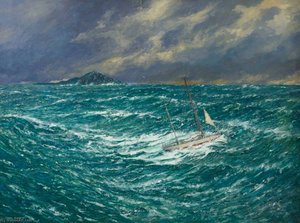
Before he was a celebrated figure in the Royal Academy, Muncaster was a man of the sea. His formative years included a perilous and transformative voyage as a deckhand aboard a windjammer navigating the treacherous waters around Cape Horn. This period of intense physical labor and direct confrontation with the raw power of the ocean instilled in him an unparalleled understanding of maritime environments. He did not merely observe the sea from the safety of a shore; he felt its rhythm, witnessed its fury, and learned the subtle language of light reflecting off turbulent swells. This lived experience became the heartbeat of his later works, allowing him to imbue his seascapes with an authenticity that resonated deeply with both critics and enthusiasts alike.
As his career blossomed during the interwar years, Muncaster emerged as a vital voice in British art. His acceptance into the Royal Academy in 1920 was not merely a professional milestone but a validation of a unique vision that blended meticulous detail with an evocative, almost dreamlike quality. He possessed a rare ability to capture the ephemeral—the way mist clings to a morning river or how a sunset dissolves the horizon into a palette of gold and violet. This talent for atmospheric storytelling led him to become a prolific illustrator, most notably collaborating with the renowned author John Masefield. In his renderings for works such as Bird of Dawning, Muncaster utilized watercolor to weave visual narratives that were as much about emotion and mood as they were about literal depiction.
His technical prowess was characterized by a sophisticated use of color and a bold approach to brushwork. Whether working in the fluid medium of watercolor or the rich textures of oil on canvas, he sought to portray nature’s grandeur through a lens of serenity and light. His landscapes often featured:
The mid-twentieth century brought profound changes to the world, and Muncaster’s life was no exception. During the Second World War, he applied his keen observational skills to a different kind of visual deception, serving as a camouflage expert. This role required an intimate understanding of how shapes, shadows, and textures blend into a natural environment—a skill that, while serving a military purpose, was deeply connected to his artistic preoccupation with the subtleties of the landscape. This period of service added a layer of complexity to his perspective, further refining his ability to manipulate perception through color and form.
By the time of his passing in 1974, Claude Grahame Muncaster had left behind a body of work that stands as a testament to the enduring beauty of the natural world. His paintings are more than mere representations; they are atmospheric captures of moments in time, preserved through a mastery of light. He remains a significant figure in the history of British landscape and marine painting, remembered for his ability to bridge the gap between the rugged reality of maritime life and the poetic elegance of the English pastoral tradition. His legacy continues to inspire those who seek to find the extraordinary within the quiet, luminous details of the earth.