Early Life and Artistic Beginnings
Charles Courtney Curran, a name synonymous with the luminous beauty of American Impressionism, was born in Hartford, Kentucky, on February 13, 1861. His early life, steeped in the traditions of his family – particularly his father’s role as a schoolteacher – subtly shaped his artistic sensibilities. Following the onset of the Civil War, Curran's family relocated to Sandusky, Ohio, a coastal town along Lake Erie. This move, and the subsequent exposure to the lake’s vastness and the surrounding natural landscape, would prove profoundly influential in establishing the core themes and visual vocabulary that defined his mature work. Curran’s artistic journey commenced at the McMicken School of Cincinnati in 1881, a formative period where he honed fundamental skills and began experimenting with various techniques. He subsequently moved to New York City, immersing himself in the vibrant art scene and seeking guidance from established masters at the National Academy of Design and the Art Students League. A pivotal moment arrived in 1887 with the creation of “Breezy Day,” a painting that secured him the Third Hallgarten Prize for Oils awarded by the National Academy – a remarkable achievement that signaled his burgeoning talent and recognition within the artistic community.Artistic Style and Notable Works
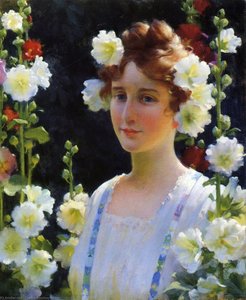
Curran’s artistic style is immediately recognizable as a refined blend of Impressionism, American Realism, and a touch of Romantic idealism. He possessed an exceptional ability to capture fleeting moments of light and atmosphere, often depicting young women engaged in leisurely activities within idyllic landscapes. His palette was characterized by soft, luminous colors—pale blues, greens, and pinks—that evoked a sense of tranquility and nostalgia. His work frequently featured scenes of rural life, capturing the essence of American leisure and beauty. Key works that exemplify his style include “On the Heights” (1909), a captivating depiction of a group of women enjoying a picnic amidst rolling hills, now housed at the Brooklyn Museum; "The Lanterns," a masterful study of light and shadow illuminating a quiet evening scene; and “Breakfast for Three,” a charming portrayal of intimacy within a rustic setting. Furthermore, Curran’s painting “Dans le jardin du luxembourg” (1889), exhibited at the Terra Foundation for American Art, offers a beautiful glimpse into Parisian life, showcasing his ability to transport viewers to another time and place.Parisian Influences and the Cragsmoor Colony
Curran's artistic development reached its zenith during his sojourn in Paris between 1888 and 1891. This period proved transformative, exposing him to the revolutionary techniques of the French Impressionists—Monet, Renoir, and Pissarro—and profoundly influencing his approach to color, light, and composition. He enrolled at the Académie Julian, absorbing their methods and experimenting with plein air painting – working directly from nature. Upon returning to America, Curran became a founding member of the Ten American Painters group, a collective dedicated to promoting modern art in the United States. In 1903, he established a studio in Cragsmoor, New York’s Hudson River Valley, and played a significant role in fostering an artistic community centered around this picturesque locale. The Cragsmoor Colony became a haven for artists seeking inspiration and camaraderie, and Curran's presence helped to solidify its reputation as a center of American art.Later Life and Legacy
Charles Courtney Curran passed away on November 9, 1942, in New York City, leaving behind an impressive body of work—over 1500 paintings encompassing oil, watercolor, and magazine illustrations. His legacy extends far beyond the canvases themselves; he is remembered as a pivotal figure in American Impressionism, bridging the gap between European artistic innovation and uniquely American sensibilities. His works are now held in prestigious collections across the nation, including the Metropolitan Museum of Art, the Smithsonian American Art Museum, and the Art Institute of Chicago. Curran’s paintings continue to resonate with viewers today, evoking a sense of nostalgia for a bygone era—a time of simple pleasures, natural beauty, and artistic refinement. His influence can be seen in subsequent generations of American artists who followed in his footsteps, carrying forward the torch of Impressionism and celebrating the enduring allure of the American landscape.Notable Achievements
Throughout his career, Curran garnered numerous accolades and recognition for his artistic talent and contributions to the art world. He received the Julius Hallgarten Prize from the National Academy of Design in 1888, a testament to his early promise. He was also awarded the First Corcoran Prize by the Corcoran Gallery of Art in Washington D.C. in 1909, further solidifying his position as a leading figure in American art. Curran’s dedication to his craft and his unwavering commitment to capturing the beauty of the natural world cemented his place as one of the most important and beloved artists of the late 19th and early 20th centuries.Perguntas e Respostas
Como a arte de Charles Courtney Curran evoluiu ao longo do tempo?
A Linha do tempo de Charles Courtney Curran é uma linha do tempo interativa que apresenta as obras do artista em ordem cronológica, organizadas em capítulos por períodos de sua carreira.
Onde posso explorar as obras de Charles Courtney Curran mapeadas por tema?
O Atlas de Temas de Charles Courtney Curran é uma página que mapeia as obras do artista por seus temas.
Existe uma linha do tempo das obras de Charles Courtney Curran?
Existe uma linha do tempo das obras de Charles Courtney Curran: a página Linha do tempo das obras do artista organiza as obras por data de criação.