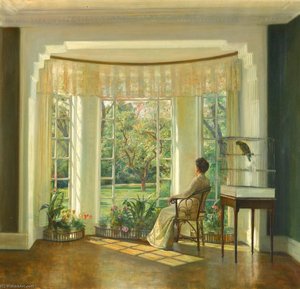
Retrato de Carl Holsøe

As 27 Pinturas Mais Famosas de Carl Holsøe, uma Seleção da Galeria

Atualizado em Novembro 2026 · classificado pela nossa pontuação de popularidade (pesquisas, visitas e pedidos de cada obra) · 28 obras de Carl Holsøe em nosso catálogo

Em resumo

De todas as obras originais que Carl Holsøe deixou, a mais famosa é Interior with the artist's wife sewing at the window. (1881). Logo atrás vêm Interior with the artist's wife reading a book by the window. (1881) e Interior with a Girl Sewing (1888). Nosso catálogo contém 28 obras de Carl Holsøe; a galeria preservou as 27 que o mundo mais admira, cada uma exibida com sua data, seu museu e sua história.

1863 – 1935, Aarhus Realism Mais obras: Statens Museum For Kunst

As 10 principais pinturas de Carl Holsøe: a escolha da galeria

1
Interior with the artist's wife sewing at the window. (1881) de Carl Holsøe

Interior with the artist's wife sewing at the window.

1881 · Oil On Canvas

Interior with the artist's wife sewing at the window. is a quiet study by Carl Holsøe, painted about 1881. The work captures a solitary moment of domestic life, focusing on a woman seated by a window, absorbed in her sewing. It is a scene that prioritizes the stillness of a room and the subtle presence of a person within a structured space.

2
Interior with the artist's wife reading a book by the window. (1881) de Carl Holsøe

Interior with the artist's wife reading a book by the window.

1881 · Oil On Canvas

The quietude of a private moment finds its form in Interior with the artist's wife reading a book by the window., an oil on canvas painted by Carl Holsøe. Created about 1881, the work captures a stillness that feels as though it is happening right now, just as the light shifts across the room. The scene rests within the intimate confines of a domestic space, where the soft glow from…

4
Interior with Girl (1905) de Carl Holsøe

Interior with Girl

1905 · Oil On Canvas · Bavarian State Painting Collections, Munique

A soft, pale light spills from a window on the far left, washing over a domestic scene that feels suspended in a moment of profound stillness. A young girl sits at a table, her form a gentle, organic curve against the rigid, rectangular lines of the room. The scene is rendered in a monochromatic palette, where every detail relies on the subtle interplay of gray, white, and deep black. There…

5
Interior from the artist's home. (1914) de Carl Holsøe

Interior from the artist's home.

1914 · Oil On Canvas

Interior from the artist's home. is a painting by Carl Holsøe. This work was created in 1914. The artist, Carl Holsøe, was born in Aarhus, Denmark, in 1863 and died in Asserbo in 1935. His practice focused primarily on domestic interior scenes, often capturing the specific arrangement of objects and the way light occupies a room.

6
An Italian village with women at the fountain (1916) de Carl Holsøe

An Italian village with women at the fountain

1916 · Oil On Canvas · Imago Museum, Pescara

In "An Italian village with women at the fountain" by Carl Holsøe, we find ourselves observing a quiet moment of daily life. The scene is set within a tranquil Italian village, where the composition is anchored by a stone fountain. Three women are gathered in the central courtyard, their presence providing a soft human element to the structured environment. This central gathering is framed by architectural structures on the left…

7
Self portrait (1920) de Carl Holsøe

Self portrait

1920 · Oil On Canvas

In this 1920 self-portrait, we find the artist, Carl Holsøe, seated within the sanctuary of his studio. The composition is intentionally asymmetrical, placing the figure slightly to the right and creating a sense of lived-in space. An easel rests in the lower foreground, a subtle reminder of the creative act that has just occurred or is about to begin. The atmosphere is one of profound stillness, where the air itself…

8
Mother and Child by a window (1935) de Carl Holsøe

Mother and Child by a window

1935 · Oil On Canvas

Soft, diffused light spills through a large window, washing the room in a gentle glow that seems to suspend time itself. Within this intimate interior, a mother and her child occupy a space of profound stillness. The scene is a quiet study of domesticity, where the weight of the world is replaced by the soft textures of fabric and the warmth of wood. The mother, dressed in dark, solid tones,…

9
Last Autumn (1935) de Carl Holsøe

Last Autumn

1935 · Oil On Canvas

In Last Autumn by Carl Holsøe, a quietude settles over a solitary interior. Created about 1935, the scene captures a lone woman seated in a room where time seems to have paused. She faces a small wooden chest or table, her dark dress providing a sharp, heavy contrast against the pale, muted tones of her surroundings. To her side, a large, closed white door dominates the space, creating a sense…

10
Interior with Mother and Child. (1881) de Carl Holsøe

Interior with Mother and Child.

1881 · Oil On Canvas

Interior with Mother and Child. is an oil on canvas by Carl Holsøe. Created in 1881, the work belongs to a period when the artist was developing his specific approach to domestic spaces. Holsøe was born in Aarhus, Denmark, in 1863 and remained a significant figure in Danish art until his death in Asserbo in 1935.

A seleção de Carl Holsøe continua, de 11 a 27

Pinturas famosas de Carl Holsøe, período por período

Os temas que cativaram o olhar de Carl Holsøe

Os quatro temas que mais se repetem nestas obras originais, cada um com o seu melhor exemplo.

Os museus que guardam os originais de Carl Holsøe

Os 3 museus que detêm a maioria das pinturas desta página.

Museus Cidade Obras de Carl Holsøe Pinturas desta lista
Statens Museum For Kunst, CopenhagueStatens Museum For Kunst Copenhague 3 Interior with a Girl Sewing, Interior with a Girl Reading, Interior with the Artist's Wife Emilie Heise
Imago Museum, PescaraImago Museum Pescara 2 An Italian village with women at the fountain, Village in the Apennine Mountains.
Bavarian State Painting Collections, MuniqueBavarian State Painting Collections Munique 1 Interior with Girl

Carl Holsøe década a década: a obra original que define cada uma

Obras por década

Escolha uma década para ver a obra original que a define.

Perguntas de colecionadores sobre as pinturas de Carl Holsøe

Por qual obra Carl Holsøe é mais conhecido(a)?Revelar a resposta

Interior with the artist's wife sewing at the window. (1881). Interior with the artist's wife reading a book by the window. (1881) e Interior with a Girl Sewing (1888) vêm a seguir.

Qual era a idade de Carl Holsøe quando Interior with the artist's wife sewing at the window. foi feita?Revelar a resposta

18 anos: Interior with the artist's wife sewing at the window. data de 1881, e Carl Holsøe nasceu em 1863.

Quais são as dez pinturas mais famosas de Carl Holsøe?Revelar a resposta

Interior with the artist's wife sewing at the window., Interior with the artist's wife reading a book by the window., Interior with a Girl Sewing, Interior with Girl, Interior from the artist's home., An Italian village with women at the fountain, Self portrait, Mother and Child by a window, Last Autumn e Interior with Mother and Child.. O ranking acima apresenta o ano e o museu de cada uma.

Quantas pinturas Carl Holsøe deixou?Revelar a resposta

Nosso catálogo contém 28 obras de Carl Holsøe, datadas de 1881 a 1935.

Em quais museus estão expostas as obras-primas de Carl Holsøe?Revelar a resposta

Principalmente em Statens Museum For Kunst (Copenhague), Imago Museum (Pescara) e Bavarian State Painting Collections (Munique). A tabela de museus acima lista todos eles.

Em que anos Carl Holsøe pintou as suas obras mais famosas?Revelar a resposta

Em 1880s: 5 das 27 obras nesta página foram feitas então, sendo Interior with the artist's wife sewing at the window. delas.

Quais são as primeiras e as últimas obras originais famosas de Carl Holsøe?Revelar a resposta

Nesta página, a mais antiga é Interior with the artist's wife sewing at the window. (1881) e a mais recente é Mother and Child by a window (1935).

Quais temas Carl Holsøe escolheu com mais frequência?Revelar a resposta

Woman (16), Table (14) e Window (13), entre as 27 obras nesta página.

Qual técnica Carl Holsøe mais utilizou?Revelar a resposta

Oil On Canvas, para 19 das 27 obras nesta página.

A qual movimento artístico pertence Carl Holsøe?Revelar a resposta

Realism, a julgar pelos originais nesta página.

Quais obras de Carl Holsøe estão expostas no Statens Museum For Kunst?Revelar a resposta

Interior with a Girl Sewing, Interior with a Girl Reading e Interior with the Artist's Wife Emilie Heise: o Statens Museum For Kunst, Copenhague detém 3 das obras desta página.

Carl Holsøe: vida e obra

O Arquiteto da Quietude: A Vida e o Legado de Carl Holsøe

Carl Vilhelm Holsøe (1863–1935) permanece como uma das vozes mais evocativas da arte dinamarquesa, um mestre do momento silencioso que transformou os limites mundanos da vida doméstica em meditações profundas sobre a luz e o espaço. Nascido em Aarhus, em uma família profundamente enraizada na tradição arquitetônica, Carl Holsøe possuía uma compreensão inata da harmonia estrutural desde os seus primeiros anos. Como filho do respeitado arquiteto N.P.C. Holsøe, seu olhar foi naturalmente treinado para a lógica das linhas, o peso das sombras e a maneira como uma sala respira. Essa imersão precoce na geometria dos edifícios forneceu o alicerce silencioso para uma visão artística que, eventualmente, priorizaria a alma atmosférica de um interior em detrimento de seu mero conteúdo físico.

Sua jornada formal pela Real Academia de Belas Artes de Copenhague e pelas Kunstnernes Frie Studieskoler colocou-o sob a mentoria de luminares como Peder Severin Krøyer. Embora esses estudos o tenham fundamentado na brilhância técnica do Impressionismo, o coração de Carl Holsøe inclinou-se para um realismo mais contemplativo. Ele encontrou inspiração profunda nos Mestres Holandeses, particularmente na quietude luminosa de Johannes Vermeer e no dramático chiaroscuro de Rembrandt. Com eles, aprendeu que um único feixe de luz caindo sobre um chão de madeira poderia carregar tanto peso emocional quanto uma grande epopeia histórica.

A Maestria da Luz e da Interioridade

Holsø e seus contemporâneos frequentemente exploravam os limites da esfera doméstica, mas a abordagem de Carl Holsøe foi unicamente caracterizada por uma contenção deliberada. Sua consagração na Exposição de Dezembro de Charlottenborg em 1886, com uma obra intitulada Interior, foi aclamada pela crítica como tendo "quase o caráter de um manifesto". Isso sinalizou a chegada de um artista que não precisava de grandes gestos para comandar atenção; em vez disso, ele utilizava uma precisão meticulosa, quase arquitetônica, para capturar as mudanças sutis da luz e a quietude da solidão.

Sua técnica era um equilíbrio delicado entre pinceladas disciplinadas e sensibilidade atmosférica. Em suas obras mais celebradas, como Girl in an Interior ou A Sunlit Interior, o espectador é convidado para um mundo onde o tempo parece suspender-se. Há uma profunda sensação de quietude, muitas vezes alcançada através de uma paleta suave que enfatiza a textura e o tom sobre a cor vibrante. Essa maestria permitiu-lhe elevar simples cenas domésticas — uma mulher lendo, um canto banhado pelo sol ou um corredor silencioso — em experiências espirituais. Sua modelo frequente e esposa, Emilie Heise, muitas vezes adornava essas telas, conferindo um calor humano aos ambientes, de outra forma austeros e estruturados, que ele criava.
Reconhecimento e Significado Histórico

Ao longo de sua prolífica carreira, Carl Holsøe foi uma presença constante na cena da arte dinamarquesa, expondo regularmente nas Exposições de Primavera e Outono de Charlottenborg. Seu talento foi reconhecido com condecorações prestigiadas, incluindo a medalha anual da academia em 1901 e 1908, e uma medalha de ouro em Munique em 1891. Além de suas conquistas individuais, ele foi uma parte vital do tecido artístico de sua era, mantendo amizades com outros titãs da pintura dinamarquesa, como Vilhelm Hammershøi. De fato, muito semelhante a Hammershøi, a obra de Carl Holsøe ocupa um espaço onde o doméstico e o metafísico se intersectam, tornando-o um pilar da pintura de interiores escandinava.

O significado duradouro de Carl Holsøe reside em sua capacidade de encontrar o extraordinário dentro do ordinário. Ele não apenas pintava quartos; ele pintava o sentimento de estar dentro deles — a solidão, a paz e a beleza fugaz de uma tarde que passa. Seu legado continua a ressoar com qualquer pessoa que encontre beleza nos cantos silenciosos do mundo, provando que as histórias mais profundas são frequentemente contadas em sussurros, e não em gritos.