Retrato de Bruno Andreas Liljefors

Pinturas de Bruno Andreas Liljefors: As 72 mais famosas, sob o olhar de uma galeria

Atualizado em Novembro 2026 · classificado pela nossa pontuação de popularidade (pesquisas, visitas e pedidos de cada obra) · 77 obras de Bruno Andreas Liljefors em nosso catálogo

Em resumo

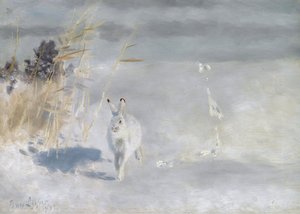
Aos olhos da galeria, a pintura mais famosa de Bruno Andreas Liljefors é Title in Swedish: Duvhök och orrar (1884), cuja obra original está exposta no Nationalmuseum, em Estocolmo. Winterhare (Snow Hare), (1932) e Title in Swedish: Rävfamilj (1886) completam o trio que todos reconhecem. Dos 77 trabalhos de Bruno Andreas Liljefors em nosso catálogo, a galeria apresenta abaixo as 72 obras mais famosas, cada uma original, com seu ano, seu museu e o que a torna única.

1860 – 1939, Paróquia da Catedral de Uppsala Impressionism Mais obras: Nationalmuseum

As 10 principais pinturas de Bruno Andreas Liljefors na galeria

1
Title in Swedish: Duvhök och orrar (1884) de Bruno Andreas Liljefors

Title in Swedish: Duvhök och orrar

1884 · Oil On Canvas · Nationalmuseum, Estocolmo

The frozen landscape of Ärentuna provides the stage for a sudden, violent encounter. In this 1884 oil on canvas, a goshawk descends with outstretched wings and claws, targeting a juvenile bird amidst a flurry of black grouse. The scene captures a precise moment of avian predation, where the stillness of the snow is broken by the frantic movement of flight and the tension of survival. The composition focuses on the…

3
Title in Swedish: Rävfamilj (1886) de Bruno Andreas Liljefors

Title in Swedish: Rävfamilj

1886 · Oil · Nationalmuseum, Estocolmo

In this 1886 work, we find ourselves observing a private moment within the Swedish wilderness. A family of foxes occupies a meadow, their forms nestled among the tall grass and wildflowers. There is a sense of stillness here, a pause in the constant movement of the natural world. Several adults and their young ones are positioned throughout the scene, some closer to the viewer and others receding into the depth…

4
Cat on a flowery meadow (1887) de Bruno Andreas Liljefors

Cat on a flowery meadow

1887 · Oil · Nationalmuseum, Estocolmo

In this 1887 oil painting, a black and white cat rests within a dense meadow of wildflowers. The animal is positioned in the lower right foreground, its body oriented toward the left side of the frame. Its fur is rendered in solid patches of black and white, contrasting with the surrounding vegetation. The meadow is composed of various flora, including yellow wildflowers and small white blossoms, interspersed with green grass…

5
The Fox (1893) de Bruno Andreas Liljefors

The Fox

1893 · Oil On Canvas · Nationalmuseum, Estocolmo

The Fox is an oil on canvas work by Bruno Liljefors, dated about 1893. The subject features a single red fox moving through a snowy landscape. This naturalist study captures the animal within its natural habitat, focusing on the interaction between the creature and the winter environment.

6
Landscape with Fox (Fox pursued by Jackals) (1899) de Bruno Andreas Liljefors

Landscape with Fox (Fox pursued by Jackals)

1899 · Oil On Canvas · Rijksmuseum Twenthe, Enschede

The scene unfolds within the oil on canvas work titled Landscape with Fox (Fox pursued by Jackals). This piece, created by Bruno Liljefors, captures a moment of tension amidst the forest. The artist, Bruno Liljefors, was born in Uppsala Cathedral Assembly, Sweden, in 1860 and lived until 1939. His hand guides the viewer through this natural setting, where the subject matter is deeply rooted in the wild realities of the…

8
An Eagle Owl (1905) de Bruno Andreas Liljefors

An Eagle Owl

1905 · Oil · Nationalmuseum, Estocolmo

An Eagle Owl by Bruno Liljefors, created about 1905, features a centered composition where the bird occupies much of the middle ground. The owl is positioned against a dark, indistinct background that suggests the interior of a hollow or a shaded forest floor. This setting creates a shallow depth, focusing the viewer's attention entirely on the subject. The color palette is dominated by earthy tones, including various shades of brown,…

9
Duckling (1903) de Bruno Andreas Liljefors

Duckling

1903 · Oil On Board

This naturalist oil painting, created in 1903, presents an intimate and highly realistic depiction of a single young duckling. The composition is centered, with the small bird positioned slightly off-center towards the left to evoke a sense of natural spontaneity. Rendered on a rectangular substrate, likely wood or board, the work focuses entirely on the subject, which emerges from a shallow, atmospheric, and indistinct background.

10
Fox with Cubs (1912) de Bruno Andreas Liljefors

Fox with Cubs

1912 · Oil On Canvas · Nationalmuseum, Estocolmo

In this work, titled Fox with Cubs, we encounter a quiet moment from the life of a Swedish artist, Bruno Liljefors. Painted in 1912, the piece reflects the naturalist sensibilities that defined his career. Liljefors was born in 1860 in Uppsala, Sweden, and his deep connection to the Swedish landscape remained a constant throughout his life until his death in Stockholm in 1939.

Pinturas de Bruno Andreas Liljefors, classificadas de 11 a 72

11Självporträtt (1913) de Bruno Andreas LiljeforsSjälvporträtt1913 · National Portrait Gallery of Sweden 12Foxes Emerging from Snowy Forest Edge (1919) de Bruno Andreas LiljeforsFoxes Emerging from Snowy Forest Edge1919 · Rijksmuseum Twenthe 13Peregrine Falcon with Little Owl (?) as Prey at its Eyrie on the Coast (1923) de Bruno Andreas LiljeforsPeregrine Falcon with Little Owl (?) as Prey at its Eyrie on the Coast1923 · Rijksmuseum Twenthe 14Fox in Winter Landscape (1938) de Bruno Andreas LiljeforsFox in Winter Landscape1938 · Nationalmuseum 15A Family of Foxes de Bruno Andreas LiljeforsA Family of Foxes 16Title in Swedish: Nötskrikor (1886) de Bruno Andreas LiljeforsTitle in Swedish: Nötskrikor1886 · Nationalmuseum 17Eluding the fox de Bruno Andreas LiljeforsEluding the fox 18Cat Hunting Birds (1883) de Bruno Andreas LiljeforsCat Hunting Birds1883 · Gothenburg Museum of Art 19Sledging (1882) de Bruno Andreas LiljeforsSledging1882 · Nationalmuseum 20A Cat with a Young Bird in its Mouth. Five studies in one frame NM 2223-2227 (1885) de Bruno Andreas LiljeforsA Cat with a Young Bird in its Mouth. Five studies in one frame NM 2223-22271885 · Nationalmuseum 21Sparrows in a Cherry Tree. Five studies in one frame, NM 2223-2227 (1885) de Bruno Andreas LiljeforsSparrows in a Cherry Tree. Five studies in one frame, NM 2223-22271885 · Nationalmuseum 22A Cat and a Chaffinch. Five animal studies in one frame, NM 2223-2227 (1885) de Bruno Andreas LiljeforsA Cat and a Chaffinch. Five animal studies in one frame, NM 2223-22271885 · Nationalmuseum 23Chaffinches and Dragonflies. Five studies in one frame, NM 2223-2227 (1885) de Bruno Andreas LiljeforsChaffinches and Dragonflies. Five studies in one frame, NM 2223-22271885 · Nationalmuseum 24Redstarts and Butterflies. Five studies in one frame, NM 2223-2227 (1885) de Bruno Andreas LiljeforsRedstarts and Butterflies. Five studies in one frame, NM 2223-22271885 · Nationalmuseum 25Swedish Foxhound and Fox (1885) de Bruno Andreas LiljeforsSwedish Foxhound and Fox1885 · Nationalmuseum 26Black Grouse Display (1889) de Bruno Andreas LiljeforsBlack Grouse Display1889 · Bavarian State Painting Collections 27Nestlings of Red-Backed Shrike (1887) de Bruno Andreas LiljeforsNestlings of Red-Backed Shrike1887 · Nationalmuseum 28Four Bird Studies, Red-Backed Shrike, Corncrake, Chaffinches, Willow Warbler. (1887) de Bruno Andreas LiljeforsFour Bird Studies, Red-Backed Shrike, Corncrake, Chaffinches, Willow Warbler.1887 · Nationalmuseum 29The Hunter (1891) de Bruno Andreas LiljeforsThe Hunter1891 · Nationalmuseum 30Man Warping (1888) de Bruno Andreas LiljeforsMan Warping1888 · Nationalmuseum 31Hooded Crows (1891) de Bruno Andreas LiljeforsHooded Crows1891 · Gothenburg Museum of Art 32Wild Geese (1898) de Bruno Andreas LiljeforsWild Geese1898 · Statens Museum For Kunst 33Sea Eagles (1897) de Bruno Andreas LiljeforsSea Eagles1897 · Nationalmuseum 34Eider Ducks (1894) de Bruno Andreas LiljeforsEider Ducks1894 · Nationalmuseum 35Landscape (Fox pursued by Snipe) (1899) de Bruno Andreas LiljeforsLandscape (Fox pursued by Snipe)1899 · Rijksmuseum Twenthe 36Dovekies (1901) de Bruno Andreas LiljeforsDovekies1901 · National Museum of Art, Architecture and Design 37Capercaillies in a Winter Landscape (1899) de Bruno Andreas LiljeforsCapercaillies in a Winter Landscape1899 · Finnish National Gallery 38Capercailzie Hen (1904) de Bruno Andreas LiljeforsCapercailzie Hen1904 · Nationalmuseum 39White-tailed Eagle with White-tailed Eagle Prey at its Nest on the Coast (1907) de Bruno Andreas LiljeforsWhite-tailed Eagle with White-tailed Eagle Prey at its Nest on the Coast1907 · Rijksmuseum Twenthe 40Sparrowhawk Buffeting a Reed Bunting (1907) de Bruno Andreas LiljeforsSparrowhawk Buffeting a Reed Bunting1907 · Rijksmuseum Twenthe 41Blackgame in Springtime (1907) de Bruno Andreas LiljeforsBlackgame in Springtime1907 · Nationalmuseum 42Curlew (1907) de Bruno Andreas LiljeforsCurlew1907 · Nationalmuseum 43Sea Eagle's Nest (1907) de Bruno Andreas LiljeforsSea Eagle's Nest1907 · Nationalmuseum 44Wildgeese Settling (1907) de Bruno Andreas LiljeforsWildgeese Settling1907 · Nationalmuseum 45Red Grouse In The Snow de Bruno Andreas LiljeforsRed Grouse In The Snow 46Eider Ducks Above Turbulent Sea (1912) de Bruno Andreas LiljeforsEider Ducks Above Turbulent Sea1912 · Rijksmuseum Twenthe 47Rolling Capercaillie with Three Hens (1913) de Bruno Andreas LiljeforsRolling Capercaillie with Three Hens1913 · Rijksmuseum Twenthe 48Autumn Landscape with Partridges (1913) de Bruno Andreas LiljeforsAutumn Landscape with Partridges1913 · Nationalmuseum 49Bellowing Capercaillies with Them (1919) de Bruno Andreas LiljeforsBellowing Capercaillies with Them1919 · Rijksmuseum Twenthe 50Grazing Brent Geese at Sunset (1921) de Bruno Andreas LiljeforsGrazing Brent Geese at Sunset1921 · Rijksmuseum Twenthe 51Pair of wild ducks by a hole in the ice (1919) de Bruno Andreas LiljeforsPair of wild ducks by a hole in the ice1919 · Rijksmuseum Twenthe 52Partridges (1922) de Bruno Andreas LiljeforsPartridges1922 · Finnish National Gallery 53Pair of Male and Female Ducks by a Cliff (1928) de Bruno Andreas LiljeforsPair of Male and Female Ducks by a Cliff1928 · Rijksmuseum Twenthe 54White-tailed Eagle Strikes at Wigeon Nest (1924) de Bruno Andreas LiljeforsWhite-tailed Eagle Strikes at Wigeon Nest1924 · Rijksmuseum Twenthe 55Whooper Swans on Evening Migration (1925) de Bruno Andreas LiljeforsWhooper Swans on Evening Migration1925 · Rijksmuseum Twenthe 56Winter Landscape with Snow Hare (1923) de Bruno Andreas LiljeforsWinter Landscape with Snow Hare1923 · Rijksmuseum Twenthe 57Herring Gulls and Arctic Terns on the Skerries off the Scandinavian Coast (1923) de Bruno Andreas LiljeforsHerring Gulls and Arctic Terns on the Skerries off the Scandinavian Coast1923 · Rijksmuseum Twenthe 58Two curlews in a peat landscape (1927) de Bruno Andreas LiljeforsTwo curlews in a peat landscape1927 · Rijksmuseum Twenthe 59Black Grouse in a Treetop (1923) de Bruno Andreas LiljeforsBlack Grouse in a Treetop1923 · Finnish National Gallery 60Moose shifting across a swamp in Sweden (1929) de Bruno Andreas LiljeforsMoose shifting across a swamp in Sweden1929 · Rijksmuseum Twenthe 61Moose Family Entering a Clearing (1930) de Bruno Andreas LiljeforsMoose Family Entering a Clearing1930 · Minneapolis Institute of Art 62Hawk attacking prey de Bruno Andreas LiljeforsHawk attacking prey 63By the Sea. A Spring Day de Bruno Andreas LiljeforsBy the Sea. A Spring DayNationalmuseum 64Fox In A Winter Landscape de Bruno Andreas LiljeforsFox In A Winter Landscape 65I know this works ''Hans Dahl'' de Bruno Andreas LiljeforsI know this works ''Hans Dahl'' 66Rocher Dans Une Foret de Bruno Andreas LiljeforsRocher Dans Une Foret 67Study Of A Wild Duck de Bruno Andreas LiljeforsStudy Of A Wild Duck 68Fox By The Fence de Bruno Andreas LiljeforsFox By The Fence 69A sea eagle chasing eider duck de Bruno Andreas LiljeforsA sea eagle chasing eider duck 70The Morning Sun (i Know This Works ''august Wilhelm Nikolaus Hagborg'') de Bruno Andreas LiljeforsThe Morning Sun (i Know This Works ''august Wilhelm Nikolaus Hagborg'') 71A Poacher (1894) de Bruno Andreas LiljeforsA Poacher1894 · Nationalmuseum 72Morning Mood by the Sea (1896) de Bruno Andreas LiljeforsMorning Mood by the Sea1896 · Thiel Gallery

Pinturas famosas de Bruno Andreas Liljefors, período por período

Os temas que cativaram o olhar de Bruno Andreas Liljefors

Os quatro temas que mais se repetem nestas obras originais, cada um com o seu melhor exemplo.

Os museus que guardam os originais de Bruno Andreas Liljefors

Os 8 museus que detêm a maioria das pinturas desta página.

Museus Cidade Obras de Bruno Andreas Liljefors Pinturas desta lista
Nationalmuseum, EstocolmoNationalmuseum Estocolmo 29 Title in Swedish: Duvhök och orrar, Title in Swedish: Rävfamilj, Cat on a flowery meadow
Rijksmuseum Twenthe, EnschedeRijksmuseum Twenthe Enschede 19 Landscape with Fox (Fox pursued by Jackals), Landscape with Hounds (Fox pursued by Brachies), Foxes Emerging from Snowy Forest Edge
Finnish National Gallery, HelsínquiaFinnish National Gallery Helsínquia 3 Capercaillies in a Winter Landscape, Partridges, Black Grouse in a Treetop
Gothenburg Museum of Art, GotemburgoGothenburg Museum of Art Gotemburgo 2 Cat Hunting Birds, Hooded Crows
National Portrait Gallery of Sweden, SträngnäsNational Portrait Gallery of Sweden Strängnäs 1 Självporträtt
Bavarian State Painting Collections, MuniqueBavarian State Painting Collections Munique 1 Black Grouse Display
Statens Museum For Kunst, CopenhagueStatens Museum For Kunst Copenhague 1 Wild Geese
National Museum of Art, Architecture and Design, OsloNational Museum of Art, Architecture and Design Oslo 1 Dovekies

Bruno Andreas Liljefors, uma pintura emblemática por década

Obras por década

Escolha uma década para ver a obra original que a define.

Pinturas de Bruno Andreas Liljefors: a galeria responde

Qual pintura de Bruno Andreas Liljefors é a mais famosa de todas?Revelar a resposta

Title in Swedish: Duvhök och orrar (1884), Nationalmuseum, Estocolmo. Winterhare (Snow Hare), (1932) e Title in Swedish: Rävfamilj (1886) vêm a seguir.

Qual era a idade de Bruno Andreas Liljefors ao concluir Title in Swedish: Duvhök och orrar?Revelar a resposta

24 anos: Title in Swedish: Duvhök och orrar data de 1884, e Bruno Andreas Liljefors nasceu em 1860.

Quais são as 10 principais pinturas de Bruno Andreas Liljefors?Revelar a resposta

Title in Swedish: Duvhök och orrar, Winterhare (Snow Hare), (1932), Title in Swedish: Rävfamilj, Cat on a flowery meadow, The Fox, Landscape with Fox (Fox pursued by Jackals), Landscape with Hounds (Fox pursued by Brachies), An Eagle Owl, Duckling e Fox with Cubs. O ranking acima apresenta o ano e o museu de cada uma.

Quantas obras Bruno Andreas Liljefors criou?Revelar a resposta

Nosso catálogo contém 77 obras de Bruno Andreas Liljefors, datadas de 1882 a 1938.

Onde estão expostos os originais mais famosos de Bruno Andreas Liljefors?Revelar a resposta

Principalmente em Nationalmuseum (Estocolmo), Rijksmuseum Twenthe (Enschede) e Finnish National Gallery (Helsínquia). A tabela de museus acima lista todos eles.

Quando é que Bruno Andreas Liljefors criou as suas pinturas mais famosas?Revelar a resposta

Em 1880s: 16 das 72 obras nesta página foram feitas então, sendo Title in Swedish: Duvhök och orrar delas.

Quais são as obras mais famosas de Bruno Andreas Liljefors no início e no fim de sua carreira?Revelar a resposta

Nesta página, a mais antiga é Sledging (1882) e a mais recente é Fox in Winter Landscape (1938).

Quais temas Bruno Andreas Liljefors mais explorou?Revelar a resposta

Fox (6), Winter (5) e Wildlife (5), entre as 72 obras nesta página.

Em qual técnica Bruno Andreas Liljefors mais trabalhou?Revelar a resposta

Oil On Canvas, para 10 das 72 obras nesta página.

Com qual movimento Bruno Andreas Liljefors está associado(a)?Revelar a resposta

Impressionism, a julgar pelos originais nesta página.

Quais obras originais de Bruno Andreas Liljefors o Nationalmuseum possui?Revelar a resposta

Title in Swedish: Duvhök och orrar, Title in Swedish: Rävfamilj e Cat on a flowery meadow: o Nationalmuseum, Estocolmo detém 29 das obras desta página.

Bruno Andreas Liljefors: o artista

Um Mestre dos Encontros Selvagens: A Vida e a Arte de Bruno Liljefors

Bruno Andreas Liljefors, nascido em Uppsala, Suécia, em 1860, emergiu como uma figura fundamental na arte do final do século XIX e início do século XX, celebrado principalmente por suas representações dinâmicas da vida selvagem. Ele não era apenas um pintor de animais; era um cronista do drama bruto da natureza, um mestre em capturar momentos fugazes de predadores e presas travando sua dança ancestral. Bruno Liljefors distinguiu-se através de uma fusão inovadora de técnicas impressionistas com uma observação meticulosa, criando obras que ressoavam tanto com precisão científica quanto com poder emocional. Sua influência estendeu-se muito além de sua Suécia natal, impactando gerações de artistas da vida selvagem que o sucederam. Sua vida inicial oferecia poucos indícios do caminho artístico que ele trilharia. Embora nascido em uma família modesta — seu pai era um funcionário da indústria mineira — um talento natural para o desenho rapidamente se tornou evidente. Comerciantes locais reconheceram e nutriram esse dom, fornecendo ao jovem Bruno materiais de arte que alimentaram sua paixão florescente. Esse incentivo precoce lançou as bases para sua formação formal na Real Academia de Belas Artes de Estocolmo, a partir de 1879.

Das Raízes Acadêmicas às Visões Impressionistas

A jornada artística de Bruno Liljefors não foi imediata ou linear. Seus estudos iniciais aderiam ao realismo acadêmico prevalente na época, focando na pintura histórica e em temas tradicionais. No entanto, um período de viagens pela Europa — Düsseldorf, Veneza, Florença, Roma e Paris — provou ser transformador. A exposição a diversas correntes artísticas, particularmente na França, desencadeou uma mudança em direção ao Impressionismo. Ele sentiu-se atraído pelas pinceladas soltas, cores vibrantes e pela ênfase em capturar os momentos fugazes de luz que caracterizavam o trabalho de artistas como Claude Monet e Pierre-Auguste Renoir. Essa nova sensibilidade estética não foi simplesmente adotada de forma integral; Bruno Liljefors a integrou ingenuamente com sua profunda compreensão do comportamento e da anatomia animal. Ele não pintava apenas animais na natureza; ele pintava a natureza através dos animais, transmitindo sua essência dentro de um ambiente dinâmico. Este período também o viu engajar-se com a colônia de artistas escandinavos em Gréz-sur-Loing, refinando ainda mais sua visão artística e fomentando conexões que moldariam sua carreira. A influência das gravuras japonesas, com suas perspectivas únicas e composições achatadas, também começou a permear sutilmente seu trabalho, adicionando outra camada de complexidade ao seu estilo em evolução.

O Drama do Selvagem: Definindo o Estilo de Liljefors

Bruno Liljefors conquistou seu nicho ao focar em cenas de predação — o falcão descendo sobre sua presa, a águia-marinha perseguindo um pato-eider, a raposa espreitando uma lebre. Estas não eram meras representações de violência; eram explorações do drama inerente da natureza, renderizadas com notável sensibilidade e percepção psicológica. Ele evitava o sensacionalismo ou o moralismo, apresentando esses encontros como ocorrências naturais dentro de um quadro ecológico mais amplo. Sua técnica era crucial para alcançar esse efeito. Bruno Liljefors empregava pinceladas fragmentadas e uma paleta vibrante para capturar o jogo de luz e sombra sobre penas, pelagens e paisagens. Ele possuía uma habilidade excepcional de renderizar padrões de camuflagem, demonstrando uma compreensão aguçada de como os animais se misturam ao seu entorno. Não se tratava apenas de precisão visual; tratava-se de transmitir a perspectiva do animal — como eles percebem e interagem com seu ambiente. Para garantir a autenticidade, Bruno Liljefors mantinha um plantel de animais vivos em sua casa, permitindo-lhe estudar seus movimentos e comportamentos em primeira mão. Ele não dependia de esboços ou fotografias; ele pintava da vida real, imbuindo suas obras com uma imediatismo e vitalidade que as diferenciavam.

Legado e Influência Duradoura

Bruno Liljefors morreu em Estocolmo em 1939, deixando para trás um corpo de obras que continua a cativar o público até hoje. Suas pinturas estão em grandes museus na Suécia e internacionalmente, servindo como testemunhos de sua habilidade artística e visão duradoura. Ele permanece como uma figura icônica na arte e cultura sueca, celebrado por sua capacidade de capturar a essência do mundo natural com precisão científica e graça poética. Sua influência sobre as gerações subsequentes de artistas da vida selvagem é inegável. Artistas como Michael Coleman reconheceram abertamente sua dívida às técnicas inovadoras de Bruno Liljefors e sua profunda compreensão do comportamento animal. Além do reino das belas artes, o trabalho de Liljefors também teve um impacto sutil, mas significativo, em nossa percepção da própria natureza. Suas pinturas nos encorajam a olhar mais de perto para o mundo ao nosso redor, a apreciar a beleza e a complexidade das relações ecológicas e a reconhecer o drama inerente que se desenrola mesmo nas paisagens aparentemente mais tranquilas. Seu legado não é apenas de conquista artística, mas também de fomentar uma conexão mais profunda entre a humanidade e o mundo natural. Ele se ergue como um testemunho do poder da arte para iluminar, inspirar e, finalmente, nos lembrar de nosso lugar dentro da grande tapeçaria da vida.