Retrato de Berto di Giovanni

As 21 Pinturas Mais Famosas de Berto di Giovanni, uma Seleção da Galeria

Atualizado em Novembro 2026 · classificado pela nossa pontuação de popularidade (pesquisas, visitas e pedidos de cada obra) · 29 obras de Berto di Giovanni em nosso catálogo

Em resumo

De todas as obras originais deixadas por Berto di Giovanni, a mais famosa é Menina com Cerejas (1491), da coleção do Metropolitan Museum of Art, em Nova York. Logo atrás vêm The Virgin and Child Enthroned (1506) e The Madonna with Child, Saint John and an angel (1510). Nosso catálogo contém 29 obras de Berto di Giovanni; a galeria preservou as 21 que o mundo mais admira, cada uma exibida com sua data, seu museu e sua história.

1475 – 1529, Perugia Mais obras: Museu do Louvre

As 10 principais pinturas de Berto di Giovanni: a escolha da galeria

1
Menina com Cerejas (1491) de Berto di Giovanni

Menina com Cerejas

1491 · Óleo · Metropolitan Museum of Art, Nova York

Uma Jornada pela Elegância Renascentista Italiana: Marco D’Oggiono e “A Menina com Cerejas” Marco D’Oggiono, um discípulo próximo de Leonardo da Vinci em Milão, permanece como uma figura essencial na vibrante paisagem artística do Renascimento lombardo italiano. Embora seu legado artístico não alcance a grandiosidade ou o reconhecimento imediato de seu mestre, D’Oggiono conquistou um lugar entre os pintores mais respeitados de sua época através da meticulosa maestria e da…

2
The Virgin and Child Enthroned (1506) de Berto di Giovanni

The Virgin and Child Enthroned

1506 · Tempera On Panel · Royal Collection, Londres

In The Virgin and Child Enthroned by Berto di Giovanni, the arrangement follows a strict pyramidal structure. The Madonna and Child occupy the central position, seated upon a rigid architectural throne that provides a sense of permanence to the sacred scene. Above them, four angels are captured in flight, while below, a balanced group of four saints stands in quiet observance. This hierarchy includes a Pope or Bishop, John the…

3
The Madonna with Child, Saint John and an angel (1510) de Berto di Giovanni

The Madonna with Child, Saint John and an angel

1510 · Oil On Panel · Castello Sforzesco, Milão

In this intimate panel from 1510, we find ourselves drawn into a secluded, rocky grotto where the light seems to emerge from within the scene itself. The Virgin Mary sits at the heart of a triangular composition, her presence anchoring the space as she cradles the Christ child. To her side, the young Saint John the Baptist holds a small cross, a subtle reminder of the path ahead, while angels…

4
Portrait of a Man aged 20 ('The Archinto Portrait') (1494) de Berto di Giovanni

Portrait of a Man aged 20 ('The Archinto Portrait')

1494 · Oil

The man stares directly at us, his presence heavy and immediate against a void of absolute black. He is young, perhaps twenty, with blonde hair that catches a soft, unseen light. A beard and mustache frame a face that holds a quiet, steady intensity. He wears a blue shirt, the fabric rendered with a subtle weight, and a tie knotted into a bow rests at his throat. In his hand,…

5
Francesco Maria Sforza (1491–1512), 'Il Duchetto' (1493) de Berto di Giovanni

Francesco Maria Sforza (1491–1512), 'Il Duchetto'

1493 · Oil · Bristol Museum - Art Gallery, Bristol

In this intimate portrait from 1493, we encounter a young boy, known as 'Il Duchetto', whose presence commands the space through a quiet, steady gaze. He is dressed in a rich red outfit, accented with meticulous gold trim that catches the light against a dark, receding background. The child holds a bird in his hand, a delicate detail that draws the eye toward the intersection of soft skin and fine…

6
Virgin and Child before a Landscape (1515) de Berto di Giovanni

Virgin and Child before a Landscape

1515 · Oil On Panel

The painting titled Virgin and Child before a Landscape is a work by Berto di Giovanni. Created in 1515, the piece captures a quiet moment of maternal connection. The Virgin Mary holds her child in her arms, a central figure of devotion set against a distant horizon.

7
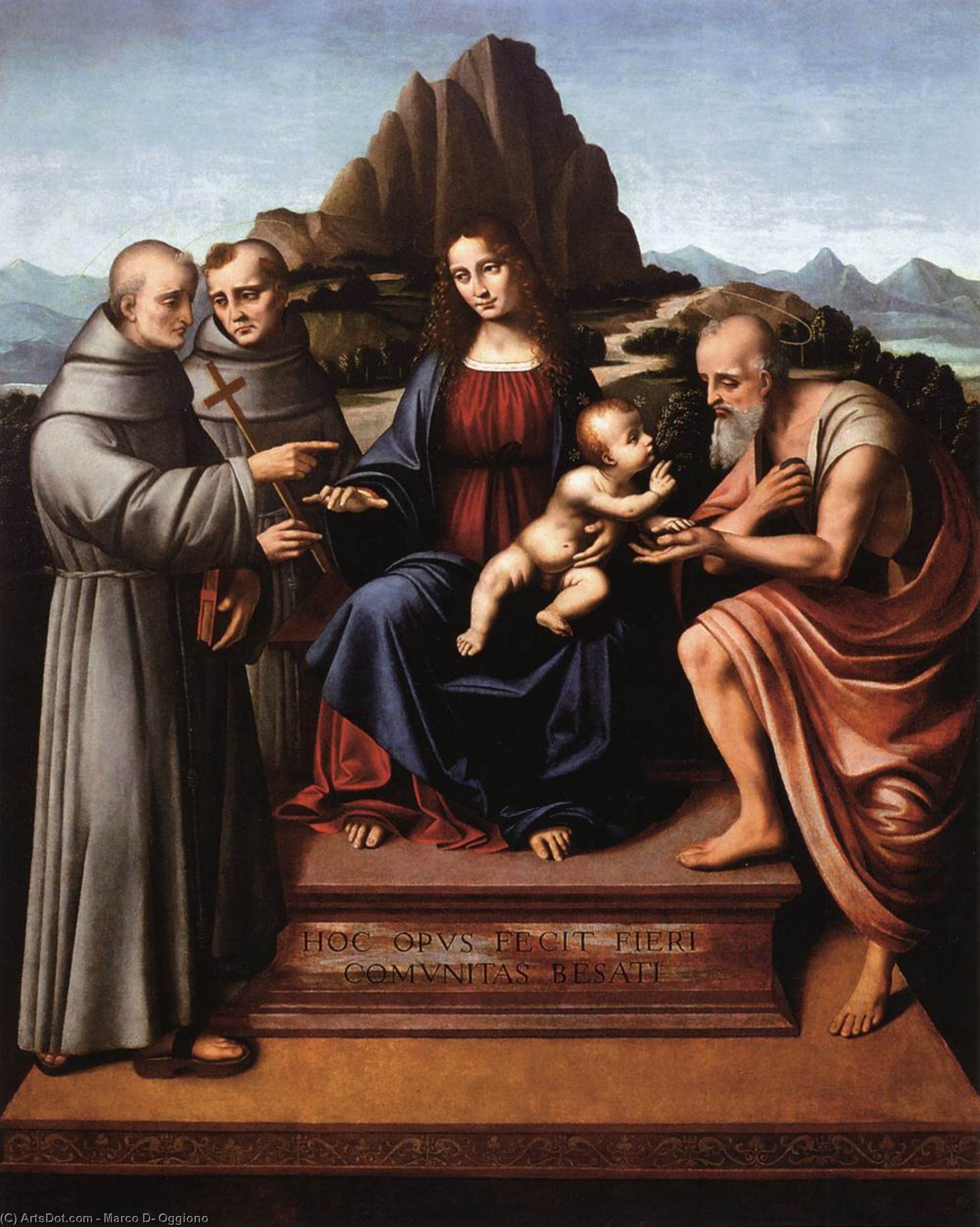
Virgin and Child Enthroned with Saints (1524) de Berto di Giovanni

Virgin and Child Enthroned with Saints

1524 · Tempera On Panel · Museo Diocesano, Milão

The painting titled Virgin and Child Enthroned with Saints was executed by the artist Berto di Giovanni. This work is dated 1506. It belongs to the High Renaissance and the Lombard school, representing a period of significant stylistic development in Northern Italy. The piece is currently held at the Royal Collection in London.

8
LA VIERGE ALLAITANT L'ENFANT JESUS de Berto di Giovanni

LA VIERGE ALLAITANT L'ENFANT JESUS

Tempera On Panel · Museu do Louvre, Paris

The composition is organized around a pyramidal structure, with the Virgin's head positioned at the apex. She is situated slightly off-center to the left of the vertical axis. The infant Jesus is held within her arms, oriented so that he faces the viewer directly. The two figures are arranged in a gentle curve, a placement that emphasizes the physical connection between mother and child.

10
The Madonna and Child with Saint John the Evangelist and Saint John the Baptist (1520) de Berto di Giovanni

The Madonna and Child with Saint John the Evangelist and Saint John the Baptist

1520

From the church of San Sepolcro, where it was taken in the second half of the eighteenth century, after the destruction of its original home in San Mattia alla Moneta (Piazza Cordusio), the triptych shows the Madonna and Child with Saint John the Evangelist and Saint John the Baptist in an arcade in the open. The construction cannot but recall the beautiful sacristy with paintings by Bergognone in Santa Maria…

A seleção de Berto di Giovanni continua, de 11 a 21

Os temas que cativaram o olhar de Berto di Giovanni

Os quatro temas que mais se repetem nestas obras originais, cada um com o seu melhor exemplo.

Os museus que guardam os originais de Berto di Giovanni

Os 8 museus que detêm a maioria das pinturas desta página.

Museus Cidade Obras de Berto di Giovanni Pinturas desta lista
Museu do Louvre, ParisMuseu do Louvre Paris 2 LA VIERGE ALLAITANT L'ENFANT JESUS, LA SAINTE FAMILLE AVEC SAINTE ELISABETH, SAINT JOACHIM ET LE PETIT SAINT JEAN BAPTISTE
Metropolitan Museum of Art, Nova YorkMetropolitan Museum of Art Nova York 1 Menina com Cerejas
Royal Collection, LondresRoyal Collection Londres 1 The Virgin and Child Enthroned
Castello Sforzesco, MilãoCastello Sforzesco Milão 1 The Madonna with Child, Saint John and an angel
Bristol Museum - Art Gallery, BristolBristol Museum - Art Gallery Bristol 1 Francesco Maria Sforza (1491–1512), 'Il Duchetto'
Museo Diocesano, MilãoMuseo Diocesano Milão 1 Virgin and Child Enthroned with Saints
Musée Condé, ChantillyMusée Condé Chantilly 1 SAINTE BARBE
Auckland Art Gallery Toi o Tāmaki, AucklandAuckland Art Gallery Toi o Tāmaki Auckland 1 Madonna and Child.

Berto di Giovanni década a década: a obra original que define cada uma

Obras por década

Escolha uma década para ver a obra original que a define.

Perguntas de colecionadores sobre as pinturas de Berto di Giovanni

Por qual obra Berto di Giovanni é mais conhecido(a)?Revelar a resposta

Menina com Cerejas (1491), Metropolitan Museum of Art, Nova York. The Virgin and Child Enthroned (1506) e The Madonna with Child, Saint John and an angel (1510) vêm a seguir.

Qual era a idade de Berto di Giovanni quando Menina com Cerejas foi feita?Revelar a resposta

16 anos: Menina com Cerejas data de 1491, e Berto di Giovanni nasceu em 1475.

Quais são as dez pinturas mais famosas de Berto di Giovanni?Revelar a resposta

Menina com Cerejas, The Virgin and Child Enthroned, The Madonna with Child, Saint John and an angel, Portrait of a Man aged 20 ('The Archinto Portrait'), Francesco Maria Sforza (1491–1512), 'Il Duchetto', Virgin and Child before a Landscape, Virgin and Child Enthroned with Saints, LA VIERGE ALLAITANT L'ENFANT JESUS, SAINTE BARBE e The Madonna and Child with Saint John the Evangelist and Saint John the Baptist. O ranking acima apresenta o ano e o museu de cada uma.

Quantas pinturas Berto di Giovanni deixou?Revelar a resposta

Nosso catálogo contém 29 obras de Berto di Giovanni, datadas de 1491 a 1524.

Em quais museus estão expostas as obras-primas de Berto di Giovanni?Revelar a resposta

Principalmente em Museu do Louvre (Paris), Metropolitan Museum of Art (Nova York) e Royal Collection (Londres). A tabela de museus acima lista todos eles.

Em que anos Berto di Giovanni pintou as suas obras mais famosas?Revelar a resposta

Em 1490s: 3 das 21 obras nesta página foram feitas então, sendo Menina com Cerejas delas.

Quais são as primeiras e as últimas obras originais famosas de Berto di Giovanni?Revelar a resposta

Nesta página, a mais antiga é Menina com Cerejas (1491) e a mais recente é Virgin and Child Enthroned with Saints (1524).

Quais temas Berto di Giovanni escolheu com mais frequência?Revelar a resposta

Child (5), Woman (4) e Throne (2), entre as 21 obras nesta página.

Qual técnica Berto di Giovanni mais utilizou?Revelar a resposta

Tempera On Panel, para 3 das 21 obras nesta página.

Quais obras de Berto di Giovanni estão expostas no Museu do Louvre?Revelar a resposta

LA VIERGE ALLAITANT L'ENFANT JESUS e LA SAINTE FAMILLE AVEC SAINTE ELISABETH, SAINT JOACHIM ET LE PETIT SAINT JEAN BAPTISTE: o Museu do Louvre, Paris detém 2 das obras desta página.

Berto di Giovanni: vida e obra

A Legacy Carved in the Shadow of a Genius

The history of the Italian Renaissance is often told through the lens of singular, incomparable titans, yet the true richness of the era lies in the brilliant circle of masters who breathed life into the shadows cast by giants. Marco d’Oggiono stands as one of the most significant figures within this luminous orbit. Born around 1475 in the picturesque town of Oggiono, nestled in the hills of Brescia, his life and artistry were inextricably woven into the fabric of Lombard painting. While history frequently centers on the revolutionary breakthroughs of Leonardo da Vinci, it is through the meticulous hand and devoted spirit of d’Oggiono that much of the Leonardesque aesthetic was preserved, refined, and disseminated throughout Northern Italy.

D’Oggiono’s artistic journey began with a foundation of rigorous classical discipline. Early evidence suggests he received an exceptional education under the influence of Andrea Mantegna, a master whose workshop emphasized anatomical precision, a command of perspective, and a profound humanist intellect. This early exposure to the Mantegnesque style instilled in d’ Oggiono a lifelong dedication to structural clarity and a reverence for the scientific observation of nature. These formative years prepared him for his most defining chapter: his prolonged and intimate association with Leonardo da Vinci.

The Master’s Apprentice and the Art of Mimicry

To study under Leonardo was not merely to learn a technique, but to undergo a transformation in perception. D’Oggiono became one of the most trusted collaborators in Leonardo’s circle, tasked with responsibilities that required both immense technical skill and an intuitive understanding of sfumato—the delicate, smoky blurring of edges that gives Leonardo's subjects their haunting, lifelike quality. His role often involved the painstaking replication of Leonardo’s masterpieces, such as Saint Jerome in His Study and the Virgin Annunciation.

These were not mere exercises in imitation; they were profound acts of artistic translation. Through these copies, d’Oggiono internalized the master's philosophy of blending scientific realism with spiritual depth. His work serves as a vital bridge, capturing the essence of Leonardo’s innovations and making them accessible to the broader Lombard school. In his hands, the soft transitions of light and shadow and the subtle, enigmatic expressions characteristic of the Leonardesque style found a secondary, equally devoted voice.

A Lasting Impression on Lombard Renaissance

As his career progressed, d’Oggiono developed a recognizable style that, while deeply indebted to his mentor, possessed its own quiet, contemplative grace. His oeuvre is characterized by a serene beauty and a focus on devotional subjects, particularly Madonnas and portraits that exude a sense of tranquil piety. The significance of his contribution extends far beyond the technical execution of his paintings; he was a key architect in the spread of the High Renaissance aesthetic across the Lombardy region.

The historical importance of Marco d’Oggiono can be summarized through several enduring contributions to the art world:

  • Preservation of Technique: His meticulous copies provided an invaluable record of Leonardo da Vinci's evolving methods and compositional strategies.
  • Stylistic Diffusion: He played a crucial role in disseminating the sophisticated Leonardesque language to other contemporary painters in Northern Italy.
  • Mastery of Atmosphere: He successfully adapted the complex use of light and shadow to create works of profound emotional and spiritual resonance.
  • Bridge Between Eras: His work represents the seamless transition from the rigorous, linear traditions of Mantegna to the atmospheric, humanistic heights of the High Renaissance.

Though he passed away around 1530, leaving behind a legacy that remains a cornerstone of Lombard art history, d’Oggiono’s influence persists. He remains a testament to the power of the artistic lineage—a painter who did not seek to eclipse the sun of his master, but rather to capture its warmth and spread it across the canvas of an entire generation.