Retrato de Barnett Newman

As 63 Pinturas Mais Famosas de Barnett Newman, Cada Uma Única

Atualizado em Novembro 2026 · classificado pela nossa pontuação de popularidade (pesquisas, visitas e pedidos de cada obra) · 69 obras de Barnett Newman em nosso catálogo

Em resumo

Fogo Negro I (1963) é a pintura de Barnett Newman que mais atrai olhares. Depois disso, o olhar recai sobre Vir Heroicus Sublimis (1950) e Prometheus Bound. Entre as 69 obras de Barnett Newman em nosso catálogo, estas 63 são as mais famosas, cada uma uma original única apresentada com o seu ano, o seu museu e a razão pela qual perdura.

1905 – 1970, Nova Iorque Color field Mais obras: National Gallery of Art

As 10 principais pinturas de Barnett Newman, sob o olhar da galeria

1
Fogo Negro I (1963) de Barnett Newman

Fogo Negro I

1963 · Óleo sobre tela

Em 1963, Barnett Newman trouxe à existência Fogo Negro I. A tela é uma presença massiva, medindo 289 x 213 cm. Ela ocupa a sala com um peso pesado e silencioso. Esta escala exige uma resposta física de qualquer pessoa que esteja diante dela. A obra surgiu como um ápice da pintura Color Field, despojando-se da confusão do mundo visível para encontrar algo mais fundamental.

2
Vir Heroicus Sublimis (1950) de Barnett Newman

Vir Heroicus Sublimis

1950 · Oil On Canvas

The canvas of Vir Heroicus Sublimis looms large, a monumental presence that demands immediate attention. Created by the American painter Barnett Newman, this work carries a title that translates from Latin as "Man, Heroic and Sublime." It is a massive expanse, reaching nearly 8 feet in height and stretching 18 feet wide, a scale that envelops the viewer's field of vision. The sheer size of the painting transforms the space…

3
Prometheus Bound de Barnett Newman

Prometheus Bound

Oil On Canvas · Museum Folkwang, Essen

In the vast, quiet landscape of Abstract Expressionism, few works command the room with such profound, understated authority as Barnett Newman’s "Prometheus Bound." To encounter this painting is to step away from the clamor of the material world and enter a space of pure, meditative stillness. Eschewing the traditional impulse to depict recognizable figures or dramatic narratives, Newman invites the viewer into a realm of Color Field Painting, where the…

4
Onement I (1948) de Barnett Newman

Onement I

1948 · Oil On Canvas · MoMA - Museu de Arte Moderna, Nova York

In the landscape of twentieth-century modernism, few works possess the quiet, seismic power of Barnett Newman’s Onement I. Completed in 1948, this masterpiece serves as a profound emblem of Abstract Expressionism and stands as a foundational cornerstone for the Color Field movement. To encounter this painting is to witness a pivotal moment in art history where the boundaries of representation were irrevocably dissolved, replaced by an exploration of pure perception.…

5
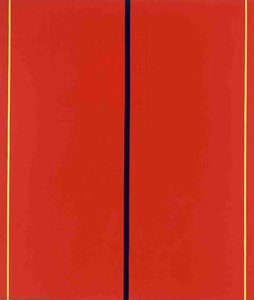
Be I (1970) de Barnett Newman

Be I

1970 · Acrylic On Canvas · Detroit Institute of Arts, Detroit

The canvas holds a heavy, dark cadmium red. This color occupies the space like the earth itself, unmodulated and thick with presence. A single white stripe, known as a zip, cuts vertically through the center of the field. It is precise and thin. This line acts as a flash of lightning against the saturated background, an instantaneous moment that breaks the stillness of the red expanse.

6
Onement, III (1949) de Barnett Newman

Onement, III

1949 · Oil On Canvas

In the vast landscape of mid-20th-century abstraction, few works command the room with such singular, quiet intensity as Barnett Newman’s Onement, III. Created in 1949, this masterpiece stands as a seminal pillar of the Color Field painting movement, offering much more than a mere arrangement of pigment on canvas. It is an invitation to experience the sublime. The painting presents a breathtaking expanse of deep, dominant red, a field of…

7
Be I (1970) de Barnett Newman

Be I

1970 · Acrylic On Canvas

To stand before Be I is to encounter a profound silence that speaks with startling intensity. Created in 1970, the final year of Barnett Newman’s life, this monumental work serves as a definitive statement of the Color Field movement. The painting does not rely on the traditional vocabulary of figures or landscapes; instead, it commands the viewer's attention through a singular, immersive expanse of deep red. This is not merely…

8
The Third (1964) de Barnett Newman

The Third

1964 · Oil On Canvas

The canvas breathes through a field of orange. It is a hue that does not merely sit upon the surface but seems to vibrate, a steady heat radiating from the center of the frame. This is the world of 1964, where color is stripped of its duty to represent objects and is instead allowed to exist as pure energy. Through the application of pigment, a flat, non-hierarchical space emerges, inviting…

9
Twelfth Station (1965) de Barnett Newman

Twelfth Station

1965 · Acrylic On Canvas · National Gallery of Art, Washington

Barnett Newman created Twelfth Station in 1965. This acrylic on canvas exists as a single movement within a larger sequence. It belongs to the series titled The Stations of the Cross / Lema Sabachthani. The work emerged from a period of intense philosophical inquiry, seeking to find a visual language for the silent weight of existence.

10
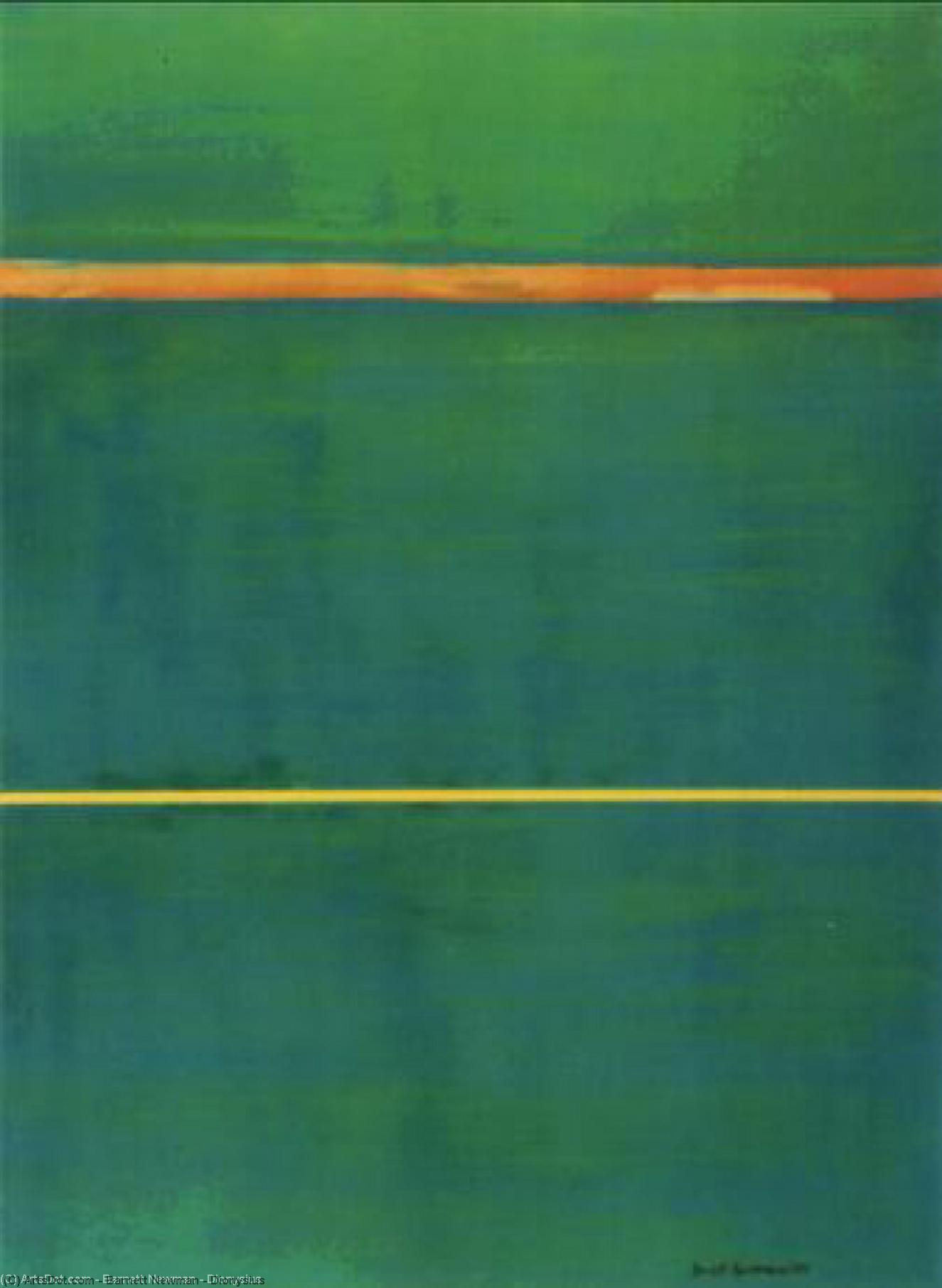
Dionysius (1949) de Barnett Newman

Dionysius

1949 · Oil On Canvas

Dionysius is a work by Barnett Newman. Created in 1949, this oil on canvas piece belongs to the Color Field style. The artist's approach here focuses on the expansive application of pigment to establish a specific spatial presence.

Pinturas famosas de Barnett Newman, números 11 a 63

Pinturas famosas de Barnett Newman, período por período

Os temas que cativaram o olhar de Barnett Newman

Os quatro temas que mais se repetem nestas obras originais, cada um com o seu melhor exemplo.

Os museus que guardam os originais de Barnett Newman

Os 6 museus que detêm a maioria das pinturas desta página.

Museus Cidade Obras de Barnett Newman Pinturas desta lista
National Gallery of Art, WashingtonNational Gallery of Art Washington 13 Twelfth Station, Fourth Station, Second Station
Museum Folkwang, EssenMuseum Folkwang Essen 1 Prometheus Bound
MoMA - Museu de Arte Moderna, Nova YorkMoMA - Museu de Arte Moderna Nova York 1 Onement I
Detroit Institute of Arts, DetroitDetroit Institute of Arts Detroit 1 Be I
Galeria Nacional do Canadá, OttawaGaleria Nacional do Canadá Ottawa 1 The Way I
Museum Ludwig, ColôniaMuseum Ludwig Colônia 1 Midnight Blue

Barnett Newman ao longo das décadas: uma obra original única para cada uma

Obras por década

Escolha uma década para ver a obra original que a define.

Pinturas de Barnett Newman: perguntas para a galeria

Qual é a obra mais famosa de Barnett Newman?Revelar a resposta

Fogo Negro I (1963). Vir Heroicus Sublimis (1950) e Prometheus Bound vêm a seguir.

Com que idade Barnett Newman criou Fogo Negro I?Revelar a resposta

58 anos: Fogo Negro I data de 1963, e Barnett Newman nasceu em 1905.

Quais são as dez pinturas mais famosas de Barnett Newman?Revelar a resposta

Fogo Negro I, Vir Heroicus Sublimis, Prometheus Bound, Onement I, Be I, Onement, III, Be I, The Third, Twelfth Station e Dionysius. O ranking acima apresenta o ano e o museu de cada uma.

Quantas obras de Barnett Newman são conhecidas?Revelar a resposta

Nosso catálogo contém 69 obras de Barnett Newman, datadas de 1944 a 1970.

Onde se pode ver os originais mais famosos de Barnett Newman?Revelar a resposta

Principalmente em National Gallery of Art (Washington), Museum Folkwang (Essen) e MoMA - Museu de Arte Moderna (Nova York). A tabela de museus acima lista todos eles.

Em que período Barnett Newman criou as suas pinturas mais conhecidas?Revelar a resposta

Em 1960s: 32 das 63 obras nesta página foram feitas então, sendo Fogo Negro I delas.

Qual pintura famosa de Barnett Newman é a mais antiga e qual é a mais recente?Revelar a resposta

Nesta página, a mais antiga é The Song of Orpheus (1944) e a mais recente é Be I (1970).

Quais temas Barnett Newman preferia?Revelar a resposta

Vertical lines (5), Geometric (4) e Spirituality (2), entre as 63 obras nesta página.

Com quais materiais Barnett Newman mais pintou?Revelar a resposta

Oil On Canvas, para 8 das 63 obras nesta página.

A qual movimento pertence a obra de Barnett Newman?Revelar a resposta

Color field e Abstract expressionism, a julgar pelos originais nesta página.

Quais originais de Barnett Newman posso ver no National Gallery of Art?Revelar a resposta

Twelfth Station, Fourth Station e Second Station: o National Gallery of Art, Washington detém 13 das obras desta página.

Barnett Newman: um retrato do artista

A Pioneer of Abstract Expressionism: The Life and Art of Barnett Newman

Barnett Newman, born in 1905 in New York City to Jewish immigrant parents from Poland, emerged as a pivotal figure in the landscape of American art. His journey wasn’t one of immediate recognition but rather a slow burn of artistic exploration and philosophical inquiry that ultimately redefined the possibilities of abstract painting. Initially studying at the Art Students League and later at the City College of New York, Newman absorbed the influences of his time – the burgeoning Cubism of Picasso and the vibrant color palettes of Matisse were early touchstones. However, he soon felt constrained by these established modes of representation, sensing a need to forge a new visual language capable of expressing the anxieties and spiritual longings of the post-war era. He even destroyed much of his earlier representational work, a deliberate act signifying his commitment to an entirely new artistic path. This period of self-imposed creative destruction was crucial; it cleared the ground for the radical simplicity that would come to define his mature style. Newman’s formative years were marked by intellectual curiosity and engagement with philosophy—a passion that would permeate throughout his life's work. He pursued a degree in Philosophy at City College of New York, where he wrestled with existential questions and developed a profound appreciation for the power of thought to illuminate the human condition. This philosophical grounding profoundly shaped his artistic vision, informing his rejection of traditional representational conventions and propelling him toward the exploration of abstract forms as vehicles for conveying spiritual truths. He was driven by a conviction that art could transcend mere visual perception, accessing realms of emotion and consciousness beyond the grasp of language.

The Birth of the “Zip” and the Expansion of Color

Newman’s breakthrough arrived with the development of what he famously termed "zips"—vertical bands of color that bisect vast fields of monochrome hues. These weren't merely lines; they were dynamic forces, asserting presence within the expansive emptiness of the canvas. His first solo exhibition in 1943 at Betty Parsons Gallery marked a significant step, though initial reactions were mixed. Critics questioned his austere aesthetic and struggled to grasp its emotional resonance. It was with works like Onement VI (1950-51) that Newman truly established his signature aesthetic. The painting’s sheer scale and austere composition—a single red zip dividing the canvas into fields of orange and red—were revolutionary. Vir Heroicus Sublimis (1958-60), a monumental work, further solidified this approach, its multiple zips creating a sense of spatial depth and evoking feelings of awe and contemplation. The “zip” wasn’t simply an aesthetic device; it was a structural element that simultaneously divided and united the canvas, acting as a symbolic marker of human presence within the infinite. Newman believed that he reached his fully distinct, signature style with the *Onement*series (from 1948). He meticulously crafted these canvases—often reaching dimensions exceeding ten feet—employing a technique characterized by monumental scale and uncompromising simplicity. The resulting paintings are imbued with an almost meditative quality, inviting viewers to contemplate the vastness of space and the profound mysteries of existence. Newman’s artistic journey was marked by experimentation and innovation. He initially dabbled in Surrealist techniques, embracing dreamlike imagery and exploring subconscious associations—a stylistic detour that ultimately served as a springboard for his subsequent development of abstract expressionism. However, he swiftly abandoned representational art altogether, recognizing its limitations in conveying the spiritual dimensions he sought to capture. Instead, he embraced the radical simplicity of color field painting, prioritizing pure hues and minimal compositional elements. This decision reflected Newman’s conviction that art could communicate truths beyond the realm of visual perception—truths rooted in emotion, intuition, and a yearning for transcendence. He famously declared: “We are in the process of making the world, to a certain extent, in our own image.” Newman's legacy extends far beyond his artistic output. He was a vocal advocate for intellectual freedom and social justice, actively engaging in political activism and championing progressive causes throughout his life. His unwavering commitment to these values mirrored his belief that art had a moral responsibility—to confront uncomfortable realities and inspire individuals to strive for a more compassionate and enlightened world. Barnett Newman died in 1970, leaving behind an indelible mark on the history of modern art and cementing his place as one of America’s most influential painters. His paintings continue to resonate with audiences today, prompting contemplation about the nature of consciousness, spirituality, and the sublime—a testament to the enduring power of abstract expressionism and Newman's singular vision.