Retrato de Antonio Zucchi

As 87 Pinturas Mais Famosas de Antonio Zucchi, uma Seleção da Galeria

Atualizado em Novembro 2026 · classificado pela nossa pontuação de popularidade (pesquisas, visitas e pedidos de cada obra) · 101 obras de Antonio Zucchi em nosso catálogo

Em resumo

De todas as obras originais deixadas por Antonio Zucchi, a mais famosa é A Putto Being Woken from Sleep by Tickling of His Nose (1770), da coleção do Nostell Priory, em Wakefield. Logo atrás vêm James Adam, 1732 - 1794. Architect and designer (1763) e Landscape with a Bridge and Ruins with Peasants Fishing (a set of six decorative wall panels) (1781). Nosso catálogo contém 101 obras de Antonio Zucchi; a galeria preservou as 87 que o mundo mais admira, cada uma exibida com sua data, seu museu e sua história.

1726 – 1795, Veneza Neoclassical style Mais obras: Nostell Priory

As 10 principais pinturas de Antonio Zucchi: a escolha da galeria

1
A Putto Being Woken from Sleep by Tickling of His Nose (1770) de Antonio Zucchi

A Putto Being Woken from Sleep by Tickling of His Nose

1770 · Oil · Nostell Priory, Wakefield

We find ourselves before A Putto Being Woken from Sleep by Tickling of His Nose, a work by the Venetian painter Antonio Zucchi. This piece dates to about 1770, a period when Zucchi was establishing his presence within the English artistic landscape. The painting is currently held within the Nostell Priory collection, where it has been preserved as part of their significant holdings.

2
James Adam, 1732 - 1794. Architect and designer (1763) de Antonio Zucchi

James Adam, 1732 - 1794. Architect and designer

1763 · Oil On Canvas · Galeria Nacional de Retratos de Escócia, Edimburgo

In this portrait, James Adam, 1732 - 1794. Architect and designer, meets the viewer through the brush of Antonio Zucchi. The scene unfolds in Rome, captured during the subject's Grand Tour of Italy in 1763. Here, the youngest member of a prominent dynasty of Scottish architects appears not merely as a man, but as a central figure in the unfolding Neoclassical movement. He carries the weight of his profession with…

3
Landscape with a Bridge and Ruins with Peasants Fishing (a set of six decorative wall panels) (1781) de Antonio Zucchi

Landscape with a Bridge and Ruins with Peasants Fishing (a set of six decorative wall panels)

1781 · Oil On Canvas · National Trust, Plymouth

Antonio Zucchi’s “Landscape with a Bridge and Ruins with Peasants Fishing,” painted in 1781, is more than just a picturesque scene; it’s a poignant meditation on time, memory, and the enduring relationship between humanity and nature. This captivating work, originally conceived as one of a set of decorative wall panels, transports us to an idealized Italian countryside where classical grandeur meets rustic simplicity. The eye is immediately drawn to the…

4
Nymphs garlanding Cupid (1774) de Antonio Zucchi

Nymphs garlanding Cupid

1774 · Oil · Nostell Priory, Wakefield

This work, titled Nymphs garlanding Cupid, is an oil painting by the Italian painter and printmaker Antonio Zucchi. Created about 1774, the piece presents a mythological scene set within a sun-drenched woodland. The composition focuses on a central group of figures, including several nymphs and a small, nude Cupid, captured in a moment of celebration.

6
Hector and Andromache (1773) de Antonio Zucchi

Hector and Andromache

1773 · Oil On Canvas · Nostell Priory, Wakefield

In Hector and Andromache, Antonio Zucchi captures a heavy moment of farewell and reunion. A muscular warrior, clad in a helmet, pulls a woman into a tight embrace. She holds a small baby against her, a fragile weight amidst the tension of the scene. They are framed by the skeletal remains of Roman architecture, where weathered stone walls and broken arches rise into the shadows. In the distance, other figures…

7
Three dancing nymphs and a reclining cupid in a landscape (1772) de Antonio Zucchi

Three dancing nymphs and a reclining cupid in a landscape

1772 · Metropolitan Museum of Art, Nova York

The forest breathes with a quiet, rhythmic energy as three women move through the dappled light. They are caught in a moment of pure, unburdened motion, their bodies swaying in a synchronized grace that defies the stillness of the trees. One woman leads on the left, her pose a delicate curve against the greenery, while the central figure anchors the movement, her form a focal point of light and motion.…

8
Jurisprudence (1769) de Antonio Zucchi

Jurisprudence

1769 · Oil · English Heritage, Londres

In the quiet, commanding presence of Antonio Zucchi’s Jurisprudence, we encounter more than a mere portrait; we enter a realm where personified virtue meets classical grandeur. Painted in 1769, this exquisite work serves as a profound meditation on the nature of law, wisdom, and authority. The composition centers upon a regal woman, seated with a poised grace that suggests both accessibility and an impenetrable intellect. As she sits with her…

9
The Four Continents America (1777) de Antonio Zucchi

The Four Continents America

1777 · Painting · National Trust, Derby

To gaze upon this magnificent piece is to step directly into the vibrant heart of Enlightenment-era global ambition. The Four Continents America, executed in 1777 by Antonio Zucchi, is far more than a mere depiction of people; it is a sweeping, allegorical testament to human connection, exploration, and the perceived organization of the known world at the close of the eighteenth century. The composition immediately draws the eye to the…

10
Mathematics (1769) de Antonio Zucchi

Mathematics

1769 · Oil On Canvas · English Heritage, Londres

In "Mathematics," Antonio Zucchi presents a scene where intellect and grace meet in a quiet, suspended moment. Completed in 1769, the painting centers on a woman seated upon an easel-like structure. She exists in a state of profound contemplation, her gaze directed upwards toward an unseen height, as if she is tracing the very logic of the heavens. This upward look suggests a mind reaching beyond the physical realm to…

A seleção de Antonio Zucchi continua, de 11 a 87

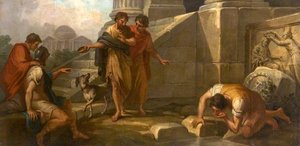
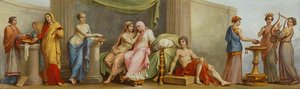
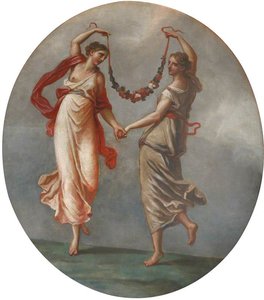
11The Four Continents Europe (1777) de Antonio ZucchiThe Four Continents Europe1777 · National Trust 12Winter (1769) de Antonio ZucchiWinter1769 · English Heritage 13Chloe Playing the Lyre to Daphnis (or Sappho and Anacreon) (1776) de Antonio ZucchiChloe Playing the Lyre to Daphnis (or Sappho and Anacreon)1776 · Nostell Priory 14The Four Continents Asia (1777) de Antonio ZucchiThe Four Continents Asia1777 · National Trust 15The Four Continents Africa (1777) de Antonio ZucchiThe Four Continents Africa1777 · National Trust 16Diogenes Casting Away His Wooden Bowl as a Superfluity, on Seeing a Youth Drinking from His Hand (a set of three decorative wall panels) (1768) de Antonio ZucchiDiogenes Casting Away His Wooden Bowl as a Superfluity, on Seeing a Youth Drinking from His Hand (a set of three decorative wall panels)1768 · National Trust 17Theology (1769) de Antonio ZucchiTheology1769 · English Heritage 18Ruins of Classical Baths with Nymphs Bathing (a set of six decorative wall panels) (1781) de Antonio ZucchiRuins of Classical Baths with Nymphs Bathing (a set of six decorative wall panels)1781 · National Trust 19A Bacchanal (1769) de Antonio ZucchiA Bacchanal1769 · English Heritage 20Minerva among the Arts (1769) de Antonio ZucchiMinerva among the Arts1769 · English Heritage 21Sappho Giving Anacreon a Feather from Cupid's Wing (1770) de Antonio ZucchiSappho Giving Anacreon a Feather from Cupid's Wing1770 · Nostell Priory 22Capriccio of Figures Dancing amongst Classical Ruins, with a Statue of the Rape of Proserpine (1775) de Antonio ZucchiCapriccio of Figures Dancing amongst Classical Ruins, with a Statue of the Rape of Proserpine1775 · Nostell Priory 23Commerce (1769) de Antonio ZucchiCommerce1769 · English Heritage 24The Rape of Europa (1769) de Antonio ZucchiThe Rape of Europa1769 · English Heritage 25Apollo and the Muses (1767) de Antonio ZucchiApollo and the Muses1767 · Nostell Priory 26Capriccio of Figures Dancing amongst Classical Ruins, with a Ruined Arch (1775) de Antonio ZucchiCapriccio of Figures Dancing amongst Classical Ruins, with a Ruined Arch1775 · Nostell Priory 27The Aldobrandini Marriage (1769) de Antonio ZucchiThe Aldobrandini Marriage1769 · English Heritage 28Navigation (1769) de Antonio ZucchiNavigation1769 · English Heritage 29Justice Embracing Peace (1769) de Antonio ZucchiJustice Embracing Peace1769 · English Heritage 30Bacchantes (5 of 6 ovals) (1773) de Antonio ZucchiBacchantes (5 of 6 ovals)1773 · English Heritage 31Homer Crowned as Poet Laureate (1767) de Antonio ZucchiHomer Crowned as Poet Laureate1767 · Nostell Priory 32Agriculture (1769) de Antonio ZucchiAgriculture1769 · English Heritage 33Bacchantes (2 of 6 ovals) (1773) de Antonio ZucchiBacchantes (2 of 6 ovals)1773 · English Heritage 34Dido and Aeneas ( ) (1773) de Antonio ZucchiDido and Aeneas ( )1773 · Nostell Priory 35An Unidentified Classical Subject A Fight (1767) de Antonio ZucchiAn Unidentified Classical Subject A Fight1767 · Nostell Priory 36Putti Making Music (1770) de Antonio ZucchiPutti Making Music1770 · Nostell Priory 37The Infant Hercules (1769) de Antonio ZucchiThe Infant Hercules1769 · English Heritage 38Anacreon Sacrificing to the Three Graces (1770) de Antonio ZucchiAnacreon Sacrificing to the Three Graces1770 · Nostell Priory 39Bacchantes (4 of 6 ovals) (1773) de Antonio ZucchiBacchantes (4 of 6 ovals)1773 · English Heritage 40Bacchantes (3 of 6 ovals) (1773) de Antonio ZucchiBacchantes (3 of 6 ovals)1773 · English Heritage 41Bacchantes (1 of 6 ovals) (1773) de Antonio ZucchiBacchantes (1 of 6 ovals)1773 · English Heritage 42Putti Fishing (1770) de Antonio ZucchiPutti Fishing1770 · Nostell Priory 43An Epithalium (1769) de Antonio ZucchiAn Epithalium1769 · English Heritage 44An Unidentified Classical Subject A Quarrel over a Dead Ass (1767) de Antonio ZucchiAn Unidentified Classical Subject A Quarrel over a Dead Ass1767 · Nostell Priory 45Putti with a Bird (1770) de Antonio ZucchiPutti with a Bird1770 · Nostell Priory 46Putti with a Dog (1770) de Antonio ZucchiPutti with a Dog1770 · Nostell Priory 47Socrates Drinking the Hemlock (1767) de Antonio ZucchiSocrates Drinking the Hemlock1767 48Wisdom (Prudence) and Temperance (1767) de Antonio ZucchiWisdom (Prudence) and Temperance1767 · Nostell Priory 49Rinaldo and Armida (1773) de Antonio ZucchiRinaldo and Armida1773 · Nostell Priory 50A Greek Philosopher and His Disciples (1767) de Antonio ZucchiA Greek Philosopher and His Disciples1767 · Nostell Priory 51Justice and Strength (Fortitude) (1767) de Antonio ZucchiJustice and Strength (Fortitude)1767 · Nostell Priory 52Minerva Presenting the Personifications of the Arts of Painting, Gardening, Sculpture and Architecture to Britannia (1767) de Antonio ZucchiMinerva Presenting the Personifications of the Arts of Painting, Gardening, Sculpture and Architecture to Britannia1767 · Nostell Priory 53Putti with a Garland of Flowers (1770) de Antonio ZucchiPutti with a Garland of Flowers1770 · Nostell Priory 54The Return of Telemachus (1773) de Antonio ZucchiThe Return of Telemachus1773 · Nostell Priory 55Virgil Reading the Aeneid to the Emperor Augustus, His Wife Livia and His Fainting Sister, Octavia (1767) de Antonio ZucchiVirgil Reading the Aeneid to the Emperor Augustus, His Wife Livia and His Fainting Sister, Octavia1767 · Nostell Priory 56Hercules between Glory and the Passions (1769) de Antonio ZucchiHercules between Glory and the Passions1769 · English Heritage 57Cupid Preparing Venus for an Amorous Encounter with Mars (1773) de Antonio ZucchiCupid Preparing Venus for an Amorous Encounter with Mars1773 · Nostell Priory 58Mythological Subject with a Couple in an Embrace (1773) de Antonio ZucchiMythological Subject with a Couple in an Embrace1773 · Nostell Priory 59Bacchus and Ceres (1773) de Antonio ZucchiBacchus and Ceres1773 · English Heritage 60Aristippus and His Companions after Being Shipwrecked, Seeing Mathematical Diagrams, Realise the Land Was Inhabited (a set of three decorative wall panels) (1768) de Antonio ZucchiAristippus and His Companions after Being Shipwrecked, Seeing Mathematical Diagrams, Realise the Land Was Inhabited (a set of three decorative wall panels)1768 · National Trust 61Mitellus Ordering a Marble Crow to Be Put on the Tomb of His Former Master, Diodorus Siculus (a set of three decorative wall panels) (1768) de Antonio ZucchiMitellus Ordering a Marble Crow to Be Put on the Tomb of His Former Master, Diodorus Siculus (a set of three decorative wall panels)1768 · National Trust 62Catullus Comforting Lesbia over the Death of Her Pet Sparrow and Writing an Ode (1773) de Antonio ZucchiCatullus Comforting Lesbia over the Death of Her Pet Sparrow and Writing an Ode1773 · Nostell Priory 63Angelica and Medoro Medoro Carving the Name of Angelica into the Trunk of a Tree (1773) de Antonio ZucchiAngelica and Medoro Medoro Carving the Name of Angelica into the Trunk of a Tree1773 · Nostell Priory 64Capriccio with a Pagan Temple and a Sacrifice (1776) de Antonio ZucchiCapriccio with a Pagan Temple and a Sacrifice1776 · Nostell Priory 65Capriccio with the Ruins of a Triumphal Arch and a Bridge (1776) de Antonio ZucchiCapriccio with the Ruins of a Triumphal Arch and a Bridge1776 · Nostell Priory 66A Ruined Temple and Fountain with Musicians (a set of six decorative wall panels) (1781) de Antonio ZucchiA Ruined Temple and Fountain with Musicians (a set of six decorative wall panels)1781 · National Trust 67Fountain with Women Washing Clothes (a set of six decorative wall panels) (1781) de Antonio ZucchiFountain with Women Washing Clothes (a set of six decorative wall panels)1781 · National Trust 68Daphnis Giving an Apple to Chloe (1776) de Antonio ZucchiDaphnis Giving an Apple to Chloe1776 · Nostell Priory 69Daphnis Bestowing a Garland of Flowers on Chloe (1776) de Antonio ZucchiDaphnis Bestowing a Garland of Flowers on Chloe1776 · Nostell Priory 70Philetus Explaining Love to Daphnis and Chloe (1776) de Antonio ZucchiPhiletus Explaining Love to Daphnis and Chloe1776 · Nostell Priory 71A Procession of Classical Figures with a Donkey and a Tambourine (a set of six decorative wall panels) (1781) de Antonio ZucchiA Procession of Classical Figures with a Donkey and a Tambourine (a set of six decorative wall panels)1781 · National Trust 72Girls Dancing amid Classical Ruins (a set of six decorative wall panels) (1781) de Antonio ZucchiGirls Dancing amid Classical Ruins (a set of six decorative wall panels)1781 · National Trust 73Philosophy (1769) de Antonio ZucchiPhilosophy1769 · English Heritage 74Spring (1769) de Antonio ZucchiSpring1769 · English Heritage 75Venus and Cupid de Antonio ZucchiVenus and CupidNostell Priory 76Putto with a Personification of Chemistry de Antonio ZucchiPutto with a Personification of ChemistryNostell Priory 77Putto with a Personification of Sculpture de Antonio ZucchiPutto with a Personification of SculptureNostell Priory 78Putto with a Personification of Drawing de Antonio ZucchiPutto with a Personification of DrawingNostell Priory 79Putto with a Personification of Architecture de Antonio ZucchiPutto with a Personification of ArchitectureNostell Priory 80Putto with a Personification of Mathematics de Antonio ZucchiPutto with a Personification of MathematicsNostell Priory 81Putto with a Personification of Painting de Antonio ZucchiPutto with a Personification of PaintingNostell Priory 82Putto with a Personification of Poetry de Antonio ZucchiPutto with a Personification of PoetryNostell Priory 83Autumn (1769) de Antonio ZucchiAutumn1769 · English Heritage 84Summer (1769) de Antonio ZucchiSummer1769 · English Heritage 85Bacchantes (6 de 6 ovais) (1773) de Antonio ZucchiBacchantes (6 de 6 ovais)1773 · English Heritage 86A Pair of Dancing Women de Antonio ZucchiA Pair of Dancing WomenNational Trust 87Disarming of Cupid de Antonio ZucchiDisarming of CupidThe National Trust For Scotland

Pinturas famosas de Antonio Zucchi, período por período

Os temas que cativaram o olhar de Antonio Zucchi

Os quatro temas que mais se repetem nestas obras originais, cada um com o seu melhor exemplo.

Os museus que guardam os originais de Antonio Zucchi

Os 8 museus que detêm a maioria das pinturas desta página.

Museus Cidade Obras de Antonio Zucchi Pinturas desta lista
Nostell Priory, WakefieldNostell Priory Wakefield 43 A Putto Being Woken from Sleep by Tickling of His Nose, Nymphs garlanding Cupid, Putto with Personification of Music
English Heritage, LondresEnglish Heritage Londres 26 Jurisprudence, Mathematics, Winter
National Trust, PlymouthNational Trust Plymouth 9 Landscape with a Bridge and Ruins with Peasants Fishing (a set of six decorative wall panels), Diogenes Casting Away His Wooden Bowl as a Superfluity, on Seeing a Youth Drinking from His Hand (a set of three decorative wall panels), Ruins of Classical Baths with Nymphs Bathing (a set of six decorative wall panels)
National Trust, DerbyNational Trust Derby 4 The Four Continents America, The Four Continents Europe, The Four Continents Asia
Galeria Nacional de Retratos de Escócia, EdimburgoGaleria Nacional de Retratos de Escócia Edimburgo 1 James Adam, 1732 - 1794. Architect and designer
Metropolitan Museum of Art, Nova YorkMetropolitan Museum of Art Nova York 1 Three dancing nymphs and a reclining cupid in a landscape
National Trust, AylesburyNational Trust Aylesbury 1 A Pair of Dancing Women
The National Trust For Scotland, MayboleThe National Trust For Scotland Maybole 1 Disarming of Cupid

Antonio Zucchi década a década: a obra original que define cada uma

Obras por década

Escolha uma década para ver a obra original que a define.

Perguntas de colecionadores sobre as pinturas de Antonio Zucchi

Por qual obra Antonio Zucchi é mais conhecido(a)?Revelar a resposta

A Putto Being Woken from Sleep by Tickling of His Nose (1770), Nostell Priory, Wakefield. James Adam, 1732 - 1794. Architect and designer (1763) e Landscape with a Bridge and Ruins with Peasants Fishing (a set of six decorative wall panels) (1781) vêm a seguir.

Qual era a idade de Antonio Zucchi quando A Putto Being Woken from Sleep by Tickling of His Nose foi feita?Revelar a resposta

44 anos: A Putto Being Woken from Sleep by Tickling of His Nose data de 1770, e Antonio Zucchi nasceu em 1726.

Quais são as dez pinturas mais famosas de Antonio Zucchi?Revelar a resposta

A Putto Being Woken from Sleep by Tickling of His Nose, James Adam, 1732 - 1794. Architect and designer, Landscape with a Bridge and Ruins with Peasants Fishing (a set of six decorative wall panels), Nymphs garlanding Cupid, Putto with Personification of Music, Hector and Andromache, Three dancing nymphs and a reclining cupid in a landscape, Jurisprudence, The Four Continents America e Mathematics. O ranking acima apresenta o ano e o museu de cada uma.

Quantas pinturas Antonio Zucchi deixou?Revelar a resposta

Nosso catálogo contém 101 obras de Antonio Zucchi, datadas de 1763 a 1781.

Em quais museus estão expostas as obras-primas de Antonio Zucchi?Revelar a resposta

Principalmente em Nostell Priory (Wakefield), English Heritage (Londres) e National Trust (Plymouth). A tabela de museus acima lista todos eles.

Em que anos Antonio Zucchi pintou as suas obras mais famosas?Revelar a resposta

Em 1770s: 38 das 87 obras nesta página foram feitas então, sendo A Putto Being Woken from Sleep by Tickling of His Nose delas.

Quais são as primeiras e as últimas obras originais famosas de Antonio Zucchi?Revelar a resposta

Nesta página, a mais antiga é James Adam, 1732 - 1794. Architect and designer (1763) e a mais recente é Landscape with a Bridge and Ruins with Peasants Fishing (a set of six decorative wall panels) (1781).

Quais temas Antonio Zucchi escolheu com mais frequência?Revelar a resposta

Woman (28), People (20) e Man (13), entre as 87 obras nesta página.

Qual técnica Antonio Zucchi mais utilizou?Revelar a resposta

Oil On Canvas, para 33 das 87 obras nesta página.

A qual movimento artístico pertence Antonio Zucchi?Revelar a resposta

Neoclassical style, a julgar pelos originais nesta página.

Quais obras de Antonio Zucchi estão expostas no Nostell Priory?Revelar a resposta

A Putto Being Woken from Sleep by Tickling of His Nose, Nymphs garlanding Cupid e Putto with Personification of Music: o Nostell Priory, Wakefield detém 43 das obras desta página.

Antonio Zucchi: vida e obra

Francis Cotes: Um Pioneiro do Pastel Inglês

Francis Cotes (1726–1770) ergue-se como uma figura fundamental no florescente mundo do retrato inglês, sendo particularmente reconhecido pelo seu uso inovador do pastel e pela sua capacidade de capturar momentos fugazes de personalidade. Nascido em Londres, foi aprendiz de William Faithorne, um pintor célebre pelos seus retratos de grupo teatrais, uma experiência que, sem dúvida, moldou as suas primeiras sensibilidades artísticas. No entanto, Cotes rapidamente superou o seu mestre, desenvolvendo um estilo distintamente individual, caracterizado por uma sensibilidade notável à luz, à textura e às nuances psicológicas dos seus modelos. Ao contrário da formalidade muitas vezes rígida do retrato inglês anterior, as obras de Cotes possuem uma imediate de vibrante, refletindo um envolvimento profundo com a personalidade do retratado e uma consciência aguda do mundo visual que o rodeava. O início da sua carreira foi marcado por encomendas de famílias proeminentes, incluindo os Astley, para os quais criou a célebre obra “Aos Sete Anos, e o seu Irmão Edward, aos Cinco Anos e Meio”, uma representação terna da inocência infantil que permanece como uma das suas obras mais amadas. Esta pintura exemplifica a capacidade de Cotes de imbuir até temas aparentemente simples com uma profunda ressonância emocional. Ele empregou habilmente o pastel — um meio então considerado relativamente novo na Inglaterra — para alcançar efeitos notáveis de cor e tom, capturando o rubor delicado da pele, o brilho dos tecidos e as subtis gradações de luz e sombra. Cotes não estava simplesmente a replicar aparências; ele traduzia a realidade observada para a tela com uma graça pictórica que o distinguia dos seus contemporâneos. O seu uso de pinceladas soltas e expressivas criava uma sensação de movimento e vitalidade, contribuindo para a qualidade cativante dos seus retratos.

Técnica e Influências

O domínio técnico de Cotes derivava não apenas do seu talento inato, mas também do seu estudo meticuloso da natureza e das obras de outros artistas. Ele foi profundamente influenciado pelos Mestres Holandeses, particularmente por Rembrandt, cujo uso de luz e sombra para criar efeitos dramáticos é evidente nos retratos de Cortes. Admirava também o trabalho de Anthony van Dyck, cujas composições elegantes e percepções psicológicas ele procurou emular. Contudo, ao contrário do estilo polido de Van Dyck, Cotes abraçou uma abordagem mais informal, frequentemente retratando os seus modelos em poses relaxadas e capturando-os em cenários naturais. A sua técnica de pastel foi ainda refinada através da experimentação com a sobreposição de cores e a aplicação destas com variados graus de pressão, permitindo-lhe alcançar uma gama surpreendente de valores tonais e texturas. Os retratos resultantes não são meros semelhanças; são estudos íntimos de caráter, imbuídos de um sentido palpável de vida.

Obras Notáveis e Encomendas

Para além do icónico “Aos Sete Anos”, Cotes produziu um corpo de trabalho significativo que inclui inúmeros retratos de membros da aristocracia e da pequena nobreza. Pintou para figuras proeminentes como Sir Robert Peel, Lord Charles Townshend e Lady Mary Wortley Montagu. As suas encomendas eram frequentemente impulsionadas pelo desejo de capturar a personalidade única e o estatuto social do modelo, refletindo as mudanças de gosto na Inglaterra do século XVIII. O seu trabalho estendeu-se também para além do retrato; produziu pinturas de paisagem e cenas de género, demonstrando a sua versatilidade como artista. A Royal Academy, fundada em 1769, reconheceu as contribuições de Cotes ao elegerlo como um dos seus membros fundadores, consolidando o seu lugar entre os principais artistas da sua época.

Legado e Significado Histórico

O legado de Francis Cotes reside primordialmente no seu papel pioneiro no desenvolvimento da pintura pastel inglesa. Ele demonstrou o potencial deste meio para capturar nuances subtis de cor e tom, abrindo caminho para gerações futuras de artistas do pastel. Os seus retratos são admirados hoje não apenas pela sua brilhância técnica, mas também pela sua profundidade psicológica e ressonância emocional. A obra de Cotes representa um afastamento das convenções formais do retrato anterior, abraçando uma abordagem mais íntima e expressiva que refletia o espírito do Iluminismo. Ele é lembrado como uma figura chave no estabelecimento da pintura inglesa como uma tradição distinta e vibrante, deixando uma marca indelével na história da arte. A sua influência pode ser vista nas obras de artistas posteriores que seguiram os seus passos, consolidando a sua posição como um verdadeiro inovador e um mestre do seu ofício.