1834 - 1912

Destaques

  • Born: 1834, Venice, Italy
  • Topics explored: italy
  • Died: 1912
  • Corpus themes: venetian realism
  • Lifespan: 78 years
  • Works on this site: 19
  • Nationality: Italy
  • Museums on this site:
    • Museu Nacional de Varsóvia
    • Sunderland Museum - Winter Gardens
    • Haworth Art Gallery
    • Lichfield District Council House

A Venetian Chronicler: The Life and Art of Antonio Ermolao Paoletti

Antonio Ermolao Paoletti, born in Venice on May 8th, 1834, and passing away in his beloved city on December 13th, 1912, was a painter deeply entwined with the spirit of Venice. He wasn’t merely *of* Venice; he chronicled it—its bustling piazzas, its quiet canals, the everyday lives unfolding within its ancient walls. Paoletti belonged to a lineage steeped in Venetian culture; his father, Ermolao Paoletti, was a renowned scholar and writer, authoring an exhaustive guide to the city’s architecture, art, and customs, as well as a dictionary of the local dialect. This upbringing undoubtedly instilled in Antonio a profound appreciation for Venice's unique character, which would become the defining subject of his artistic career.

Early Training and Artistic Development

Paoletti received his formal training at the Accademia di Belle Arti in Venice, studying under Pompeo Marino Molmenti. He found himself amongst a vibrant circle of fellow artists, including sculptor Antonio Dal Zotto and Armenian painter Edgar Chahine. This period was formative, shaping his technical skills and solidifying his interest in genre painting—depicting scenes from everyday life. While the grand historical canvases were popular at the time, Paoletti gravitated towards capturing the fleeting moments of Venetian existence. His early works already hinted at a keen observational ability and a talent for portraying human interaction with warmth and detail. He wasn’t interested in idealized representations but rather in the authentic texture of life as it was lived by ordinary people.

Themes and Style: Echoes of the Bamboccianti

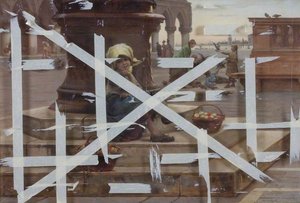
Paoletti's oeuvre is characterized by its charming depictions of Venetian genre scenes, often recalling the style of the *Bamboccianti*—a group of Dutch and Flemish painters who settled in Rome during the 17th century and focused on everyday Roman life. Like them, Paoletti found beauty in the commonplace: children playing in the streets, women engaged in domestic tasks, vendors hawking their wares. His paintings are filled with a sense of nostalgia, capturing a Venice that was both timeless and subtly changing. He frequently depicted scenes around Piazza San Marco, showcasing the lively interactions between locals and tourists. Feeding the Pigeons, one of his most recognizable works, exemplifies this—a vibrant snapshot of daily life unfolding against the backdrop of the iconic square. He also painted sacred frescoes for churches in the Veneto region, demonstrating a versatility beyond purely secular subjects. His brushwork is generally smooth and detailed, with a focus on capturing light and atmosphere.

Exhibitions and Recognition

Throughout his career, Paoletti exhibited widely, gaining recognition for his evocative portrayals of Venetian life. He participated in exhibitions in Milan (1872), Turin (1884), and at the Promotrice Popolana Venicena. His submissions often featured scenes brimming with local color and character—such as Ecco come va il vino nelle messe, Flowers for the Holy Virgin, and Fa' caro al nonno!. These exhibitions provided a platform to showcase his talent to a wider audience, solidifying his reputation as a skilled genre painter. He also contributed significantly to the artistic landscape of Venice by becoming a professor at the Accademia di Belle Arti, passing on his knowledge and passion for painting to future generations.

Legacy: A Preserver of Venetian Identity

Antonio Ermolao Paoletti’s historical significance lies in his dedication to documenting the everyday life of Venice during a period of transition. While not aiming for groundbreaking innovation, he excelled at capturing the essence of the city—its atmosphere, its people, and its unique cultural identity. His paintings offer valuable insights into 19th-century Venetian society, providing a glimpse into the lives of those often overlooked by grand historical narratives. He wasn’t simply painting pictures; he was preserving memories, celebrating the beauty of the commonplace, and ensuring that the spirit of Venice would endure through his art. His works continue to resonate with viewers today, offering a charming and evocative window into a bygone era.

Quiz

Cada pergunta possui apenas uma resposta correta.

Pergunta 1:
Antonio Ermolao Paoletti was primarily known for painting what type of scenes?
Pergunta 2:
In which city was Antonio Ermolao Paoletti born?
Pergunta 3:
Who was Antonio Ermolao Paoletti's father?
Pergunta 4:
Paoletti displayed his work at an exhibition in Milan in what year?
Pergunta 5:
What subject matter did Paoletti often depict in his genre scenes?

Perguntas e Respostas

Onde posso encontrar as obras de Antonio Ermolao Paoletti agrupadas por paleta?

Para encontrar obras de Antonio Ermolao Paoletti em uma paleta específica, acesse a página de Por paleta de cores do artista.

Existe uma visão geral de todos os temas que Antonio Ermolao Paoletti pintou?

O Atlas de Temas de Antonio Ermolao Paoletti é uma página que mapeia as obras do artista por seus temas.

Posso navegar pelas obras de Antonio Ermolao Paoletti por humor?

A Coleção por Humor de Antonio Ermolao Paoletti organiza as obras do artista por humor.

Por quais outros nomes ou pseudônimos Antonio Ermolao Paoletti é conhecido?

Antonio Ermolao Paoletti também é conhecido como Antonio Paoletti, A. Paoletti, A. Ermolao Paoletti, Антонио Паолетти, Антоніо Ермолао Паолетті.

Posso visitar um museu virtual das obras de Antonio Ermolao Paoletti?

A Galeria 3D de Antonio Ermolao Paoletti é uma página que apresenta as obras do artista em uma galeria virtual tridimensional.

Em que cidade e país Antonio Ermolao Paoletti nasceu?

Antonio Ermolao Paoletti nasceu em Venice, em Italy.

Quantas obras de Antonio Ermolao Paoletti estão disponíveis para explorar?

Você pode explorar 19 obras de arte obras de Antonio Ermolao Paoletti na página Todas as obras.

Quais cores Antonio Ermolao Paoletti utilizou com mais frequência?

O uso da cor em Antonio Ermolao Paoletti, através das obras listadas em este site, pode ser estudado na página DNA da Paleta do artista.

De onde é Antonio Ermolao Paoletti?

Antonio Ermolao Paoletti nasceu em Italy.