Retrato de Alfred Philippe Roll

As 49 Pinturas Mais Famosas de Alfred Philippe Roll, uma Seleção da Galeria

Atualizado em Novembro 2026 · classificado pela nossa pontuação de popularidade (pesquisas, visitas e pedidos de cada obra) · 50 obras de Alfred Philippe Roll em nosso catálogo

Em resumo

De todas as obras originais que Alfred Philippe Roll deixou, a mais famosa é Portrait de Mme Roll. Logo atrás vêm Retour du bal e The feast of Silenus (1871). Nosso catálogo contém 50 obras de Alfred Philippe Roll; a galeria preservou as 49 que o mundo mais admira, cada uma exibida com sua data, seu museu e sua história.

1845 – 1919, Paris Mais obras: Petit Palais

As 10 principais pinturas de Alfred Philippe Roll: a escolha da galeria

1
Portrait de Mme Roll de Alfred Philippe Roll

Portrait de Mme Roll

Oil On Canvas

The portrait depicts a woman, identified as Madame Roll, positioned in a vertical orientation. She is situated slightly off-center within a domestic interior, appearing to stand near a window. The figure is rendered with a muted color palette, primarily composed of blacks, grays, and browns. Subtle ochre and muted red tones appear in the highlights and the background. Her attire is formal, and her expression remains serene with a slight…

2
Retour du bal de Alfred Philippe Roll

Retour du bal

Oil On Canvas · Musée d'Arts de Nantes, Nantes

The air in the room feels heavy with the scent of perfume and the soft rustle of silk as two women move through an opulent interior. We watch them from behind, catching only the graceful curve of their backs and the sweeping lines of their attire. They are poised, perhaps caught in a moment of transition between the excitement of a social gathering and the quietude of their private quarters.…

3
The feast of Silenus (1871) de Alfred Philippe Roll

The feast of Silenus

1871 · Oil On Canvas · Museum of Fine Arts Ghent (MSK), Gante

The feast of Silenus emerges from the brush of Alfred Philippe Roll, a painter whose life spanned the transformative decades of the late nineteenth century. Born in the former 8th arrondissement of Paris, France, in 1845, Roll carries the weight of a changing era within his lineage. He remains a figure of the French tradition, having departed this world in 1919. This specific work, The feast of Silenus, captures a…

4
Marianne Orfrey, Green Crier (1880) de Alfred Philippe Roll

Marianne Orfrey, Green Crier

1880 · Oil On Canvas · Musée des Beaux-Arts de Pau, Pau

In this 1880 oil on canvas, we find ourselves standing at eye-level with a solitary woman, a street vendor whose presence commands a quiet, stoic dignity. She is positioned slightly off-center, a choice that lends a sense of naturalism to the vertical composition. There is a certain weight to her figure, anchored by the heavy folds of her skirt and the rounded, organic form of the basket she carries. The…

5
July 14, 1880, Inauguration of the Monument to the République (1882) de Alfred Philippe Roll

July 14, 1880, Inauguration of the Monument to the République

1882 · Oil · Petit Palais, Paris

The canvas depicts a dense, wide-angle view of a Parisian square during a large-scale public celebration. In the center of the composition, a monument rises toward a sky filled with fluttering flags. The scene is populated by a vast, diverse crowd of figures that extend from the immediate foreground into the distance. These people are rendered with varied postures, some standing in groups and others moving through the space. The…

6
Henri Rochefort (Victor-Henri, marquis de Rochefort-Luçay, 1831-1913), journalist, politician and writer (1879) de Alfred Philippe Roll

Henri Rochefort (Victor-Henri, marquis de Rochefort-Luçay, 1831-1913), journalist, politician and writer

1879 · Oil On Canvas · Musée Carnavalet, Paris

The portrait emerges from a period of transition in French art, moving away from the rigid constraints of academic tradition toward a more grounded, empathetic realism. The visible layering of paint suggests a preoccupation with the authentic human form rather than an idealized version of it. There is a palpable sense of the man's internal life, a quiet intensity that lingers in the way the light interacts with his features.…

7
Woman and bull (1885) de Alfred Philippe Roll

Woman and bull

1885 · Oil · Museu Nacional de Belas Artes, Buenos Aires

The air feels heavy and still within this shadowed woodland, where the light filters through a dense canopy in soft, dappled patches. A nude woman rests in an intimate, quiet moment, her pale skin glowing against the deep, earthy tones of the surrounding meadow. Beside her, the muscular form of a bull emerges from the darkness, its presence a powerful counterpoint to her vulnerability. There is a profound sense of…

8
Alsatian and Lorrainer (1891) de Alfred Philippe Roll

Alsatian and Lorrainer

1891 · Oil · Museum of the French Revolution, Vizille

In the work Alsatian and Lorrainer by Alfred Philippe Roll, the composition is structured as a tight, intimate close-up of two female figures. The primary subject is positioned in the foreground, presented in a sharp profile facing toward the left side of the frame. Behind her, a second woman is partially visible, also oriented toward the left. This overlapping arrangement creates a sense of depth within the narrow field of…

9
Portrait of Thaulow and His Wife (1890) de Alfred Philippe Roll

Portrait of Thaulow and His Wife

1890 · Oil On Canvas · Petit Palais, Paris

In this intimate oil on canvas, Alfred Philippe Roll presents Portrait of Thaulow and His Wife. Painted about 1890, the work captures a quiet moment between a man and a woman. The subjects are likely the artist's acquaintances, Thaulow and his wife, rendered with a sense of naturalism that suggests a close proximity to the figures. There is a palpable sense of companionship in the way they are positioned together.

10
Portrait of Jane Hading (1890) de Alfred Philippe Roll

Portrait of Jane Hading

1890 · Oil On Canvas · Petit Palais, Paris

The portrait presents a woman seated centrally within a luxurious interior. She is positioned in a vertical orientation, wearing a sleeveless black gown that features shimmering, light-colored patterns suggestive of sequins or embroidery. A large, dark, textured element, resembling a fur mantle or heavy drapery, surrounds the upper portion of her chair. Her skin is rendered with smooth, luminous textures, and her reddish-brown hair is styled softly around her face.…

A seleção de Alfred Philippe Roll continua, de 11 a 49

11André Manaut (1890) de Alfred Philippe RollAndré Manaut1890 · Municipal museum (Saverne) 12Au trot (1888) de Alfred Philippe RollAu trot1888 · Municipal museum (Saverne) 13Adolphe Alphand (1888) de Alfred Philippe RollAdolphe Alphand1888 · Petit Palais 14Centenary of the Estates General at the Neptune Basin (May 3, 1889) (1889) de Alfred Philippe RollCentenary of the Estates General at the Neptune Basin (May 3, 1889)1889 15Exodus (1893) de Alfred Philippe RollExodus1893 · Petit Palais 16Louise Cattel, wet nurse (1894) de Alfred Philippe RollLouise Cattel, wet nurse1894 · Palais des Beaux-Arts de Lille 17Alexandre Dumas fils (1895) de Alfred Philippe RollAlexandre Dumas fils1895 · Musée des Beaux-Arts 18Roll Painting (1900) de Alfred Philippe RollRoll Painting1900 · Petit Palais 19Portrait de Mme Henriette Roll (1900) de Alfred Philippe RollPortrait de Mme Henriette Roll1900 · Municipal museum (Saverne) 20Nu couché (1900) de Alfred Philippe RollNu couché1900 · Musée d'Art Moderne et Contemporain de Strasbourg 21In Summer, Woman with Dog (1909) de Alfred Philippe RollIn Summer, Woman with Dog1909 · Petit Palais 22Sketch for the Petit Palais, south gallery: Apotheosis (central ceiling) (1909) de Alfred Philippe RollSketch for the Petit Palais, south gallery: Apotheosis (central ceiling)1909 · Petit Palais 23Sketch for the Petit Palais, south gallery: Poetry - Drama (1910) de Alfred Philippe RollSketch for the Petit Palais, south gallery: Poetry - Drama1910 · Petit Palais 24Sketch for the Petit Palais, south gallery: Fantastic Music (1911) de Alfred Philippe RollSketch for the Petit Palais, south gallery: Fantastic Music1911 · Petit Palais 25Sketch for the South Gallery of the Petit Palais: Apotheosis (central ceiling) (1913) de Alfred Philippe RollSketch for the South Gallery of the Petit Palais: Apotheosis (central ceiling)1913 · Petit Palais 26The Big Bed (1912) de Alfred Philippe RollThe Big Bed1912 · Municipal museum (Saverne) 27Bourgeoisie (1913) de Alfred Philippe RollBourgeoisie1913 · Municipal museum (Saverne) 28Portrait of Miss Amélie Diéterle, in 1913. Title : In June, Amélie Diéterle. (1913) de Alfred Philippe RollPortrait of Miss Amélie Diéterle, in 1913. Title : In June, Amélie Diéterle.1913 · Petit Palais 29The Tea Cup (1918) de Alfred Philippe RollThe Tea Cup1918 · Municipal museum (Saverne) 30CHEMIN SOUS BOIS de Alfred Philippe RollCHEMIN SOUS BOIS 31July 14, 1880, Inauguration of the Monument to the Republic (1881) de Alfred Philippe RollJuly 14, 1880, Inauguration of the Monument to the Republic1881 · Petit Palais 32Esquisse pour La fête nationale du 14 juillet 1880 (1881) de Alfred Philippe RollEsquisse pour La fête nationale du 14 juillet 18801881 · Municipal museum (Saverne) 33Sketch for the Hôtel de Ville de Paris: Art, Movement, Work, Lights (1897) de Alfred Philippe RollSketch for the Hôtel de Ville de Paris: Art, Movement, Work, Lights1897 · Petit Palais 34The Vigil under the Arc de Triomphe (1903) de Alfred Philippe RollThe Vigil under the Arc de Triomphe1903 · Musée Victor Hugo 35The Wave (1911) de Alfred Philippe RollThe Wave1911 · Petit Palais 36Sketch for the Petit Palais, south gallery: Fantastic Music (1911) de Alfred Philippe RollSketch for the Petit Palais, south gallery: Fantastic Music1911 · Petit Palais 37Peder Severin Kröyer (1851-1909) de Alfred Philippe RollPeder Severin Kröyer (1851-1909)Nationalmuseum 38Petite République (1907) de Alfred Philippe RollPetite République1907 · Municipal museum (Saverne) 39La grève de mineurs de Alfred Philippe RollLa grève de mineurs 40Portrait de Léon Bourgeois de Alfred Philippe RollPortrait de Léon Bourgeois 41PORTRAIT DE JEUNE FILLE de Alfred Philippe RollPORTRAIT DE JEUNE FILLE 42Portrait de jeune femme de Alfred Philippe RollPortrait de jeune femme 43L'Exécution d'un trompette sous la Commune de Alfred Philippe RollL'Exécution d'un trompette sous la CommuneMusée Carnavalet 44Les baigneuses Panneau décoratif (Ancien titre) de Alfred Philippe RollLes baigneuses Panneau décoratif (Ancien titre) 45Bathers de Alfred Philippe RollBathersMusée des Beaux-Arts de Dijon 46Chevaux à l'écurie de Alfred Philippe RollChevaux à l'écurie 47Manda Lamétrie, fermière (1887) de Alfred Philippe RollManda Lamétrie, fermière1887 · Musée d'Orsay 48The Young Republic (1908) de Alfred Philippe RollThe Young Republic1908 · Musée d'Orsay 49The Striker's Wife de Alfred Philippe RollThe Striker's WifeMusee Baron Martin

Pinturas famosas de Alfred Philippe Roll, período por período

Os temas que cativaram o olhar de Alfred Philippe Roll

Os quatro temas que mais se repetem nestas obras originais, cada um com o seu melhor exemplo.

Os museus que guardam os originais de Alfred Philippe Roll

Os 8 museus que detêm a maioria das pinturas desta página.

Museus Cidade Obras de Alfred Philippe Roll Pinturas desta lista
Petit Palais, ParisPetit Palais Paris 16 July 14, 1880, Inauguration of the Monument to the République, Portrait of Thaulow and His Wife, Portrait of Jane Hading
Municipal museum (Saverne), SaverneMunicipal museum (Saverne) Saverne 8 André Manaut, Au trot, Portrait de Mme Henriette Roll
Musée Carnavalet, ParisMusée Carnavalet Paris 2 Henri Rochefort (Victor-Henri, marquis de Rochefort-Luçay, 1831-1913), journalist, politician and writer, L'Exécution d'un trompette sous la Commune
Musée d'Orsay, ParisMusée d'Orsay Paris 2 Manda Lamétrie, fermière, The Young Republic
Musée d'Arts de Nantes, NantesMusée d'Arts de Nantes Nantes 1 Retour du bal
Museum of Fine Arts Ghent (MSK), GanteMuseum of Fine Arts Ghent (MSK) Gante 1 The feast of Silenus
Musée des Beaux-Arts de Pau, PauMusée des Beaux-Arts de Pau Pau 1 Marianne Orfrey, Green Crier
Museu Nacional de Belas Artes, Buenos AiresMuseu Nacional de Belas Artes Buenos Aires 1 Woman and bull

Alfred Philippe Roll década a década: a obra original que define cada uma

Obras por década

Escolha uma década para ver a obra original que a define.

Perguntas de colecionadores sobre as pinturas de Alfred Philippe Roll

Por qual obra Alfred Philippe Roll é mais conhecido(a)?Revelar a resposta

Portrait de Mme Roll. Retour du bal e The feast of Silenus (1871) vêm a seguir.

Quais são as dez pinturas mais famosas de Alfred Philippe Roll?Revelar a resposta

Portrait de Mme Roll, Retour du bal, The feast of Silenus, Marianne Orfrey, Green Crier, July 14, 1880, Inauguration of the Monument to the République, Henri Rochefort (Victor-Henri, marquis de Rochefort-Luçay, 1831-1913), journalist, politician and writer, Woman and bull, Alsatian and Lorrainer, Portrait of Thaulow and His Wife e Portrait of Jane Hading. O ranking acima apresenta o ano e o museu de cada uma.

Quantas pinturas Alfred Philippe Roll deixou?Revelar a resposta

Nosso catálogo contém 50 obras de Alfred Philippe Roll, datadas de 1871 a 1918.

Em quais museus estão expostas as obras-primas de Alfred Philippe Roll?Revelar a resposta

Principalmente em Petit Palais (Paris), Municipal museum (Saverne) (Saverne) e Musée Carnavalet (Paris). A tabela de museus acima lista todos eles.

Em que anos Alfred Philippe Roll pintou as suas obras mais famosas?Revelar a resposta

Em 1880s: 9 das 49 obras nesta página foram feitas então, sendo Marianne Orfrey, Green Crier delas.

Quais são as primeiras e as últimas obras originais famosas de Alfred Philippe Roll?Revelar a resposta

Nesta página, a mais antiga é The feast of Silenus (1871) e a mais recente é The Tea Cup (1918).

Quais temas Alfred Philippe Roll escolheu com mais frequência?Revelar a resposta

Woman (19), Man (8) e Skin tones (5), entre as 49 obras nesta página.

Qual técnica Alfred Philippe Roll mais utilizou?Revelar a resposta

Oil On Canvas, para 17 das 49 obras nesta página.

Quais obras de Alfred Philippe Roll estão expostas no Petit Palais?Revelar a resposta

July 14, 1880, Inauguration of the Monument to the République, Portrait of Thaulow and His Wife e Portrait of Jane Hading: o Petit Palais, Paris detém 16 das obras desta página.

Alfred Philippe Roll: vida e obra

A Alma da Terceira República: A Jornada Artística de Alfred Philippe Roll

Na paisagem vibrante e mutável da França do final do século XIX, poucos artistas capturaram o pulsar de uma nação em transformação de forma tão pungente quanto Alfred Philippe Roll. Nascido em Paris em 1846, Roll emergiu dos prestigiados salões da École des Beaux-Arts, um aluno moldado pelas rigorosas tradições acadêmicas de mestres como Jean-Léon Gérôme, Léon Bonnat e Charles-François Daubigny. Seus primeiros anos foram marcados por uma sensibilidade romântica, um período estilístico onde suas telas respiravam com a grandiosidade e o charme pitoresco característicos da época. Durante esta fase formativa, sua obra frequentemente ecoava a emocionalidade arrebatadora da tradição bolonhesa e o realismo emergente de Gustave Courbet, criando uma tensão delicada entre a beleza clássica e a observação crua.

A trajetória da carreira de Roll foi irrevogavelmente alterada pelos ventos turbulentos da história. A Guerra Franco-Prussiana, na qual serviu como tenente da milícia, infundiu sua perspectiva com uma compreensão profunda da resiliência humana e das convulsões sociais. Este período de conflito atuou como um crisol, refinando seu olhar do puramente romântico em direção a um realismo mais terreno e empático. Sua obra-prima de 1875, The Flood at Toulouse, permanece como um testemunho assombroso desta transição; ao capturar o sofrimento imediato e a fragilidade da vida durante um desastre natural, ele foi além da mera decoração para se envolver com o psiquismo coletivo do povo francês. Esta obra, que agora reside no Musée Malraux, sinalizou sua chegada como um artista capaz de uma profunda narrativa visual.

Do Romantismo à Crueza do Realismo

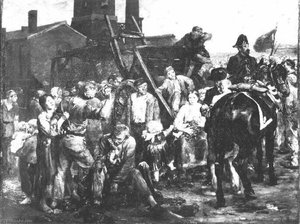
À medida que as décadas passavam, o pincel de Roll começou a despojar-se de suas arestas romantizadas, abraçando, em vez disso, a aspereza e a verdade do movimento Naturalista. Ele tornou-se um pintor do povo, voltando sua atenção para a dinâmica sociopolítica da Terceira República. Esta evolução não foi meramente estilística, mas profundamente ideológica. Ele buscou documentar a experiência humana autêntica, particularmente as lutas e os triunfos da classe trabalhadora. Sua pintura histórica, Miners’ Strike (1880), permanece como uma de suas conquistas mais significativas, catapultando-o para os escalões superiores do mundo da arte francesa. Nesta obra, ele não apenas retratou o descontentamento trabalhista; ele humanizou a luta, imbuindo as figuras com uma dignidade que ressoou muito além das paredes da galeria.

Este compromisso com o realismo social permitiu que Roll navegasse pelas complexidades de sua era com uma destreza notável. Seu repertório expandiu-se para incluir:

  • Paisagens Urbanas: Representações meticulosas da vida parisiense e do rosto mutável da cidade.
  • Retratos Íntimos: Estudos que refletiam as nuances das identidades burguesas e da classe trabalhadora.
  • Narrativas Sociais: Composições de grande escala que abordavam questões políticas e sociais contemporâneas.

Sua habilidade em fundir a precisão técnica aprendida com seus mentores acadêmicos com uma abordagem progressiva, quase documental, em relação ao tema, tornou-o uma voz vital na arte francesa. Ele não foi apenas um observador da vida, mas um cronista de suas transformações mais prementes.

Legado e Significância Histórica

O legado de Alfred Philippe Roll é definido por seu papel como uma ponte entre o velho mundo da tradição acadêmica e o novo mundo do engajamento social. Como cofundador da Société Nationale des Beaux-Arts, ele desempenhou um papel crucial na reformulação do cenário institucional da arte francesa, defendendo um espaço onde estilos diversos pudessem coexistir. Sua obra permanece como um registro histórico vital, capturando a essência de uma França presa entre os ecos do romantismo e as realidades cruas da industrialização e da reforma social.

Através de seu domínio da luz, da textura e da composição, Roll garantiu que as lutas e a beleza da vida cotidiana fossem imortalizadas. Seja através das vistas panorâmicas da região de Champagne ou dos tons sombrios de uma greve de trabalhadores, sua arte continua a convidar os espectadores para um diálogo profundo com o passado. Ele permanece uma figura significativa para qualquer pessoa que busque compreender o pulsar da França do século XIX — um artista que olhou para o mundo não apenas como ele aparecia, mas como ele era sentido.