Retrato de Alexandre Calame

As 58 Pinturas Mais Famosas de Alexandre Calame, Cada Uma Única

Atualizado em Novembro 2026 · classificado pela nossa pontuação de popularidade (pesquisas, visitas e pedidos de cada obra) · 63 obras de Alexandre Calame em nosso catálogo

Em resumo

Torrent in the Alps (1849) é a pintura de Alexandre Calame que mais atrai olhares. Depois disso, o olhar recai sobre The Mythen (1861) e Valley of Lauterbrunnen (1856). Entre as 63 obras de Alexandre Calame em nosso catálogo, estas 58 são as mais famosas, cada uma uma original única apresentada com o seu ano, o seu museu e a razão pela qual perdura.

1810 – 1864, Vevey Romantic landscape painting Mais obras: Amsterdam Museum

As 10 principais pinturas de Alexandre Calame, sob o olhar da galeria

1
Torrent in the Alps (1849) de Alexandre Calame

Torrent in the Alps

1849 · Oil On Canvas

The oil on canvas titled Torrent in the Alps was painted by Alexandre Calame in 1849. This work captures a specific moment of movement within the Swiss landscape. The physical presence of the piece measures 57.8 x 76.0 cm or 58.5 x 76.3 cm.

2
The Mythen (1861) de Alexandre Calame

The Mythen

1861 · Oil

The painting depicts a mountain landscape dominated by two prominent, snow-covered peaks. One peak occupies the left side of the composition, while the second rises toward the right. The sky above these summits is rendered in shades of purple. Below the rocky heights, several figures are positioned within the scene. Some individuals appear in the foreground, while others are situated at a distance, creating a sense of scale and depth.…

3
Valley of Lauterbrunnen (1856) de Alexandre Calame

Valley of Lauterbrunnen

1856 · Lithograph

The landscape known as Valley of Lauterbrunnen emerges from the hand of Alexandre Calame, a Swiss landscape painter and lithographer. Created in 1856, this work captures a specific moment in the artist's life, a period when he was already well-established in his craft. Calame, who was born in 1810, brings a deep familiarity with the topography of his homeland to this scene. The piece exists as a window into the…

4
Landscape (1837) de Alexandre Calame

Landscape

1837 · Print · Rijksmuseum, Amsterdã

The sun hangs low, casting a luminous yellow-gold glow across a sky that promises either a quiet sunrise or a fading sunset. Below this celestial light, a winding river carves its way through the terrain, leading the eye from the immediate, shadowed foreground into a hazy, distant horizon. The air feels heavy with moisture, creating a misty, ethereal quality that softens the edges of the world. Deep forest greens and…

5
High Mountain Gorge (Handeggtal in the Canton of Bern) (1854) de Alexandre Calame

High Mountain Gorge (Handeggtal in the Canton of Bern)

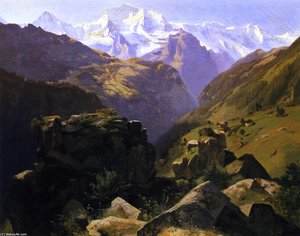
1854 · Oil On Canvas · Alte Nationalgalerie, Berlim

The rugged terrain of the Handeggtal in the Canton of Bern is rendered with a focus on the overwhelming scale of the natural world. A dark, wind-swept evergreen tree anchors the mid-ground, its verticality contrasting against the steep, diagonal slopes of the gorge. Light breaks through a turbulent, heavy sky to illuminate a distant, rocky peak and a small, cascading waterfall on the left. This composition emphasizes the immense depth…

6
Fallen Tree (1842) de Alexandre Calame

Fallen Tree

1842 · Oil On Canvas · National Gallery of Art, Washington

The composition is dominated by heavy, diagonal lines created by fallen trunks that cut across the frame. These splintered remains of large trees lie in a state of chaotic movement, their jagged edges pointing into the depths of the forest. The scene focuses on the immediate aftermath of natural destruction, where the structural integrity of the woods has been broken. Deep shadows settle within the hollows of the fractured wood,…

7
Landscape with Oaks (1859) de Alexandre Calame

Landscape with Oaks

1859 · Oil On Canvas · Museu Hermitage, São Petersburgo

In this 1859 oil on canvas, we find ourselves standing before a scene of profound stillness. A large tree, heavy with green leaves, anchors the center of the composition, its roots seemingly entwined with a rugged, rocky terrain. The ground beneath is a mixture of dirt and grass, suggesting a corner of the world left to its own devices. In the distance, other trees emerge through a soft haze, providing…

8
Lake Lucerne (1853) de Alexandre Calame

Lake Lucerne

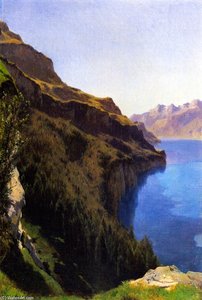
1853 · Oil On Canvas · Alte Nationalgalerie, Berlim

Alexandre Calame captures the stillness of the Swiss landscape in his 1853 oil painting, Lake Lucerne. This landscape painting focuses on the quietude of the water held between steep, rugged cliffs. The artist, born in Vevey, Switzerland, translates the physical weight of the Alps into a study of light and shadow. The composition centers on the lake itself, a serene blue expanse nestled beneath the shadow of the mountains.

9
Chalets at Rigi (1861) de Alexandre Calame

Chalets at Rigi

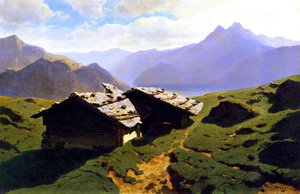
1861 · Oil On Canvas · National Gallery, Londres

In this oil on canvas, Alexandre Calame presents a quiet moment amidst the high peaks. The work, titled Chalets at Rigi, captures a specific slice of mountain life. We find ourselves looking upon a hillside where three main chalets sit nestled against the landscape. Each structure possesses its own unique size and shape, appearing as if they have grown naturally from the earth itself. The scene unfolds with a sense…

10
Swiss Landscape (1830) de Alexandre Calame

Swiss Landscape

1830 · Oil On Canvas · National Gallery of Art, Washington

In the work Swiss Landscape by Alexandre Calame, the composition is organized around a wide, panoramic view. The perspective is elevated, providing a high vantage point that looks out over a vast expanse of terrain. The viewer's eye is led from a textured, shadowed foreground through a series of patterned agricultural fields. These fields are defined by the geometric boundaries of cultivated plots and the undulating contours of the hills.…

Pinturas famosas de Alexandre Calame, números 11 a 58

11Waterfall of the Handeck at the Grimsel (1839) de Alexandre CalameWaterfall of the Handeck at the Grimsel1839 · Amsterdam Museum 12landscape: river-valley with rocks in the mountains (1835) de Alexandre Calamelandscape: river-valley with rocks in the mountains1835 13Mountain Landscape (1838) de Alexandre CalameMountain Landscape1838 · Amsterdam Museum 14italian landscape with lake (1835) de Alexandre Calameitalian landscape with lake1835 15Mountain landscape (1835) de Alexandre CalameMountain landscape1835 16Lake with mountains in the background (1835) de Alexandre CalameLake with mountains in the background1835 17landscape with figures (1835) de Alexandre Calamelandscape with figures1835 18Mountain Landscape, Valais, Switzerland (1838) de Alexandre CalameMountain Landscape, Valais, Switzerland1838 19The Thunderstorm at Handeck (1839) de Alexandre CalameThe Thunderstorm at Handeck1839 20Edge of the Forest (1847) de Alexandre CalameEdge of the Forest1847 21In the Berner Oberland (1847) de Alexandre CalameIn the Berner Oberland1847 · Amsterdam Museum 22Mountain Stream in the Alps (Reichenbach) (1842) de Alexandre CalameMountain Stream in the Alps (Reichenbach)1842 · Amsterdam Museum 23The Sycamores (1848) de Alexandre CalameThe Sycamores1848 24Lake at the Edge of a Forest (1848) de Alexandre CalameLake at the Edge of a Forest1848 · Museu de Belas Artes de Boston 25Mountaneous Landscape in Valais (1840) de Alexandre CalameMountaneous Landscape in Valais1840 · Nationalmuseum 26Pozzuoli and the Bay of Naples (1844) de Alexandre CalamePozzuoli and the Bay of Naples1844 27Mountainous Landscape with a Torrent (1840) de Alexandre CalameMountainous Landscape with a Torrent1840 28Part of Lake Geneva (1852) de Alexandre CalamePart of Lake Geneva1852 29Lake Lucerne (1852) de Alexandre CalameLake Lucerne1852 · Amsterdam Museum 30Broken Tree at Kerket, near Meyringen (Bernese Oberland) (1850) de Alexandre CalameBroken Tree at Kerket, near Meyringen (Bernese Oberland)1850 31View Taken in the Ansasca Valley (Piedmont). Evening Effect. (1850) de Alexandre CalameView Taken in the Ansasca Valley (Piedmont). Evening Effect.1850 32Grimsel Pass (Canton of Berne) (1850) de Alexandre CalameGrimsel Pass (Canton of Berne)1850 33Winter (1851) de Alexandre CalameWinter1851 · Musée d'Art et d'Histoire de Genève 34The Sycamores (1854) de Alexandre CalameThe Sycamores1854 · Cincinnati Art Museum 35Lake of the Four Cantons (1850) de Alexandre CalameLake of the Four Cantons1850 · Museu Nacional de Varsóvia 36The Jungfrau, Switzerland (1853) de Alexandre CalameThe Jungfrau, Switzerland1853 · Walters Art Museum 37Mountain Torrent before a Storm (also known as The Aare River, Hastital) (1850) de Alexandre CalameMountain Torrent before a Storm (also known as The Aare River, Hastital)1850 38Mountain Torrent (1850) de Alexandre CalameMountain Torrent1850 39Trunk of a Beech Tree (1850) de Alexandre CalameTrunk of a Beech Tree1850 40A View of the Jungfrau Massif seen from Above, Interlaken (1854) de Alexandre CalameA View of the Jungfrau Massif seen from Above, Interlaken1854 41Study from Nature Near Villeneuve (1855) de Alexandre CalameStudy from Nature Near Villeneuve1855 42Lake of the Four Cantons (Lake Lucerne), near Brunnen (1852) de Alexandre CalameLake of the Four Cantons (Lake Lucerne), near Brunnen1852 43Rocky Path (1860) de Alexandre CalameRocky Path1860 44Cliffs of Seelisberg, Lake Lucern (1861) de Alexandre CalameCliffs of Seelisberg, Lake Lucern1861 45Riverbed at Rosenlaui (1862) de Alexandre CalameRiverbed at Rosenlaui1862 46The River Lutschine near Lauterbrunnen (1862) de Alexandre CalameThe River Lutschine near Lauterbrunnen1862 47Souvenir of Lake Lucerne (1862) de Alexandre CalameSouvenir of Lake Lucerne1862 48Souvenir of Rosenlaui, Switzerland (1860) de Alexandre CalameSouvenir of Rosenlaui, Switzerland1860 · Wallace Collection 49Tempestade em Handeck (1838) de Alexandre CalameTempestade em Handeck1838 · Museu Fitzwilliam 50Alpine Landscape de Alexandre CalameAlpine LandscapeFinnish National Gallery 51Alpine Waterfall de Alexandre CalameAlpine WaterfallFinnish National Gallery 52The Wetterhorn de Alexandre CalameThe WetterhornRoyal Museum of Fine Arts Antwerp 53Etude de montagne de Alexandre CalameEtude de montagne 54Alpine Landscape de Alexandre CalameAlpine Landscape 55Etude de torrent de Alexandre CalameEtude de torrent 56The Lake of Thun de Alexandre CalameThe Lake of ThunNational Gallery 57Mountainous Riverscape de Alexandre CalameMountainous Riverscape 58Trees at the Bank de Alexandre CalameTrees at the Bank

Pinturas famosas de Alexandre Calame, período por período

Os temas que cativaram o olhar de Alexandre Calame

Os quatro temas que mais se repetem nestas obras originais, cada um com o seu melhor exemplo.

Os museus que guardam os originais de Alexandre Calame

Os 8 museus que detêm a maioria das pinturas desta página.

Museus Cidade Obras de Alexandre Calame Pinturas desta lista
Amsterdam Museum, AmsterdãoAmsterdam Museum Amsterdão 5 Waterfall of the Handeck at the Grimsel, Mountain Landscape, In the Berner Oberland
Alte Nationalgalerie, BerlimAlte Nationalgalerie Berlim 2 High Mountain Gorge (Handeggtal in the Canton of Bern), Lake Lucerne
National Gallery of Art, WashingtonNational Gallery of Art Washington 2 Fallen Tree, Swiss Landscape
National Gallery, LondresNational Gallery Londres 2 Chalets at Rigi, The Lake of Thun
Finnish National Gallery, HelsínquiaFinnish National Gallery Helsínquia 2 Alpine Landscape, Alpine Waterfall
Rijksmuseum, AmsterdãRijksmuseum Amsterdã 1 Landscape
Museu Hermitage, São PetersburgoMuseu Hermitage São Petersburgo 1 Landscape with Oaks
Museu de Belas Artes de Boston, BostonMuseu de Belas Artes de Boston Boston 1 Lake at the Edge of a Forest

Alexandre Calame ao longo das décadas: uma obra original única para cada uma

Obras por década

Escolha uma década para ver a obra original que a define.

Pinturas de Alexandre Calame: perguntas para a galeria

Qual é a obra mais famosa de Alexandre Calame?Revelar a resposta

Torrent in the Alps (1849). The Mythen (1861) e Valley of Lauterbrunnen (1856) vêm a seguir.

Com que idade Alexandre Calame criou Torrent in the Alps?Revelar a resposta

39 anos: Torrent in the Alps data de 1849, e Alexandre Calame nasceu em 1810.

Quais são as dez pinturas mais famosas de Alexandre Calame?Revelar a resposta

Torrent in the Alps, The Mythen, Valley of Lauterbrunnen, Landscape, High Mountain Gorge (Handeggtal in the Canton of Bern), Fallen Tree, Landscape with Oaks, Lake Lucerne, Chalets at Rigi e Swiss Landscape. O ranking acima apresenta o ano e o museu de cada uma.

Quantas obras de Alexandre Calame são conhecidas?Revelar a resposta

Nosso catálogo contém 63 obras de Alexandre Calame, datadas de 1830 a 1862.

Onde se pode ver os originais mais famosos de Alexandre Calame?Revelar a resposta

Principalmente em Amsterdam Museum (Amsterdão), Alte Nationalgalerie (Berlim) e National Gallery of Art (Washington). A tabela de museus acima lista todos eles.

Em que período Alexandre Calame criou as suas pinturas mais conhecidas?Revelar a resposta

Em 1850s: 19 das 58 obras nesta página foram feitas então, sendo Valley of Lauterbrunnen delas.

Qual pintura famosa de Alexandre Calame é a mais antiga e qual é a mais recente?Revelar a resposta

Nesta página, a mais antiga é Swiss Landscape (1830) e a mais recente é Riverbed at Rosenlaui (1862).

Quais temas Alexandre Calame preferia?Revelar a resposta

Sky (32), Trees (27) e Rocks (25), entre as 58 obras nesta página.

Com quais materiais Alexandre Calame mais pintou?Revelar a resposta

Oil On Canvas, para 35 das 58 obras nesta página.

A qual movimento pertence a obra de Alexandre Calame?Revelar a resposta

Romantic landscape painting, a julgar pelos originais nesta página.

Quais originais de Alexandre Calame posso ver no Amsterdam Museum?Revelar a resposta

Waterfall of the Handeck at the Grimsel, Mountain Landscape e In the Berner Oberland: o Amsterdam Museum, Amsterdão detém 5 das obras desta página.

Alexandre Calame: um retrato do artista

Alexandre Calame (1810 – 1864): Capturando a Majestade Alpina

Alexandre Calame, nascido em Arabie (atual Vevey), na Suíça, em 1810, foi um pintor de paisagens suíço que alcançou renome considerável durante a era Romântica, sendo considerado uma figura fundamental da Escola de Pintura de Düsseldorf. Sua jornada artística teve um início marcado por circunstâncias desafiadoras — a ruína financeira de seu pai impediu-lhe de seguir uma educação formal, forçando-o a trabalhar como escriturário de banco desde a adolescência. No entanto, essa necessidade pragmática alimentou sua paixão pela arte, nutrida por um encontro com o banqueiro Diodati, que lhe garantiu uma tutela inestimável sob a orientação de François Diday, um celebrado pintor de paisagens de Düsseldorf. Reconhecendo seu talento inato e sua dedicação, Calame abandonou rapidamente os deveres burocráticos em busca da excelência artística.

Seus anos formativos foram marcados pelo esboço diligente de paisagens suíças — principalmente vistas do Oberland Bernês — uma prática aperfeiçoada sob a orientação de Diday. Esse foco inicial estabeleceu uma preocupação vitalícia com o cenário alpino, refletindo a fascinação romântica pela natureza selvagem e pela beleza sublime. A associação de Calame com a Escola de Düsseldorf consolidou sua reputação como um mestre da perspectiva atmosférica e da modulação tonal. Artistas como Wilhelm Leibl e Anton Richter defenderam o estilo de Calame, enfatizando a observação meticulosa e pinceladas expressivas para transmitir o impacto emocional da natureza.

Estilo Artístico e Técnica

A assinatura artística de Calame residia em sua habilidade de traduzir a grandiosidade dos Alpes para a tela com notável precisão e sensibilidade. Ele empregava uma técnica caracterizada por camadas de vernizes — lavagens finas e translúcidas de pigmento aplicadas sequencialmente — para alcançar paletas de cores luminosas e capturar variações sutis de luz e sombra. Essa abordagem meticulosa espelhava a influência de Diday e distinguia Calame de muitos de seus contemporâneos que preferiam pinceladas mais soltas. Suas paisagens não eram meras representações; eram imbuídas de uma emoção palpável, transmitindo o drama das tempestades, a serenidade dos lagos glaciais e os tons vibrantes das prados alpinos. Obras notáveis incluem “Handeck Fall”, “Torrent in the Alps” e “Storm at Handeck”, cada uma demonstrando seu domínio da harmonia tonal e do equilíbrio composicional.

A contribuição de Calame estendeu-se para além da pintura; ele se destacou como litógrafo, produzindo gravuras deslumbrantes que difundiram ainda mais sua visão das paisagens alpinas.

Conquistas Notáveis e Legado

Calame obteve aclamação considerável na Alemanha durante as décadas de 1830 e 1840, tornando-se um favorito tanto de colecionadores quanto de críticos. Exposições em Paris apresentaram seu talento a um público mais amplo, solidificando sua posição como um dos principais artistas de paisagem da Suíça. Ele lecionou na Universidade de Genebra, fomentando o desenvolvimento artístico de alunos como Adolf Mosengel, que deu continuidade ao legado de Calame. Sua jornada pela Itália rendeu inspirações valiosas — particularmente de Roma e Nápoles — resultando em pinturas que capturaram a essência da beleza natural italiana ao lado de suas amadas vistas alpinas. O fascínio duradouro pelas representações de Calame de geleiras e riachos de montanha testemunha seu apelo atemporal e continua a inspirar artistas nos dias de hoje.

Obras Ilustrativas e Influência Artística

A influência artística de Calame ressoou por todo o movimento Romântico, moldando a sensibilidade estética de gerações subsequentes. Sua observação meticulosa e técnica expressiva serviram como modelo para pintores de paisagem que buscavam capturar a grandiosidade sublime da natureza. Além disso, suas gravuras litográficas desempenharam um papel crucial na popularização das paisagens alpinas e na disseminação dos ideais românticos por toda a Europa. A beleza duradoura e a profundidade emocional das pinturas de Calame garantem que sua contribuição para a história da arte permaneça firmemente estabelecida.