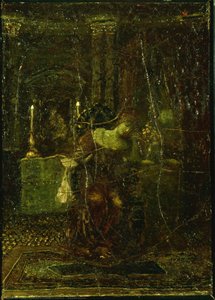
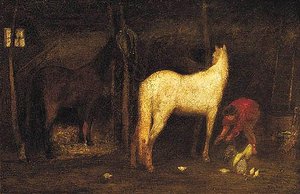
Retrato de Albert Pinkham Ryder

Pinturas de Albert Pinkham Ryder: As 100 mais famosas, sob o olhar de uma galeria

Atualizado em Novembro 2026 · classificado pela nossa pontuação de popularidade (pesquisas, visitas e pedidos de cada obra) · 102 obras de Albert Pinkham Ryder em nosso catálogo

Em resumo

Aos olhos da galeria, a pintura mais famosa de Albert Pinkham Ryder é A pista de corrida (A morte sobre um cavalo branco), cuja obra original está exposta no Cleveland Museum of Art, em Cleveland. Summer's Fruitful Pasture, (painting) (1870) e Macbeth and the Witches (1899) completam o trio que todos reconhecem. Dos 102 trabalhos de Albert Pinkham Ryder em nosso catálogo, a galeria apresenta abaixo as 100 obras mais famosas, cada uma original, com seu ano, seu museu e o que a torna única.

1847 – 1917, New Bedford Tonalism Mais obras: Smithsonian American Art Museum

As 10 principais pinturas de Albert Pinkham Ryder na galeria

1
A pista de corrida (A morte sobre um cavalo branco) de Albert Pinkham Ryder

A pista de corrida (A morte sobre um cavalo branco)

Óleo sobre tela · Cleveland Museum of Art, Cleveland

Mergulhe no mundo evocativo de "The Race Track", de Albert Pinkham Ryder, uma obra cativante que funde elementos do Simbolismo e do Expressionismo para criar uma cena de profunda profundidade emocional. Esta obra-prima convida os espectadores a um cenário onírico, onde um cavaleiro solitário galopa contra o pano de fundo de um céu melancólico e expansivo. A composição dinâmica e a rica paleta de cores tornam esta peça uma adição…

2
Summer's Fruitful Pasture, (painting) (1870) de Albert Pinkham Ryder

Summer's Fruitful Pasture, (painting)

1870 · Painting

Summer's Fruitful Pasture, (painting) is a work by Albert Pinkham Ryder. The artist was born in 1847 in New Bedford, United States. This piece dates to about 1870. It emerges from a period when the painter was beginning to find his voice within the American landscape.

3
Macbeth and the Witches (1899) de Albert Pinkham Ryder

Macbeth and the Witches

1899 · Oil · The Phillips Collection, Washington, D.C.

The canvas presents a nocturnal landscape where the boundaries between the physical and the spectral dissolve. A central, luminous orb of light pierces through a murky, atmospheric gloom, casting a dim, ochre glow upon swirling, indistinct forms. These nebulous shapes suggest the presence of the three witches from Act 1, scene 3 of Shakespeare’s play, their forms caught in a state of perpetual, ghostly motion. The composition is claustrophobic, lacking…

4
Moonlight Marine (1870) de Albert Pinkham Ryder

Moonlight Marine

1870 · Oil On Panel · Metropolitan Museum of Art, Nova York

Introduction to the Artist and Painting Albert Pinkham Ryder, an American painter known for his dreamlike, often melancholic landscapes, created Moonlight Marine in 1870. This oil on panel painting measures 29 x 31 cm and is housed at The Metropolitan Museum of Art in New York. Background and Inspiration Raised in the whaling port of New Bedford, Massachusetts, Ryder maintained a deep connection with the ocean even after moving to…

5
Under a Cloud (1900) de Albert Pinkham Ryder

Under a Cloud

1900 · Oil On Canvas · Metropolitan Museum of Art, Nova York

A single, dark mass of cloud hangs in the upper left, heavy with the weight of unfallen rain. It looms over a small sailing vessel, a tiny silhouette lost against the dark expanse of the sea. The water is a murky collection of deep blacks and ochre, moving with a slow, rhythmic tension. A pale, ghostly orb sits in the center-left, casting a diffused, weak light that fails to pierce…

6
Siegfried and the Rhine Maidens (1891) de Albert Pinkham Ryder

Siegfried and the Rhine Maidens

1891 · Oil On Canvas · National Gallery of Art, Washington

Siegfried and the Rhine Maidens is an oil on canvas painted by Albert Pinkham Ryder. The artist, born in 1847 and deceased in 1917, captured this scene in 1891. The work emerges from a moment of intense creative impulse. Ryder reportedly rushed home after a five-hour performance of Wagner's Götterdämmerung, working for forty-eight hours without food or sleep to translate the opera's narrative into this visual form.

7
Boy Driving a Wagon (1875) de Albert Pinkham Ryder

Boy Driving a Wagon

1875 · Oil On Board · Fine Arts Museums of San Francisco, São Francisco

Boy Driving a Wagon by Albert Pinkham Ryder, created about 1875, presents a scene of rural life set within a quiet landscape. A boy sits atop a large, heavy mass of hay that fills a wagon. This wagon is being pulled by a horse along a narrow dirt path. The subject is positioned centrally, moving through a landscape characterized by organic shapes and muted tones. The sky above is pale…

9
Woman and Staghound (Geraldine) (1883) de Albert Pinkham Ryder

Woman and Staghound (Geraldine)

1883 · Oil On Canvas · New Britain Museum of American Art, New Britain

In Woman and Staghound (Geraldine), Albert Pinkham Ryder presents a vertically oriented composition that feels heavy with atmosphere. A vast, dark expanse occupies the majority of the frame, creating a sense of nocturnal space that seems to swallow the periphery. Within this shadow, the color palette remains deeply somber, relying on dark browns, blacks, and deep umbers to establish a moody, nocturnal environment. This darkness is interrupted by a luminous…

10
The Hunter (1880) de Albert Pinkham Ryder

The Hunter

1880 · Oil · Brooklyn Museum, Brooklyn

The Hunter is an oil painting by Albert Pinkham Ryder, executed in 1880. The work emerged during a period of significant creative development for the American artist, who lived from 1847 to 1917. This piece belongs to a body of work characterized by its atmospheric depth and a departure from traditional academic precision.

Pinturas de Albert Pinkham Ryder, classificadas de 11 a 100

11Woman and Staghound, (painting) (1883) de Albert Pinkham RyderWoman and Staghound, (painting)1883 12The Story of the Cross (1890) de Albert Pinkham RyderThe Story of the Cross1890 13The Culprit Fay, (painting) (1886) de Albert Pinkham RyderThe Culprit Fay, (painting)1886 14The Smugglers' Cove (1880) de Albert Pinkham RyderThe Smugglers' Cove1880 · Metropolitan Museum of Art 15Pegasus Departing (1901) de Albert Pinkham RyderPegasus Departing1901 · Smithsonian American Art Museum 16The Bridge (1880) de Albert Pinkham RyderThe Bridge1880 · Metropolitan Museum of Art 17Jonah (1890) de Albert Pinkham RyderJonah1890 · Smithsonian American Art Museum 18Curfew Hour (1882) de Albert Pinkham RyderCurfew Hour1882 · Metropolitan Museum of Art 19The Toilers of the Sea (1880) de Albert Pinkham RyderThe Toilers of the Sea1880 · Metropolitan Museum of Art 20Mending the Harness (1870) de Albert Pinkham RyderMending the Harness1870 · National Gallery of Art 21Landscape (1897) de Albert Pinkham RyderLandscape1897 · Metropolitan Museum of Art 22Dancing Dryads (1879) de Albert Pinkham RyderDancing Dryads1879 · Smithsonian American Art Museum 23The Forest of Arden (1908) de Albert Pinkham RyderThe Forest of Arden1908 · Metropolitan Museum of Art 24Evening Glow, The Old Red Cow (1870) de Albert Pinkham RyderEvening Glow, The Old Red Cow1870 · Brooklyn Museum 25A Stag Drinking (1870) de Albert Pinkham RyderA Stag Drinking1870 · Smithsonian American Art Museum 26A Stag and Two Does (1870) de Albert Pinkham RyderA Stag and Two Does1870 · Smithsonian American Art Museum 27The Bridge (1880) de Albert Pinkham RyderThe Bridge1880 · Metropolitan Museum of Art 28The Grazing Horse (1872) de Albert Pinkham RyderThe Grazing Horse1872 · Brooklyn Museum 29Plodding Homeward, (painting) (1878) de Albert Pinkham RyderPlodding Homeward, (painting)1878 30Self Portrait, (painting) (1878) de Albert Pinkham RyderSelf Portrait, (painting)1878 31Spirit of Autumn (1875) de Albert Pinkham RyderSpirit of Autumn1875 32Panel for a Screen Children Frightened by a Rabbit (1876) de Albert Pinkham RyderPanel for a Screen Children Frightened by a Rabbit1876 · Smithsonian American Art Museum 33Panel for a Screen Woman with a Deer (1876) de Albert Pinkham RyderPanel for a Screen Woman with a Deer1876 · Smithsonian American Art Museum 34Spring (1879) de Albert Pinkham RyderSpring1879 · Toledo Museum of Art 35Autumn's Golden Pathway (1880) de Albert Pinkham RyderAutumn's Golden Pathway1880 · Cincinnati Art Museum 36The Waste of Waters is Their Field (1880) de Albert Pinkham RyderThe Waste of Waters is Their Field1880 · Brooklyn Museum 37The Old Mill by Moonlight (1885) de Albert Pinkham RyderThe Old Mill by Moonlight1885 38Perrette (1885) de Albert Pinkham RyderPerrette1885 39With Sloping Mast and Dipping Prow (1885) de Albert Pinkham RyderWith Sloping Mast and Dipping Prow1885 · Smithsonian American Art Museum 40Moonlit Cove (1880) de Albert Pinkham RyderMoonlit Cove1880 · The Phillips Collection 41Resurrection (1885) de Albert Pinkham RyderResurrection1885 · The Phillips Collection 42Christ Appearing to Mary (1885) de Albert Pinkham RyderChrist Appearing to Mary1885 · Smithsonian American Art Museum 43The Lovers' Boat (1881) de Albert Pinkham RyderThe Lovers' Boat1881 · Smithsonian American Art Museum 44The Canal (1890) de Albert Pinkham RyderThe Canal1890 45Florizel and Perdita (1887) de Albert Pinkham RyderFlorizel and Perdita1887 · Smithsonian American Art Museum 46Moonlight (1887) de Albert Pinkham RyderMoonlight1887 · Smithsonian American Art Museum 47Flying Dutchman (1887) de Albert Pinkham RyderFlying Dutchman1887 · Smithsonian American Art Museum 48Dead Bird (1890) de Albert Pinkham RyderDead Bird1890 · The Phillips Collection 49The Wood Road (1893) de Albert Pinkham RyderThe Wood Road1893 · Worcester Art Museum 50Homeward Bound (1893) de Albert Pinkham RyderHomeward Bound1893 · The Phillips Collection 51Constance (1896) de Albert Pinkham RyderConstance1896 · Museu de Belas Artes de Boston 52The Essex Canal (1896) de Albert Pinkham RyderThe Essex Canal1896 · Art Institute of Chicago 53Pastoral Study, (painting) (1897) de Albert Pinkham RyderPastoral Study, (painting)1897 54Constance, (painting) (1896) de Albert Pinkham RyderConstance, (painting)1896 55Childe Harold's Pilgrimage (1895) de Albert Pinkham RyderChilde Harold's Pilgrimage1895 56Jonah (1895) de Albert Pinkham RyderJonah1895 57Desdemona (1896) de Albert Pinkham RyderDesdemona1896 · The Phillips Collection 58Landscape with Trees and Cattle, (painting) (1897) de Albert Pinkham RyderLandscape with Trees and Cattle, (painting)1897 59Pastoral Study (1897) de Albert Pinkham RyderPastoral Study1897 · Smithsonian American Art Museum 60Dead Bird, (painting) (1900) de Albert Pinkham RyderDead Bird, (painting)1900 61Passing Song (1902) de Albert Pinkham RyderPassing Song1902 · Smithsonian American Art Museum 62In the Stable, (painting) (1911) de Albert Pinkham RyderIn the Stable, (painting)1911 63Lord Ullin's Daughter (1907) de Albert Pinkham RyderLord Ullin's Daughter1907 · Smithsonian American Art Museum 64The Lorelei (1917) de Albert Pinkham RyderThe Lorelei1917 · Smithsonian American Art Museum 65Misty Moonlight (1885) de Albert Pinkham RyderMisty Moonlight1885 · Crystal Bridges Museum of American Art 66The Monastery (1885) de Albert Pinkham RyderThe Monastery1885 · Parrish Art Museum 67The Smugglers' Cove (1880) de Albert Pinkham RyderThe Smugglers' Cove1880 · Metropolitan Museum of Art 68The River (1889) de Albert Pinkham RyderThe River1889 · Museu de Arte do Condado de Los Angeles 69The Tempest (1892) de Albert Pinkham RyderThe Tempest1892 · Detroit Institute of Arts 70Fisherman's Hut de Albert Pinkham RyderFisherman's HutThe Phillips Collection 71A Country Girl (1905) de Albert Pinkham RyderA Country Girl1905 72The Lone Scout (1885) de Albert Pinkham RyderThe Lone Scout1885 · Fine Arts Museums of San Francisco 73In the Stable (1911) de Albert Pinkham RyderIn the Stable1911 · Smithsonian American Art Museum 74Seascape de Albert Pinkham RyderSeascapeDallas Museum of Art 75The Temple of the Mind de Albert Pinkham RyderThe Temple of the MindBuffalo AKG Art Museum 76Summer Night, Moonlight de Albert Pinkham RyderSummer Night, MoonlightDetroit Institute of Arts 77Noli Me Tangere de Albert Pinkham RyderNoli Me TangereCarnegie Museum of Art 78Gay Head de Albert Pinkham RyderGay HeadThe Phillips Collection 79Silver Moon de Albert Pinkham RyderSilver MoonMuseu de Belas Artes de Boston 80The Golden Hour de Albert Pinkham RyderThe Golden HourMuseu de Belas Artes de Boston 81Roadside Meeting de Albert Pinkham RyderRoadside MeetingButler Institute of American Art 82Macbeth and the Witches de Albert Pinkham RyderMacbeth and the Witches 83Evening Rest de Albert Pinkham RyderEvening Rest 84The White Horse de Albert Pinkham RyderThe White Horse 85The Poor Artist de Albert Pinkham RyderThe Poor Artist 86Moonrise at South Ferry, (painting) de Albert Pinkham RyderMoonrise at South Ferry, (painting) 87Three Sailing Ships, (painting) de Albert Pinkham RyderThree Sailing Ships, (painting) 88Essex Canal, (painting) de Albert Pinkham RyderEssex Canal, (painting) 89The Pond de Albert Pinkham RyderThe Pond 90The Farmyard de Albert Pinkham RyderThe Farmyard 91Pond in Moonlight de Albert Pinkham RyderPond in Moonlight 92Marine de Albert Pinkham RyderMarine 93Elemental Forces, (painting) de Albert Pinkham RyderElemental Forces, (painting) 94The Way of the Cross, (painting) de Albert Pinkham RyderThe Way of the Cross, (painting) 95The Elegy, (painting) de Albert Pinkham RyderThe Elegy, (painting) 96Mother and Child de Albert Pinkham RyderMother and Child 97Landscape de Albert Pinkham RyderLandscape 98Landscape with House, (painting) de Albert Pinkham RyderLandscape with House, (painting) 99Harvest de Albert Pinkham RyderHarvestSmithsonian American Art Museum 100Sailing by Moonlight de Albert Pinkham RyderSailing by MoonlightThe Phillips Collection

Pinturas famosas de Albert Pinkham Ryder, período por período

Os temas que cativaram o olhar de Albert Pinkham Ryder

Os quatro temas que mais se repetem nestas obras originais, cada um com o seu melhor exemplo.

Os museus que guardam os originais de Albert Pinkham Ryder

Os 8 museus que detêm a maioria das pinturas desta página.

Museus Cidade Obras de Albert Pinkham Ryder Pinturas desta lista
Smithsonian American Art Museum, Washington, D.C.Smithsonian American Art Museum Washington, D.C. 21 Panel for a Screen Children Playing with a Rabbit, Pegasus Departing, Jonah
Metropolitan Museum of Art, Nova YorkMetropolitan Museum of Art Nova York 10 Moonlight Marine, Under a Cloud, The Smugglers' Cove
The Phillips Collection, Washington, D.C.The Phillips Collection Washington, D.C. 9 Macbeth and the Witches, Moonlit Cove, Resurrection
Brooklyn Museum, BrooklynBrooklyn Museum Brooklyn 4 The Hunter, Evening Glow, The Old Red Cow, The Grazing Horse
Museu de Belas Artes de Boston, BostonMuseu de Belas Artes de Boston Boston 3 Constance, Silver Moon, The Golden Hour
National Gallery of Art, WashingtonNational Gallery of Art Washington 2 Siegfried and the Rhine Maidens, Mending the Harness
Fine Arts Museums of San Francisco, São FranciscoFine Arts Museums of San Francisco São Francisco 2 Boy Driving a Wagon, The Lone Scout
Detroit Institute of Arts, DetroitDetroit Institute of Arts Detroit 2 The Tempest, Summer Night, Moonlight

Albert Pinkham Ryder, uma pintura emblemática por década

Obras por década

Escolha uma década para ver a obra original que a define.

Pinturas de Albert Pinkham Ryder: a galeria responde

Qual pintura de Albert Pinkham Ryder é a mais famosa de todas?Revelar a resposta

A pista de corrida (A morte sobre um cavalo branco), Cleveland Museum of Art, Cleveland. Summer's Fruitful Pasture, (painting) (1870) e Macbeth and the Witches (1899) vêm a seguir.

Quais são as 10 principais pinturas de Albert Pinkham Ryder?Revelar a resposta

A pista de corrida (A morte sobre um cavalo branco), Summer's Fruitful Pasture, (painting), Macbeth and the Witches, Moonlight Marine, Under a Cloud, Siegfried and the Rhine Maidens, Boy Driving a Wagon, Panel for a Screen Children Playing with a Rabbit, Woman and Staghound (Geraldine) e The Hunter. O ranking acima apresenta o ano e o museu de cada uma.

Quantas obras Albert Pinkham Ryder criou?Revelar a resposta

Nosso catálogo contém 102 obras de Albert Pinkham Ryder, datadas de 1870 a 1917.

Onde estão expostos os originais mais famosos de Albert Pinkham Ryder?Revelar a resposta

Principalmente em Smithsonian American Art Museum (Washington, D.C.), Metropolitan Museum of Art (Nova York) e The Phillips Collection (Washington, D.C.). A tabela de museus acima lista todos eles.

Quando é que Albert Pinkham Ryder criou as suas pinturas mais famosas?Revelar a resposta

Em 1880s: 26 das 100 obras nesta página foram feitas então, sendo Woman and Staghound (Geraldine) delas.

Quais são as obras mais famosas de Albert Pinkham Ryder no início e no fim de sua carreira?Revelar a resposta

Nesta página, a mais antiga é Summer's Fruitful Pasture, (painting) (1870) e a mais recente é The Lorelei (1917).

Quais temas Albert Pinkham Ryder mais explorou?Revelar a resposta

Landscape (16), Sky (8) e American art (5), entre as 100 obras nesta página.

Em qual técnica Albert Pinkham Ryder mais trabalhou?Revelar a resposta

Oil On Canvas, para 15 das 100 obras nesta página.

Com qual movimento Albert Pinkham Ryder está associado(a)?Revelar a resposta

Tonalism, a julgar pelos originais nesta página.

Quais obras originais de Albert Pinkham Ryder o Smithsonian American Art Museum possui?Revelar a resposta

Panel for a Screen Children Playing with a Rabbit, Pegasus Departing e Jonah: o Smithsonian American Art Museum, Washington, D.C. detém 20 das obras desta página.

Albert Pinkham Ryder: o artista

Early Life and Artistic Beginnings

Albert Pinkham Ryder, born March 19, 1847, in New Bedford, Massachusetts, remains a somewhat enigmatic figure in American art history. Details of his childhood are scarce, shrouded in the mists that would later become so characteristic of his paintings. However, it is known that he began to explore his artistic inclinations early on, capturing the landscapes of his native New Bedford with nascent skill. This coastal upbringing, steeped in the atmosphere of a bustling whaling port, undoubtedly left an indelible mark on his imagination and would resurface throughout his career as a recurring source of inspiration. He was the youngest of four children and little is known about his formative years beyond his family’s relocation to New York City in 1867 or 1868. This move placed young Albert within a vibrant cultural milieu, offering opportunities for artistic development and exposure to new ideas. While assisting with family responsibilities—primarily managing the Hotel Albert alongside his brother—he continued to pursue his passion for painting, laying the groundwork for his future artistic journey. His paternal grandparents belonged to a strict Methodist sect whose women dressed Quaker fashion, reflecting the values of his upbringing.

Formal Training and European Influences

Ryder’s formal art education commenced with studies under William Edgar Marshall in New York City. Subsequently, he enrolled at the National Academy of Design between 1870 and 1875, where he exhibited his first work in 1873 and forged a lifelong friendship with fellow artist Julian Alden Weir. These formative years instilled him with foundational techniques and introduced him to the established art world. However, Ryder’s artistic vision transcended conventional academic boundaries. Between 1877 and 1903, he undertook four expeditions to Europe—to Paris, Antwerp, Munich, and The Hague—immersing himself in the artistic currents of the Old World. He was particularly captivated by the French Barbizon school, prioritizing naturalism and plein air painting, and the Dutch Hague School, admiring its atmospheric landscapes and muted color palettes. These influences profoundly shaped his aesthetic sensibilities, contributing to the development of his distinctive style.

A Unique Artistic Vision: Style and Themes

Ryder’s artistic signature is instantly recognizable—a captivating blend of Symbolism, Tonalism, and a deeply personal vision. His paintings are not mere representations of reality but rather evocative interpretations of nature infused with mood, mystery, and spiritual resonance. He favored broad, often ill-defined shapes and stylized figures set within dreamlike landscapes or seascapes, creating an atmosphere that is both ethereal and haunting. Light plays a crucial role in Ryder’s work. His scenes are frequently illuminated by dim sunlight filtering through eerie clouds or the soft glow of moonlight, casting long shadows and enhancing the sense of drama and introspection. He masterfully manipulated color to create subtle variations and atmospheric effects, often employing a limited palette to maximize emotional impact. Notable works such as Misty Moonlight exemplify Ryder’s ability to transform personal memories into universal expressions of longing and contemplation. Other significant paintings—like Siegfried & The Rhine Maidens—demonstrate his fascination with mythology and symbolism. His distinctive brushwork—characterized by expansive strokes—further contributes to the overall mood and texture, conveying a palpable sense of emotion.

Later Years and Lasting Legacy

After 1900, Ryder’s creative output diminished considerably. He became increasingly reclusive, dedicating himself tirelessly to reworking existing paintings in pursuit of perfection. Despite this decline in productivity, his earlier masterpieces continued to garner acclaim and admiration. Albert Pinkham Ryder passed away on March 28, 1917, leaving behind a body of work that continues to captivate audiences today. A memorial exhibition held at the Metropolitan Museum of Art in New York in 1918 solidified his reputation as a monumental figure in American art. Ryder’s influence extends far beyond his immediate contemporaries; he is recognized as a pioneer of American Tonalism and Symbolism, an artist whose mystical paintings inspire awe and wonder—a legacy that persists to this day.