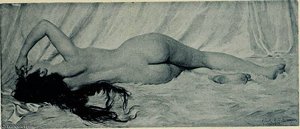
Retrato de Albert Aublet

As 28 Pinturas Mais Famosas de Albert Aublet, uma Seleção da Galeria

Atualizado em Novembro 2026 · classificado pela nossa pontuação de popularidade (pesquisas, visitas e pedidos de cada obra) · 28 obras de Albert Aublet em nosso catálogo

Em resumo

De todas as obras originais que Albert Aublet deixou, a mais famosa é On the Shingle (1883). Logo atrás vêm Selene (1880) e Reading on the garden path (1883). Nosso catálogo contém 28 obras de Albert Aublet; a galeria preservou as 28 que o mundo mais admira, cada uma exibida com sua data, seu museu e sua história.

1851 – 1938, Paris Academic art Mais obras: Petit Palais

As 10 principais pinturas de Albert Aublet: a escolha da galeria

1
On the Shingle (1883) de Albert Aublet

On the Shingle

1883 · Oil

The composition is defined by a strong horizontal orientation, placing the horizon line high to emphasize the vastness of the sea and the shoreline. Under a bright, hazy sky, the scene captures a crowded beach populated by numerous figures. Some individuals stand, some sit, and others walk near the water's edge, their forms rendered with varying degrees of detail. Those in the foreground appear more defined, while the figures in…

2
Selene (1880) de Albert Aublet

Selene

1880 · Oil

In this vertical oil painting from 1880, a nude female figure occupies the center of a celestial scene. The subject is positioned in an S-shaped curve, appearing to drift through a pale, translucent moon that dominates the background. Her limbs are rendered with smooth textures and subtle shading to define the anatomical form. Her hair flows upward, merging into the edges of the lunar disc. The color palette consists of…

3
Reading on the garden path (1883) de Albert Aublet

Reading on the garden path

1883 · Oil On Canvas

A solitary woman occupies the center of a lush garden, her attention fixed entirely upon a book. She is framed by a dense arrangement of flora, where the soft white of her dress provides a focal point against the surrounding greenery. The scene captures a fleeting instance of stillness, where the subject is lost in thought amidst the natural world. Sunlight filters through the canopy, illuminating the textures of the…

5
Sketch for the Hall of Festivities of the Hôtel de Ville: Lights (1892) de Albert Aublet

Sketch for the Hall of Festivities of the Hôtel de Ville: Lights

1892 · Gouache · Petit Palais, Paris

Three small, nude figures move through a pale, hazy space. They are putti, caught in a rhythmic, circular dance that suggests a celebration of light. The composition is shallow, like a carving in stone or a relief on a wall. Their bodies are defined not by hard lines, but by the gentle meeting of shadow and glow. A muted palette of dusty rose, mauve, and lavender wraps around their rounded…

6
Sketch for the Hall of Festivities of the Hôtel de Ville: Fruits (1892) de Albert Aublet

Sketch for the Hall of Festivities of the Hôtel de Ville: Fruits

1892 · Pastel · Petit Palais, Paris

In this preparatory study, a group of five nude figures moves through a shallow, frieze-like space, their bodies caught in a graceful, circular motion. They gather around large bowls and baskets, their limbs reaching and twisting as they handle a bounty of fruit. The scene feels less like a static pose and more like a captured moment of rhythmic labor, intended to decorate the grand Hall of Festivities of the…

7
Sketch for the Salle des Fêtes of the Hôtel de Ville: Flowers (1892) de Albert Aublet

Sketch for the Salle des Fêtes of the Hôtel de Ville: Flowers

1892 · Gouache · Petit Palais, Paris

This preparatory sketch, titled Sketch for the Salle des Fêtes of the Hôtel de Ville: Flowers, presents a composition of four nude human figures arranged in a circular, dance-like procession. The figures are rendered with soft, gestural lines that define their contours without the use of heavy shading or anatomical precision. They appear to move in a rhythmic sequence, interacting with a garland of flowers that loops through the center…

9
Sketch for the Hall of Festivities of the Hôtel de Ville: Drinks (1892) de Albert Aublet

Sketch for the Hall of Festivities of the Hôtel de Ville: Drinks

1892 · Pastel · Petit Palais, Paris

A sense of rhythmic movement fills the space as a group of cherubic, nude figures, known as putti, engage in a spirited scene. They gather around a small cart or wheel, their bodies caught in a moment of playful celebration. The composition stretches horizontally, creating a frieze-like arrangement that pulls the eye across the page. Soft, rounded shapes define their limbs, giving the figures a voluminous, fleshy quality that suggests…

10
Une Beaute Orientale de Albert Aublet

Une Beaute Orientale

Oil

In this composition, we find ourselves in a private, shadowed space where a single figure commands the viewer's attention. The woman is captured in a moment of transition, her hands lifting a light blue drape over her head. There is a certain poise in her stance, a subtle bend at the knee that suggests a movement caught in mid-breath. The lighting is soft, falling from above to trace the gentle…

A seleção de Albert Aublet continua, de 11 a 28

Os temas que cativaram o olhar de Albert Aublet

Os quatro temas que mais se repetem nestas obras originais, cada um com o seu melhor exemplo.

Os museus que guardam os originais de Albert Aublet

Os 2 museus que detêm a maioria das pinturas desta página.

Museus Cidade Obras de Albert Aublet Pinturas desta lista
Petit Palais, ParisPetit Palais Paris 6 Sketch for the Salle des Fêtes of the Hôtel de Ville: Music, Sketch for the Hall of Festivities of the Hôtel de Ville: Lights, Sketch for the Hall of Festivities of the Hôtel de Ville: Fruits
Musée d'art et d'histoire de Narbonne, NarbonneMusée d'art et d'histoire de Narbonne Narbonne 3 Interior of the Rüstem Pacha Mosque of Constantinople, Les toits de Tunis, Devant la mosquée

Albert Aublet década a década: a obra original que define cada uma

Obras por década

Escolha uma década para ver a obra original que a define.

Perguntas de colecionadores sobre as pinturas de Albert Aublet

Por qual obra Albert Aublet é mais conhecido(a)?Revelar a resposta

On the Shingle (1883). Selene (1880) e Reading on the garden path (1883) vêm a seguir.

Qual era a idade de Albert Aublet quando On the Shingle foi feita?Revelar a resposta

32 anos: On the Shingle data de 1883, e Albert Aublet nasceu em 1851.

Quais são as dez pinturas mais famosas de Albert Aublet?Revelar a resposta

On the Shingle, Selene, Reading on the garden path, Sketch for the Salle des Fêtes of the Hôtel de Ville: Music, Sketch for the Hall of Festivities of the Hôtel de Ville: Lights, Sketch for the Hall of Festivities of the Hôtel de Ville: Fruits, Sketch for the Salle des Fêtes of the Hôtel de Ville: Flowers, Sketch for the Hall of Festivities of the Hôtel de Ville: Cotillons, Sketch for the Hall of Festivities of the Hôtel de Ville: Drinks e Une Beaute Orientale. O ranking acima apresenta o ano e o museu de cada uma.

Quantas pinturas Albert Aublet deixou?Revelar a resposta

Nosso catálogo contém 28 obras de Albert Aublet, datadas de 1880 a 1912.

Em quais museus estão expostas as obras-primas de Albert Aublet?Revelar a resposta

Principalmente em Petit Palais (Paris) e Musée d'art et d'histoire de Narbonne (Narbonne). A tabela de museus acima lista todos eles.

Em que anos Albert Aublet pintou as suas obras mais famosas?Revelar a resposta

Em 1890s: 6 das 28 obras nesta página foram feitas então, sendo Sketch for the Salle des Fêtes of the Hôtel de Ville: Music delas.

Quais são as primeiras e as últimas obras originais famosas de Albert Aublet?Revelar a resposta

Nesta página, a mais antiga é Selene (1880) e a mais recente é Les toits de Tunis (1912).

Quais temas Albert Aublet escolheu com mais frequência?Revelar a resposta

Lavender (6), People (5) e Woman (5), entre as 28 obras nesta página.

Qual técnica Albert Aublet mais utilizou?Revelar a resposta

Oil, para 3 das 28 obras nesta página.

A qual movimento artístico pertence Albert Aublet?Revelar a resposta

Academic art, a julgar pelos originais nesta página.

Quais obras de Albert Aublet estão expostas no Petit Palais?Revelar a resposta

Sketch for the Salle des Fêtes of the Hôtel de Ville: Music, Sketch for the Hall of Festivities of the Hôtel de Ville: Lights e Sketch for the Hall of Festivities of the Hôtel de Ville: Fruits: o Petit Palais, Paris detém 6 das obras desta página.

Albert Aublet: vida e obra

O Legado Radiante de Albert Aublet

Nascido no coração de Paris em 1851, Albert Aublet emergiu das correntes vibrantes e mutáveis da cena artística francesa durante a Belle Époque. Sua jornada teve início nos prestigiados salões da École des Beaux-Arts, onde refinou seu ofício sob o olhar atento de mestres como Claudius Jacquand e o renomado Jean-Léon Gérôme. Esta base acadêmica rigorosa proporcionou-lhe uma precisão técnica que mais tarde serviria como alicerce para suas explorações mais expressivas. Sua estreia precoce no Salão de 1873 marcou a chegada de um talento significativo, conquistando reconhecimento imediato quando obras como Intérieur de Boucherie au Tréport foram adquiridas por figuras notáveis como Alexandre Dumas Fils. Nesses anos formativos, o pincel de Aublet capturou a dignidade silenciosa da vida rural e a beleza rústica da Normandia, estabelecendo uma reputação de realismo que ressoou com a fascinação da época pela verdade nua e crua.

À medida que sua carreira amadurecia, o olhar artístico de Aublet estendeu-se muito além das fronteiras da França, buscando o fascínio luminoso do Oriente. Uma jornada transformadora a Constantinopla, em 1881, acendeu uma paixão vitalícia por temas orientalistas, alterando para sempre a trajetória de sua obra. Esse fascínio não era meramente uma busca pelo exótico, mas um engajamento profundo e erudito com uma nova luz e cultura. Acompanhado por contemporâneos como Jean-Léon Gérôme e Alberto Pasini, ele explorou as paisagens vibrantes da Argélia e da Turquia, transpondo para a tela os mercados movimentados, a grandiosidade arquitetônica e as sutilezas atmosféricas do Oriente. Seu trabalho tornou-se uma ponte entre a tradição acadêmica europeia e a riqueza sensorial do Norte da África e do Império Otomano, caracterizado por uma sensibilidade aguda à luz e um uso magistral de gradações tonais que infundiam vida a cada cena.

Maestria da Luz e do Sujeito

A evolução da técnica de Aublet permitiu-lhe transitar perfeitamente entre as exigências estruturadas da Arte Acadêmica e as qualidades mais fluidas e emotivas encontradas em suas aquarelas e gouaches. Ele possuía uma habilidade rara de capturar momentos fugazes — a maneira como a luz do sol filtra através de um véu ou o brilho suave do crepúsculo sobre um pátio tunisiano. Essa maestria estendeu-se às suas representações de figuras humanas, onde explorou tanto a graça dos nus quanto estudos de caráter íntimos de dignitários locais e pessoas comuns. Seus anos tardios estiveram profundamente entrelaçados com a cultura de Tunes; após adquirir o magnífico Palais Dar Ben Abdalah em 1905, ele tornou-se uma figura central na comunidade artística local, chegando a servir como presidente do primeiro salão de arte local. Essa imersão profunda permitiu que sua obra transcendesse a mera observação, tornando-se uma documentação de alma de um mundo em transição.

As conquistas de Aublet foram recebidas com significativo aclamação internacional, refletindo seu status como um artista verdadeiramente global. Suas contribuições ao mundo da arte foram pontuadas por honrarias prestigiadas que consolidaram sua posição entre a elite de sua época:

  • A Medalha do Salão de 1880: Um reconhecimento precoce de sua habilidade emergente e de sua crescente proeminência em Paris.
  • A Medalha de Ouro da Exposição Universal de Paris de 1889: Uma conquista máxima que celebrou sua capacidade de cativar um público mundial durante o auge da Exposition Universelle.
  • A Légion d'honneur (1890): Um testemunho profundo de seu impacto cultural e de seu serviço à tradição artística francesa.

Hoje, a importância histórica de Albert Aublet reside em sua capacidade de sintetizar o meticulosismo da Academia com o espírito evocativo do Impressionismo. Suas pinturas permanecem como janelas vitais para uma era passada, preservadas em coleções estimadas, como o Musée National des Beaux-Arts de Québec e o Philadelphia Museum of Art. Através de seus olhos, continuamos a testemunhar a magia duradoura do Oriente e a elegância atemporal da tradição francesa, renderizadas com uma mão que compreendia tanto o peso da história quanto a leveza de uma sombra passageira.