Abraham Walkowitz: um retrato do artista
A Pioneer of American Modernism: The Life and Art of Abraham Walkowitz
Abraham Walkowitz, a figure often overshadowed by the brighter lights of early 20th-century American art, nevertheless played a crucial role in bridging the gap between European avant-garde movements and the nascent modernist scene in America. Born in Tyumen, Siberia, in 1878, his life was marked by displacement and a relentless pursuit of artistic expression—a journey that culminated in a distinctive body of work characterized by dynamic cityscapes, evocative portraits, and an unparalleled fascination with movement, particularly as embodied by the revolutionary dancer Isadora Duncan.
Early Years and Artistic Foundations
Walkowitz’s childhood was shaped by his family's emigration to the United States when he was just a young boy. This experience instilled within him a deep sensitivity to change and a profound awareness of human movement—qualities that would profoundly influence his artistic vision. He began his formal training at the National Academy of Design in New York City, mastering traditional techniques before seeking further refinement in Paris at the Académie Julian under Jean-Paul Laurens. Even during this period of structured learning, Walkowitz’s innate talent shone through; accounts recall him sketching with chalk on floors as a child—a testament to an uncontainable creative impulse and a lifelong fascination with capturing dynamic forms. This early inclination towards abstraction foreshadowed the stylistic shifts he would later embrace.
The Influence of Alfred Stieglitz and the 291 Gallery
A pivotal moment in Walkowitz’s artistic development occurred through his association with Alfred Stieglitz and his influential 291 Gallery. The gallery, a hub for American modernists like Arthur Dove, Marsden Hartley, and John Marin, provided Walkowitz with an unparalleled opportunity to engage with the latest European developments in art—particularly the work of Paul Cézanne. It was at the 1907 memorial exhibition dedicated to Cézanne that Walkowitz experienced a transformative encounter, absorbing the spirit of European modernism’s emphasis on subjective experience and flattened perspectives. This exposure solidified his commitment to exploring form and structure beyond mere imitation of reality—a core principle that would define much of his subsequent work. The 291 Gallery became more than just a professional venue; it was a crucible where artistic ideas were tested, debated, and ultimately forged into something new.
Capturing the Essence of Isadora Duncan
Perhaps Walkowitz’s most enduring legacy lies in his extraordinary series of drawings depicting Isadora Duncan. Drawn to the dancer's revolutionary spirit and her unconventional approach to movement, he produced over five thousand sketches—a monumental undertaking that reveals a deep understanding of both Duncan’s physical form and her inner essence. These aren’t simply portraits; they are explorations of liberation, dynamism, and artistic innovation. Walkowitz masterfully captured the fluidity of Duncan's movements, translating them into dynamic compositions filled with energy and emotion. The drawings demonstrate his ability to distill complex ideas into simple lines and shapes—a hallmark of modernist abstraction. His work on Duncan stands as a testament to his unique vision and his profound appreciation for artistic expression in all its forms.
Key Works and Artistic Style
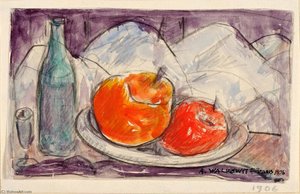
Walkowitz’s artistic output spanned a diverse range of subjects, including cityscapes, still lifes, and portraits. His New York Skyline (1913) is a prime example of his mastery of linear perspective and atmospheric depth—a hazy watercolor that simultaneously captures the energy and anonymity of urban life. Later works, such as Metropolis, No. 1 (1919), reveal a darker, more Expressionistic sensibility, reflecting themes of destruction and loss through dramatic charcoal renderings. Throughout his career, Walkowitz’s style evolved from representational depictions to increasingly abstract forms—yet he consistently retained an authentically American character—a blend of European influences filtered through his own unique perspective. His still lifes similarly demonstrate this exploration of form and color, pushing the boundaries of traditional genre painting towards modernist abstraction.
Historical Significance and Lasting Legacy
Abraham Walkowitz’s contributions to early American Modernism are often understated, yet profoundly significant. He served as a vital bridge between European avant-garde ideas and the emerging artistic identity taking root in America. His involvement with Alfred Stieglitz's 291 Gallery was instrumental in establishing a platform for modern art, introducing European artists to an American audience and fostering a community of like-minded innovators. Walkowitz’s participation in the Armory Show of 1913—where he exhibited alongside other groundbreaking artists—marked a turning point in the acceptance of modern art within the United States. Beyond his broader contributions, his extensive drawings of Isadora Duncan provide invaluable insights into both her artistic practice and his own evolving style. Walkowitz’s legacy continues to inspire artists today, reminding us of the power of artistic vision and the importance of forging one's own path in the pursuit of creative expression.