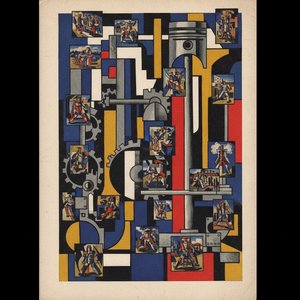
The Shattered Window: Deconstructing the Traditional Landscape
 Fragmented Beauty: Exploring the Soul and Geometric Depth of Cubist Landscapes
Beyond the Single Viewpoint: The Revolution of Perspective To look upon a landscape is, for most of human history, to witness a window opened upon the world. We have long been accustomed to the singular, steady gaze—the idea that a painting should ca...
For centuries, the act of looking upon a landscape was akin to peering through a pristine window. The artist’s duty was one of fidelity—to capture the ephemeral dance of light upon a riverbank or the soft, atmospheric haze of a distant mountain range from a single, unwavering vantage point. This tradition provided a sense of stability and comfort, a way to document the world as it appeared to the stationary eye. However, as the twentieth century dawned, this tranquil window began to fracture. The advent of Cubism did not merely suggest a new way of seeing; it demanded a fundamental reimagative of reality itself, stripping away the illusion of depth to reveal the structural truths beneath.
To encounter a Cubist landscape is to abandon the comfort of the familiar. The boundaries of distance and horizon dissolve, replaced by a profound desire to perceive not just what the eye captures in a fleeting moment, but what the mind understands through memory and movement. This revolution was far more than a stylistic whim; it was an intellectual rebellion against the tyranny of the single viewpoint. Where previous generations sought to replicate the surface of nature, the Cubists sought to dismantle it, inviting the viewer into a world where time and space converge in a multidimensional truth.
Geometric Architecture: The Intellectual Puzzle of Analytical Cubism
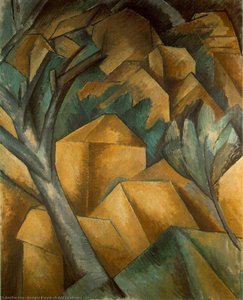 Cubist Landscape
A Fragmented Vision: Exploring Braque’s Cubist Landscape (1914) This captivating painting by Georges Braque transports viewers to a deconstructed world, offering a compelling example of early Cubism. Created in 1914, at the height of the movement's a...
In the hands of masters such as Georges Braque, the landscape was transformed from a picturesque vista into a rigorous, intellectual puzzle. During the height of the Analytical phase, particularly around 1914, the natural world was deconstructed into its most essential components. A village nestled among trees was no longer a collection of organic shapes, but an arrangement of interlocking planes, rectangles, and triangles. This process of fragmentation was not intended to create chaos; rather, it was a disciplined attempt to reveal the underlying architecture of existence.
The technique employed in these works is as much about structure as it is about vision. Through the use of impasto—thick, tactile layers of oil paint—artists created surfaces that possessed a physical weight, mirroring the solidity of the geometric forms they depicted. The color palette often retreated into a sophisticated restraint, favoring earthy ochres, deep browns, and muted golds. This deliberate limitation of hue ensured that the viewer’s attention remained fixed upon the interplay of light and shadow across faceted surfaces, emphasizing the mathematical purity and rhythmic order found within the apparent randomness of nature.
Beyond the Single Viewpoint: Capturing Time and Motion in Space
--- title: Multiple Perspectives | MoMA author: Alexandra Morrison url: https://www.moma.org/collection/terms/cubism/multiple-perspectives hostname: moma.org description: In the early 20th century, scientists and philosophers were generating more kno...
One of the most radical achievements of the Cubist movement was its ability to represent the subject in a greater context by incorporating multiple perspectives. The artists realized that human perception is never truly static; we move through space, our eyes darting from a foreground detail to a distant peak, our minds synthesizing various angles into a singular, complex understanding. By depicting objects from several viewpoints simultaneously, Cubism introduced a temporal dimension to the canvas, allowing the painting to breathe with the rhythm of lived experience.
This fragmentation of form serves as a powerful metaphor for the complexity of modern identity and perception. When we observe the angular planes of a figure or the fractured horizon of a valley, we are witnessing the intersection of multiple truths. The dense, layered compositions invite an active engagement from the collector, prompting one to piece together the hidden narratives within the abstract forms. It is a meditative process, where the viewer becomes a participant in the reconstruction of a shattered world, finding beauty in the very act of assembly.
From Cézanne to Picasso: The Lineage of Structural Revolution
 Colored Landscape with Aquatic Birds
Colored Landscape with Aquatic Birds (French: Paysage coloré aux oiseaux aquatiques) is an oil painting created circa 1907 by the French artist and theorist Jean Metzinger. Paysage coloré aux oiseaux aquatiques is a Proto-Cubist work executed in a Po...
While Cubism is often viewed as a sudden rupture, it was actually the culmination of a long-standing evolution in modern art. The seeds of this revolution were sown by Paul Cézanne, whose late works began to treat nature through the lens of the cylinder, the sphere, and the cone. His influence is palpable in the proto-Cubist works of Jean Metzinger, where broad, omnidirectional brushstrokes and a Fauve-like palette begin to hint at the structural metamorphosis to come. The transition from the Divisionist technique—using small, mosaic-like strokes of color—to the more expansive, geometric language of Cubism represents one of the most significant shifts in art history.
This lineage extends through the works of Pablo Picasso and Georges Braque, who together pioneered a style that would redefine the visual vocabulary of the twentieth century. Even as the movement evolved toward more abstract forms, the core mission remained: to find a universal order expressed through the elegant simplicity of geometry. This pursuit of truth through structure paved the way for later movements like Geometric Abstraction, where artists such as Auguste Herbin and Kazimir Malevich would push the boundaries even further, stripping art down to its most fundamental, mathematical essence.
Curating Modernity: Integrating Cubist Masterpieces into Luxury Interiors
 Redefining Nature: A Collector's Guide to the Geometric Beauty of Cubist Landscapes
Beyond the Horizon: Discovering the Soul of Cubist Landscapes All about cubism | Tate --- title: All about cubism | Tate url: https://www.tate.org.uk/art/art-terms/c/cubism/all-about-cubism hostname: tate.org.uk description: This resource introduces ...
For the discerning collector and the professional interior designer, incorporating Cubist-inspired works into a contemporary space offers an unparalleled opportunity to inject intellectual depth and architectural sophistication. A large-scale Cubist landscape, perhaps rendered as a multi-panel set spanning three or five canvases, can serve as a commanding focal point for a grand hallway or a minimalist salon. The rhythmic interplay of lines and the structured arrangement of shapes provide a sense of balance that complements modern, clean-lined architecture.
Integrating such profound works requires an eye for harmony. A Cubist piece with a muted, earthy palette can anchor a room filled with natural textures like stone, wood, and linen, while more vibrant, color-driven abstractions can provide a striking contrast to monochromatic environments. At OriginalUniqueArt.com, we specialize in bringing this historical grandeur into the modern home through our exquisite Handmade Oil Reproductions. Our master artists, holding degrees from the world's most prestigious academies, meticulously recreate the texture, impasto, and soul of these masterpieces on 100% cotton canvas. Whether you are seeking a bespoke commission that reimagines a personal photograph in the Cubist style or a museum-quality reproduction of a Braque landscape, our service ensures that your collection remains a testament to timeless elegance and unparalleled craftsmanship.