The Breaking of Tradition: The Birth of the Secessionist Movement
At the twilight of the nineteenth century, the cultural heart of Europe beat with a restless, transformative energy. In Vienna, a city steeped in the rigid hierarchies of the Habsburg Empire, a group of avant-garde visionaries felt the suffocating weight of academic tradition. The established Künstlerhaus, the bastion of conservative realism and historical mimicry, no longer provided a sanctuary for the burgeoning spirit of modernity. This tension culminated in 1897 with a profound act of artistic rebellion: the secession. Led by figures who refused to be bound by the stale dictates of the past, these artists formally broke away from the established academy to form the Vienna Secession.
This was not merely a disagreement over technique, but a fundamental philosophical schism. The secessionists sought to liberate art from the obligation of historical narrative and moralizing didacticism. They yearned for an aesthetic that reflected the complexities of the human psyche and the sensory richness of the contemporary world. By establishing their own exhibition spaces and journals, they created a sanctuary where experimentation could flourish, unburdened by the scrutiny of the traditionalist elite. This movement was a declaration of independence, a bold assertion that art should be a living, breathing entity, intimately connected to the pulse of a changing era.
The birth of this movement signaled the end of an era and the dawn of something entirely unprecedented. It was a moment where the boundaries between fine art and decorative craft began to dissolve, paving the way for a holistic approach to beauty that would eventually permeate every facet of Viennese life. The secessionists did not just want to change how art looked; they wanted to change how it functioned within society, transforming the very atmosphere of the modern city.
A New Aesthetic Language: Symbolism, Ornamentation, and the Golden Phase
As the movement matured, a distinct and mesmerizing visual language began to emerge, characterized by an intoxicating blend of Symbolism and intricate ornamentation. The secessionist aesthetic rejected the starkness of realism in favor of a dreamlike, evocative realm where objects and motifs carried profound psychological weight. Every curve, every floral pattern, and every geometric shape was imbued with meaning, inviting the viewer into a contemplative dialogue with the subconscious. This era saw the rise of a decorative complexity that felt both ancient and strikingly modern.
Perhaps the most breathtaking manifestation of this language was the celebrated Golden Phase. During this period, artists integrated precious materials—most notably gold leaf—directly into the fabric of their compositions. This use of gold was not merely for opulence; it served to elevate the subject matter to a level of the sacred and the eternal. The shimmering surfaces created a sense of depth and luminosity that seemed to transcend the two-dimensional plane, enveloping the viewer in a celestial glow. In works such as Idylle, the interplay between organic forms and opulent metallic detailing creates a mesmerizing tension between the sensual and the spiritual.
This aesthetic was deeply rooted in the concept of the Gesamtkunstwerk, or the total work of art. The secessionists believed that beauty should not be confined to a gilded frame on a gallery wall but should extend to architecture, furniture, typography, and even everyday objects. Through the use of stylized flora, flowing lines, and rhythmic patterns, they sought to create an immersive environment where every element contributed to a unified aesthetic experience. This pursuit of ornamental harmony redefined the relationship between art and life, turning the mundane into something extraordinary.
Masters of the Revolution: The Visionary Artistry of Gustav Klimt and Josef Maria Auchentaller
No exploration of the Vienna Secession would be complete without paying homage to its most luminous titans: Gustav Klimt and Josef Maria Auchentaller. Klimt, the movement's undisputed icon, possessed an unparalleled ability to marry eroticism with mysticism. His portraits, often characterized by their haunting beauty and intricate textures, serve as windows into a world of profound emotional depth. Whether through the meticulous pencil studies seen in his explorations of form or the breathtakingly complex compositions of his mature works, Klimlam's mastery of light and pattern remains unparalleled.
Klimt’s work often features a signature use of gold leaf and mosaic-like patterns that transform the human figure into a centerpiece of cosmic significance. In masterpieces like Girl with Hat and Cape in Profile, one can witness his ability to capture the delicate nuances of identity through a lens of Symbolist abstraction. His legacy is not merely found in his finished canvases but in the very way he redefined the boundaries of portraiture, blending the tactile reality of the subject with an ethereal, decorative dreamscape.
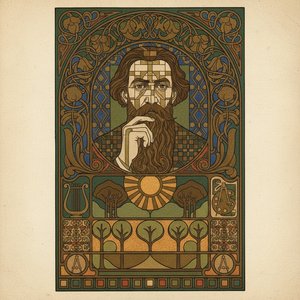
Alongside Klimt, Josef Maria Auchentaller played a pivotal role in shaping the visual identity of the movement. While Klimt focused on the profound depth of the canvas, Auchentaller excelled in the realm of graphic design and applied arts. His contributions to the Secessionist aesthetic were instrumental in bridging the gap between fine art and the decorative arts. Through his intricate designs and mastery of floral motifs, Auchentaller helped cultivate a cohesive visual culture that was as much about the elegance of a printed poster as it was about the grandeur of an oil painting. Together, these masters forged a path that would influence generations of artists to come.
Ver Sacrum: The Sacred Spring of Design and Graphic Innovation
Central to the dissemination of Secessionist ideals was the publication of Ver Sacrum, or "Sacred Spring." This periodical served as the movement's official organ, a vibrant laboratory for graphic experimentation and a mouthpiece for the new aesthetic. Named after the ancient Roman ritual of renewing the community through the sacrifice of the young, the journal embodied the spirit of rebirth and the relentless pursuit of innovation that defined the era.
The pages of Ver Sacrum were a triumph of layout and typography, where the boundaries between text and image were perpetually blurred. The publication featured works by the movement's leading artists, showcasing a revolutionary approach to printmaking and graphic design. It was here that the Secessionist love for organic, flowing lines and asymmetrical compositions found its most dynamic expression. The journal did not merely report on art; it was art, a meticulously designed object that embodied the very principles of the movement it sought to promote.
Through this "Sacred Spring," the Secessionists were able to reach a wider audience, influencing the burgeoning field of advertising and poster art. The bold, legible, yet highly decorative graphics seen in Ver Sacrum helped establish a new standard for visual communication. This period of intense graphic innovation ensured that the Secessionist aesthetic was not confined to elite circles but became a pervasive influence on the visual landscape of the modern age, leaving an indelible mark on the history of design.
The Legacy of the Secession: How Vienna Redefined the Modern Visual Landscape
The impact of the Vienna Secession extends far beyond the borders of Austria or the temporal limits of the early twentieth century. By challenging the hegemony of academic realism, the movement laid the essential groundwork for the development of modernism. The liberation of form, the elevation of the decorative, and the integration of diverse media all point toward a future where art would become increasingly abstract, conceptual, and multidisciplinary.
The Secessionists taught us that beauty is not merely a matter of imitation, but a matter of expression. They demonstrated that the ornamental could be profound, that the symbolic could be visceral, and that the boundaries between different artistic disciplines are inherently fluid. Their legacy lives on in every movement that seeks to break tradition, from the avant-garde experiments of the mid-century to the contemporary digital landscapes of today.
Today, we continue to find inspiration in their courage to dissent and their passion for renewal. The works of Klimt, Auchentaller, and their contemporaries remain as vibrant and provocative as ever, reminding us that true artistic progress requires the bravery to leave the familiar behind and embrace the unknown. In the grand tapestry of art history, the Vienna Secession remains a brilliant, golden thread, weaving together the past and the future in a timeless celebration of human creativity.
At OriginalUniqueArt.com, we celebrate this enduring legacy of human creativity. We specialize in bringing the profound beauty of historical masterpieces into the modern home through our exquisite hand-painted oil reproductions and museum-quality Giclée prints. Whether you seek to capture the shimmering gold of a Klimt original or the delicate graphic elegance of the Secessionist era, our master artists are dedicated to preserving the soul and texture of these iconic works for generations to come.