The Dawn of Devotion: Early Christian Symbolism & Art
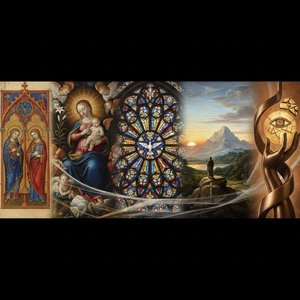
Before the grand narratives of the Renaissance unfolded, a quiet revolution was taking place within the nascent world of early Christian art. Emerging from the secrecy of catacombs and the solemnity of basilicas, these first visual expressions weren’t merely decorative; they were theological statements rendered in mosaic, fresco, and illuminated manuscript. The challenges faced by early Christians – lacking established artistic traditions and operating under Roman rule – necessitated a symbolic language that could convey complex beliefs to a largely illiterate population. Consider the enduring power of the ichthys, the fish symbol, subtly proclaiming faith amidst persecution. Or the adoption of the Good Shepherd imagery, borrowing from pagan motifs but imbuing them with new spiritual resonance. These weren’t attempts at realistic representation as we understand it today; they were visual catechisms, designed to instruct and inspire devotion, a coded language of belief whispered through form and color.
The focus wasn't on individual portraiture or detailed landscapes, but on essential doctrines—the resurrection, the ascension, the promise of salvation. Early depictions often favored allegory over accuracy, prioritizing spiritual truth over physical likeness. This period established a visual vocabulary that would profoundly influence subsequent artistic developments, laying the groundwork for the more elaborate and naturalistic styles to come. The very act of creating these images was an assertion of faith, a defiant expression in a world not always receptive to its message.
Renaissance Reverence: Humanism, Faith, and Artistic Innovation
 Resurreccion
Discover 'Resurreccion' (1463) by Piero della Francesca, a masterful early Renaissance religious artwork. Hand-painted reproduction capturing divine symbolism, serene composition, and timeless spiritual depth.
The Renaissance witnessed a seismic shift in the portrayal of religious themes. It wasn’t simply a revival of classical forms; it was a fusion of ancient wisdom with burgeoning humanism and a renewed focus on the individual. Artists began to infuse their works not only with spiritual devotion but also with an unprecedented sense of realism and emotional depth. This era saw biblical narratives populated by figures who felt palpably human, grappling with doubt, joy, and sorrow. The emphasis shifted from abstract theological concepts to relatable human experiences within a divine framework.
Consider the work of Piero della Francesca, whose ‘Resurreccion’ (1463) exemplifies this new approach. The serene composition, the crystalline clarity of form, and the subtle use of perspective create an atmosphere of profound tranquility. The divine is not absent, but it's presented through a lens of human understanding, emphasizing Christ’s humanity as much as his divinity. Similarly, Hans Holbein the Younger’s ‘Meyer Madonna’ (1526) showcases meticulous detail and realism, portraying the Virgin Mary with a quiet dignity that invites contemplation. These artists weren’t merely illustrating religious stories; they were exploring the intersection of faith, reason, and human emotion.
Iconography Unveiled: Decoding Religious Symbols in Painting
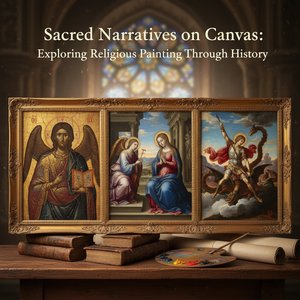
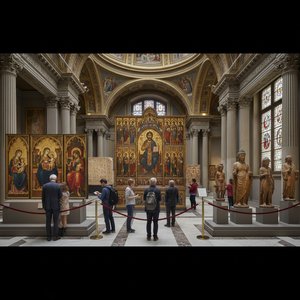 Sacred Narratives Embodied: A Comprehensive Exploration of Religious Iconography in Art History
Explore the rich history of religious iconography in art! Discover symbolism, movements & masterpieces from Byzantine to Renaissance periods. Expert insights for collectors and enthusiasts at OriginalUniqueArt.
Religious art is replete with symbolism – a visual language layered with meaning. Understanding these symbols unlocks deeper interpretations and reveals the artist’s intent. The halo, for instance, originating in ancient Mesopotamian depictions of divine glamour and evolving through Greek and Roman representations of heroes, became a universal signifier of sanctity in Christian iconography. More than mere ornamentation, it signified an emanation of divine light, representing spiritual grace and holiness. The color itself held significance; gold often denoted royalty and divinity, while red signaled martyrdom or passion.
Beyond the halo, numerous other symbols permeate religious paintings. Lilies represent purity, frequently associated with the Virgin Mary. Doves symbolize the Holy Spirit. The cross, of course, embodies the sacrifice of Christ. Duccio di Buoninsegna’s ‘Maestà’ back panel, depicting Pontius Pilate washing his hands, is a masterclass in symbolic representation. Pilate's gesture isn't merely an act of cleanliness; it represents his attempt to absolve himself of responsibility, a visual commentary on guilt and moral compromise. Artists deliberately employed these symbols to convey complex theological ideas, inviting viewers to engage with the artwork on multiple levels.
Emotional Turmoil & Spiritual Expression: Grünewald and the Isenheim Altarpiece
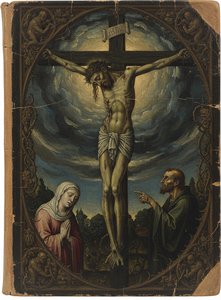 Matthias Grünewald: Devotion, Distortion & Spiritual Turmoil in Renaissance Art
Explore the profound religious art of Matthias Grünewald, master of the Isenheim Altarpiece. Discover his unique expressionism, symbolism & lasting impact on Renaissance painting. A guide for collectors and enthusiasts.
While many Renaissance artists sought harmony and balance, Matthias Grünewald dared to explore the darker aspects of faith – suffering, torment, and spiritual anguish. His masterpiece, the Isenheim Altarpiece, is a visceral depiction of Christ’s crucifixion, created for a hospital dedicated to treating sufferers of St. Anthony's Fire (ergotism). The altarpiece wasn’t intended as a beautiful object; it was meant to offer solace and hope to those enduring unimaginable pain.
Grünewald’s unique expressionism, characterized by distorted figures, intense colors, and raw emotionality, is unlike anything else in Renaissance art. The depiction of Christ on the cross isn't idealized; it's a harrowing portrayal of physical and spiritual agony. The surrounding scenes – the Annunciation, the Resurrection – are equally powerful, reflecting themes of redemption and divine mercy. Grünewald’s work challenges viewers to confront the harsh realities of life and death, offering a profound meditation on faith in the face of suffering.
The Halo Effect: A Transcultural History of Sacred Light
The halo, as we've seen, isn't exclusive to Christian art. Its origins trace back to ancient Mesopotamia, where *melam*, a “brilliant, visible glamour,” surrounded gods and heroes. Persian mythology speaks of *Khvarenah*, a divine radiance that sanctified kings. In ancient Greece, Homer described luminous halos around the heads of warriors. The practice spread eastward through Buddhist art in India, where it became an integral part of depicting Amitabha Buddha and other deities, often rendered as flames or intricate mandorlas.
The evolution of the halo demonstrates a universal human impulse to visually represent holiness and spiritual power. While its specific form and meaning varied across cultures, the underlying concept remained consistent: to signify an individual’s connection to the divine. From the Kushan Empire's rulers adorning themselves with halos on their coins to the elaborate aureoles of Tibetan Buddhist saints, the halo serves as a powerful reminder of our enduring fascination with the sacred.
Collecting Belief: Building a Narrative Through Religious Art
Acquiring religious art isn’t merely about possessing beautiful objects; it's about connecting with centuries of faith, history, and artistic innovation. Whether you are drawn to the serene beauty of Piero della Francesca or the raw emotion of Matthias Grünewald, each artwork tells a story – a story of devotion, struggle, and spiritual awakening. Building a collection allows you to curate your own visual narrative, reflecting your personal beliefs and aesthetic sensibilities.
At OriginalUniqueArt.com, we offer meticulously hand-painted reproductions of iconic religious masterpieces, allowing you to bring these timeless works into your home. Our skilled artists capture the nuances of each style, ensuring authenticity and lasting beauty. From custom sizing and framing options to expert art consultation, we are dedicated to helping you find the perfect piece to inspire contemplation and enrich your life. Explore our collection today and discover the power of belief embodied in art.