Pop Art · 1955
Collection (Robert Rauschenberg, 1955)
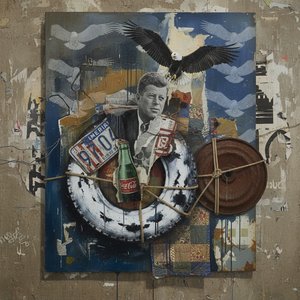
Robert Rauschenberg (1925–2008) criou Collection. Data de 1955. Pertence ao movimento Pop Art. É feito em Mixed Media. Está conservada no San Francisco Museum of Modern Art, em São Francisco, Estados Unidos da América. Mede 203 × 243 cm.
- 1955
- Mixed Media
- 203 × 243 cm
- San Francisco Museum of Modern Art, São Francisco

 Visualizar na parede

 Pintura a Óleo Feita à Mão
 Compartilhar
 Compartilhar
 Ficha técnica


 Baixar imagem
 Semelhantes
 Raio X
 Ver diaporama
 Perguntas e Respostas

 Estatísticas
Collection, em resumo
- Título
- Collection
- Artista
- Robert Rauschenberg (1925–2008)
- Artista nascido em
- Port Arthur, Estados Unidos
- Data
- 1955
- Técnica
- Mixed Media
- Dimensões
- 203 × 243 cm
- Onde ver
- San Francisco Museum of Modern Art, São Francisco, Estados Unidos da América
- Movimento
- Pop Art
- Período
- Modern
- Tema
- combine painting, collage, fabric, wood scraps, color field, everyday objects
O que Collection retrata?
A Symphony of Chaos and Color: Rediscovering Rauschenberg’s “Collection”
In the mid-1950s, the art world was gripped by the intense, often brooding emotionalism of Abstract Expressionism. Yet, amidst this era of heavy shadows and singular gestures, Robert Rauschenberg emerged with a vision that refused to be contained by the edges of a traditional canvas. His 1955 masterpiece, “Collection,” serves as a breathtaking manifesto of this new era—a work that does not merely sit upon a wall but breathes with the vibrant, messy, and beautiful energy of life itself. To encounter this piece is to witness a pivotal moment in American art history, where the boundaries between the high art of the gallery and the raw textures of the street began to dissolve into something entirely new.
The visual impact of “Collection” is immediate and overwhelming. Spanning an impressive 203 x 243 cm, the work presents a kaleidoscopic tapestry that defies monochromatic simplicity. Instead of the somber tones favored by his contemporaries, Rauschenberg orchestrates a brilliant dialogue between deep reds, sunny yellows, calming blues, and fiery oranges. This is not a painting of static shapes, but a dynamic landscape of layered complexity. As your eyes wander across the surface, you encounter an asymmetrical dance of elements: fragments of weathered wood scraps juxtaposed against unexpected textures, and even the subtle, haunting presence of a mirror positioned off-center, which invites the viewer to physically enter the artwork’s space.
The Alchemy of the Combine: Technique and Texture
At the heart of this work lies Rauschenberg’s revolutionary “Combine” technique, a method that fundamentally redefined what a painting could be. He moved beyond the brush to embrace the world around him, seamlessly blending traditional painting with the tactile reality of collage. Through the use of silkscreen printing alongside meticulously applied fabric and found objects, he achieved a textural richness that is almost sculptural in nature. This hybrid approach allows light to play differently across the canvas, catching on raised surfaces and receding into deep, shadowed crevices.
For the discerning collector or interior designer, this piece offers an unparalleled depth of character. The way the artwork incorporates various shades—from verdant greens to stark whites—creates a sense of movement that changes depending on the lighting of a room. It is a work that demands attention, providing a sophisticated focal point that bridges the gap between modern abstraction and contemporary installation art. The inclusion of diverse shapes, including a delicate bird figure that drifts through the composition, adds a layer of narrative intrigue, making every viewing a new discovery.
A Legacy of Freedom and Artistic Rebellion
To understand “Collection” is to understand the spirit of rebellion that defined Rauschenberg’s career. Born in the oil fields of Texas, his life was one of transition and movement, a nomadic sensibility that allowed him to see beauty in the discarded and the everyday. By integrating found objects into his work, he sought to liberate painting from the rigid confines of form and content, mirroring the broader cultural shifts of a post-war America seeking new modes of expression. He rejected the perceived heaviness of the New York School in favor of a more democratic, inclusive aesthetic.
Ultimately, “Collection” is an invitation to embrace complexity. It symbolizes the beauty found in the collision of disparate parts—the way chaos can be orchestrated into harmony. For those seeking to bring a sense of historical significance and avant-garde energy into a curated space, a high-quality reproduction of this work offers more than just decoration; it offers a piece of the revolution. It is a profound statement of artistic freedom that continues to inspire awe, reminding us that art is not just something to be looked at, but something to be lived within.
Em qual museu se encontra Collection?
San Francisco Museum of Modern Art
São Francisco, Estados Unidos da América
Origens e História da Instituição O San Francisco Museum of Modern Art foi estabelecido em 1935. Fundada sob a direção de Grace L. McCann Morley, a instituição operava originalmente como o San Francisco Museum of Art.


Imagens em alta resolução de Collection

Protected by copyright: these files are for personal reference, not a licence to republish.
Robert Rauschenberg, Collection (1955), San Francisco Museum of Modern Art.
Perguntas sobre Collection respondidas
Onde posso ver a obra original "Collection", de Robert Rauschenberg?
"Collection", de Robert Rauschenberg está em exibição no San Francisco Museum of Modern Art, São Francisco, Estados Unidos da América. A referência ao museu diz respeito à obra original, não a reproduções.
Em que ano foi criado "Collection", de Robert Rauschenberg?
"Collection" data de 1955. A data situa a obra na carreira de Robert Rauschenberg e em sua época.
De que técnica é feita a obra "Collection"?
A técnica de "Collection", de Robert Rauschenberg é Mixed Media. As reproduções visam reproduzir a aparência desta técnica.
Quais são as dimensões de "Collection", de Robert Rauschenberg na vida real?
"Collection" mede 203 x 243 cm em sua forma original. As dimensões originais são uma referência útil ao escolher o tamanho de uma reprodução.
O que representa "Collection"?
Os temas presentes em "Collection", de Robert Rauschenberg incluem combine painting, collage, fabric, wood scraps, color field, everyday objects, abstract forms. Juntos, eles sintetizam o assunto da obra.
"Collection" está em domínio público?
Informação de direitos autorais para "Collection", de Robert Rauschenberg: a obra está em ainda protegido por direitos autorais. Isso determina se reproduções da imagem podem ser feitas livremente.
Quem criou "Collection"?
O artista por trás de "Collection" é Robert Rauschenberg. A obra está catalogada sob o nome de Robert Rauschenberg.
A qual movimento artístico pertence "Collection", de Robert Rauschenberg?
O movimento associado a "Collection", de Robert Rauschenberg é Pop Art. Esta classificação situa a obra entre artistas e obras de arte relacionados.
A que período da carreira de Robert Rauschenberg pertence "Collection"?
"Collection" pertence ao Combine Era da carreira de Robert Rauschenberg. Esta classificação relaciona a obra ao desenvolvimento do artista.
Sobre o artista, Robert Rauschenberg

1925–2008, Estados Unidos
Robert Rauschenberg
Uma Vida Forjada na Transição Robert Rauschenberg, nascido Milton Ernest Rauschenberg em 1925 no seio das paisagens ricas em petróleo de Port Arthur, Texas, foi um artista cuja própria existência parecia ecoar a energia dinâmica e o espírito transformador que trouxe ao mundo da arte. Sua infância não foi definida por um único local; a profissão de seu pai exigia um estilo de vida nômade, percorrendo diversos terrenos que sutilmente lhe incutiram uma receptividade a estímulos visuais variados e uma disposição para abraçar a mudança. Essa exposição precoce fomentou uma sensibilidade atenta às texturas e ritmos da vida americana – uma corrente subterrânea que moldou profundamente suas explorações artísticas. Embora inicialmente atraído pela farmacologia na Universidade do Texas, o caminho de Rauschenberg desviou-se rapidamente, levando-o à arte – primeiro por necessidade durante o serviço militar na Marinha, depois com estudos focados no Kansas City Art Institute e, crucialmente, no Black Mountain College na Carolina do Norte.
Sobre Robert Rauschenberg Obras notáveis de Robert Rauschenberg
Também de Robert Rauschenberg
 Patrimônio1963
 Signs1970
 Barge1963
 Odalisk1958
Ensaios sobre Collection
 Robert Rauschenberg: Bridging Painting & Life – A Comprehensive Exploration of Combines, Silkscreens, and the Erasure of BoundariesExplore the revolutionary art of Robert Rauschenberg – Combines, silkscreens & more. Discover his impact on Pop Art, investment potential &…
 Mastering Art Collecting: A Professional Guide to Acquiring Museum-Quality Famous ReproductionsMaster the art of collecting with our expert guide to museum-quality oil reproductions. Learn to distinguish hand-painted masterpieces from…
 Beyond the Subject: The Raw Power of Abstract Expressionism | A Definitive Guide for the Modern CollectorExplore the visceral power of Abstract Expressionism. From the New York School to action painting, discover how to collect high-impact, han…