Expressionism
Sunset (Emil Nolde)
Sunset é uma obra de Emil Nolde (1867–1956). Pertence ao movimento Expressionism. É feito em Oil On Canvas.
- Oil On Canvas

 Visualizar na parede

 Pintura a Óleo Feita à Mão
 Compartilhar
 Compartilhar
 Guia


 Baixar imagem
 Semelhantes
 Raio X
 Ver diaporama
 Perguntas e Respostas

 Estatísticas
Sunset: o essencial
- Título
- Sunset
- Artista
- Emil Nolde (1867–1956)
- Artista nascido em
- Nolde, Dinamarca
- Técnica
- Oil On Canvas
- Movimento
- Expressionism
- Período
- Modern
- Tema
- sun, ocean, sky, boat, waves, orange
Observando Sunset
The Weight of Light
The sun hangs as a heavy, bright circle at the center of the sky, a singular eye watching the descent of the day. Below it, the atmosphere burns with shades of yellow, orange, and red, bleeding into one another to create a warm, thick air. The ocean receives this light, its waves rolling gently toward the shore in a rhythmic, quiet motion. A lone boat floats upon the water, a small, silent shape amidst the vastness of the sea and sky. The composition pulls the eye toward that central orb, where the light is most intense.
The Language of Color
The paint is applied with a sense of urgency, a spontaneous and impulsive movement of the brush that leaves the surface textured and alive. This technique does not seek to smooth the world, but to capture the immediate sensation of a fading light. The artist uses color as the very substance of the form, rather than a mere layer applied to a shape. In this work, the elements of sky, land, and sea fuse into a single, emotive play of light.
- Oil on canvas
- Heightened use of color
- Spontaneous brushstrokes
- Signed 'Emil Nolde' in the lower left
The Pulse of the Sea
The sea is an elemental force here, an imposing presence that mirrors the artist's own connection to the coast. There is a tension between the peaceful ambiance of the floating boat and the intense, brooding energy of the colors. The brushwork moves swiftly, capturing a specific moment of weather before the light shifts into shadow. It is a study of the internal weight of a landscape, where the color carries the emotional gravity of the setting sun. The tide pulls at the shore.
Sunset em alta resolução

Emil Nolde, Sunset. Domínio público.
Um especialista digital verifica as cores em relação à pintura original e retoca o ficheiro, respeitando fielmente a pincelada do artista.
Comprar a imagem em alta resoluçãoPerguntas sobre Sunset
De que forma o tema de "Sunset" se relaciona com os temas habituais de Emil Nolde?
Os temas recorrentes de Emil Nolde incluem post-impressionism, die brücke group, vincent van gogh, expressive use of color, nature and the sea; "Sunset" foca em sun, ocean, sky, boat, waves, orange, yellow, red.
Quão saturada é a paleta de "Sunset"?
A paleta de "Sunset" possui uma saturação Clear Color Presence.
Quem é o autor de "Sunset" e a qual movimento pertence?
"Sunset" foi criada por Emil Nolde no estilo Expressionism. O artista e o movimento identificam a tradição da obra.
Que emoção transmite "Sunset", de Emil Nolde?
O tom emocional registrado para "Sunset", de Emil Nolde é Dramatic. Ele resume o sentimento que a obra expressa.
"Sunset" é mais claro ou mais escuro no geral?
Os valores registrados para "Sunset", de Emil Nolde são: bright de brilho e Gentle Luminance de luminância.
Qual é a atmosfera de "Sunset"?
A atmosfera geral de "Sunset", de Emil Nolde é Bold. O clima descreve a sensação predominante da obra.
Que harmonia de cores apresenta "Sunset", de Emil Nolde?
As cores de "Sunset", de Emil Nolde apresentam uma harmonia Discordant Palette. A harmonia descreve como as cores se relacionam entre si.
Qual uso e espaço são recomendados para "Sunset", de Emil Nolde?
"Sunset" é sugerida para Mood, e o espaço recomendado é um(a) Living Room.
Posso ver "Sunset", de Emil Nolde sob diferentes luzes?
A visualização em Raio-X de "Sunset", de Emil Nolde está disponível na página Raio X da obra: um exame interativo da imagem através de onze camadas ópticas.
Sobre o artista, Emil Nolde
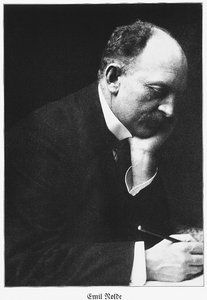
1867–1956, Dinamarca
Emil Nolde
A Vida e a Identidade de Emil Nolde Nascido como Hans Emil Hansen em 7 de agosto de 1867, o homem que viria a ser conhecido como Emil Nolde cresceu nas proximidades da aldeia de Nolde, no Ducado de Schleswig. Seus primeiros anos foram moldados pela vida rural e agrária de sua família, um cenário de tradições profundas que acabaria por influenciar sua visão artística. Eventualmente, ele se afastou desse caminho, optando por trabalhar como entalhador de madeira e decorador de móveis. Esse trabalho manual e tátil precedeu sua transição para a pintura e a gravura, servindo como uma base fundamental para sua sensibilidade estética.
Também de Emil Nolde
 Sea with Red Sky
 Couple on the beach1903
 Masks1911
 Christ among the Children

Essays around Sunset
 Shifting Tides: The Luminous Language of Light in Impressionist SeascapesExplore the evolution of light and motion in Impressionist seascapes through masterworks. Dive into this luminous journey today.
 Sails and Sunlight: The Fleeting Motion of Boats in Impressionist ArtExplore the luminous evolution of maritime Impressionism from Courbet to Monet. Rediscover the magic of light and water today.
 The Language of Brushstrokes: How Texture and Technique Reveal the Soul of ArtDiscover the profound connection between texture and emotion in Impressionist art. Explore how masterful brushstrokes by Renoir and Monet c…