Expressionism · 1906
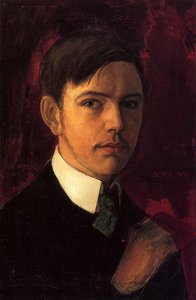
Self-portrait (August Macke, 1906)
Self-portrait is a work by August Macke (1887–1914). It dates from 1906. It belongs to the Expressionism movement. It is made in Oil. It measures 54 × 35 cm.
- 1906
- Oil
- 54 × 35 cm

 Visualizar na parede

 Pintura a Óleo Feita à Mão
 Compartilhar
 Compartilhar
 Guia


 Baixar imagem
 Semelhantes
 Raio X
 Ver diaporama
 Perguntas e Respostas

 Estatísticas
Self-portrait: the essentials
- Title
- Self-portrait
- Artist
- August Macke (1887–1914)
- Artist born in
- Meschede, Alemanha
- Date
- 1906
- Medium
- Oil
- Dimensions
- 54 × 35 cm
- Movement
- Expressionism
- Period
- Modern
- Subject
- famous people, men, portraits
Looking at Self-portrait
A Moment Frozen in Time: The Introspection of August Macke
In the quiet, focused gaze of Self-portrait (1906), we encounter a rare moment of stillness from an artist whose life would soon be swept up in the turbulent currents of German Expressionism. Before the vibrant, kaleidoscopic colors of his later works defined his legacy, this early piece captures August Macke in a state of profound introspection. The painting presents a man with short, neatly groomed hair, dressed in the formal elegance of a white shirt and tie—an attire that suggests a sense of dignity and perhaps a preparation for the public eye. Yet, beneath this composed exterior, there is an unmistakable depth to his expression. His eyes, directed toward the viewer, hold a serious, contemplative weight that invites us to look beyond the surface of the canvas and into the psyche of a young creator on the cusp of greatness.
The composition of this work serves as a masterclass in early twentieth-century portraiture, balancing the intimacy of the subject with a structured, almost architectural background. While the man remains the undeniable focal point, the subtle presence of decorative elements in the periphery hints at an environment rich with culture and aesthetic awareness. The technique employed here reflects Macke’s formative years at the Düsseldorf Art Academy, where he honed his ability to render texture and light with meticulous care. There is a palpable sense of realism in the way the fabric of his shirt catches the light, contrasted against the more shadowed, enigmatic depths of the background. This interplay between clarity and mystery creates a tension that keeps the viewer perpetually engaged, searching for meaning within the artist's steady stare.
For the discerning collector or interior designer, this self-portrait offers much more than mere decoration; it provides a window into the soul of a lost generation. As an era-defining piece from 1906, it carries the historical gravity of the pre-war period, capturing a sense of peace and intellectual rigor before the world was irrevocably changed by conflict. The painting’s sophisticated palette and balanced proportions make it an ideal centerpiece for a curated gallery wall or a refined study. It possesses a timeless emotional impact, evoking feelings of nostalgia, respect, and quiet strength. To possess a reproduction of this work is to bring a piece of art history into one's personal space—a tribute to the enduring power of the human spirit and the transformative beauty of the expressive gaze.
Self-portrait in high resolution

August Macke, Self-portrait (1906). Public domain.
A digital expert checks the colors against the original painting and retouches the file, faithful to the artist's brushwork.
Buy the high-resolution imageQuestions about Self-portrait
Como o movimento e a época se encontram em "Self-portrait", de August Macke?
Em "Self-portrait", de August Macke, o movimento Expressionism encontra a era Modernismo.
Posso examinar "Self-portrait" com mais detalhes?
"Self-portrait" pode ser examinado camada por camada na página Raio X da obra, um visualizador inspirado em uma mesa de luz de conservação com onze leituras ópticas da imagem.
Existe uma ficha informativa sobre "Self-portrait", de August Macke para estudantes?
Uma página de Ficha informativa está disponível para "Self-portrait", de August Macke: uma ficha informativa imprimível sobre a obra, projetada para estudantes e uso em sala de aula.
"Self-portrait", de August Macke, está em domínio público? E por quê?
"Self-portrait", de August Macke está em em domínio público — seus direitos autorais expiraram. O período de direitos autorais conta a partir do falecimento do artista, ocorrido em 1914.
Qual é a atmosfera geral de "Self-portrait", de August Macke?
"Self-portrait", de August Macke é descrito como tendo um clima Classic. Esta classificação pode ajudar a combinar a obra com um ambiente.
Quando e com quais materiais foi feita a obra "Self-portrait"?
A técnica de "Self-portrait", de August Macke é Oil, e a obra data de 1906.
Qual origem nacional fundamenta o Expressionism de "Self-portrait"?
"Self-portrait" foi criada por August Macke, nascido em Alemanha, dentro do movimento Expressionism. A origem do artista vincula a obra ao Expressionism, tal como praticado por artistas de Alemanha.
"Self-portrait", de August Macke é uma composição em formato retrato, paisagem ou quadrada?
"Self-portrait", de August Macke é uma composição em Portrait. Vale a pena conferir as proporções antes de escolher o tamanho da impressão.
Quem criou "Self-portrait" e em que ano?
A obra "Self-portrait" é de autoria de August Macke e data de 1906.
About the artist, August Macke
1887–1914, Alemanha
August Macke
Primeiros Anos, Família e Formação A história de August Macke tem início na cidade de Meschede, na Alemanha, onde nasceu em 3 de janeiro de 1887. Ele foi o único filho de August Friedrich Hermann Macke, um empreiteiro e artista amador, e Maria Florentine. Sua infância foi moldada pelas flutuações da fortuna da empresa de seu pai, que levou a família para Colônia e, posteriormente, para Bonn. Mesmo ainda criança, a inclinação para a expressão visual era evidente; ele passava seus primeiros anos esboçando e desenhando cenários para peças escolares, encontrando uma maneira de traduzir o que o rodeava para o papel muito antes de ingressar em uma academia formal.
Also by August Macke
 Mulher em um Casaco Verde1913
 Bathing Girls com Cidade ao Fundo1913
 A Loja de Chapéus1913
 Portrait of the Artist's Wife with Hat1909
Essays around Self-portrait
 The Inner Landscape: Exploring Themes of Introspection in Visual Art Across Movements & ErasExplore the captivating world of introspective art! Discover how artists across eras – from Rembrandt to Kahlo – used self-portraiture to r…
 Unmasking Emotion: Top 10 Expressionist Masterpieces That Changed Art ForeverExplore iconic Expressionist works by Munch and Kandinsky. Discover the emotion behind the art on OriginalUniqueArt.com.
 August Macke: Expressionist Visions of Harmony & Modern LifeExplore the vibrant Expressionist paintings of August Macke (1887-1914). Discover his key role in Der Blaue Reiter, Fauvist influences, and…