


1


Atualizado em Novembro 2026 · classificado pela nossa pontuação de popularidade (pesquisas, visitas e pedidos de cada obra) · 52 obras de Yuri Ivanovych Khymych em nosso catálogo
Em resumo
Cobblestones and tiles (1962) é a pintura de Yuri Ivanovych Khymych que mais atrai olhares. Depois disso, o olhar recai sobre White vertical (1962) e Bakhchisarai, Palace baths (1963). Entre as 52 obras de Yuri Ivanovych Khymych em nosso catálogo, estas 52 são as mais famosas, cada uma uma original única apresentada com o seu ano, o seu museu e a razão pela qual perdura.


 Near the Genoese fortress1983
12
 At the Pump1950
13
 Bakhchisarai Street1952
14
 Evening at the Lavra1957 · Finnish National Gallery
15
 Sofia. View from the bell tower1960
16
 Sophia of Kyiv1966
17
 The ruins of the Genoese fortress1962
18
 Sophia of Kyiv1966
19
 Three towers1962
20
 Walking woman1962
21
 Blue mountains1963
22
 Saint Sophia Cathedral1964
23
 Sevastopol, Malakhiv mound1963
24
 White clouds over the blue mountain1962
25
 Finland1972
26
 Panorama of Vydubychi monastery1972
27
 Kovnirovsky building (Kyiv-Pechersk Lavra)1970
28
 Bakhchisarai. Entrance to the city1970
29
 Mountain geometry1970
30
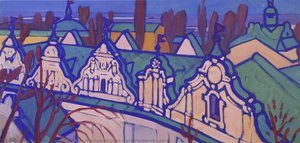 In the sunset light (Kyiv-Pechersk Lavra)1973
31
 The Last Snow (Kyiv-Pechersk Lavra)1975
32
 The Dnieper overflowed (Kyiv-Pechersk Lavra)1975
33
 Lavra in the spring1980
34
 Cyril's Church (Kyiv)1980
35
 Worried sky1980
36
 The bell tower of the Far Caves1980
37
 Ruins of the Assumption Cathedral (Kyiv-Pechersk Lavra)1980
38
 Over the Dnieper1979
39
 Houses and towers1983
40
 Women and bicycles1983
41
 Linen at the tower1983
42
 Mountain Crimea1983
43
 Blue twilight1983
44
 End of route1983
45
 Heated tiles1983
46
 Kyiv Lavra. Summer1990
47
 Sophia of Kyiv. North tower interior1991
48
 Snow-covered naves (St. Sophia)1992
49Frosty evening (Sofia Kiyiv)1992
50
 Zaborowski Gate (St. Sophia)1991
51
 The bell tower of the Near and Far Caves (Kyiv Lavra)1993
52
 The bell tower of the Far Caves (Kyiv Lavra)1996
Os quatro temas que mais se repetem nestas obras originais, cada um com o seu melhor exemplo.
O museu que detém a maioria das pinturas desta página.
| Museus | Cidade | Obras de Yuri Ivanovych Khymych | Pinturas desta lista |
|---|---|---|---|
 Finnish National Gallery |
Helsínquia | 1 | Evening at the Lavra |
Escolha uma década para ver a obra original que a define.


Cobblestones and tiles (1962). White vertical (1962) e Bakhchisarai, Palace baths (1963) vêm a seguir.
34 anos: Cobblestones and tiles data de 1962, e Yuri Ivanovych Khymych nasceu em 1928.
Cobblestones and tiles, White vertical, Bakhchisarai, Palace baths, Looking at the artist, Tourists, Purple road, Entrance to the Genoese fortress, Ancient Division. Behind the wall of the Florovsky monastery, Crossroads of times e Sudack. Signs of the times. O ranking acima apresenta o ano e o museu de cada uma.
Nosso catálogo contém 52 obras de Yuri Ivanovych Khymych, datadas de 1950 a 1996.
Principalmente em Finnish National Gallery (Helsínquia). A tabela de museus acima lista todos eles.
Em 1960s: 17 das 52 obras nesta página foram feitas então, sendo Cobblestones and tiles delas.
Nesta página, a mais antiga é At the Pump (1950) e a mais recente é The bell tower of the Far Caves (Kyiv Lavra) (1996).
Ukrainian landscape (4), Ukrainian architecture (3) e Urban landscape (2), entre as 52 obras nesta página.
Post-impressionism, a julgar pelos originais nesta página.
In the tapestry of twentieth-century Ukrainian fine arts, few threads are as intricately woven as those left by Yuri Ivanovych Khymych. Born in 1928 in the historic city of Kamianets-Podilskyi, Khymych was a man whose vision was shaped by the dual lenses of structural precision and poetic fluidity. His journey began not merely with a brush, but with the drafting tools of an architect. Graduating from the Kyiv Engineering and Construction Institute, he possessed a rare ability to understand the skeletal strength of a cathedral as intimately as the way light dances across its weathered stone. This unique duality—the disciplined mind of an architect paired with the sensitive soul of a watercolorist—allowed him to transform static monuments into breathing, emotive landscapes.
Khymych’s early years were steeped in the aesthetic traditions of his era, navigating the complexities of Socialist Realism while quietly nurturing a more personal, expressive language. As his career matured, he moved beyond mere documentation, embracing Post-Impressionist and even Cubist influences to capture the essence of his subjects. He did not simply paint buildings; he painted the atmosphere that enveloped them. Whether it was the monumental presence of the Saint Sophia Cathedral in Kyiv or the quiet, ancient dignity of a rural monastery, Khymych sought to reproduce the aesthetic features of historical monuments with an emotional resonance that transcended time.
While his mastery extended to oil and gouache, it was in the delicate medium of watercolor that Khymych achieved his most profound heights. He gained widespread renown as one of the finest watercolorists of the Soviet era, a title earned through his unparalleled ability to manipulate pigment and water to create luminous, ethereal effects. His technique was characterized by a remarkable balance of vivid color and subtle texture, allowing him to render the heavy masonry of fortresses with a lightness that seemed almost translucent.
His repertoire of subjects served as a love letter to the Ukrainian landscape and its architectural heritage. A viewer wandering through his works might encounter:
Beyond the canvas, Khymych was a pillar of the Ukrainian artistic community. As a dedicated educator, he passed his technical expertise and passion for heritage to generations of students at the Kyiv Engineering and Construction Institute and the National Academy of Architecture and Arts. His accolades were numerous, reflecting his status as a true master: he was an Honored Artist of Ukraine, a member of the National Union of Artists, and an honorary member of the Academy of Architecture of Ukraine. In a beautiful tribute to his contribution to national identity, a Ukrainian postage stamp was even issued in 2005, featuring his depiction of Saint Sophia Cathedral.
Today, the works of Yuri Khymych remain vital components of the Ukrainian artistic canon. He stands as a bridge between the rigid structures of the past and the expressive freedoms of modern art. Through his eyes, we do not merely see the ruins or the monuments of history; we feel their weight, their light, and their enduring spirit. His legacy is etched in every delicate brushstroke that captures the fleeting moment where architecture meets the infinite sky.


