Retrato de Joseph Noel Paton

As 46 Pinturas Mais Famosas de Joseph Noel Paton, uma Seleção da Galeria

Atualizado em Novembro 2026 · classificado pela nossa pontuação de popularidade (pesquisas, visitas e pedidos de cada obra) · 46 obras de Joseph Noel Paton em nosso catálogo

Em resumo

De todas as obras originais que Joseph Noel Paton deixou, a mais famosa é Hesperus, the Evening Star, Sacred to Lovers (1857). Logo atrás vêm Puck and Fairies, from "A Midsummer Night's Dream" (1850) e Michelangelo's dream. Nosso catálogo contém 46 obras de Joseph Noel Paton; a galeria preservou as 46 que o mundo mais admira, cada uma exibida com sua data, seu museu e sua história.

1821 – 1901, Dunfermline Pre-raphaelite Mais obras: Scottish National Gallery

As 10 principais pinturas de Joseph Noel Paton: a escolha da galeria

1
Hesperus, the Evening Star, Sacred to Lovers (1857) de Joseph Noel Paton

Hesperus, the Evening Star, Sacred to Lovers

1857 · Oil On Board

A man kneels before a woman in a secluded natural setting, their figures framed by the dense foliage of trees. He holds her hands in a gesture of devotion, his gaze fixed upon her as she looks down at him. The scene is quiet, set within a clearing where the soft light of the evening begins to settle. A single star hangs in the sky above them, casting a subtle…

2
Puck and Fairies, from "A Midsummer Night's Dream" (1850) de Joseph Noel Paton

Puck and Fairies, from "A Midsummer Night's Dream"

1850 · Oil On Board · Yale Center for British Art, New Haven

The forest breathes with a secret life as the moonlight filters through a dense canopy of tangled vegetation. In this intimate clearing, the air feels heavy with the scent of damp earth and the hum of unseen magic. Puck leans over the scene from the upper right, his large, rounded form casting a watchful presence over the delicate gathering below. The sprites move with a fluid, organic grace, their soft…

3
Michelangelo's dream de Joseph Noel Paton

Michelangelo's dream

Oil On Canvas

The artwork presents a dramatic portrait of a figure draped in a deep red robe, positioned within an archway formed by classical columns. This central figure dominates the vertically oriented composition, creating a sense of enclosure. Through the arch, a landscape is visible, featuring a crescent moon and a distant horizon line suggesting twilight or dawn. The scene is characterized by a strong use of chiaroscuro, with a single light…

4
The Temptations of St. Anthony (1860) de Joseph Noel Paton

The Temptations of St. Anthony

1860 · Terracotta · Museu de Israel, Jerusalém

In this circular, terracotta-colored relief sculpture, Joseph Noel Paton presents a quiet, intimate scene titled The Temptations of St. Anthony. The composition is centered on two figures rendered in classical attire, creating a focused, balanced arrangement. A seated female figure is captured in profile, facing toward the left. She is dressed in a draped garment characterized by fine vertical folds that catch the light. Opposite her, a smaller winged figure…

5
In Memoriam (1863) de Joseph Noel Paton

In Memoriam

1863 · Watercolor · Royal Collection, Londres

The scene unfolds within the delicate, translucent layers of In Memoriam, a poignant watercolor or gouache study by the Scottish artist Joseph Noel Paton. Created in 1863, this work captures a quiet, spectral moment where the boundaries between the physical and the spiritual begin to dissolve. The paper holds a vision of memory, rendered with a softness that suggests the fleeting nature of life itself.

6
The Man with the Muck Rake (study) (1872) de Joseph Noel Paton

The Man with the Muck Rake (study)

1872 · Oil

The Man with the Muck Rake (study) emerges from the brush of Joseph Noel Paton, a man whose hands were shaped by the intricate patterns of the Scottish textile industry. Born in 1821 in Dunfermline, United Kingdom, Paton carries the precision of a weaver into his work as an artist, illustrator, and sculptor. This particular piece, dating to 1872, captures a moment of intense spiritual or moral focus. It exists…

7
Michelangelo Sculpting the Statue of 'Night' de Joseph Noel Paton

Michelangelo Sculpting the Statue of 'Night'

Painting

Michelangelo Sculpting the Statue of 'Night' is a painting by Joseph Noel Paton. The artist, born in 1821 in Dunfermline, United Kingdom, lived until 1901. His hand moved through the Victorian era, capturing scenes that bridge the gap between the tangible and the imagined.

8
The choice de Joseph Noel Paton

The choice

In "The choice" by Joseph Noel Paton, a heavy tension hangs in the air, freezing a moment of profound conflict. Three figures dressed in medieval clothing occupy the center of the scene, their bodies angled toward one another in a struggle of words or wills. On the left, a man clad in armor stands as a rigid presence, his metallic attire catching the light amidst the unfolding drama. The others…

9
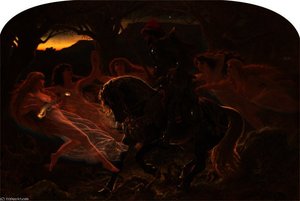
Oskold and the Elle Maids de Joseph Noel Paton

Oskold and the Elle Maids

Oil

A man sits atop a horse, a solitary figure amidst a sudden surge of movement. Around him, the forest breathes with the presence of the Elle Maids. These women, appearing as nymphs or fairies, drift through the shadows and the light, their forms scattered like fallen petals across the woodland floor. Some linger in the foreground, their presence felt in the immediate air, while others recede into the deep green…

10
The Reconciliation of Oberon and Titania de Joseph Noel Paton

The Reconciliation of Oberon and Titania

Oil On Canvas · Scottish National Gallery, Edimburgo

The Reconciliation of Oberon and Titania emerges from the shadows of a Scottish forest, a scene where magic and emotion collide. Painted in 1847, this oil on canvas work by Sir Joseph Noel Paton captures a moment of profound transition. The air feels heavy with the aftermath of a great dispute, as the fairy rulers move toward a delicate peace. It is a sequel to a previous quarrel, a continuation…

A seleção de Joseph Noel Paton continua, de 11 a 46

Os temas que cativaram o olhar de Joseph Noel Paton

Os quatro temas que mais se repetem nestas obras originais, cada um com o seu melhor exemplo.

Os museus que guardam os originais de Joseph Noel Paton

Os 7 museus que detêm a maioria das pinturas desta página.

Museus Cidade Obras de Joseph Noel Paton Pinturas desta lista
Scottish National Gallery, EdimburgoScottish National Gallery Edimburgo 3 The Reconciliation of Oberon and Titania, Dawn - Luther at Erfurt, The Quarrel of Oberon and Titania
Royal Collection, LondresRoyal Collection Londres 2 In Memoriam, 'Home': The Return from the Crimea
Yale Center for British Art, New HavenYale Center for British Art New Haven 1 Puck and Fairies, from "A Midsummer Night's Dream"
Museu de Israel, JerusalémMuseu de Israel Jerusalém 1 The Temptations of St. Anthony
Laing Art Gallery, New South WalesLaing Art Gallery New South Wales 1 The Man of Sorrows
Sheffield City Art Galleries, SheffieldSheffield City Art Galleries Sheffield 1 The Fairy Queen
Musée de Grenoble, GrenobleMusée de Grenoble Grenoble 1 Beati mundo corde

Joseph Noel Paton década a década: a obra original que define cada uma

Obras por década

Escolha uma década para ver a obra original que a define.

Perguntas de colecionadores sobre as pinturas de Joseph Noel Paton

Por qual obra Joseph Noel Paton é mais conhecido(a)?Revelar a resposta

Hesperus, the Evening Star, Sacred to Lovers (1857). Puck and Fairies, from "A Midsummer Night's Dream" (1850) e Michelangelo's dream vêm a seguir.

Qual era a idade de Joseph Noel Paton quando Hesperus, the Evening Star, Sacred to Lovers foi feita?Revelar a resposta

36 anos: Hesperus, the Evening Star, Sacred to Lovers data de 1857, e Joseph Noel Paton nasceu em 1821.

Quais são as dez pinturas mais famosas de Joseph Noel Paton?Revelar a resposta

Hesperus, the Evening Star, Sacred to Lovers, Puck and Fairies, from "A Midsummer Night's Dream", Michelangelo's dream, The Temptations of St. Anthony, In Memoriam, The Man with the Muck Rake (study), Michelangelo Sculpting the Statue of 'Night', The choice, Oskold and the Elle Maids e The Reconciliation of Oberon and Titania. O ranking acima apresenta o ano e o museu de cada uma.

Quantas pinturas Joseph Noel Paton deixou?Revelar a resposta

Nosso catálogo contém 46 obras de Joseph Noel Paton, datadas de 1849 a 1875.

Em quais museus estão expostas as obras-primas de Joseph Noel Paton?Revelar a resposta

Principalmente em Scottish National Gallery (Edimburgo), Royal Collection (Londres) e Yale Center for British Art (New Haven). A tabela de museus acima lista todos eles.

Em que anos Joseph Noel Paton pintou as suas obras mais famosas?Revelar a resposta

Em 1850s: 4 das 46 obras nesta página foram feitas então, sendo Hesperus, the Evening Star, Sacred to Lovers delas.

Quais são as primeiras e as últimas obras originais famosas de Joseph Noel Paton?Revelar a resposta

Nesta página, a mais antiga é The Quarrel of Oberon and Titania (1849) e a mais recente é The Man of Sorrows (1875).

Quais temas Joseph Noel Paton escolheu com mais frequência?Revelar a resposta

Man (5), Woman (5) e Forest (5), entre as 46 obras nesta página.

Qual técnica Joseph Noel Paton mais utilizou?Revelar a resposta

Oil On Canvas, para 4 das 46 obras nesta página.

A qual movimento artístico pertence Joseph Noel Paton?Revelar a resposta

Pre-raphaelite e Romanticism, a julgar pelos originais nesta página.

Quais obras de Joseph Noel Paton estão expostas no Scottish National Gallery?Revelar a resposta

The Reconciliation of Oberon and Titania, Dawn - Luther at Erfurt e The Quarrel of Oberon and Titania: o Scottish National Gallery, Edimburgo detém 3 das obras desta página.

Joseph Noel Paton: vida e obra

A Scottish Visionary: The Life and Art of Sir Joseph Noel Paton

Sir Joseph Noel Paton, um pintor escocês de rara sensibilidade e técnica impecável, emergiu no cenário artístico vitoriano como uma voz singular, tecendo entre o folclore celta, as lendas religiosas e a influência sutil do movimento Pré-Rafaelita. Nascido em Dunfermline, na vibrante região têxtil da Escócia, em 13 de dezembro de 1821, Paton foi moldado desde cedo pela atmosfera criativa de sua família: seus pais eram habilidosos designers e tecelões de damasco, um ofício que lhe proporcionou uma apreciação precoce pelo detalhe e pelo padrão – elementos que se tornariam a base de seu estilo artístico. Embora inicialmente envolvido nos negócios familiares, liderando o design em uma fábrica de muselina bordada, a verdadeira vocação de Paton residia em um mundo diferente: a busca por conhecimento artístico o levou à Academia de Arte de Dunfermline, lançando as bases para uma carreira profundamente enraizada na rica tapeçaria da cultura escocesa. Uma breve incursão nos estudos na Royal Academy de Londres, em 1843, expôs-o às correntes artísticas predominantes, e a oferta de John Everett Millais de se juntar ao Pre-Rafaelita – uma proposta que ele gentilmente recusou – demonstra sua conexão com esse movimento influente, mesmo enquanto forjava seu próprio caminho distinto.

Weaving Myth and Morality: The Development of a Unique Style

A jornada artística de Paton foi marcada por uma síntese extraordinária de influências diversas. Ele não se limitava a ilustrar contos; ele dava vida a eles com um detalhe meticuloso e uma profundidade emocional que o diferenciavam dos demais. Suas primeiras obras, como “The Quarrel of Oberon and Titania” (1847), agora um marco na coleção da National Gallery of Scotland, estabeleceram imediatamente sua reputação por capturar cenas fantásticas com notável realismo. Essa pintura, inspirada no *A Midsummer Night’s Dream* de Shakespeare, não apenas demonstrava habilidade técnica, mas também a capacidade de Paton de imbuir temas mitológicos com complexidade psicológica. Ele não simplesmente retratava fadas; ele pintava suas paixões, conflitos e vulnerabilidades. Além do reino da lenda, Paton explorou temas religiosos com igual fervor, como evidenciado em obras como “Luther Discovering Justification by Faith”, revelando um profundo engajamento com conceitos teológicos. Sua atenção meticulosa aos detalhes – evidente nos figurinos elaborados, paisagens vívidas e expressões faciais expressivas – adicionava camadas de significado às suas composições. O uso dramático da luz e das cores ricas intensificava o impacto emocional de suas pinturas. Paton não era apenas um cronista de histórias; ele usava-as como veículos para explorar experiências humanas universais.

Themes and Symbolism: A Window into Victorian Scotland

O trabalho de Paton está profundamente imbuído de simbolismo, refletindo tanto crenças pessoais quanto as ansiedades culturais mais amplas da era vitoriana. Sua fascinação por lendas celtas reflete um crescente interesse pela identidade nacional e pelo folclore durante este período. As pinturas de fadas, embora aparentemente caprichosas, frequentemente carregam mensagens morais subjacentes sobre tentação, inocência e os perigos do desejo descontrolado. As obras religiosas, como aquelas que retratam cenas da vida de Martin Luther, exploram temas de fé, redenção e a luta contra a opressão. A paleta de cores vibrantes, o uso de luz e sombra, e a composição cuidadosa contribuem para a atmosfera emocional das pinturas.
  • Sua atenção meticulosa aos detalhes – evidente nos figurinos elaborados, paisagens vívidas e expressões faciais expressivas – adicionava camadas de significado às suas composições.
  • O uso dramático da luz e das cores ricas intensificava o impacto emocional de suas pinturas.
  • Paton’s works often feature allegorical figures representing abstract concepts like love, death, and justice.

A Royal Appointment and Enduring Legacy

O reconhecimento do talento excepcional de Paton veio em 1865 com sua nomeação como "Limner Real" para a Escócia – uma posição prestigiosa que solidificou seu status como o principal artista do país. Dois anos depois, ele foi empossado cavaleiro, um testemunho de suas contribuições significativas para as artes e a cultura escocesa. Este período viu-o continuar a produzir obras que combinavam precisão histórica com narrativas imaginativas. Pinturas como “Puck and Fairies” exemplificam sua maestria na captura da beleza etérea e do espírito travesso do mundo das fadas. Sua capacidade de criar cenas críveis, mas outraswordly, o diferenciava de muitos de seus contemporâneos. A influência de Paton se estendeu além da pintura; ele era um antiquário respeitado, colecionando armas e armaduras, e suas empreitadas poéticas enriqueceram ainda mais sua visão artística. Ele publicou dois volumes de poesia que refletiam a mesma sensibilidade romântica encontrada em suas pinturas.

A Lasting Impression: Paton’s Place in Art History

Sir Joseph Noel Paton faleceu em 26 de dezembro de 1901, deixando para trás um rico legado artístico que continua a cativar o público hoje. Suas obras podem ser encontradas em museus e coleções proeminentes, incluindo a Scottish National Gallery e o National Records of Scotland, garantindo que sua arte permaneça acessível às gerações futuras. Embora tenha recusado formalmente a adesão ao Pre-Rafaelita, seu trabalho compartilha seu compromisso com detalhes, simbolismo e narrativas. No entanto, a combinação única de Paton de mitologia celta, temas religiosos e sensibilidade vitoriana o distingue como um artista verdadeiramente original. Ele é um testemunho do poder da arte para nos transportar para outros mundos, explorar verdades profundas e celebrar a rica herança cultural da Escócia. Suas pinturas não são meros artefatos históricos; elas são manifestações vivas de imaginação, fé e visão artística.