Retrato de Jacopo Bellini

As 60 Pinturas Mais Famosas de Jacopo Bellini, Cada Uma Única

Atualizado em Outubro 2026 · classificado pela nossa pontuação de popularidade (pesquisas, visitas e pedidos de cada obra) · 62 obras de Jacopo Bellini em nosso catálogo

Em resumo

The Aposle Peter (1430) é a pintura de Jacopo Bellini que mais atrai olhares; a obra original pertence ao Staatliche Museen zu Berlin, Berlim. Depois disso, o olhar recai sobre Madonna and Child (1450) e Saint Anthony Abbot and Saint Bernardino of Siena (1459). Entre as 62 obras de Jacopo Bellini em nosso catálogo, estas 60 são as mais famosas, cada uma uma original única apresentada com o seu ano, o seu museu e a razão pela qual perdura.

1400 – 1470, Veneza Renascimento inicial Mais obras: Museu do Louvre

As 10 principais pinturas de Jacopo Bellini, sob o olhar da galeria

1
The Aposle Peter (1430) de Jacopo Bellini

The Aposle Peter

To stand before Jacopo Bellini's depiction of The Apostle Peter is to encounter not merely a portrait, but a profound moment suspended in the amber glow of the early Renaissance. This oil on wood painting, dating from 1430, immediately draws the viewer into its narrative depth. Bellini masterfully captures the gravitas and intellectual weight associated with the figure of Peter. The composition itself is a lesson in visual storytelling; every…

2
Madonna and Child (1450) de Jacopo Bellini

Madonna and Child

1450 · Acrylic On Canvas · Metropolitan Museum of Art, Nova York

The year is roughly 1450, and within the bustling heart of Venice, a young artist named Jacopo Bellini was quietly revolutionizing the very fabric of painting. His “Madonna and Child,” now residing in the Uffizi Gallery, isn't merely a depiction of the Virgin Mary cradling her infant son; it’s a window into the burgeoning Renaissance spirit, a testament to Bellini’s innovative approach to perspective, color, and emotional resonance. This work…

3
Saint Anthony Abbot and Saint Bernardino of Siena (1459) de Jacopo Bellini

Saint Anthony Abbot and Saint Bernardino of Siena

1459 · Oil On Canvas · National Gallery of Art, Washington

Jacopo Bellini's “Saint Anthony Abbot and Saint Bernardino of Siena,” painted in 1459, isn’t merely a depiction of two revered saints; it’s a profound meditation on faith, the natural world, and the burgeoning spirit of Renaissance Venice. This oil-on-poplar panel, now housed within the National Gallery of Art in Washington D.C., offers a rare glimpse into a pivotal moment in Venetian art – a transition from the rigid formality of…

4
St John the Evangelist (1430) de Jacopo Bellini

St John the Evangelist

1430 · Oil On Panel · Staatliche Museen zu Berlin, Berlim

To stand before this depiction of Saint John the Evangelist is to step into a hushed moment of profound intellectual reckoning. The air seems thick with the scent of aged vellum and deep thought. This painting captures not merely a portrait, but an entire state of being—the quiet intensity of divine revelation meeting human contemplation. The figure dominates the vertical space, his posture one of serene yet palpable engagement with…

5
Epigrafi e Statue (1450) de Jacopo Bellini

Epigrafi e Statue

1450 · Charcoal · Museu do Louvre, Paris

To gaze upon this preparatory drawing by Jacopo Bellini is to step directly into the vibrant, intellectual crucible of the early Italian Renaissance. It is not merely an image; it is a blueprint of genius—a tangible record of an artist wrestling with the monumental weight and exquisite potential of classical antiquity. Rendered in the delicate interplay of charcoal and ink upon aged paper, the composition presents three distinct sculptural visions:…

6
Saint Peter (1432) de Jacopo Bellini

Saint Peter

1432 · Tempera On Panel · Gemäldegalerie, Berlim

A vertical, arched composition defines this Renaissance-era religious panel, presenting a standing figure of Saint Peter with a formal, iconographic presence. The subject is an elderly man, characterized by a balding head and a full, greyish-white beard, his gaze directed slightly upward and toward the viewer's left. He is draped in voluminous, layered robes: a red undergarment visible at the base, a heavy golden-yellow mantle across the torso, and a…

7
Annunciation (1444) de Jacopo Bellini

Annunciation

1444 · Tempera On Panel

The scene unfolds within a highly ornate polyptych, a structure defined by two main arched panels separated by a central gilded pillar. On the left, the Archangel Gabriel kneels in profile, his presence marked by an intricately patterned gold brocade robe accented with blue. His large, feathered wings frame a moment of profound stillness. Opposite him, the Virgin Mary kneels before a decorated prie-dieu, her posture one of quiet devotion.…

8
St. Jerome with St. Francis and St. Anthony Abbot (1450) de Jacopo Bellini

St. Jerome with St. Francis and St. Anthony Abbot

1450 · Tempera On Panel · Frances Lehman Loeb Art Center

This Renaissance triptych, dated to 1450, presents three holy figures arranged within a gilded Gothic architectural frame. The composition follows a symmetrical structure, featuring a larger central panel flanked by two narrower side panels. In the center, St. Jerome is depicted wearing a crimson robe, holding a book and a small model of a church. To the left, St. Francis is shown in a muted grey habit, and to the…

9
Saint Bernardino of Siena (1450) de Jacopo Bellini

Saint Bernardino of Siena

1450 · Tempera On Panel

A solemn portrait of Saint Bernardino of Siena emerges from a dark, patterned background, rendered with the precision of the Early Renaissance. The composition focuses on a three-quarter view of the elderly saint, whose weathered skin and deep-set eyes suggest a life of intense spiritual rigor. Soft, directional light from the upper left carves out the bony structure of his face, casting gentle shadows into the folds of his monastic…

10
Madonna and Child (1440) de Jacopo Bellini

Madonna and Child

1440 · Tempera On Panel · Accademia Carrara, Bergamo

The painting titled Madonna and Child is a work by the Venetian artist Jacopo Bellini. Born in Venice, Italy, Bellini helped shape the visual language of the Renaissance through a precise, observational hand. This specific panel captures a quiet, sacred moment between mother and son.

Pinturas famosas de Jacopo Bellini, números 11 a 60

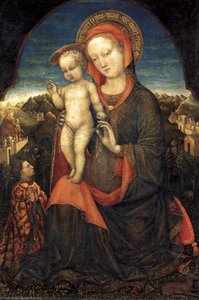
11Adoration of the Magi (1460) de Jacopo BelliniAdoration of the Magi1460 · Pinacoteca Nazionale 12Virgin and Child (1465) de Jacopo BelliniVirgin and Child1465 13Mourning over Christ (1470) de Jacopo BelliniMourning over Christ1470 · Gemäldegalerie 14Profile Portrait of a Boy (1470) de Jacopo BelliniProfile Portrait of a Boy1470 · National Gallery of Art 15Natividade (1440) de Jacopo BelliniNatividade1440 · Museu do Louvre 16Dormition of the Virgin (1450) de Jacopo BelliniDormition of the Virgin1450 · Museu do Louvre 17Presentation of the Virgin at the Temple de Jacopo BelliniPresentation of the Virgin at the TempleMuseu do Louvre 18St. John the Baptist Preaching de Jacopo BelliniSt. John the Baptist PreachingMuseu do Louvre 19Flagellation (1450) de Jacopo BelliniFlagellation1450 · Museu do Louvre 20Johannes der Evangelist, Der Apostel Petrus (1430) de Jacopo BelliniJohannes der Evangelist, Der Apostel Petrus1430 21Der heilige Hieronymus (1430) de Jacopo BelliniDer heilige Hieronymus1430 · Gemäldegalerie 22madonna and child, uffizi (1450) de Jacopo Bellinimadonna and child, uffizi1450 23Annunciation (1444) de Jacopo BelliniAnnunciation1444 · Sant'Alessandro 24Lamentation (from the sketchook, folios 57b-58a) (1440) de Jacopo BelliniLamentation (from the sketchook, folios 57b-58a)1440 · Museu do Louvre 25Madonna and Child (1450) de Jacopo BelliniMadonna and Child1450 · Pinacoteca di Brera 26Saint Anthony Abbot and Saint Bernardino of Siena (1459) de Jacopo BelliniSaint Anthony Abbot and Saint Bernardino of Siena1459 · National Gallery of Art 27Madonna with Child (1465) de Jacopo BelliniMadonna with Child1465 · Museu de Arte do Condado de Los Angeles 28Triptych of the Virgin (1464) de Jacopo BelliniTriptych of the Virgin1464 · Gallerie dell'Accademia di Venezia 29Saint Anthony Abbot and Saint Bernardino da Siena (1460) de Jacopo BelliniSaint Anthony Abbot and Saint Bernardino da Siena1460 30Livro do Louvre, epigrafes e moedas (1450) de Jacopo BelliniLivro do Louvre, epigrafes e moedas1450 · Museu do Louvre 31Le triomphe de Bacchus de Jacopo BelliniLe triomphe de BacchusMuseu do Louvre 32Madonna and Child Adored by Lionello d'Este (1450) de Jacopo BelliniMadonna and Child Adored by Lionello d'Este1450 · Museu do Louvre 33Ross and rider de Jacopo BelliniRoss and rider 34Sieben Heilige de Jacopo BelliniSieben Heilige 35Profile of a man de Jacopo BelliniProfile of a man 36Crucifix de Jacopo BelliniCrucifix 37Madonna mit dem Kind de Jacopo BelliniMadonna mit dem KindBonnefanten Museum 38Christus in der Vorhölle de Jacopo BelliniChristus in der Vorhölle 39Heiliger Hieronymus in der Wüste de Jacopo BelliniHeiliger Hieronymus in der Wüste 40The Three Dead and Three Loud de Jacopo BelliniThe Three Dead and Three Loud 41The scourging at the torchlight de Jacopo BelliniThe scourging at the torchlight 42Christ in the grave de Jacopo BelliniChrist in the grave 43The Twelve Apostles in a Barrel Vaulted Passage (1440) de Jacopo BelliniThe Twelve Apostles in a Barrel Vaulted Passage1440 · British Museum 44Sketch of young deer de Jacopo BelliniSketch of young deer 45Sketch of deer doe de Jacopo BelliniSketch of deer doe 46Tomb of a prince de Jacopo BelliniTomb of a prince 47View of a fortification of Jerusalem de Jacopo BelliniView of a fortification of Jerusalem 48Christ's Descent into Limbo de Jacopo BelliniChrist's Descent into Limbo 49saint anthony abbot and saint bernardino of sie(1 de Jacopo Bellinisaint anthony abbot and saint bernardino of sie(1 50The Crucifixion de Jacopo BelliniThe CrucifixionMuseo Correr 51Sketch of figures and scenes from the antique age de Jacopo BelliniSketch of figures and scenes from the antique age 52Virgin with Child de Jacopo BelliniVirgin with ChildGallerie dell'Accademia di Venezia 53St Michael Defeating Satan de Jacopo BelliniSt Michael Defeating SatanBritish Museum 54Madonna and Child (1450) de Jacopo BelliniMadonna and Child1450 · Galleria degli Uffizi 55Madonna Tadini (1450) de Jacopo BelliniMadonna Tadini1450 56Triptych of St Lawrence (1464) de Jacopo BelliniTriptych of St Lawrence1464 · Gallerie dell'Accademia di Venezia 57Triptych of St Sebastian (1464) de Jacopo BelliniTriptych of St Sebastian1464 · Gallerie dell'Accademia di Venezia 58Triptych of the Nativity (1464) de Jacopo BelliniTriptych of the Nativity1464 · Gallerie dell'Accademia di Venezia 59Madonna and Child (1420) de Jacopo BelliniMadonna and Child1420 · Castelvecchio Museum 60Saint Jerome in the Desert (1460) de Jacopo BelliniSaint Jerome in the Desert1460 · Castelvecchio Museum

Pinturas famosas de Jacopo Bellini, período por período

Os temas que cativaram o olhar de Jacopo Bellini

Os quatro temas que mais se repetem nestas obras originais, cada um com o seu melhor exemplo.

Os museus que guardam os originais de Jacopo Bellini

Os 8 museus que detêm a maioria das pinturas desta página.

Museus Cidade Obras de Jacopo Bellini Pinturas desta lista
Museu do Louvre, ParisMuseu do Louvre Paris 10 Epigrafi e Statue, Natividade, Dormition of the Virgin
Gallerie dell'Accademia di Venezia, VenezaGallerie dell'Accademia di Venezia Veneza 5 Triptych of the Virgin, Virgin with Child, Triptych of St Lawrence
National Gallery of Art, WashingtonNational Gallery of Art Washington 3 Saint Anthony Abbot and Saint Bernardino of Siena, Profile Portrait of a Boy, Saint Anthony Abbot and Saint Bernardino of Siena
Gemäldegalerie, BerlimGemäldegalerie Berlim 3 Saint Peter, Mourning over Christ, Der heilige Hieronymus
Staatliche Museen zu Berlin, BerlimStaatliche Museen zu Berlin Berlim 2 The Aposle Peter, St John the Evangelist
British Museum, LondresBritish Museum Londres 2 The Twelve Apostles in a Barrel Vaulted Passage, St Michael Defeating Satan
Castelvecchio Museum, VeronaCastelvecchio Museum Verona 2 Madonna and Child, Saint Jerome in the Desert
Metropolitan Museum of Art, Nova YorkMetropolitan Museum of Art Nova York 1 Madonna and Child

Jacopo Bellini ao longo das décadas: uma obra original única para cada uma

Obras por década

Escolha uma década para ver a obra original que a define.

Pinturas de Jacopo Bellini: perguntas para a galeria

Qual é a obra mais famosa de Jacopo Bellini?Revelar a resposta

The Aposle Peter (1430), Staatliche Museen zu Berlin, Berlim. Madonna and Child (1450) e Saint Anthony Abbot and Saint Bernardino of Siena (1459) vêm a seguir.

Com que idade Jacopo Bellini criou The Aposle Peter?Revelar a resposta

30 anos: The Aposle Peter data de 1430, e Jacopo Bellini nasceu em 1400.

Quais são as dez pinturas mais famosas de Jacopo Bellini?Revelar a resposta

The Aposle Peter, Madonna and Child, Saint Anthony Abbot and Saint Bernardino of Siena, St John the Evangelist, Epigrafi e Statue, Saint Peter, Annunciation, St. Jerome with St. Francis and St. Anthony Abbot, Saint Bernardino of Siena e Madonna and Child. O ranking acima apresenta o ano e o museu de cada uma.

Quantas obras de Jacopo Bellini são conhecidas?Revelar a resposta

Nosso catálogo contém 62 obras de Jacopo Bellini, datadas de 1420 a 1470.

Onde se pode ver os originais mais famosos de Jacopo Bellini?Revelar a resposta

Principalmente em Museu do Louvre (Paris), Gallerie dell'Accademia di Venezia (Veneza) e National Gallery of Art (Washington). A tabela de museus acima lista todos eles.

Em que período Jacopo Bellini criou as suas pinturas mais conhecidas?Revelar a resposta

Em 1450s: 14 das 60 obras nesta página foram feitas então, sendo Madonna and Child delas.

Qual pintura famosa de Jacopo Bellini é a mais antiga e qual é a mais recente?Revelar a resposta

Nesta página, a mais antiga é Madonna and Child (1420) e a mais recente é Mourning over Christ (1470).

Quais temas Jacopo Bellini preferia?Revelar a resposta

Renaissance (9), Virgin mary (8) e Child (7), entre as 60 obras nesta página.

Com quais materiais Jacopo Bellini mais pintou?Revelar a resposta

Tempera On Panel, para 10 das 60 obras nesta página.

A qual movimento pertence a obra de Jacopo Bellini?Revelar a resposta

Renascimento inicial, a julgar pelos originais nesta página.

Quais originais de Jacopo Bellini posso ver no Museu do Louvre?Revelar a resposta

Epigrafi e Statue, Natividade e Dormition of the Virgin: o Museu do Louvre, Paris detém 10 das obras desta página.

Jacopo Bellini: um retrato do artista

O Pioneiro Veneziano da Perspectiva Renascentista

Jacopo Bellini ergue-se como uma figura fundamental no florescente estilo de pintura renascentista que prosperou em Veneza e no norte da Itália. Ele foi muito mais do que um mero pintor; foi um dos inovadores fundacionais de sua era, moldando as sensibilidades artísticas através de uma observação meticulosa da natureza e de uma incorporação magistral da perspectiva linear — uma técnica que, anteriormente, estava amplamente ausente na tradição veneziana. Embora poucas das telas originais de Bellini sobrevivam hoje para serem apreciadas em toda a sua glória, seu legado profundo reside primordialmente em seus requintados cadernos de esboços, como aqueles preservados no British Museum e no Louvre. Esses desenhos revelam uma profunda fascinação por vastas paisagens e elaborados projetos arquitetônicos, oferecendo uma visão inestimável de um processo artístico que prefigurou as revoluções estilísticas dos séculos seguintes.

Nascido em Veneza por volta de 1396, os anos formativos de Jacopo foram imersos nas ricas e decorativas tradições do período gótico tardio. Sua formação inicial sugere que ele foi discípulo do célebre Gentile da Fabriano, um artista cujo ateliê produziu alguns dos afrescos mais ambiciosos e ornamentados da época. Esta prestigiada associação sem dúvida instilou em Bellini um apreço vitalício pelo detalhe intrincado, pela harmonia das cores e por uma certa complexidade decorativa. No início de sua carreira, ele esteve ativo em Foligno entre 1411 e 1412, onde colaborou nos monumentais afrescos do Palazzo Trinci, trabalhando ao lado dos próprios mestres que definiram o estilo gótico internacional.

Uma Jornada pelo Coração do Renascimento

Um ponto de virada significativo ocorreu quando Bellini viajou para Florença por volta de 1423. Esta jornada colocou-o no epicentro de um período intenso de experimentação artística, liderado por luminares como Brunelleschi, Donatello e Masaccio. Em Florença, ele encontrou a ciência emergente da perspectiva linear, uma descoberta que alteraria fundamentalmente sua abordagem ao espaço e à profundidade. Ao fundir a elegância lírica e decorativa de suas raízes venezianas com o rigor estrutural e a clareza espacial dos inovadores florentinos, Bellini começou a forjar uma linguagem visual única. Esta síntese permitiu-lhe ir além dos planos simbólicos e planos do período medieval em direção a uma representação do mundo mais imersiva, como se fosse uma janela aberta.

À medida que sua carreira progredia, Bellini tornou-se uma figura central no estabelecimento de uma dinastia familiar que dominaria a arte veneziana por gerações. Sua influência não foi meramente pessoal, mas pedagógica, pois ele transmitiu suas inovações aos seus filhos, Gentile e Giovanni. Através deles, as sementes de sua experimentação com a luz, a paisagem e a perspectiva floresceram no esplendor do Alto Renascimento associado ao nome Bellini. Sua obra serviu como uma ponte entre as tradições ornamentais do passado e o realismo humanista do futuro, tornando-o um elo indispensável na evolução da arte italiana.

Legado e Significância Histórica

A importância histórica de Jacopo Bellini reside em seu papel como catalisador de mudanças. Embora grande parte de sua produção permaneça capturada no meio íntimo da tinta e da pena, aqueles esboços servem como um projeto para o Renascimento veneziano. Sua habilidade de vislumbrar paisagens complexas e multicamadas e arquiteturas matematicamente coerentes forneceu a base para que seus sucessores explorassem a beleza atmosférica da lagoa veneziana. Estudar Bellini é testemunhar o exato momento em que o olhar do artista começou a dominar verdadeiramente a ilusão de profundidade, mudando para sempre a forma como a humanidade percebe o mundo pintado.