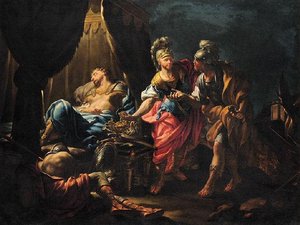
Retrato de Francesco Trevisani

Pinturas de Francesco Trevisani: As 61 mais famosas, sob o olhar de uma galeria

Atualizado em Novembro 2026 · classificado pela nossa pontuação de popularidade (pesquisas, visitas e pedidos de cada obra) · 63 obras de Francesco Trevisani em nosso catálogo

Em resumo

Aos olhos da galeria, a pintura mais famosa de Francesco Trevisani é The Madonna and Child (1700). Study for 'The Massacre of the Innocents' (1710) e Christ Supported by Angels (1720) completam o trio que todos reconhecem. Dos 63 trabalhos de Francesco Trevisani em nosso catálogo, a galeria apresenta abaixo as 61 obras mais famosas, cada uma original, com seu ano, seu museu e o que a torna única.

1656 – 1746, Koper Baroque Mais obras: Bavarian State Painting Collections

As 10 principais pinturas de Francesco Trevisani na galeria

1
The Madonna and Child (1700) de Francesco Trevisani

The Madonna and Child

1700 · Oil On Copper

The Virgin Mary cradles her sleeping child in a moment of profound stillness. She sits with a gentle weight, her form draped in soft fabrics that catch the light. A veil rests upon her head, and a single strand of pearls encircles her neck, catching a glint of the room's soft illumination. Behind them, the silhouette of a chair anchors the composition, providing a sense of domestic depth to this…

2
Study for 'The Massacre of the Innocents' (1710) de Francesco Trevisani

Study for 'The Massacre of the Innocents'

1710 · Oil On Canvas · Museu Fitzwilliam, Cambridge

A man hangs upside down, his legs grasping the air, while a hand tightens around his throat. The scene unfolds before a structure of cold, pale columns. Shadows stretch across the ground where figures sit and stand in a state of sudden, jarring motion. In the periphery, two dogs watch the unfolding chaos, their presence grounding the frantic energy of the central struggle. A single infant is visible, a small…

3
Christ Supported by Angels (1720) de Francesco Trevisani

Christ Supported by Angels

1720 · Oil On Canvas · Bristol Museum - Art Gallery, Bristol

In this oil on canvas, Francesco Trevisani presents Christ Supported by Angels. The work is a profound meditation on religious sacrifice and grief. It captures a moment of quiet, heavy sorrow through its focused subject matter. The composition centers on the physical and spiritual weight of the scene.

4
The Agony in the Garden (1740) de Francesco Trevisani

The Agony in the Garden

1740 · Oil On Copper

The night air hangs heavy over the garden, a dark landscape that presses against the central figures. In the center of this gloom, a man in red robes and a blue cloak bends forward, his body heavy with the weight of prayer. He is in a state of distress, his posture a silent cry for strength. Behind him, a woman reaches out, her hand gently cradling his head in a…

5
The Crucifixion (1717) de Francesco Trevisani

The Crucifixion

1717 · Oil On Canvas · Yale University Art Gallery, New Haven

The canvas presents a vertical arrangement centered on the figure of Christ upon a wooden cross. The lighting follows a chiaroscuro method, casting deep shadows in the background while illuminating the pale skin of the central figure and the faces of those gathered below. The color palette relies on dark tones, including blacks, browns, and umber, which contrast with the red and blue fabrics worn by the mourning figures. The…

6
The Prophet Baruch (1718) de Francesco Trevisani

The Prophet Baruch

1718 · Oil On Canvas · Kunstpalast, Düsseldorf

The painting, titled The Prophet Baruch, immediately draws the viewer into an atmosphere of profound stillness. We encounter a figure seated upon the ground, his posture speaking volumes without uttering a single word. With his head bowed into his hands, he embodies a moment of deep introspection or perhaps prayer. The subject is rendered with such palpable humanity that one feels they are witnessing a private communion between man and…

8
Penitent Mary Magdalene (1710) de Francesco Trevisani

Penitent Mary Magdalene

1710 · Oil · Kunsthistorisches Museum, Viena

In this oil painting from 1710, a woman identified as Mary Magdalene is depicted in profile, her body oriented toward the right side of the frame. She is shown in a moment of religious reflection, with her gaze directed upward. Her hands are clasped near her chest, and her long, auburn hair falls in wavy textures over her shoulders. She wears a white chemise and a garment with subtle pink…

9
Dead Christ Supported by Angels (1710) de Francesco Trevisani

Dead Christ Supported by Angels

1710 · Oil On Canvas · Metropolitan Museum of Art, Nova York

In this quiet corner of the late Baroque, we find ourselves face to face with a profound moment of grief and divinity. The composition is tightly focused, drawing us into an intimate encounter with the lifeless body of Christ. He rests upon a winding-sheet, his pale, limp form emerging from a deep, heavy shadow that swallows much of the background. Two angels attend to him, their presence providing both physical…

10
LE SOMMEIL DE L'ENFANT JESUS de Francesco Trevisani

LE SOMMEIL DE L'ENFANT JESUS

Oil On Canvas · Museu do Louvre, Paris

In the quietude of Francesco Trevisani’s “Le Sommeil de l'Enfant Jésus”, the viewer is invited into a moment of profound celestial intimacy. Painted during the first decade of the eighteenth century, this masterpiece serves as a breathtaking window into the Venetian Baroque, a period defined by its ability to marry dramatic tension with tender devotion. The scene captures the Holy Family in a state of sacred repose, where the weight…

Pinturas de Francesco Trevisani, classificadas de 11 a 61

11Lucretia (1687) de Francesco TrevisaniLucretia1687 12Lucretia (1681) de Francesco TrevisaniLucretia1681 13Body of Christ, held by angels (1707) de Francesco TrevisaniBody of Christ, held by angels1707 · Kunsthistorisches Museum 14The Holy Family (1701) de Francesco TrevisaniThe Holy Family1701 · Bavarian State Painting Collections 15Christ with the Disciples on the Way to Emmaus (1701) de Francesco TrevisaniChrist with the Disciples on the Way to Emmaus1701 · Bavarian State Painting Collections 16Archangel Michael (1701) de Francesco TrevisaniArchangel Michael1701 · Bavarian State Painting Collections 17Saint Sebastian (1701) de Francesco TrevisaniSaint Sebastian1701 · Bavarian State Painting Collections 18Christ at Emmaus (1701) de Francesco TrevisaniChrist at Emmaus1701 · Bavarian State Painting Collections 19Hl. Sebastian (1701) de Francesco TrevisaniHl. Sebastian1701 · Bavarian State Painting Collections 20The Infant Jesus Sleeping (1709) de Francesco TrevisaniThe Infant Jesus Sleeping1709 21The Infant Jesus Pointing Out the Flowers of the Passion to the Virgin (1701) de Francesco TrevisaniThe Infant Jesus Pointing Out the Flowers of the Passion to the Virgin1701 22Christ Before Caiaphas (1707) de Francesco TrevisaniChrist Before Caiaphas1707 23Tobias Curing His Father's Blindness (1712) de Francesco TrevisaniTobias Curing His Father's Blindness1712 · Museum Boijmans Van Beuningen 24Prince James Francis Edward Stuart (1688-1766) (1719) de Francesco TrevisaniPrince James Francis Edward Stuart (1688-1766)1719 · Royal Collection 25Portrait of Thomas Coke, 1st Earl of Leicester, 1697-1759 (fifth creation). (1717) de Francesco TrevisaniPortrait of Thomas Coke, 1st Earl of Leicester, 1697-1759 (fifth creation).1717 · Holkham Hall 26Presentation Sketch for "The Holy Family with Saints Anne, Joachim, and John the Baptist" (for Santa Maria in Via Lata, Roma) (1729) de Francesco TrevisaniPresentation Sketch for "The Holy Family with Saints Anne, Joachim, and John the Baptist" (for Santa Maria in Via Lata, Roma)1729 · Cleveland Museum of Art 27The Ecstasy of Saint Francis (1725) de Francesco TrevisaniThe Ecstasy of Saint Francis1725 · Staatliche Kunstsammlungen Dresden 28Elector Clemens August (1750) de Francesco TrevisaniElector Clemens August1750 · Bavarian State Painting Collections 29Crucifixion of Saint Andrew (1746) de Francesco TrevisaniCrucifixion of Saint Andrew1746 · Musée des Beaux-Arts de Strasbourg 30Christ on the Cross (1746) de Francesco TrevisaniChrist on the Cross1746 · Musée des Beaux-Arts de Strasbourg 31A Nun de Francesco TrevisaniA NunNationalmuseum 32The Virgin and Child (1709) de Francesco TrevisaniThe Virgin and Child1709 · Museu do Prado 33Diana and Endymion de Francesco TrevisaniDiana and EndymionGemäldegalerie Alte Meister im Schloss Wilhelmshöhe 34Philippe de Vendome (1700) de Francesco TrevisaniPhilippe de Vendome1700 35The Martyrdom of the Seven Sons of Saint Felicity, Francesco Trevisani, 1709 (1709) de Francesco TrevisaniThe Martyrdom of the Seven Sons of Saint Felicity, Francesco Trevisani, 17091709 · Rijksmuseum 36Prince James Francis Edward Stuart (1688–1766), Son of James VII and II (1720) de Francesco TrevisaniPrince James Francis Edward Stuart (1688–1766), Son of James VII and II1720 · Galeria Nacional de Retratos de Escócia 37St. Francis in Penitence (1700) de Francesco TrevisaniSt. Francis in Penitence1700 · Patrick and Beatrice Haggerty Museum of Art 38Christ mort porté par des anges de Francesco TrevisaniChrist mort porté par des angesMuseu do Louvre 39The Agony in the Garden de Francesco TrevisaniThe Agony in the GardenFitzwilliam Museum 40Portrait of Captain Daniel Pain of Welford de Francesco TrevisaniPortrait of Captain Daniel Pain of Welford 41The Madonna and Child with the infant Saint John the Baptist de Francesco TrevisaniThe Madonna and Child with the infant Saint John the Baptist 42The Appearance of the Virgin to St. Maurice de Francesco TrevisaniThe Appearance of the Virgin to St. MauriceTe Whare O Rehua Sarjeant Gallery 43Pity de Francesco TrevisaniPity 44La Mort d'Alexandre le Grand de Francesco TrevisaniLa Mort d'Alexandre le Grand 45Sainte Geneviève de Francesco TrevisaniSainte Geneviève 46Annonciation de Francesco TrevisaniAnnonciation 47L'ENFANT JESUS DESIGNANT A LA VIERGE LES FLEURS DE LA PASSION de Francesco TrevisaniL'ENFANT JESUS DESIGNANT A LA VIERGE LES FLEURS DE LA PASSIONMuseu do Louvre 48La famille de Darius aux pieds d'Alexandre de Francesco TrevisaniLa famille de Darius aux pieds d'AlexandreMuseu do Louvre 49A Virgem apresentando o Filho para São António (1730) de Francesco TrevisaniA Virgem apresentando o Filho para São António1730 · Palácio Nacional de Mafra 50Apollo and Daphne de Francesco TrevisaniApollo and DaphneMuseu Hermitage 51Latona and the Frogs de Francesco TrevisaniLatona and the Frogs 52Portrait of Cardinal Pietro Ottoboni de Francesco TrevisaniPortrait of Cardinal Pietro Ottoboni 53Portrait of Maria Clementina Sobieska. de Francesco TrevisaniPortrait of Maria Clementina Sobieska.Galeria Nacional de Retratos de Escócia 54penitent Magdalen de Francesco Trevisanipenitent Magdalen 55The Raising of Lazarus de Francesco TrevisaniThe Raising of Lazarus 56Madonna and Child with Infant St. John the Baptist and St. Joseph de Francesco TrevisaniMadonna and Child with Infant St. John the Baptist and St. JosephArt Institute of Chicago 57Dead Christ Supported by Angels de Francesco TrevisaniDead Christ Supported by Angels 58Frances, Wife of John, 6th Earl of Mar, Daughter of Evelyn, 1st Duke of Kingston de Francesco TrevisaniFrances, Wife of John, 6th Earl of Mar, Daughter of Evelyn, 1st Duke of KingstonNational Trust For Scotland 59An Angel Holding the Column de Francesco TrevisaniAn Angel Holding the ColumnNational Trust 60Angels carrying the corpse of Christ de Francesco TrevisaniAngels carrying the corpse of Christ 61An Angel Holding Veronica's Veil de Francesco TrevisaniAn Angel Holding Veronica's VeilNational Trust

Pinturas famosas de Francesco Trevisani, período por período

Os temas que cativaram o olhar de Francesco Trevisani

Os quatro temas que mais se repetem nestas obras originais, cada um com o seu melhor exemplo.

Os museus que guardam os originais de Francesco Trevisani

Os 8 museus que detêm a maioria das pinturas desta página.

Museus Cidade Obras de Francesco Trevisani Pinturas desta lista
Bavarian State Painting Collections, MuniqueBavarian State Painting Collections Munique 7 The Holy Family, Christ with the Disciples on the Way to Emmaus, Archangel Michael
Museu do Louvre, ParisMuseu do Louvre Paris 4 LE SOMMEIL DE L'ENFANT JESUS, Christ mort porté par des anges, L'ENFANT JESUS DESIGNANT A LA VIERGE LES FLEURS DE LA PASSION
Kunsthistorisches Museum, VienaKunsthistorisches Museum Viena 2 Penitent Mary Magdalene, Body of Christ, held by angels
Musée des Beaux-Arts de Strasbourg, EstrasburgoMusée des Beaux-Arts de Strasbourg Estrasburgo 2 Crucifixion of Saint Andrew, Christ on the Cross
Galeria Nacional de Retratos de Escócia, EdimburgoGaleria Nacional de Retratos de Escócia Edimburgo 2 Prince James Francis Edward Stuart (1688–1766), Son of James VII and II, Portrait of Maria Clementina Sobieska.
National Trust, GuildfordNational Trust Guildford 2 An Angel Holding the Column, An Angel Holding Veronica's Veil
Museu Fitzwilliam, CambridgeMuseu Fitzwilliam Cambridge 1 Study for 'The Massacre of the Innocents'
Bristol Museum - Art Gallery, BristolBristol Museum - Art Gallery Bristol 1 Christ Supported by Angels

Francesco Trevisani, uma pintura emblemática por década

Obras por década

Escolha uma década para ver a obra original que a define.

Pinturas de Francesco Trevisani: a galeria responde

Qual pintura de Francesco Trevisani é a mais famosa de todas?Revelar a resposta

The Madonna and Child (1700). Study for 'The Massacre of the Innocents' (1710) e Christ Supported by Angels (1720) vêm a seguir.

Qual era a idade de Francesco Trevisani ao concluir The Madonna and Child?Revelar a resposta

44 anos: The Madonna and Child data de 1700, e Francesco Trevisani nasceu em 1656.

Quais são as 10 principais pinturas de Francesco Trevisani?Revelar a resposta

The Madonna and Child, Study for 'The Massacre of the Innocents', Christ Supported by Angels, The Agony in the Garden, The Crucifixion, The Prophet Baruch, L'Enfant Jésus endormi, Penitent Mary Magdalene, Dead Christ Supported by Angels e LE SOMMEIL DE L'ENFANT JESUS. O ranking acima apresenta o ano e o museu de cada uma.

Quantas obras Francesco Trevisani criou?Revelar a resposta

Nosso catálogo contém 63 obras de Francesco Trevisani, datadas de 1681 a 1746.

Onde estão expostos os originais mais famosos de Francesco Trevisani?Revelar a resposta

Principalmente em Bavarian State Painting Collections (Munique), Museu do Louvre (Paris) e Kunsthistorisches Museum (Viena). A tabela de museus acima lista todos eles.

Quando é que Francesco Trevisani criou as suas pinturas mais famosas?Revelar a resposta

Em 1700s: 15 das 61 obras nesta página foram feitas então, sendo The Madonna and Child delas.

Quais são as obras mais famosas de Francesco Trevisani no início e no fim de sua carreira?Revelar a resposta

Nesta página, a mais antiga é Lucretia (1681) e a mais recente é Crucifixion of Saint Andrew (1746).

Quais temas Francesco Trevisani mais explorou?Revelar a resposta

Woman (14), Man (13) e Drapery (9), entre as 61 obras nesta página.

Em qual técnica Francesco Trevisani mais trabalhou?Revelar a resposta

Oil On Canvas, para 26 das 61 obras nesta página.

Com qual movimento Francesco Trevisani está associado(a)?Revelar a resposta

Baroque, a julgar pelos originais nesta página.

Quais obras originais de Francesco Trevisani o Bavarian State Painting Collections possui?Revelar a resposta

The Holy Family, Christ with the Disciples on the Way to Emmaus e Archangel Michael: o Bavarian State Painting Collections, Munique detém 7 das obras desta página.

Francesco Trevisani: o artista

A Graça do Barochetto

Francesco Trevisani ergue-se como uma figura luminosa na transição entre a intensidade dramática do Barroco tardio e a elegância emergente do início do Rococó, um período frequentemente referido como barochetto. Nascido em Capodistria, Ístria, sua jornada artística foi moldada pelas ricas tradições de Veneza e Roma. Como filho de um arquiteto, aprendeu primeiramente os princípios fundamentais do desenho sob a orientação de seu pai, Antonio Trevisani. Esta base precoce em estrutura e composição permitiria, mais tarde, que ele dominasse os arranjos complexos e teatrais que definem suas obras mais célebres.

Sua formação estava profundamente enraizada nos mestres de sua era, estudando sob figuras como Antonio Zanchi e Joseph Heintz, o Jovem. Essas influências proporcionaram-lhe um vocabulário técnico que fundia o movimento vigoroso com uma sensibilidade refinada. Ao percorrer os centros artísticos de Veneza e Roma, Trevisani desenvolveu um estilo capaz de capturar tanto a profunda dor do martírio religioso quanto a terna e celestial graça dos encontros divinos. Sua habilidade em navegar por esses extremos emocionais tornou-o um pintor muito requisitado para importantes encomendas eclesiásticas e privadas.

O Domínio da Emoção e da Luz

As obras de Trevisani são caracterizadas por um compromisso inabalável com a profundidade emocional e um uso arrebatador da luz. Em suas composições religiosas, as fronteiras entre o terreno e o divino parecem frequentemente se dissolver. Pode-se observar isso em suas representações de cenas sagradas, onde o silêncio pesado e sagrado de um momento é palpável. Seja retratando o corpo sem vida de Cristo sendo carregado por anjos ou a devoção pungente dos santos, Trevisani utilizava uma paleta e pinceladas que enfatizavam o fervor espiritual da época.

Sua destreza técnica é particularmente evidente em sua capacidade de renderizar textura e atmosfera. Em obras como O Martírio dos Sete Filhos de Santa Felicidade, ele entrelaça narrativas complexas que envolvem imperadores romanos, estátuas pagãs e mensageiros celestiais. Através de detalhes meticulosos, ele direciona o olhar do espectador pela tela, usando a luz para destacar a agonia dos mártires e a esperança oferecida pelas coroas celestiais. Este domínio da pintura narrativa permitiu-lhe criar obras que não eram meramente decorativas, mas que serviam como profundos instrumentos de devoção.

Legado e Significância Artística

Ao longo de sua longa carreira, a influência de Trevisani foi sentida profundamente na cena artística romana, particularmente através de sua conexão com patronos influentes, como o Cardeal Ottoboni. Sua obra-prima, os afrescos em San Silvestro in Capite, serve como um testemunho de sua capacidade de transformar espaços arquitetônicos com narrativas grandiosas e abrangentes. Seu estilo, fortemente influenciado por Carlo Maratta, ajudou a definir a estética do Barroco tardio, construindo uma ponte entre as sombras densas do século anterior e as composições mais leves e aéreas da era Rococo que viria.

A importância histórica de Francesco Trevisani reside em seu papel como um elo entre eras. Ele manteve a grandiosidade e a tensão dramática exigidas pela Contrarreforma, ao mesmo tempo em que introduziu uma doçura e uma graça que anteciparam o próximo movimento na arte europeia. Sua habilidade em equilibrar o monumental com o íntimo garante que suas pinturas permaneçam janelas poderosas para a alma espiritual e artística do início do século dezoito.