Retrato de Eustache Le Sueur

Pinturas de Eustache Le Sueur: As 100 mais famosas, sob o olhar de uma galeria

Atualizado em Novembro 2026 · classificado pela nossa pontuação de popularidade (pesquisas, visitas e pedidos de cada obra) · 113 obras de Eustache Le Sueur em nosso catálogo

Em resumo

Aos olhos da galeria, a pintura mais famosa de Eustache Le Sueur é MORT DE RAYMOND DIOCRES, cuja obra original está exposta no Museu do Louvre, em Paris. Christ Healing the Blind Man e Ludwig IX. der Heilige (1635) completam o trio que todos reconhecem. Dos 113 trabalhos de Eustache Le Sueur em nosso catálogo, a galeria apresenta abaixo as 100 obras mais famosas, cada uma original, com seu ano, seu museu e o que a torna única.

1616 – 1655, Paris Baroque realismo Mais obras: Museu do Louvre

As 10 principais pinturas de Eustache Le Sueur na galeria

1
MORT DE RAYMOND DIOCRES de Eustache Le Sueur

MORT DE RAYMOND DIOCRES

Oil On Canvas · Museu do Louvre, Paris

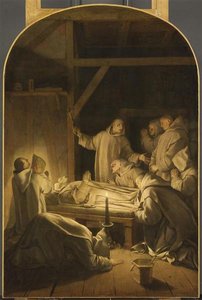
A single bed occupies the center of a quiet, dim room. Upon it lies Raymond Diocres, his body surrendered to the stillness of death. The air in the chamber feels heavy, thick with the scent of old wood and the weight of passing time. Around the bed, figures gather like shadows caught in a sudden beam of light. They lean in, their faces etched with the quiet gravity of those…

2
Christ Healing the Blind Man de Eustache Le Sueur

Christ Healing the Blind Man

Oil On Canvas

In this work, titled Christ Healing the Blind Man, Eustache Le Sueur presents a profound moment of divine intervention. The subject matter is drawn directly from the Bible, capturing the specific instance where Christ restores sight to a man. It is a quiet, focused encounter that centers on the act of healing. Through this narrative, the painting conveys a message of hope and redemption.

3
Ludwig IX. der Heilige (1635) de Eustache Le Sueur

Ludwig IX. der Heilige

1635 · Oil On Canvas · Bavarian State Painting Collections, Munique

This oil painting, dated 1635, presents a religious scene rendered in a grayscale, monochromatic palette. The composition is contained within an oval format, creating a vignette effect that centers the viewer's attention on a group of figures within an architectural interior. The setting appears to be a cathedral or a chapel, defined by receding arches that establish a sense of depth. Light enters from the upper right, creating a high-contrast…

4
The Sacrifice of Manoah (1626) de Eustache Le Sueur

The Sacrifice of Manoah

1626 · Oil On Canvas · Musée des Augustins, Toulouse

The Sacrifice of Manoah by Eustache Le Sueur captures a singular moment of spiritual revelation. The scene centers on a divine communication that interrupts the earthly ritual of a sacrifice. From the rising grey smoke of the altar, an angel emerges to meet the gaze of the faithful. This celestial presence breaks the silence of the landscape, turning a simple offering into a profound encounter between the mortal and the…

5
Raymond Diocrès Responds After His Death (1646) de Eustache Le Sueur

Raymond Diocrès Responds After His Death

1646 · Oil On Canvas

Raymond Diocrès Responds After His Death is a painting by Eustache Le Sueur. The canvas captures the figure of Raymond Diocrès, a professor at the Sorbonne, in a moment of spiritual transition. This work belongs to a larger cycle of twenty-two paintings depicting the life of Saint Bruno. These images were created between 1645 and 1648 for the small cloister of the Chartreuse de Paris.

6
Cupid, Reprimanded by His Mother, Takes Refuge in the Arms of Ceres (1646) de Eustache Le Sueur

Cupid, Reprimanded by His Mother, Takes Refuge in the Arms of Ceres

1646 · Oil On Canvas

This large-scale, horizontal oil painting from 1646 presents a mythological scene unfolding within a sky of voluminous, pale clouds. The composition is organized into three distinct groups of figures set against an atmospheric background of grays and whites. On the left, a woman draped in a deep blue mantle reclines upon dark clouds, her hand extended in a gesture toward the center of the frame. In the middle ground, a…

8
Saint Bruno in Prayer (1646) de Eustache Le Sueur

Saint Bruno in Prayer

1646 · Oil

In a dense, shadowy woodland, three monks occupy a space defined by deep browns, muted greens, and ochre. The composition is organized through layers of depth within the dark forest. In the foreground left, a monk in white robes kneels, leaning forward with hands clasped near his face, holding a tool resembling a pickaxe. To the lower right, another monk in a similar white habit kneels, using a shovel to…

9
Ascension of the Lord, (1646) de Eustache Le Sueur

Ascension of the Lord,

1646 · Oil · Groninger Museum, Groningen

The Ascension of the Lord, by Eustache Le Sueur, is a vertically oriented oil painting created about 1646. The composition directs the viewer's gaze upward from a group of terrestrial figures toward the ascending figure of Christ. This upward movement is reinforced by the use of perspective, which establishes a sense of ascension from the grounded figures at the bottom toward the nebulous, cloud-filled sky above. The arrangement of the…

10
Meeting of Saint Bruno and Count Roger of Sicily (1646) de Eustache Le Sueur

Meeting of Saint Bruno and Count Roger of Sicily

1646 · Oil On Canvas

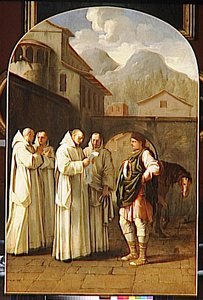
The forest breathes in shades of sepia and cream. A large white horse, its muscular flank catching a soft light from the upper left, anchors the composition. Beside it, a man kneels in the dirt, his arm raised in a sudden gesture of reverence or perhaps startled recognition. He is met by a standing figure dressed in monastic habit, a presence of quiet authority amidst the dense, dark foliage. A…

Pinturas de Eustache Le Sueur, classificadas de 11 a 100

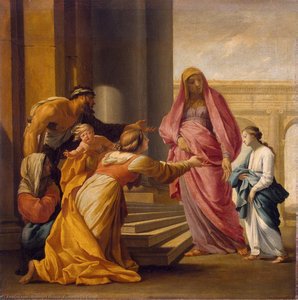
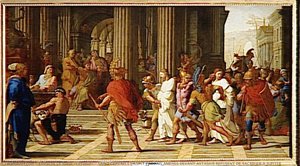
11The Ark of the Covenant (Procession from the Temple) (1642) de Eustache Le SueurThe Ark of the Covenant (Procession from the Temple)1642 12Bacchus and Ariadne (1640) de Eustache Le SueurBacchus and Ariadne1640 · Museu de Belas Artes de Boston 13Marine Gods Paying Homage to Love (1636) de Eustache Le SueurMarine Gods Paying Homage to Love1636 · J. Paul Getty Museum 14The Rape of Tamar (1640) de Eustache Le SueurThe Rape of Tamar1640 · Metropolitan Museum of Art 15Cupid Ordering Mercury to Announce his Power to the Universe (1647) de Eustache Le SueurCupid Ordering Mercury to Announce his Power to the Universe1647 · Museu do Louvre 16Saint Bruno and His Companions Distributing Their Goods to the Poor (1655) de Eustache Le SueurSaint Bruno and His Companions Distributing Their Goods to the Poor1655 17Jacob Sending His Son Joseph to Seek His Brothers at Sichem (1650) de Eustache Le SueurJacob Sending His Son Joseph to Seek His Brothers at Sichem1650 18Portrait of a Man (1650) de Eustache Le SueurPortrait of a Man1650 19Hercules fighting Cacus (1653) de Eustache Le SueurHercules fighting Cacus1653 · Muzeum Palacu Króla Jana Iii w Wilanowie 20The Annunciation (1650) de Eustache Le SueurThe Annunciation1650 · Toledo Museum of Art 21Allegory of Magnificence (1654) de Eustache Le SueurAllegory of Magnificence1654 · Instituto de Arte de Dayton 22Christ in the House of Mary and Martha (1650) de Eustache Le SueurChrist in the House of Mary and Martha1650 · Bavarian State Painting Collections 23St. Bruno in Prayer (1650) de Eustache Le SueurSt. Bruno in Prayer1650 · Gemäldegalerie 24Sleeping Venus (1639) de Eustache Le SueurSleeping Venus1639 · Legion of Honor 25St. Gervase and St. Protase Brought before Anastasius (1652) de Eustache Le SueurSt. Gervase and St. Protase Brought before Anastasius1652 · Museu do Louvre 26The Birth of Cupid (1647) de Eustache Le SueurThe Birth of Cupid1647 · Museu do Louvre 27Saint Paul preaching at Ephesus (1649) de Eustache Le SueurSaint Paul preaching at Ephesus1649 · National Gallery 28TERPSICHORE de Eustache Le SueurTERPSICHOREMuseu do Louvre 29SAINT BRUNO EN PRIERE DANS SON ORATOIRE de Eustache Le SueurSAINT BRUNO EN PRIERE DANS SON ORATOIREMuseu do Louvre 30PHAETON DEMANDE A APOLLON LA CONDUITE DU CHAR DU SOLEIL de Eustache Le SueurPHAETON DEMANDE A APOLLON LA CONDUITE DU CHAR DU SOLEILMuseu do Louvre 31Portrait of a Young Man (1640) de Eustache Le SueurPortrait of a Young Man1640 · Wadsworth Atheneum Museum of Art 32L'AMOUR DEROBE LA FOUDRE A JUPITER de Eustache Le SueurL'AMOUR DEROBE LA FOUDRE A JUPITERMuseu do Louvre 33Christ on the Cross with the Magdalen, the Virgin Mary and Saint John the Evangelist (1643) de Eustache Le SueurChrist on the Cross with the Magdalen, the Virgin Mary and Saint John the Evangelist1643 · National Gallery 34Solomon and the Queen of Sheba (1650) de Eustache Le SueurSolomon and the Queen of Sheba1650 · The Barber Institute of Fine Arts 35Christ on the Cross with the Virgin and Saints de Eustache Le SueurChrist on the Cross with the Virgin and Saints 36SONGE DE SAINT BRUNO de Eustache Le SueurSONGE DE SAINT BRUNOMuseu do Louvre 37ARRIVEE DE SAINT BRUNO A ROME de Eustache Le SueurARRIVEE DE SAINT BRUNO A ROMEMuseu do Louvre 38LA SALUTATION ANGELIQUE de Eustache Le SueurLA SALUTATION ANGELIQUEMuseu do Louvre 39Casrmelite in extasy de Eustache Le SueurCasrmelite in extasy 40Alms de Eustache Le SueurAlmsMusée d'art et d'histoire de Narbonne 41The Madonna and Child de Eustache Le SueurThe Madonna and Child 42Marriage of Tobias and Sarah de Eustache Le SueurMarriage of Tobias and SarahMuseu Nacional de Varsóvia 43LA NAISSANCE DE L'AMOUR de Eustache Le SueurLA NAISSANCE DE L'AMOURMuseu do Louvre 44URANIE de Eustache Le SueurURANIEMuseu do Louvre 45Le Christ sur la Croix de Eustache Le SueurLe Christ sur la Croix 46ARRIVEE DE SAINT BRUNO A GRENOBLE, CHEZ SAINT HUGUES de Eustache Le SueurARRIVEE DE SAINT BRUNO A GRENOBLE, CHEZ SAINT HUGUESMuseu do Louvre 47L'AMOUR, REPRIMANDE PAR SA MERE, SE REFUGIE DANS LES BRAS DE CERES de Eustache Le SueurL'AMOUR, REPRIMANDE PAR SA MERE, SE REFUGIE DANS LES BRAS DE CERESMuseu do Louvre 48VOYAGE A LA CHARTREUSE de Eustache Le SueurVOYAGE A LA CHARTREUSEMuseu do Louvre 49VENUS PRESENTE L'AMOUR A JUPITER de Eustache Le SueurVENUS PRESENTE L'AMOUR A JUPITERMuseu do Louvre 50L'AMOUR ORDONNE A MERCURE D'ANNONCER SON POUVOIR A L'UNIVERS de Eustache Le SueurL'AMOUR ORDONNE A MERCURE D'ANNONCER SON POUVOIR A L'UNIVERSMuseu do Louvre 51SAINT BRUNO PREND L'HABIT MONASTIQUE de Eustache Le SueurSAINT BRUNO PREND L'HABIT MONASTIQUEMuseu do Louvre 52SAINT BRUNO EST ENLEVE AU CIEL de Eustache Le SueurSAINT BRUNO EST ENLEVE AU CIELMuseu do Louvre 53LE RETOUR DE TOBIE de Eustache Le SueurLE RETOUR DE TOBIEMuseu do Louvre 54VENUS PRESENTE L'AMOUR A JUPITER, JUNON, NEPTUNE ET AMPHITRITE de Eustache Le SueurVENUS PRESENTE L'AMOUR A JUPITER, JUNON, NEPTUNE ET AMPHITRITEMuseu do Louvre 55SAINT BRUNO EN PRIERE de Eustache Le SueurSAINT BRUNO EN PRIEREMuseu do Louvre 56RAYMOND DIOCRES REPOND APRES SA MORT de Eustache Le SueurRAYMOND DIOCRES REPOND APRES SA MORTMuseu do Louvre 57PLAN DE LA CHARTREUSE DE PARIS PORTE PAR DEUX ANGES de Eustache Le SueurPLAN DE LA CHARTREUSE DE PARIS PORTE PAR DEUX ANGESMuseu do Louvre 58SAINT BRUNO ASSISTE AU SERMON DE RAYMOND DIOCRES de Eustache Le SueurSAINT BRUNO ASSISTE AU SERMON DE RAYMOND DIOCRESMuseu do Louvre 59SAINT BRUNO REFUSE L'ARCHEVEQUE DE REGGIO QUE LUI OFFRE URBAIN II de Eustache Le SueurSAINT BRUNO REFUSE L'ARCHEVEQUE DE REGGIO QUE LUI OFFRE URBAIN IIMuseu do Louvre 60JESUS PORTANT SA CROIX de Eustache Le SueurJESUS PORTANT SA CROIXMuseu do Louvre 61LE PAPE VICTOR III CONFIRME L'INSTITUTION DES CHARTREUX de Eustache Le SueurLE PAPE VICTOR III CONFIRME L'INSTITUTION DES CHARTREUXMuseu do Louvre 62SAINT BRUNO EXAMINE UN DESSIN DES THERMES DE DIOCLETIN, EMPLACEMENT DE LA FUTURE CHARTREUSE DE ROME de Eustache Le SueurSAINT BRUNO EXAMINE UN DESSIN DES THERMES DE DIOCLETIN, EMPLACEMENT DE LA FUTURE CHARTREUSE DE ROMEMuseu do Louvre 63Clio, Euterpe et Thalie de Eustache Le SueurClio, Euterpe et ThalieMuseu do Louvre 64Poliphile s'agenouille devant la reine Eleutherilide de Eustache Le SueurPoliphile s'agenouille devant la reine Eleutherilide 65GANYMEDE ENLEVE PAR JUPITER de Eustache Le SueurGANYMEDE ENLEVE PAR JUPITERMuseu do Louvre 66L'AMOUR RECOIT LES DONS DE DIANE, D'APOLLON ET DE MERCURE de Eustache Le SueurL'AMOUR RECOIT LES DONS DE DIANE, D'APOLLON ET DE MERCUREMuseu do Louvre 67Agar et l'ange de Eustache Le SueurAgar et l'angeMusée des Beaux-Arts 68DEDICACE D'UNE EGLISE DE CHARTREUX de Eustache Le SueurDEDICACE D'UNE EGLISE DE CHARTREUXMuseu do Louvre 69L'AMOUR RECOIT L'HOMMAGE DE DIANE, D'APOLLON ET DE MERCURE de Eustache Le SueurL'AMOUR RECOIT L'HOMMAGE DE DIANE, D'APOLLON ET DE MERCUREMuseu do Louvre 70Sainte Marie Madeleine en prière de Eustache Le SueurSainte Marie Madeleine en prièrePalais des Beaux-Arts de Lille 71DESCENTE DE CROIX de Eustache Le SueurDESCENTE DE CROIXMuseu do Louvre 72Saint Bruno reçoit un message du pape de Eustache Le SueurSaint Bruno reçoit un message du papeMuseu do Louvre 73JESUS APPARAIT A LA MADELEINE de Eustache Le SueurJESUS APPARAIT A LA MADELEINEMuseu do Louvre 74The Muse Terpsichore (1652) de Eustache Le SueurThe Muse Terpsichore1652 · Museu do Louvre 75SAINT BRUNO FAIT CONSTRUIRE LE MONASTERE de Eustache Le SueurSAINT BRUNO FAIT CONSTRUIRE LE MONASTEREMuseu do Louvre 76MELPOMENE, ERATO ET POLYMNIE de Eustache Le SueurMELPOMENE, ERATO ET POLYMNIEMuseu do Louvre 77Presentation of the Virgin (1641) de Eustache Le SueurPresentation of the Virgin1641 · Museu Hermitage 78CALLIOPE de Eustache Le SueurCALLIOPEMuseu do Louvre 79SAINT BRUNO DONNE L'HABIT A PLUSIEURS PERSONNES de Eustache Le SueurSAINT BRUNO DONNE L'HABIT A PLUSIEURS PERSONNESMuseu do Louvre 80SAINT GERVAIS ET SAINT PROTAIS AMENES DEVANT ASTASIUS REFUSENT DE SACRIFIER A JUPITER de Eustache Le SueurSAINT GERVAIS ET SAINT PROTAIS AMENES DEVANT ASTASIUS REFUSENT DE SACRIFIER A JUPITERMuseu do Louvre 81St Bruno Appearing to Comte Roger (1645) de Eustache Le SueurSt Bruno Appearing to Comte Roger1645 · Museu do Louvre 82A Gathering Of Friends de Eustache Le SueurA Gathering Of Friends 83L'AMOUR, ENTOURE DE LA JEUNESSE ET DE LA BEAUTE, ORDONNE A MERCURE D'ANNONCER SON POUVOIR A L'UNIVERS de Eustache Le SueurL'AMOUR, ENTOURE DE LA JEUNESSE ET DE LA BEAUTE, ORDONNE A MERCURE D'ANNONCER SON POUVOIR A L'UNIVERSMuseu do Louvre 84Caligula Depositing The Ashes Of His Mother And Brother In The Tomb Of His Ancestors de Eustache Le SueurCaligula Depositing The Ashes Of His Mother And Brother In The Tomb Of His AncestorsRoyal Collection 85L'Ange Raphaël révèle sa véritable nature à Tobie et à sa famille et s'élève au ciel La famille de Tobie remerciant Dieu après le départ de l'ange Raphaël (Ancien titre) de Eustache Le SueurL'Ange Raphaël révèle sa véritable nature à Tobie et à sa famille et s'élève au ciel La famille de Tobie remerciant Dieu après le départ de l'ange Raphaël (Ancien titre) 86SAINT BRUNO ENGAGE SES DISCIPLES ET SES AMIS A QUITTER LE MONDE de Eustache Le SueurSAINT BRUNO ENGAGE SES DISCIPLES ET SES AMIS A QUITTER LE MONDEMuseu do Louvre 87Poliphile au bain avec les nymphes de Eustache Le SueurPoliphile au bain avec les nymphesMusée National Magnin 88Diane découvrant la grossesse de Callisto de Eustache Le SueurDiane découvrant la grossesse de CallistoMusée National Magnin 89SAINT BRUNO ET SES COMPAGNONS, AVANT DE PARTIR POUR GRENOBLE, DISTRIBUENT TOUS LEURS BIENS AUX PAUVRES de Eustache Le SueurSAINT BRUNO ET SES COMPAGNONS, AVANT DE PARTIR POUR GRENOBLE, DISTRIBUENT TOUS LEURS BIENS AUX PAUVRESMuseu do Louvre 90Alexander and his Doctor de Eustache Le SueurAlexander and his Doctor 91APPARITION DE LA VIERGE ACCOMPAGNEE DE SAINTE AGNES ET DE SAINTE THECLE A SAINT MARTIN DIT AUTREFOIS APPARITION DE SAINTE SCHOLASTIQUE A SAINT BENOIT de Eustache Le SueurAPPARITION DE LA VIERGE ACCOMPAGNEE DE SAINTE AGNES ET DE SAINTE THECLE A SAINT MARTIN DIT AUTREFOIS APPARITION DE SAINTE SCHOLASTIQUE A SAINT BENOITMuseu do Louvre 92Alexander and his Doctor de Eustache Le SueurAlexander and his DoctorNational Gallery 93The Preaching of St. Paul at Ephesus (1649) de Eustache Le SueurThe Preaching of St. Paul at Ephesus1649 · Museu do Louvre 94MORT DE SAINT BRUNO LE 6 OCTOBRE 1101 de Eustache Le SueurMORT DE SAINT BRUNO LE 6 OCTOBRE 1101Museu do Louvre 95A Gathering of Friends de Eustache Le SueurA Gathering of FriendsMuseu do Louvre 96Melpomene, Erato and Polyhymnia de Eustache Le SueurMelpomene, Erato and Polyhymnia 97Madonna and Child with Saint John the Baptist (1635) de Eustache Le SueurMadonna and Child with Saint John the Baptist1635 98Justice (1650) de Eustache Le SueurJustice1650 · Musée des Beaux-Arts de Strasbourg 99Meekness (Douceur or Mansuétude) (1650) de Eustache Le SueurMeekness (Douceur or Mansuétude)1650 · Art Institute of Chicago 100The Muses: Clio, Euterpe and Thalia (1652) de Eustache Le SueurThe Muses: Clio, Euterpe and Thalia1652 · Museu do Louvre

Pinturas famosas de Eustache Le Sueur, período por período

Os temas que cativaram o olhar de Eustache Le Sueur

Os quatro temas que mais se repetem nestas obras originais, cada um com o seu melhor exemplo.

Os museus que guardam os originais de Eustache Le Sueur

Os 8 museus que detêm a maioria das pinturas desta página.

Museus Cidade Obras de Eustache Le Sueur Pinturas desta lista
Museu do Louvre, ParisMuseu do Louvre Paris 56 MORT DE RAYMOND DIOCRES, Cupid Ordering Mercury to Announce his Power to the Universe, St. Gervase and St. Protase Brought before Anastasius
National Gallery, LondresNational Gallery Londres 3 Saint Paul preaching at Ephesus, Christ on the Cross with the Magdalen, the Virgin Mary and Saint John the Evangelist, Alexander and his Doctor
Bavarian State Painting Collections, MuniqueBavarian State Painting Collections Munique 2 Ludwig IX. der Heilige, Christ in the House of Mary and Martha
Musée National Magnin, DijonMusée National Magnin Dijon 2 Poliphile au bain avec les nymphes, Diane découvrant la grossesse de Callisto
Musée des Augustins, ToulouseMusée des Augustins Toulouse 1 The Sacrifice of Manoah
Groninger Museum, GroningenGroninger Museum Groningen 1 Ascension of the Lord,
Museu de Belas Artes de Boston, BostonMuseu de Belas Artes de Boston Boston 1 Bacchus and Ariadne
J. Paul Getty Museum, Los AngelesJ. Paul Getty Museum Los Angeles 1 Marine Gods Paying Homage to Love

Eustache Le Sueur, uma pintura emblemática por década

Obras por década

Escolha uma década para ver a obra original que a define.

Pinturas de Eustache Le Sueur: a galeria responde

Qual pintura de Eustache Le Sueur é a mais famosa de todas?Revelar a resposta

MORT DE RAYMOND DIOCRES, Museu do Louvre, Paris. Christ Healing the Blind Man e Ludwig IX. der Heilige (1635) vêm a seguir.

Quais são as 10 principais pinturas de Eustache Le Sueur?Revelar a resposta

MORT DE RAYMOND DIOCRES, Christ Healing the Blind Man, Ludwig IX. der Heilige, The Sacrifice of Manoah, Raymond Diocrès Responds After His Death, Cupid, Reprimanded by His Mother, Takes Refuge in the Arms of Ceres, Pope Victor III Confirms the Institution of the Carthusians, Saint Bruno in Prayer, Ascension of the Lord, e Meeting of Saint Bruno and Count Roger of Sicily. O ranking acima apresenta o ano e o museu de cada uma.

Quantas obras Eustache Le Sueur criou?Revelar a resposta

Nosso catálogo contém 113 obras de Eustache Le Sueur, datadas de 1626 a 1655.

Onde estão expostos os originais mais famosos de Eustache Le Sueur?Revelar a resposta

Principalmente em Museu do Louvre (Paris), National Gallery (Londres) e Bavarian State Painting Collections (Munique). A tabela de museus acima lista todos eles.

Quando é que Eustache Le Sueur criou as suas pinturas mais famosas?Revelar a resposta

Em 1640s: 17 das 100 obras nesta página foram feitas então, sendo Raymond Diocrès Responds After His Death delas.

Quais são as obras mais famosas de Eustache Le Sueur no início e no fim de sua carreira?Revelar a resposta

Nesta página, a mais antiga é The Sacrifice of Manoah (1626) e a mais recente é Saint Bruno and His Companions Distributing Their Goods to the Poor (1655).

Quais temas Eustache Le Sueur mais explorou?Revelar a resposta

Man (11), Woman (11) e People (10), entre as 100 obras nesta página.

Em qual técnica Eustache Le Sueur mais trabalhou?Revelar a resposta

Oil On Canvas, para 32 das 100 obras nesta página.

Com qual movimento Eustache Le Sueur está associado(a)?Revelar a resposta

Baroque realismo, a julgar pelos originais nesta página.

Quais obras originais de Eustache Le Sueur o Museu do Louvre possui?Revelar a resposta

MORT DE RAYMOND DIOCRES, Cupid Ordering Mercury to Announce his Power to the Universe e St. Gervase and St. Protase Brought before Anastasius: o Museu do Louvre, Paris detém 53 das obras desta página.

Eustache Le Sueur: o artista

Uma Vida Dedicada à Visão Divina: O Mundo de Eustache Le Sueur

Eustache Le Sueur, um nome que ressoa com o fervor e o refinamento da pintura barroca francesa do século XVII, ergue-se como uma figura fundamental na evolução artística da nação. Nascido em Paris, em 19 de novembro de 1617, e falecendo entre as suas muralhas em 30 de abril de 1655, Le Sueur dedicou a sua vida a capturar narrativas religiosas com uma sensibilidade cada vez mais neoclássica. A sua jornada não foi marcada por viagens expansivas ou dramas pessoais profundos; antes, foi uma ascensão focada dentro do mundo da arte parisiense, culminando no seu papel como membro fundador da prestigiante Academia Francesa de Pintura e Escultura. O seu pai, Cathelin Le Sueur, um habilidoso torneiro e escultor em madeira, reconheceu precocemente o talento emergente do filho e tornou-o aprendiz de Simon Vouet, então a força dominante na pintura francesa. Este treino fundamental provou ser crucial, instilando no jovem Eustache um domínio do desenho e da composição que caracterizaria toda a sua carreira.

Sucessos Precoces e Comissões Reais

Le Sueur distinguiu-se rapidamente no atelier de Vouet, conquistando prontamente a admissão na guilda dos mestres pintores. As suas primeiras obras, notadamente aquelas que ilustravam cenas do Hypnerotomachia Poliphili, um complexo romance alegórico, trouxeram-lhe o reconhecimento inicial. No entanto, foi a sua série de decorações encomendadas para a mansão de Lambert de Thorigny que verdadeiramente começou a estabelecer a sua reputação. Embora estes projetos fossem frequentemente interrompidos por outras exigências do seu tempo, eles demonstraram a crescente capacidade de Le Sueur em criar composições dinâmicas e imbuir as suas figuras com um sentido de presença dramática. O próprio Louvre tornou-se uma tela para a sua ambição, à medida que ele realizou várias pinturas para os aposentos reais – obras infelizmente perdidas para a história, mas documentadas em inventários da época. Estas encomendas sinalizaram uma aceitação crescente nos mais altos escalões da sociedade francesa, pavimentando o caminho para novas oportunidades e consolidando a sua posição como um artista muito requisitado. Ele não estava meramente a executar esquemas decorativos; ele estava a contribuir para a linguagem visual de poder e piedade que definiu a corte de Luís XIII e, mais tarde, de Luís XIV.
A Fundação da Academia e uma Viragem Neoclássica

Um momento decisivo na carreira de Le Sueur ocorreu com o estabelecimento da Real Academia Francesa de Pintura e Escultura em 1648. Ele foi eleito como um dos doze anciãos originais, encarregado de guiar o desenvolvimento da instituição e de estabelecer padrões de excelência artística. Este papel não era meramente administrativo; refletia uma mudança mais ampla nas sensibilidades estéticas de Le Sueres. Ele sentiu-se cada vez mais atraído por um estilo neoclássico, caracterizado pela clareza da forma, emoção contida e um foco na beleza idealizada – um afastamento das tendências mais exuberantes da pintura barroca anterior. Este Aticismo Parisiense, como passou a ser conhecido, enfatizava o rigor intelectual e um retorno aos princípios clássicos, influenciando não apenas a sua própria obra, mas também moldando a direção da arte francesa para as gerações vindouras.

A Vida de São Bruno: Uma Obra-Prima de Devoção

Talvez o legado mais duradouro de Le Sueur resida na sua série que retrata A Vida de São Bruno, encomendada para o claustro do monastério Cartuxo. Estas pinturas, que originalmente adornavam as paredes da abadia, representam o auge da sua visão artística e perícia técnica. São notáveis não apenas pelo seu poder narrativo, mas também pela sua profunda qualidade espiritual. As figuras de Le Sueur possuem uma dignidade serena e um profundo sentido de devoção, transmitindo os ideais ascéticos da ordem cartuxa com uma força envolvente. O uso do chiaroscuro – o jogo dramático entre luz e sombra – intensifica o impacto emocional de cada cena, atraindo o espectador para o mundo de São Bruno e dos seus seguidores. Apesar de terem sofrido danos e passado por restaurações ao longo do tempo, estas obras retêm grande parte da sua beleza original, oferecendo um vislumbre do domínio de Le Sueur sobre a composição, a cor e a perspicácia psicológica.

Legado e Significado Histórico

A influência de Eustache Le Sueur estendeu-se para além das suas próprias pinturas. Ele formou inúmeros discípulos, incluindo o irmão da sua esposa, Theodore Goussé, e vários dos seus irmãos, fomentando um atelier que perpetuou o seu estilo e técnicas. Os seus desenhos, muitos preservados no Cabinet des Dessins do Louvre, demonstram o seu desenho excepcional e fornecem uma visão valiosa sobre o seu processo criativo. Embora alguns críticos tenham notado uma certa convencionalidade na sua obra – uma tendência para confiar em tipos estabelecidos – é inegável que Le Sueur desempenhou um papel crucial na moldagem da paisagem estética da França do século XVII. Ele construiu a ponte entre a exuberância barroca inicial e o classicismo mais contido que viria a definir a arte francesa sob Luís XIV, deixando para trás um corpo de trabalho que continua a inspirar admiração e reverência. A sua dedicação aos temas religiosos, combinada com o seu brilho técnico e compromisso com a excelência artística, assegura o seu lugar como um dos pintores mais importantes da sua era.