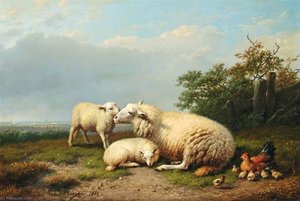
Retrato de Eugène Joseph Verboeckhoven

Pinturas de Eugène Joseph Verboeckhoven: As 88 mais famosas, sob o olhar de uma galeria

Atualizado em Novembro 2026 · classificado pela nossa pontuação de popularidade (pesquisas, visitas e pedidos de cada obra) · 91 obras de Eugène Joseph Verboeckhoven em nosso catálogo

Em resumo

Aos olhos da galeria, a pintura mais famosa de Eugène Joseph Verboeckhoven é Good Friends (1878), cuja obra original está exposta no Nottingham Castle Museum And Art Gallery, em Nottingham. Still-Life with a Hare (1844) e Sheep (1840) completam o trio que todos reconhecem. Dos 91 trabalhos de Eugène Joseph Verboeckhoven em nosso catálogo, a galeria apresenta abaixo as 88 obras mais famosas, cada uma original, com seu ano, seu museu e o que a torna única.

1799 – 1881, Warneton Realism Mais obras: Nottingham Castle Museum And Art Gallery

As 10 principais pinturas de Eugène Joseph Verboeckhoven na galeria

1
Good Friends (1878) de Eugène Joseph Verboeckhoven

Good Friends

1878 · Óleo sobre tela · Nottingham Castle Museum And Art Gallery, Nottingham

“Good Friends” by Eugène Joseph Verboeckhoven is more than just a painting; it’s a window into the artistic spirit of 1878 Belgium—a testament to Romantic idealism blended with meticulous observation of the natural world. Housed at Nottingham Castle Museum And Art Gallery, this oil on canvas masterpiece captures a quintessential scene of rural tranquility: sheep and horses grazing peacefully together under an expansive sky.

2
Still-Life with a Hare (1844) de Eugène Joseph Verboeckhoven

Still-Life with a Hare

1844 · Oil On Canvas · Museu Hermitage, São Petersburgo

Eugène Joseph Verboeckhoven's "Still-Life with a Hare," painted in 1844, is more than just a depiction of animals and hunting paraphernalia; it’s a poignant meditation on mortality, the fleeting beauty of nature, and the inherent sadness within the pursuit of life. This remarkable work, now housed at the Hermitage Museum in St. Petersburg, offers a glimpse into the final flowering of a particular artistic tradition – the idyllic landscapes and…

3
Sheep (1840) de Eugène Joseph Verboeckhoven

Sheep

1840 · Oil On Canvas · Grundy Art Gallery, Blackpool

The quietude of a rustic barn settles over the viewer through Sheep, an oil on canvas painted by Eugène Verboeckhoven. Created in 1840, the work captures a specific moment of stillness within a wooden stable. The scene feels immediate, as if the air inside the shelter is still heavy with the scent of hay and the warmth of the animals gathered within.

4
Flock of Sheep Surprised by Thunderstorm (1823) de Eugène Joseph Verboeckhoven

Flock of Sheep Surprised by Thunderstorm

1823 · Lithograph

A heavy, gray sky presses down upon the landscape, thick with the scent of impending rain. The clouds are not merely shapes but turbulent, swirling masses that churn with a restless energy. Beneath this celestial upheaval, a flock of sheep moves with sudden, agitated purpose. Their woolly bodies, rendered with meticulous detail, catch the sharp, directional light breaking through the storm. A shepherd moves among them, a small figure caught…

5
Landschap met herder en vee bij een boom (1824) de Eugène Joseph Verboeckhoven

Landschap met herder en vee bij een boom

1824 · Oil · Rijksmuseum, Amsterdã

A weathered tree trunk anchors the right side of this 1824 oil painting, providing a vertical counterpoint to the vast, horizontal expanse of a Belgian meadow. Beneath an expansive, cloudy sky, a small herd of cattle—rendered in shades of brown, white, and black—grazes across the grassy plain. A lone shepherd rests at the base of the tree, a quiet human presence amidst the livestock. The composition utilizes a low horizon…

6
goats (1830) de Eugène Joseph Verboeckhoven

goats

1830 · Oil

We are looking at goats, an oil painting by the Belgian artist Eugène Verboeckhoven. This work dates to about 1830, a period when the artist was establishing his presence within the European art landscape. It is a quiet, intimate study that captures a specific moment of pastoral stillness.

7
Peasant Asking His Way (1837) de Eugène Joseph Verboeckhoven

Peasant Asking His Way

1837 · Ink On Paper

In "Peasant Asking His Way" by Eugène Verboeckhoven, the composition is defined by a vast, expansive sky that occupies the upper two-thirds of the frame. This large area of space creates a sense of openness above the terrestrial scene. In the lower third of the work, the focal point consists of three figures: a man mounted on a white horse, a standing man facing him, and a small dog positioned…

8
Sheep in a Forest (1840) de Eugène Joseph Verboeckhoven

Sheep in a Forest

1840 · Oil · Amsterdam Museum, Amsterdão

In "Sheep in a Forest" by Eugène Verboeckhoven, a quiet stillness settles over a dense woodland clearing. The scene unfolds at eye-level with the animals, pulling the viewer directly into this secluded, shaded sanctuary. A small group of sheep rests within the heart of the forest, their presence grounding the composition. In the mid-ground, a single sheep stands in profile, facing right, its body angled slightly toward the observer as…

9
Landscape with animals (1846) de Eugène Joseph Verboeckhoven

Landscape with animals

1846 · Oil On Canvas · Museum of Fine Arts Ghent (MSK), Gante

Landscape with animals is a painting by the Belgian artist Eugène Verboeckhoven. Created about 1846, this work depicts a pastoral scene set within a lush meadow. The composition focuses on a group of livestock positioned in the landscape, including cows, sheep, and goats. A shepherd is situated near these animals, providing a human presence within the rural setting.

10
Self Portrait (1854) de Eugène Joseph Verboeckhoven

Self Portrait

1854 · Oil On Canvas · Royal Museum of Fine Arts Antwerp, Antuérpia

is an oil on canvas work by the Belgian painter Eugène Verboeckhoven. Executed in 1854, the painting captures the artist during a period of significant professional activity in the mid-nineteenth century. Verboeckhoven, born in 1799, was a central figure in the development of Belgian animal and landscape painting, bridging the gap between seventeenth-century traditions and the emerging realism of his era.

Pinturas de Eugène Joseph Verboeckhoven, classificadas de 11 a 88

11Een rustend schaap en een lam (1840) de Eugène Joseph VerboeckhovenEen rustend schaap en een lam1840 · Amsterdam Museum 12sheep and ducks (1849) de Eugène Joseph Verboeckhovensheep and ducks1849 · Museum Tongerlohuys 13Leaving for the Market (1854) de Eugène Joseph VerboeckhovenLeaving for the Market1854 · Royal Museum of Fine Arts Antwerp 14Shepherd (1855) de Eugène Joseph VerboeckhovenShepherd1855 · Finnish National Gallery 15A Cavalier at Rest (1849) de Eugène Joseph VerboeckhovenA Cavalier at Rest1849 16Outbound herd (1856) de Eugène Joseph VerboeckhovenOutbound herd1856 · Alte Nationalgalerie 17Scotch Sheep (1868) de Eugène Joseph VerboeckhovenScotch Sheep1868 · New York Historical Society 18Sheep in a Byre (1856) de Eugène Joseph VerboeckhovenSheep in a Byre1856 · Laing Art Gallery 19Wood Landscape with Animals (1836) de Eugène Joseph VerboeckhovenWood Landscape with Animals1836 · National Museum of Art, Architecture and Design 20Hungry Wolves Attack a Group of Riders (1836) de Eugène Joseph VerboeckhovenHungry Wolves Attack a Group of Riders1836 · Rijksmuseum 21Landscape (1836) de Eugène Joseph VerboeckhovenLandscape1836 22Gathering the Flock (1839) de Eugène Joseph VerboeckhovenGathering the Flock1839 · The New Art Gallery Walsall 23Dutch Sheepfold (1844) de Eugène Joseph VerboeckhovenDutch Sheepfold1844 · Bavarian State Painting Collections 24Donkey and Sheep (1845) de Eugène Joseph VerboeckhovenDonkey and Sheep1845 · Amsterdam Museum 25A Mountainous Landscape with Resting Cattle (1840) de Eugène Joseph VerboeckhovenA Mountainous Landscape with Resting Cattle1840 · Amsterdam Museum 26Goats and Sheep (1843) de Eugène Joseph VerboeckhovenGoats and Sheep1843 · Royal Collection 27Bull (1847) de Eugène Joseph VerboeckhovenBull1847 · Royal Museum of Fine Arts Antwerp 28Cattle near a Lake (1842) de Eugène Joseph VerboeckhovenCattle near a Lake1842 29The Sign Post (1848) de Eugène Joseph VerboeckhovenThe Sign Post1848 30Sheep and Cattle (1843) de Eugène Joseph VerboeckhovenSheep and Cattle1843 31Sheep and Cows (1844) de Eugène Joseph VerboeckhovenSheep and Cows1844 · Wallace Collection 32Watering Cattle (1845) de Eugène Joseph VerboeckhovenWatering Cattle1845 33Goats (1840) de Eugène Joseph VerboeckhovenGoats1840 · The New Art Gallery Walsall 34The Twins (1846) de Eugène Joseph VerboeckhovenThe Twins1846 · Nottingham Castle Museum And Art Gallery 35Sheep, Goat, and Chickens (1851) de Eugène Joseph VerboeckhovenSheep, Goat, and Chickens1851 · New York Historical Society 36Cow in a Pool (1850) de Eugène Joseph VerboeckhovenCow in a Pool1850 · New York Historical Society 37Donkey and Lambs (1849) de Eugène Joseph VerboeckhovenDonkey and Lambs1849 38A Bull Leaping a Fence (1849) de Eugène Joseph VerboeckhovenA Bull Leaping a Fence1849 · National Trust 39Sheep and Dogs (1861) de Eugène Joseph VerboeckhovenSheep and Dogs1861 40Bull's Head (1857) de Eugène Joseph VerboeckhovenBull's Head1857 41After the Hunt (1865) de Eugène Joseph VerboeckhovenAfter the Hunt1865 · Museum aan de Stroom 42Landscape with Sheep (1868) de Eugène Joseph VerboeckhovenLandscape with Sheep1868 · Auckland Art Gallery Toi o Tāmaki 43Dune Landscape with Resting Sheep (1871) de Eugène Joseph VerboeckhovenDune Landscape with Resting Sheep1871 · Nationalmuseum 44Startled (1864) de Eugène Joseph VerboeckhovenStartled1864 45An Extensive Wooded Rocky Landscape with Shepherds and Flock, Cows and a Traveller on a Horseback (1868) de Eugène Joseph VerboeckhovenAn Extensive Wooded Rocky Landscape with Shepherds and Flock, Cows and a Traveller on a Horseback1868 46In the Highlands (1869) de Eugène Joseph VerboeckhovenIn the Highlands1869 47Sheep, Hen and Chicks in a Landscape (1865) de Eugène Joseph VerboeckhovenSheep, Hen and Chicks in a Landscape1865 48Landscape with Sheep and Ducks (1865) de Eugène Joseph VerboeckhovenLandscape with Sheep and Ducks1865 49Cattle and Sheep in a Landscape (1874) de Eugène Joseph VerboeckhovenCattle and Sheep in a Landscape1874 50Sheep (1876) de Eugène Joseph VerboeckhovenSheep1876 · Nottingham Castle Museum And Art Gallery 51A Sheep, Two Lambs, a Cock and a Hen in a Landscape (1876) de Eugène Joseph VerboeckhovenA Sheep, Two Lambs, a Cock and a Hen in a Landscape1876 52Landscape with a Herd (1862) de Eugène Joseph VerboeckhovenLandscape with a Herd1862 · Museu Hermitage 53bulls on the meadow de Eugène Joseph Verboeckhovenbulls on the meadow 54cows + goat in landscape de Eugène Joseph Verboeckhovencows + goat in landscape 55white horse before a stable de Eugène Joseph Verboeckhovenwhite horse before a stable 56Sheep, Lamb and Ducks by a pond de Eugène Joseph VerboeckhovenSheep, Lamb and Ducks by a pond 57Cows in the pasture de Eugène Joseph VerboeckhovenCows in the pastureMuseu Nacional de Varsóvia 58A Sunlit Barn with Ewes, Lambs and Chickens de Eugène Joseph VerboeckhovenA Sunlit Barn with Ewes, Lambs and ChickensHaworth Art Gallery 59Group of Sheep (1863) de Eugène Joseph VerboeckhovenGroup of Sheep1863 · Towneley Hall Art Gallery - Museum 60Sheep and Hens in a Barn (1874) de Eugène Joseph VerboeckhovenSheep and Hens in a Barn1874 · Walker Art Gallery 61Landscape with Sheep (1867) de Eugène Joseph VerboeckhovenLandscape with Sheep1867 62Landscape with Sheep de Eugène Joseph VerboeckhovenLandscape with SheepDetroit Institute of Arts 63Head of a Horse de Eugène Joseph VerboeckhovenHead of a HorseNational Museum of Art, Architecture and Design 64Buck's Head de Eugène Joseph VerboeckhovenBuck's HeadMusée Alphonse-georges Poulain 65Cows and Sheep de Eugène Joseph VerboeckhovenCows and SheepRoyal Museum of Fine Arts Antwerp 66Schafe auf der Weide de Eugène Joseph VerboeckhovenSchafe auf der Weide 67sheep in a stable de Eugène Joseph Verboeckhovensheep in a stable 68Sheep and Chicken in a Landscape de Eugène Joseph VerboeckhovenSheep and Chicken in a Landscape 69A gathering in the pasture de Eugène Joseph VerboeckhovenA gathering in the pasture 70Mountainous Landscape with Bridge de Eugène Joseph VerboeckhovenMountainous Landscape with Bridge 71Guarding the flock by the coast de Eugène Joseph VerboeckhovenGuarding the flock by the coast 72Un pâturage de Eugène Joseph VerboeckhovenUn pâturage 73Rider Conversing with a Shepherdess in an Extensive Landscape de Eugène Joseph VerboeckhovenRider Conversing with a Shepherdess in an Extensive Landscape 74Sheep grazing by the coast de Eugène Joseph VerboeckhovenSheep grazing by the coast 75Sheep in a Scottish landscape de Eugène Joseph VerboeckhovenSheep in a Scottish landscape 76Sheep and Chicken in a Landscape de Eugène Joseph VerboeckhovenSheep and Chicken in a Landscape 77Crossing the marsh de Eugène Joseph VerboeckhovenCrossing the marsh 78A white stallion in a landscape de Eugène Joseph VerboeckhovenA white stallion in a landscape 79Guarding the Lamb de Eugène Joseph VerboeckhovenGuarding the Lamb 80At the Stable Door de Eugène Joseph VerboeckhovenAt the Stable Door 81A farmer at rest with his stock de Eugène Joseph VerboeckhovenA farmer at rest with his stock 82A Horse, Sheep and a Goat in a Landscape de Eugène Joseph VerboeckhovenA Horse, Sheep and a Goat in a Landscape 83a shepherd and his flock de Eugène Joseph Verboeckhovena shepherd and his flock 84The Sheep de Eugène Joseph VerboeckhovenThe SheepNottingham Castle Museum And Art Gallery 85A Shepherdess with her Flock de Eugène Joseph VerboeckhovenA Shepherdess with her Flock 86Sheep with chickens and a goat in a barn de Eugène Joseph VerboeckhovenSheep with chickens and a goat in a barn 87A Horse Feeding in a Stable de Eugène Joseph VerboeckhovenA Horse Feeding in a StableUsher Gallery 88Farmhand with Horse and Dog in Landscape de Eugène Joseph VerboeckhovenFarmhand with Horse and Dog in Landscape

Os temas que cativaram o olhar de Eugène Joseph Verboeckhoven

Os quatro temas que mais se repetem nestas obras originais, cada um com o seu melhor exemplo.

Os museus que guardam os originais de Eugène Joseph Verboeckhoven

Os 8 museus que detêm a maioria das pinturas desta página.

Museus Cidade Obras de Eugène Joseph Verboeckhoven Pinturas desta lista
Nottingham Castle Museum And Art Gallery, NottinghamNottingham Castle Museum And Art Gallery Nottingham 4 Good Friends, The Twins, Sheep
Amsterdam Museum, AmsterdãoAmsterdam Museum Amsterdão 4 Sheep in a Forest, Een rustend schaap en een lam, Donkey and Sheep
Royal Museum of Fine Arts Antwerp, AntuérpiaRoyal Museum of Fine Arts Antwerp Antuérpia 4 Self Portrait, Leaving for the Market, Bull
New York Historical Society, Nova YorkNew York Historical Society Nova York 3 Scotch Sheep, Sheep, Goat, and Chickens, Cow in a Pool
Museu Hermitage, São PetersburgoMuseu Hermitage São Petersburgo 2 Still-Life with a Hare, Landscape with a Herd
Rijksmuseum, AmsterdãRijksmuseum Amsterdã 2 Landschap met herder en vee bij een boom, Hungry Wolves Attack a Group of Riders
National Museum of Art, Architecture and Design, OsloNational Museum of Art, Architecture and Design Oslo 2 Wood Landscape with Animals, Head of a Horse
The New Art Gallery Walsall, WalsallThe New Art Gallery Walsall Walsall 2 Gathering the Flock, Goats

Eugène Joseph Verboeckhoven, uma pintura emblemática por década

Obras por década

Escolha uma década para ver a obra original que a define.

Pinturas de Eugène Joseph Verboeckhoven: a galeria responde

Qual pintura de Eugène Joseph Verboeckhoven é a mais famosa de todas?Revelar a resposta

Good Friends (1878), Nottingham Castle Museum And Art Gallery, Nottingham. Still-Life with a Hare (1844) e Sheep (1840) vêm a seguir.

Qual era a idade de Eugène Joseph Verboeckhoven ao concluir Good Friends?Revelar a resposta

79 anos: Good Friends data de 1878, e Eugène Joseph Verboeckhoven nasceu em 1799.

Quais são as 10 principais pinturas de Eugène Joseph Verboeckhoven?Revelar a resposta

Good Friends, Still-Life with a Hare, Sheep, Flock of Sheep Surprised by Thunderstorm, Landschap met herder en vee bij een boom, goats, Peasant Asking His Way, Sheep in a Forest, Landscape with animals e Self Portrait. O ranking acima apresenta o ano e o museu de cada uma.

Quantas obras Eugène Joseph Verboeckhoven criou?Revelar a resposta

Nosso catálogo contém 91 obras de Eugène Joseph Verboeckhoven, datadas de 1823 a 1878.

Onde estão expostos os originais mais famosos de Eugène Joseph Verboeckhoven?Revelar a resposta

Principalmente em Nottingham Castle Museum And Art Gallery (Nottingham), Amsterdam Museum (Amsterdão) e Royal Museum of Fine Arts Antwerp (Antuérpia). A tabela de museus acima lista todos eles.

Quando é que Eugène Joseph Verboeckhoven criou as suas pinturas mais famosas?Revelar a resposta

Em 1840s: 21 das 88 obras nesta página foram feitas então, sendo Still-Life with a Hare delas.

Quais são as obras mais famosas de Eugène Joseph Verboeckhoven no início e no fim de sua carreira?Revelar a resposta

Nesta página, a mais antiga é Flock of Sheep Surprised by Thunderstorm (1823) e a mais recente é Good Friends (1878).

Quais temas Eugène Joseph Verboeckhoven mais explorou?Revelar a resposta

Sheep (13), Sky (9) e Grass (8), entre as 88 obras nesta página.

Em qual técnica Eugène Joseph Verboeckhoven mais trabalhou?Revelar a resposta

Oil On Canvas, para 10 das 88 obras nesta página.

Com qual movimento Eugène Joseph Verboeckhoven está associado(a)?Revelar a resposta

Realism e Romantic landscape painting, a julgar pelos originais nesta página.

Quais obras originais de Eugène Joseph Verboeckhoven o Nottingham Castle Museum And Art Gallery possui?Revelar a resposta

Good Friends, The Twins e Sheep: o Nottingham Castle Museum And Art Gallery, Nottingham detém 4 das obras desta página.

Eugène Joseph Verboeckhoven: o artista

O Mestre da Tranquilidade Pastoral

Na grandiosa tapeçaria da arte europeia do século XIX, poucos fios são tecidos com tanta delicadeza quanto aqueles criados por Eugène Joseph Verboeckhoven. Nascido em 1798, na cidade belga de Warneton, Verboeckhoven emergiu como um pintor capaz de unir o abismo entre os ecos desvanecentes da tradição pastoral do século XVII e o realismo atento e florescente de sua própria era. Sua vida foi moldada por um período de profunda transformação; ele testemunhou a Revolução Belga de 1830 e viu sua nação encontrar sua identidade, assim como ajudou a definir uma identidade estética específica para a pintura de paisagem e de animais na Bélgica. Contemplar uma tela de Verboeckhoven é entrar em um mundo onde o tempo desacelera, onde o pastoreio rítmico das ovelhas e a dignidade silenciosa do gado servem como âncoras em um mundo em constante mudança.

Sua base artística foi construída sobre um legado de artesanato meticuloso. Estudando inicialmente sob a tutela de seu pai, Barthélemy Verboeckhoven — um escultor — ele adquiriu um cedo apreço pela forma e pela precisão anatômica. Esse treinamento foi ainda mais refinado nos vibrantes centros artísticos de Gante e Antuérpia, onde trabalhou sob o comando de mestres como Louis-Pierre Verwee e Voituron. Esses anos formativos instilaram nele uma reverência pelos Antigos Mestres, particularmente as tradições holandesa e flamenga de Paulus Potter e Rembrandt. Ele não buscava meramente imitá-los; em vez disso, procurava infundir nova vida às suas técnicas, utilizando o domínio da luz e da textura para elevar os humildes temas da vida rural ao nível das belas artes.

Uma Jornada Através da Luz e da Paisagem

A arte de Verboeckhoven foi profundamente moldada por seu espírito inquieto e pelo desejo de capturar as nuances atmosféricas do mundo natural. Entre 1el 1826 e 1841, ele embarcou em extensas viagens que se tornariam a essência vital de suas composições. Da beleza rústica das Ardenas às paisagens ensolaradas da Itália, passando pelas florestas da Alemanha e da França, cada região deixou uma marca indelével em sua paleta. Essas expedições permitiram-lhe observar como a luz interage com diferentes terrenos — como ela suaviza uma manhã de névoa em um prado belga ou projeta sombras dramáticas através de uma passagem de montanha. Essa sensibilidade à atmosfera é o que eleva seu trabalho de mera documentação para uma narrativa evocativa.

Sua destreza técnica era mais evidente em sua habilidade de renderizar as texturas do reino animal. Fosse a lã áspera de uma ovelha, a pelagem sedosa de um cavalo ou os traços delicados de uma lebre, Verbockhoven abordava cada tema com uma precisão quase científica, aliada a uma alma romântica. Sua habilidade era tão prestigiada que ele se tornou um colaborador muito requisitado; muitos pintores de paisagem contemporâneos encomendavam-lhe especificamente o staffage — os animais e figuras vivas — que sopravam vida em seus cenários. Esse espírito colaborativo destaca seu papel central no mercado de arte do século XIX, onde sua capacidade de povoar uma cena com criaturas realistas e emotivas era inigualável.

O Legado do Realista Belga

Conforme sua carreira progredia, Verboeckhoven tornou-se um pilar do estabelecimento artístico europeu. Sua presença frequente nos prestigiados Salões de Bruxelas e Gante, bem como sua participação nas academias de Antuérpia, São Petersburgo e Amsterdã, atesta uma reputação que transcendia fronteiras nacionais. Ele não era apenas um talento local, mas uma figura internacional cujas obras eram colecionadas por realeza e conhecedores da arte. Mesmo quando os movimentos artísticos se voltaram para formas de expressão mais radicais, Verboeckhoven permaneceu como um guardião constante do idílico, proporcionando um senso de continuidade e conforto através de suas cenas belissimamente renderizadas de paz rural.

A importância histórica de Eugène Joseph Verboeckhoven reside em seu papel como uma ponte estilística. Ele sintetizou com sucesso os ideais clássicos de composição e beleza idealizada com um compromisso moderno com o realismo observacional. Suas pinturas, que continuam a adornar museus em todo o mundo, servem como um lembrete pungente de uma era perdida de harmonia pastoral. Através de seu pincel, o simples ato de ovelhas pastando ou um momento silencioso em um celeiro tornam-se uma profunda meditação sobre a beleza duradoura do mundo natural, garantindo que seu nome permaneça gravado nos anais da história da arte como um dos pintores de animais mais realizados que já existiram.