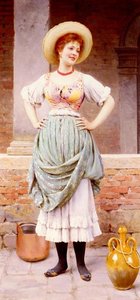
Retrato de Eugen Von Blaas

Pinturas de Eugen Von Blaas: As 100 mais famosas, sob o olhar de uma galeria

Atualizado em Novembro 2026 · classificado pela nossa pontuação de popularidade (pesquisas, visitas e pedidos de cada obra) · 137 obras de Eugen Von Blaas em nosso catálogo

Em resumo

Aos olhos da galeria, a pintura mais famosa de Eugen Von Blaas é The Serenade. The Friendly Gossips (1901) e Gathering Shells completam o trio que todos reconhecem. Dos 137 trabalhos de Eugen Von Blaas em nosso catálogo, a galeria apresenta abaixo as 100 obras mais famosas, cada uma original, com seu ano, seu museu e o que a torna única.

1843 – 1931, Albano Laziale Academicism Mais obras: Szépművészeti Múzeum

As 10 principais pinturas de Eugen Von Blaas na galeria

1
The Serenade de Eugen Von Blaas

The Serenade

Oil

In the tender embrace of The Serenade, we are transported to a sun-drenched corner of nineteenth-century Venice, where the air seems to vibrate with the soft strumming of a guitar. Eugen von Blaas, a master of Academic Classicism, captures more than just a musical performance; he captures a fleeting moment of communal intimacy. The scene unfolds around a central figure—a musician perched upon a stone wall, his instrument serving as…

2
The Friendly Gossips (1901) de Eugen Von Blaas

The Friendly Gossips

1901 · Oil

The painting depicts a domestic interior within a modest Italian dwelling. Three women sit together on a bench, their bodies oriented toward one another in a state of active conversation. They wear dresses consistent with the turn of the twentieth century. To the right, a chair sits near the edge of the frame, while a vase occupies the left side. The composition is divided into two distinct zones. In the…

3
Gathering Shells de Eugen Von Blaas

Gathering Shells

Oil On Canvas

In Gathering Shells, Eugene de Blaas captures a quiet moment of labor on a sandy beach. Two women occupy the foreground, their bodies anchored to the earth. One woman kneels in the sand, her hands busy sorting shells into a wooden bucket. Beside her, another woman stands upright, her gaze drifting toward the horizon. They are immersed in the simple, repetitive rhythm of their task.

4
Gathering Cockles at the Seashore de Eugen Von Blaas

Gathering Cockles at the Seashore

Watercolor

Gathering Cockles at the Seashore is a work by the Italian painter Eugene de Blaas, executed before 1932. The painting captures a scene of everyday life, focusing on the quiet labor of a woman collecting shellfish along a sandy beach. Through this subject, the artist explores the intersection of human activity and the natural coastal environment.

5
Which Came First de Eugen Von Blaas

Which Came First

Oil On Canvas

In this work, titled Which Came First, we encounter the quiet, observational hand of Eugene de Blaas. The painting presents a woman carrying two baskets, a scene that captures a fleeting moment of daily life. It is a composition that relies on the presence of the figure to anchor the viewer's attention.

7
A Pensive Moment de Eugen Von Blaas

A Pensive Moment

Oil On Canvas

A young woman sits upon a weathered brick wall, her body positioned slightly off-center within the frame. She is oriented toward a body of water that recedes into a hazy background, creating a sense of depth through atmospheric perspective. Her pose is one of stillness, with her gaze directed away from the viewer in a manner that suggests introspection. The scene is set under a pale, overcast sky, which provides…

8
A Young Fishwife de Eugen Von Blaas

A Young Fishwife

Oil

We are looking at A Young Fishwife, a work by the Italian painter Eugene de Blaas. This piece offers a quiet glimpse into a specific way of life, captured through the artist's particular lens. Eugene de Blaas was born in 1843 in Albano Laziale, Italy, and his life's work continued until his death in 1931.

9
Female portrait (1863) de Eugen Von Blaas

Female portrait

1863 · Oil On Canvas

In the bust-length portrait titled "Female portrait" by Eugene de Blaas, a young woman occupies the center of a quiet, shadowed space. She is positioned slightly off-center, her presence anchored against a background of deep browns. Her gaze is direct and calm, meeting the viewer with a steady, unblinking stillness. A dark navy blue garment covers her shoulders, absorbing the light and grounding the composition in heavy, muted tones. A…

10
Young Woman with Children on the Beach (1868) de Eugen Von Blaas

Young Woman with Children on the Beach

1868 · Oil On Canvas

Young Woman with Children on the Beach is a work by Eugene de Blaas, executed about 1868. This piece belongs to the tradition of Academic Classicism, a style that emphasizes formal precision and a refined approach to composition. The artist, born in Albano Laziale, Italy, in 1843, brought a disciplined technical foundation to his depictions of human figures and natural settings. He remained active in his craft until his death…

Pinturas de Eugen Von Blaas, classificadas de 11 a 100

11The bingo game (1871) de Eugen Von BlaasThe bingo game1871 12A Venetian beauty (1865) de Eugen Von BlaasA Venetian beauty1865 13Feeding the ducks (1874) de Eugen Von BlaasFeeding the ducks1874 14The Secret (1876) de Eugen Von BlaasThe Secret1876 15Portrait of a Woman at a Window (1885) de Eugen Von BlaasPortrait of a Woman at a Window1885 16Girl with fish (1879) de Eugen Von BlaasGirl with fish1879 17Hesitancy (1885) de Eugen Von BlaasHesitancy1885 · Szépművészeti Múzeum 18Venetians at the balcony (1881) de Eugen Von BlaasVenetians at the balcony1881 19Head of a boy (1880) de Eugen Von BlaasHead of a boy1880 · Victoria and Albert Museum 20Festival day, Venice (1879) de Eugen Von BlaasFestival day, Venice1879 21At the Carnival (1879) de Eugen Von BlaasAt the Carnival1879 · Wolverhampton Art Gallery 22Singing Group of Women on the Seashore (1888) de Eugen Von BlaasSinging Group of Women on the Seashore1888 23The young woman called 'Ninetta' (1887) de Eugen Von BlaasThe young woman called 'Ninetta'1887 24Curiosity (1891) de Eugen Von BlaasCuriosity1891 · Te Whare O Rehua Sarjeant Gallery 25The Work de Eugen Von BlaasThe Work 26The Suitor (1887) de Eugen Von BlaasThe Suitor1887 27Young lady with red fan (1897) de Eugen Von BlaasYoung lady with red fan1897 28A Good Catch (1894) de Eugen Von BlaasA Good Catch1894 29The Unseen Suitor (1898) de Eugen Von BlaasThe Unseen Suitor1898 30Love's Labor Lost (1903) de Eugen Von BlaasLove's Labor Lost1903 31Mother's Little Helper (1884) de Eugen Von BlaasMother's Little Helper1884 32The Flower Girl (1911) de Eugen Von BlaasThe Flower Girl1911 33Catch of the Day de Eugen Von BlaasCatch of the Day 34The Seamstress de Eugen Von BlaasThe Seamstress 35In the Sacristy (1877) de Eugen Von BlaasIn the Sacristy1877 36Philip Richard Morris (1865) de Eugen Von BlaasPhilip Richard Morris1865 37The Love Letter (1887) de Eugen Von BlaasThe Love Letter1887 38The Offer (1887) de Eugen Von BlaasThe Offer1887 39Accepted (1887) de Eugen Von BlaasAccepted1887 40The Italian Flower Girl (1887) de Eugen Von BlaasThe Italian Flower Girl1887 41A Venetian Water Carrier (1890) de Eugen Von BlaasA Venetian Water Carrier1890 42A Venetian Courtship (1891) de Eugen Von BlaasA Venetian Courtship1891 · New Walk Museum - Art Gallery 43The Fruit Seller de Eugen Von BlaasThe Fruit Seller 44Portrait of a Boy (1900) de Eugen Von BlaasPortrait of a Boy1900 45Baroness von Scholl de Eugen Von BlaasBaroness von Scholl 46Daydreaming 1 de Eugen Von BlaasDaydreaming 1 47Musette de Eugen Von BlaasMusette 48God's Creatures de Eugen Von BlaasGod's Creatures 49Fruit Vendor de Eugen Von BlaasFruit Vendor 50An Affectionate Glance de Eugen Von BlaasAn Affectionate Glance 51Madchenbildnis de Eugen Von BlaasMadchenbildnis 52Unknown de Eugen Von BlaasUnknown 53Madchen mit Granatapfeln de Eugen Von BlaasMadchen mit Granatapfeln 54Daydreaming de Eugen Von BlaasDaydreaming 55Am Brunnen de Eugen Von BlaasAm Brunnen 56Lisa de Eugen Von BlaasLisa 57The Flower Seller de Eugen Von BlaasThe Flower Seller 58The Farewell de Eugen Von BlaasThe Farewell 59Portrait of a Woman de Eugen Von BlaasPortrait of a Woman 60Die Lauscherin de Eugen Von BlaasDie Lauscherin 61A Pensive Beauty de Eugen Von BlaasA Pensive Beauty 62Balcony de Eugen Von BlaasBalcony 63The Days Catch de Eugen Von BlaasThe Days Catch 64Young Italian Beauty de Eugen Von BlaasYoung Italian Beauty 65An Interesting Story de Eugen Von BlaasAn Interesting Story 66A Young Beauty de Eugen Von BlaasA Young Beauty 67Elegant Lady de Eugen Von BlaasElegant Lady 68Flirtation at the Well de Eugen Von BlaasFlirtation at the Well 69A Viennese Beauty de Eugen Von BlaasA Viennese Beauty 70The Flirtation de Eugen Von BlaasThe Flirtation 71On the Balcony de Eugen Von BlaasOn the Balcony 72Shared Correspondance de Eugen Von BlaasShared Correspondance 73The Flirtation 1 de Eugen Von BlaasThe Flirtation 1 74The Yellow Shawl de Eugen Von BlaasThe Yellow Shawl 75The Grape Picker de Eugen Von BlaasThe Grape Picker 76The Pearl Necklace de Eugen Von BlaasThe Pearl Necklace 77Portrait of a Venetian Lady de Eugen Von BlaasPortrait of a Venetian Lady 78Zwei Kinder de Eugen Von BlaasZwei Kinder 79Die Wassertragerin de Eugen Von BlaasDie Wassertragerin 80Young Beauty de Eugen Von BlaasYoung Beauty 81The Knitting Lesson de Eugen Von BlaasThe Knitting Lesson 82Le Plaisir de Eugen Von BlaasLe Plaisir 83On The Balcony 1 de Eugen Von BlaasOn The Balcony 1 84Head of a Young Boy de Eugen Von BlaasHead of a Young Boy 85The Eavesdropper de Eugen Von BlaasThe Eavesdropper 86Good News de Eugen Von BlaasGood News 87Venetian Beauty on Balcony de Eugen Von BlaasVenetian Beauty on Balcony 88Venetian Flower Seller de Eugen Von BlaasVenetian Flower Seller 89Meeting in the Square de Eugen Von BlaasMeeting in the Square 90Portrait of a Lady de Eugen Von BlaasPortrait of a Lady 91La lavandière (1912) de Eugen Von BlaasLa lavandière1912 92Untitled (AQTQMF) (1931) de Eugen Von BlaasUntitled (AQTQMF)1931 · National Portrait Gallery 93Dressing for the Masquerade (1885) de Eugen Von BlaasDressing for the Masquerade1885 94Young italian girl de Eugen Von BlaasYoung italian girl 95The Laundress de Eugen Von BlaasThe Laundress 96the rose de Eugen Von Blaasthe rose 97Eugen von The Eavesdropper de Eugen Von BlaasEugen von The Eavesdropper 98Gethering Shells de Eugen Von BlaasGethering Shells 99A Venetian Beauty de Eugen Von BlaasA Venetian Beauty 100A Venetian Beauty de Eugen Von BlaasA Venetian Beauty

Pinturas famosas de Eugen Von Blaas, período por período

Os temas que cativaram o olhar de Eugen Von Blaas

Os quatro temas que mais se repetem nestas obras originais, cada um com o seu melhor exemplo.

Os museus que guardam os originais de Eugen Von Blaas

Os 6 museus que detêm a maioria das pinturas desta página.

Museus Cidade Obras de Eugen Von Blaas Pinturas desta lista
Szépművészeti Múzeum, BudapesteSzépművészeti Múzeum Budapeste 1 Hesitancy
Victoria and Albert Museum, LondresVictoria and Albert Museum Londres 1 Head of a boy
Wolverhampton Art Gallery, WolverhamptonWolverhampton Art Gallery Wolverhampton 1 At the Carnival
Te Whare O Rehua Sarjeant GalleryTe Whare O Rehua Sarjeant Gallery 1 Curiosity
New Walk Museum - Art Gallery, LeicesterNew Walk Museum - Art Gallery Leicester 1 A Venetian Courtship
National Portrait Gallery, LondresNational Portrait Gallery Londres 1 Untitled (AQTQMF)

Eugen Von Blaas, uma pintura emblemática por década

Obras por década

Escolha uma década para ver a obra original que a define.

Pinturas de Eugen Von Blaas: a galeria responde

Qual pintura de Eugen Von Blaas é a mais famosa de todas?Revelar a resposta

The Serenade. The Friendly Gossips (1901) e Gathering Shells vêm a seguir.

Quais são as 10 principais pinturas de Eugen Von Blaas?Revelar a resposta

The Serenade, The Friendly Gossips, Gathering Shells, Gathering Cockles at the Seashore, Which Came First, Portrait of a Boy, A Pensive Moment, A Young Fishwife, Female portrait e Young Woman with Children on the Beach. O ranking acima apresenta o ano e o museu de cada uma.

Quantas obras Eugen Von Blaas criou?Revelar a resposta

Nosso catálogo contém 137 obras de Eugen Von Blaas, datadas de 1863 a 1931.

Onde estão expostos os originais mais famosos de Eugen Von Blaas?Revelar a resposta

Principalmente em Szépművészeti Múzeum (Budapeste), Victoria and Albert Museum (Londres) e Wolverhampton Art Gallery (Wolverhampton). A tabela de museus acima lista todos eles.

Quando é que Eugen Von Blaas criou as suas pinturas mais famosas?Revelar a resposta

Em 1880s: 13 das 100 obras nesta página foram feitas então, sendo Portrait of a Woman at a Window delas.

Quais são as obras mais famosas de Eugen Von Blaas no início e no fim de sua carreira?Revelar a resposta

Nesta página, a mais antiga é Female portrait (1863) e a mais recente é Untitled (AQTQMF) (1931).

Quais temas Eugen Von Blaas mais explorou?Revelar a resposta

Women (25), Woman (21) e Portraits (13), entre as 100 obras nesta página.

Em qual técnica Eugen Von Blaas mais trabalhou?Revelar a resposta

Oil On Canvas, para 20 das 100 obras nesta página.

Com qual movimento Eugen Von Blaas está associado(a)?Revelar a resposta

Academicism, a julgar pelos originais nesta página.

Eugen Von Blaas: o artista

Eugen von Blaas: Um Mestre Veneziano do Classicismo Acadêmico

Nascido em Albano, perto de Roma, em 1843, Eugen de Blaas (mais tarde conhecido como Eugene von Blaas) emergiu de uma família profundamente imersa na tradição artística. Seu pai, Karl von Blaas, era ele próprio um respeitado pintor e professor na Academia de Veneza, proporcionando ao jovem Eugen uma base inigualável em história da arte, técnicas de afresco e nos princípios da composição clássica. Esta influência familiar moldou profundamente sua trajetória artística, levando-o a abraçar os preceitos do Classicismo Acadêmico – um estilo caracterizado pelo detalhe meticuloso, formas idealizadas e uma reverência por temas históricos e mitológicos.

Os primeiros anos de Eugen foram passados imersos na atmosfera vibrante de Veneza, uma cidade que ele viria a tanto pintar quanto admirar profundamente. Ao mudar-se com sua família para a cidade da lagoa ainda criança, ele absorveu sua cultura única, arquitetura e costumes sociais. Esta conexão íntima com Veneza tornou-se o alicerce de sua produção artística, informando sua escolha de temas e sua linguagem visual distinta. Diferente de muitos de seus contemporâneos que buscavam capturar momentos fugazes ou cenas contemporâneas, Blaas retornava consistentemente às representações da vida veneziana – particularmente as elegantes mulheres de seus círculos aristocráticos – oferecendo uma visão cuidadosamente construída e idealizada desta cidade cativante.

A Arte das Cenas de Gênero Venezianas

A carreira artística de Blaas floresceu no final do século XIX, um período marcado por mudanças significativas na arte europeia. Enquanto o Impressionismo ganhava força em outros lugares, Blaas permaneceu firmemente enraizado no Classicismo Acadêmico, produzindo um corpo de trabalho que é simultaneamente meticulosamente detalhado e imbuído de um senso de nostalgia romântica. Suas obras mais celebradas enquadram-se na categoria de “cenas de gênero”, que capturam momentos cotidianos dentro da sociedade veneziana. Estas não são representações cruas da vida; pelo contrário, são vinhetas cuidadosamente encenadas, muitas vezes apresentando mulheres ricas em trajes elaborados, participando de atividades de lazer como compras, frequentando reuniões sociais ou simplesmente desfrutando da beleza de seus arredores.

Suas pinturas frequentemente exibem uma atenção notável aos detalhes – desde os tecidos cintilantes e joias intrincadas usados por suas personagens até a arquitetura meticulosamente renderizada e a iluminação atmosférica. O uso da cor por Blaas é particularmente digno de nota; ele emprega tons ricos e saturados para evocar o calor e a luminosidade do sol veneziano, criando cenas que são visualmente deslumbrantes e emocionalmente ressonantes. Ele foi um mestre em capturar a essência da Veneza aristocrática, apresentando uma imagem idealizada de riqueza, beleza e graça social.

Obras Primordiais e Estilo Artístico

Entre as pinturas mais icônicas de Blaas estão “Mother’s Little Helper” (1884), que oferece um vislumbre encantador de uma cena rústica em uma cozinha veneziana, e “On the Balcony” (1877), uma representação vibrante de um encontro elegante em uma varanda com vista para os canais. “La forma nuziale in sacrestia” é outro exemplo notável, retratando uma cerimônia de casamento dentro de uma sacristia de igreja com precisão e elegância admiráveis. Estas obras exemplificam seu estilo característico – definido pelo realismo meticuloso, composição equilibrada e uma sutil profundidade emocional.

Seu desenvolvimento artístico pode ser traçado através de uma progressão de temas mais abertamente clássicos para representações cada vez mais íntimas da vida veneziana. Embora tenha continuado a pintar retratos ao longo de sua carreira, foram suas cenas de gênero que finalmente consolidaram sua reputação como um dos artistas mais realizados de sua geração. Ele misturou habilmente influências históricas com a observação contemporânea, criando obras que são ao mesmo tempo atemporais e profundamente enraizadas em seu contexto específico.

Legado e Significância Histórica

A obra de Eugen von Blaas representa uma intersecção fascinante entre tradição artística e identidade cultural. Seu compromisso com o Classicismo Acadêmico proporcionou-lhe as habilidades técnicas e o treinamento formal necessários para se destacar como pintor, enquanto seu profundo afeto por Veneza infundiu sua arte com um senso único de lugar e atmosfera. Suas pinturas oferecem percepções valiosas sobre os costumes sociais, tendências de moda e sensibilidades estéticas da sociedade veneziana do século XIX.

Apesar de não ter alcançado fama generalizada durante sua vida, o trabalho de Blaas foi desde então reconhecido por seu mérito artístico e importância histórica. Suas pinturas encontram-se agora em museus prestigiados e coleções particulares ao redor do mundo, servindo como um testemunho de seu legado duradouro como um dos artistas mais celebrados de Veneza. Sua atenção meticulosa aos detalhes, aliada às suas representações evocativas da vida veneziana, continua a cativar o público até os dias de hoje.