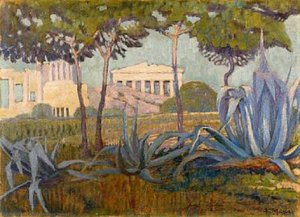
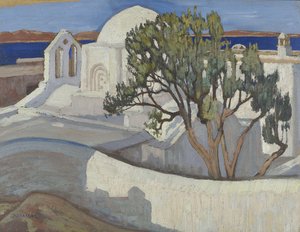
Retrato de Constantine Maleas

As 54 Pinturas Mais Famosas de Constantine Maleas, uma Seleção da Galeria

Atualizado em Outubro 2026 · classificado pela nossa pontuação de popularidade (pesquisas, visitas e pedidos de cada obra) · 55 obras de Constantine Maleas em nosso catálogo

Em resumo

De todas as obras originais que Constantine Maleas deixou, a mais famosa é Three Egyptian Women (1911). Logo atrás vêm Landscape of Attica e Nile Landscape (1911). Nosso catálogo contém 55 obras de Constantine Maleas; a galeria preservou as 54 que o mundo mais admira, cada uma exibida com sua data, seu museu e sua história.

1879 – 1928, Istambul Post-impressionism Mais obras: National Gallery

As 10 principais pinturas de Constantine Maleas: a escolha da galeria

A seleção de Constantine Maleas continua, de 11 a 54

Os temas que cativaram o olhar de Constantine Maleas

Os quatro temas que mais se repetem nestas obras originais, cada um com o seu melhor exemplo.

Os museus que guardam os originais de Constantine Maleas

Os 3 museus que detêm a maioria das pinturas desta página.

Museus Cidade Obras de Constantine Maleas Pinturas desta lista
National Gallery, AtenasNational Gallery Atenas 3 The Church of the Pantanassa, Naxos, Kammeni, Santorini, Delphi
Municipal Museum of the Kalavritan Holocaust, KalavritaMunicipal Museum of the Kalavritan Holocaust Kalavrita 1 Wailing
Corfu National Gallery, CorfuCorfu National Gallery Corfu 1 Aswan of the Nile

Constantine Maleas ano a ano: as obras originais que definem cada um

De 1911 a 1928, Constantine Maleas trabalhou durante 18 anos: a seleção acompanha essa longa carreira ano a ano, através das suas mais belas obras originais.

Obras por ano

Escolha um ano para ver as obras originais.

Perguntas de colecionadores sobre as pinturas de Constantine Maleas

Por qual obra Constantine Maleas é mais conhecido(a)?Revelar a resposta

Three Egyptian Women (1911). Landscape of Attica e Nile Landscape (1911) vêm a seguir.

Qual era a idade de Constantine Maleas quando Three Egyptian Women foi feita?Revelar a resposta

32 anos: Three Egyptian Women data de 1911, e Constantine Maleas nasceu em 1879.

Quais são as dez pinturas mais famosas de Constantine Maleas?Revelar a resposta

Three Egyptian Women, Landscape of Attica, Nile Landscape, The Church of Ayia Aikaterini, Thessaloniki, Methana, Attica Landscape, Lavrio Landscape, Pines at Rafina, Thermos, Aitoloakarnania e Church with trees. O ranking acima apresenta o ano e o museu de cada uma.

Quantas pinturas Constantine Maleas deixou?Revelar a resposta

Nosso catálogo contém 55 obras de Constantine Maleas, datadas de 1911 a 1928.

Em quais museus estão expostas as obras-primas de Constantine Maleas?Revelar a resposta

Principalmente em National Gallery (Atenas), Municipal Museum of the Kalavritan Holocaust (Kalavrita) e Corfu National Gallery (Corfu). A tabela de museus acima lista todos eles.

Em que anos Constantine Maleas pintou as suas obras mais famosas?Revelar a resposta

Em 1920: 5 das 54 obras nesta página foram feitas então, sendo Methana delas.

Quais são as primeiras e as últimas obras originais famosas de Constantine Maleas?Revelar a resposta

Nesta página, a mais antiga é Three Egyptian Women (1911) e a mais recente é Santorini (1928).

Quais temas Constantine Maleas escolheu com mais frequência?Revelar a resposta

Landscape (15), Forests (6) e Temples (4), entre as 54 obras nesta página.

A qual movimento artístico pertence Constantine Maleas?Revelar a resposta

Post-impressionism, a julgar pelos originais nesta página.

Quais obras de Constantine Maleas estão expostas no National Gallery?Revelar a resposta

The Church of the Pantanassa, Naxos, Kammeni, Santorini e Delphi: o National Gallery, Atenas detém 3 das obras desta página.

Constantine Maleas: vida e obra

A Pioneer of Modern Greece: The Life and Art of Konstantinos Maleas

Konstantinos Maleas, born in the vibrant heart of Constantinople in 1879, stands as a pivotal figure in the transformation of Greek painting. His life unfolded as a compelling journey – from the rich cultural landscape of his birthplace to the artistic crucible of Paris, and ultimately back to Greece, where he indelibly shaped the Athenian art scene. Unlike many of his contemporaries who remained firmly rooted in the traditions of the Munich School, Maleas’s formative years were spent away from its dominant influence, allowing him to forge a distinctly personal and revolutionary artistic path. Initially pursuing studies at the Phanar Greek Orthodox College, a burgeoning artistic sensibility soon propelled him westward, to Paris in 1901. While he began with aspirations in architecture, it was within the realm of painting that his true calling resonated profoundly. He enrolled in classes under Henri Martin, immersing himself completely in the avant-garde currents surging through the French capital – Impressionism, Post-Impressionism, Symbolism, and even Fauvism all left an indelible mark on his developing style.

The Parisian Crucible and a Shift in Vision

Paris proved to be a transformative crucible for Maleas’s artistic evolution. It wasn't merely about absorbing techniques; it was a fundamental shift in his perception of art itself. The works of Paul Cézanne, with their meticulous attention to form and structure, captivated him deeply, as did the expressive use of color championed by Paul Gauguin and Vincent van Gogh. These influences weren’t adopted blindly – they were synthesized into something uniquely his own: a style characterized by bold brushstrokes, luminous colors, and a dynamic energy that immediately distinguished him from his peers. He spent nearly a decade in Paris, absorbing not just techniques but also the spirit of experimentation and innovation that defined the era. During this time, he developed a keen eye for capturing light and atmosphere, skills that would later become central to his distinctive approach to Greek landscapes.

Return to Greece and the Challenge of Athenian Conservatism

In 1913, Maleas returned to Greece, initially settling in Thessaloniki before relocating to Athens in 1917. This return wasn’t a simple homecoming; it represented a new chapter focused on translating his Parisian experiences into a distinctly Greek context. He arrived at a time when Athenian art was grappling with significant conservatism, largely dominated by the lingering influence of the Munich School, which favored academic realism and traditional subject matter. Maleas immediately challenged this status quo head-on, introducing a breath of fresh air into the scene – vibrant, expressive paintings that were unapologetically modern. He employed large brushes to create compositions that pulsed with life, and color became his primary tool for conveying emotion and atmosphere. His preference for pure, bright hues, combined with innovative techniques for capturing the unique quality of light in Greece—a light both intense and ethereal—set him apart from the prevailing artistic trends.

A Distinctive Style and a Focus on Greek Identity

Maleas’s landscapes weren't mere depictions of scenery; they were emotional responses to the land, imbued with a profound sense of place. He frequently depicted iconic locations – Attica, Delphi, Santorini—transforming them into evocative representations of Greek identity. His travels throughout Greece, Western Europe, Palestine, and Egypt fueled his artistic vision, constantly seeking new inspiration and refining his ability to capture the essence of these diverse regions. Importantly, Maleas wasn’t interested in simply replicating reality; he sought to convey its *feeling*, its spirit—a core principle that defined his entire oeuvre. He meticulously studied the interplay of light and shadow, color palettes, and composition to create works that resonated with a deep understanding of Greek culture and landscape.

Legacy and Recognition: A Modernist Icon

Despite facing initial resistance from some art critics who struggled to reconcile his innovative style with prevailing tastes, Maleas’s work gradually gained recognition for its originality and artistic merit. Fotos Politis was among the first to champion his paintings, recognizing their groundbreaking spirit and urging younger artists to learn from his techniques. In 1917, he became a founding member of “Omada Techni” (Art Group), an avant-garde collective dedicated to introducing international contemporary art movements to Greece – a testament to both his artistic vision and his commitment to fostering a more open and progressive art scene. Beyond painting, Maleas actively engaged in public discourse, contributing significantly to discussions about modernizing the Greek language and illustrating the first alphabet book in Demotiki (the new modern Greek vernacular). The Greek government acknowledged his contributions with its “Highest Acknowledgement of Letters and Arts.” Today, his works are prominently displayed at the National Gallery of Athens and other institutions, ensuring his lasting legacy as one of Greece’s most important modern artists. Konstantinos Maleas remains a celebrated figure, not just for his artistic achievements but also for his courage to challenge convention and pave the way for future generations of Greek artists to explore new horizons.